

ERP system: how ERP works and how can it help you?

What is an ERP system, what a great helper is it in many areas and how can it simplify several tasks, including eliminating the occurrence of unnecessary errors? It is most commonly found in human resource management, finance, economics and logistics, but it is also used outside of these areas. What is an ERP system and what benefits can it give you?

What are ERP systems?

Before we explain what an ERP system is, it’s important to find out what the acronym ERP actually stands for. The ERP acronym is made up of the first three letters of three English words – Enterprise Resource Planning, which translates to Enterprise Resource Planning.

In other words, ERP systems are used for comprehensive business management. People use them mainly to plan their goals and coordinate company resources or individual departments.

An ERP system can easily connect multiple business processes, providing better visibility and easy control over the entire company. So you can manage information about logistics, administration, warehouse, production, etc. in one system.

Interestingly, while today ERP systems are a practical tool without which companies cannot imagine their functioning, this was not the case in the past. The systems worked independently and separately. They were unable to communicate with other programs and systems. In addition, each program required a special and very expensive code. This negatively impacted the whole work process and often hindered the adoption of new technologies.

Modern ERP systems can be interfaced with other systems and working with them is relatively easy and fast. Employees don’t have to be IT specialists to know how to use them. All they need is a short training and a little practice. Another great advantage of ERPs is that most of them have enhanced security that ensures a high level of privacy protection.

ERP meaning and importance

ERP software is crucial in businesses for several reasons. The first reason is the fact that, thanks to automation and integration, it can efficiently manage day-to-day activities, saving time and making work easier.

ERP modules centralise and manage different business processes and data in one single unit. This sophisticated system allows you to effectively manage and monitor your resources. Ability to make individual decisions in a timely manner to achieve business objectives and minimize risks.

The importance of ERP varies depending on the industry. In logistics, for example, cooperation between customers and suppliers needs to be streamlined. Instead of handling the tasks for each of the parties in a separate software, you only need one, where you have the possibility to implement specific ERP modules.

The same is true within the financial area of the company. ERP systems give you an overview of paid and unpaid invoices from suppliers and customers. So you know which invoice your company hasn’t paid yet and which one someone has to pay to you.

Last but not least, an ERP system is also key in the strategic decision making of companies. It gives you real-time data so you know exactly where your business stands. Make sure you’re working with up-to-date information when you’re scheduling tasks or major changes. This allows you to achieve the most ideal results.

Did you know that…

… there’s also something called low-code ERP? These are ERP systems that require minimal programming knowledge for integration and customisation. This means that employees do not need advanced technical skills, such as the most used programming language expertise.

Where is ERP program used?

ERP systems have a wide range of applications. They are typically used in medium and larger enterprises, playing a key role in the various work processes in these areas:

  • economics,
  • finance,
  • accounting, invoicing and payroll,
  • human resources management,
  • logistics,
  • customer support,
  • trade, production and order management,
  • business intelligence.
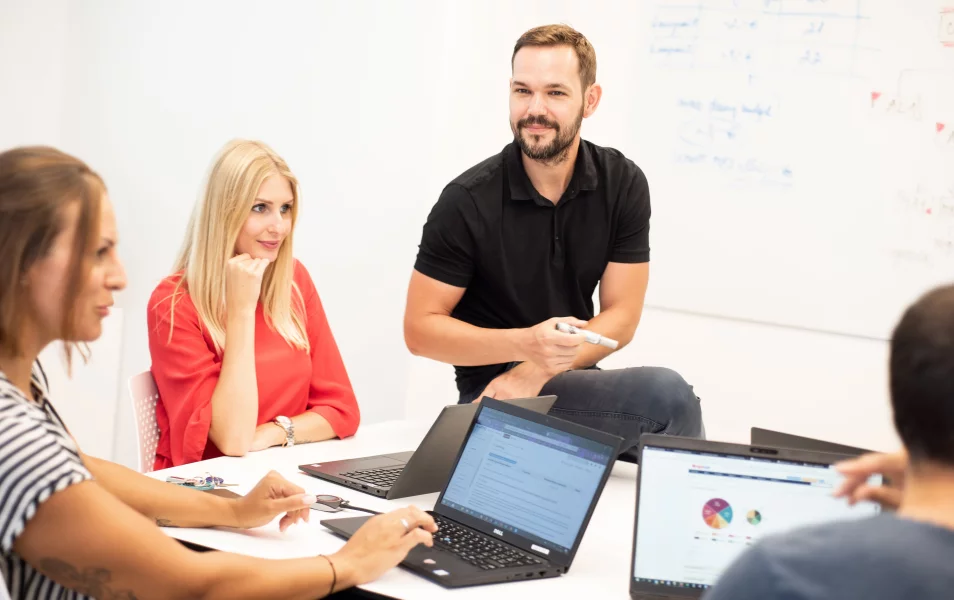
A young woman and a man discussing and working on one laptop
ERP systems can be used in almost all areas of a company, which simplifies many tasks.

ERP system benefits

An ERP system has a large number of advantages. Which benefits it will bring you depends mainly on what area you want to use it in. However, its biggest benefits generally include:

  • Reduced costs – by bringing together all the relevant information from multiple areas, an ERP system can provide a completely different angle on the entire enterprise. This allows you to find tasks or activities that can be combined or skipped altogether, thus saving you a lot of money. ERP systems even work with artificial intelligence that can plan some activities much better than the employees themselves, which can also lead to cost savings.
  • Ensured order in the company – by bringing important areas of the business together in one place, ERP provides an overview of all tasks and activities. You know what’s going on in the company, what you need to do first and what can wait. The company thus effectively avoids chaos that could lead to unnecessary problems.
  • Optimized and automated work tasks – ERP systems contain a number of tools that help with stereotypical activities. This saves time and allows employees to focus on more important tasks.
  • Advanced analysis and forecasting – when you have all the information you need in one place, it’s much easier to find answers to planning or decision-making questions.
  • Access data from anywhere – many ERP online systems allow you to access data from anywhere, whether you’re in the office, at home or on a business trip. Even some solutions have mobile device optimization, including an“ERP app“, which opens up additional possibilities for work outside of the office.
  • Quality support – when you choose a quality and proven supplier, you have the confidence that you can call on quality customer service whenever you need it. He will be happy to help you with any problem, from implementation to various updates or feature extensions.
  • Lot of options available – there are many ERP systems on the market. Popular foreign ones include Oracle ERP, NetSuite, SAP Business One or Microsoft Dynamics 365 Business Central. Popular Slovak systems include ONIX, ERP Money S4 or FLOWii. Everyone will find their own.
Recommend
We recommend:

ERP systems are also widely used by organizations operating in the insurance market. We at msg life Slovakia are one of them. We use our own ERP system. If you know how to program in Java and would like to be involved in developing ERP systems, take a look at our Java Developer job offer.

What are the disadvantages of an ERP system?

ERP systems also have a few disadvantages. The ones you should know about before you start using them include:

  • High entry costs – ERP systems are not cheap. You’ll have to pay extra for the features they provide. Most of them are available as Saas (Software as a Service), which in practice means that you will pay a monthly fee for the system. Its amount is usually based on the number of users and modules. The more modules/functions a system has, the more expensive it will be. In addition to this amount, don’t forget about additional fees for implementation, importing existing data, testing, staff training, updates, etc.
  • More complicated to use – even though modern ERP software is much easier to use than those used in the past, it can still cause problems for some employees. As a result, this complicates their work, reduces performance and affects sales.
  • Longer implementation – ERP software implementation is not a matter of a few days. In reality, it takes several months, with several days to a week of staff training immediately after its introduction. So it can take several years before a business starts to reap the full benefits of ERP.

Comparison of ERP software with other systems

You can use other systems in your business besides ERP. Some may seem very similar at first, complicating the whole selection process. For a better overview, we have compared some of them.
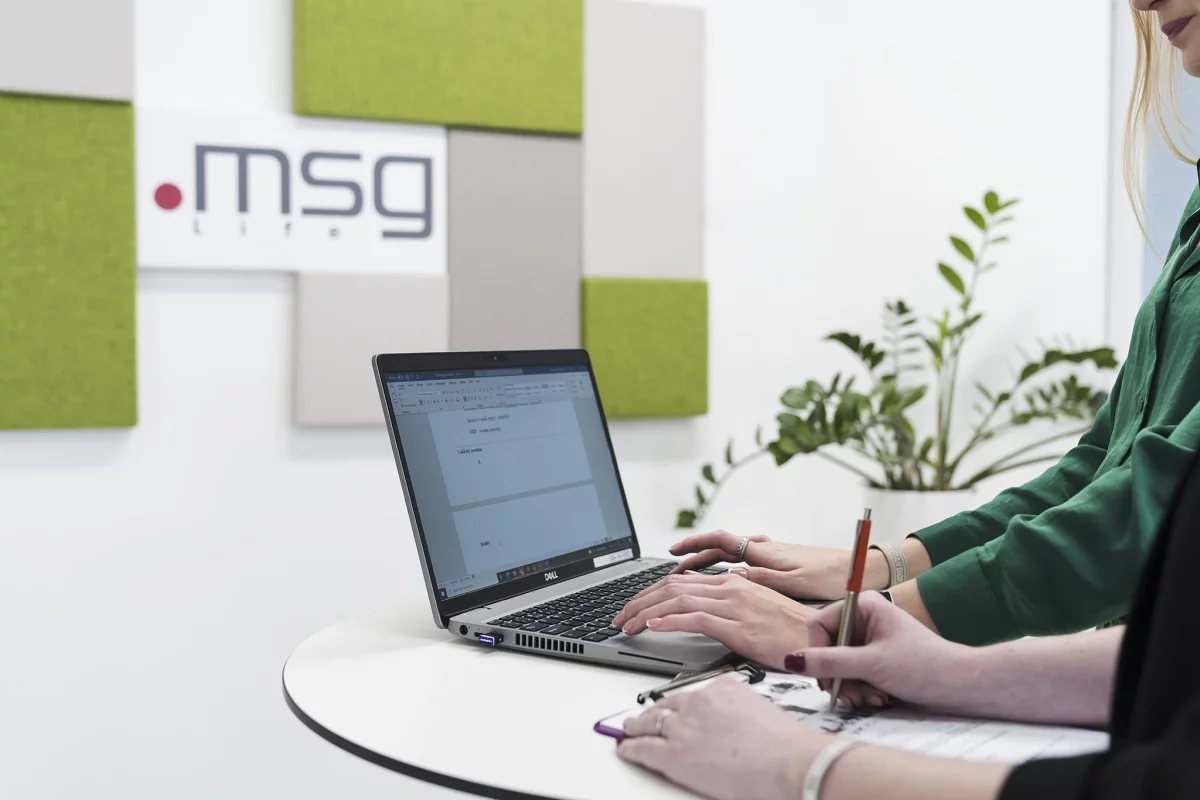
two sets of hands are working on a laptop and taking notes in msg office
ERP system can be customized according to the needs of the company.

ERP vs CRM

CRM (Customer Relationship Management) is a system that manages all the ways a customer interacts with a company. Its main task is to collect and store customer information. CRM can work independently or as part of ERP.

The biggest difference between ERP and CRM is that ERP is a complex system providing dozens of features and countless uses. On the contrary, CRM is only used to manage customers and activities directed to them.

When thinking about whether to choose both solutions or just one of them, base your decision on the goals of the business. If the focus is more on streamlining management and establishing order, ERP is the obvious choice.

However, if your goals are more focused on building customer relationships, prospecting and maintaining them, a CRM is ideal. Alternatively, choose a combination of ERP and CRM, which, although more expensive, really does provide everything the business needs.

ERP vs MRP

MRP (Material Requirements Planning) is a software designed to calculate the required materials and their quantities. In addition, it can also manage the timing of deliveries to meet the needs of customers. Like CRM, MRP can be a stand-alone unit or part of ERP.

When choosing one of the options, keep an eye on the needs of the business. MRP is ideal for companies looking to streamline production schedules and segment inventory. ERP is designed for those who want a comprehensive solution, including additional functions related to accounting, logistics, etc.

ERP vs ECC

ECC (Enterprise Central Component), sometimes referred to as SAP ERP is often associated with the concept and comparison of ERP system vs SAP. However, SAP EPR is an IT enterprise resource planning system that includes various modules such as FI, HR, PM, PP. This is one of the ERP systems currently on the market. It is developed by SAP.

ERP vs MES

MES (Manufacturing Execution System) is used to monitor manufacturing processes. Its role is to help workers make important decisions within the production area. One of the characteristics of MES is that it operates in real time.

MES can be integrated into an ERP system, but it can also be standalone. The first option is more comprehensive and practical. It is ideal if the company also needs a system for other areas, such as logistics or finance.

ERP vs EPM

EPM (Enterprise Performance Management) provides the detailed information needed for planning, analytics, data reporting or forecasting certain events. It provides users with advanced tools designed to make the information collected easier to understand.

EPM can be part of your ERP, giving you a comprehensive solution that guarantees the best working results.

ERP vs WMS

ERP WMS (Warehouse Management System) is used to manage and control warehouse operations. This speeds up the receipt of goods from suppliers and the delivery of orders to customers.

The biggest difference between ERP and WMS is that WMS has a specific purpose, whereas ERP is a comprehensive package that you can use in different areas. It is a tailor-made solution that can also include a WMS. However, if you don’t need anything else besides WMS functionality, it’s not worth investing in an ERP system. It would be unnecessarily expensive and complicated for you.

ERP systems in Slovakia

The price of ERP systems in Slovakia or abroad depends on how many users will use them and what functions the company will need. In general, however, we can say that the cheapest solutions are in the range of 2- to 10-thousand Euros.
On the other hand, advanced and complex ERP systems in Slovakia with a wide range of functions and in the event that multiple ERP modules are implemented, the price can rise significantly. In the case of larger companies with complex processes and higher management requirements, the price of an ERP system can exceed 70 thousand Euros or more.

Are you a programmer interested in ERP systems?

If you have experience with Java programming, relational databases or ERP systems and are looking for a job, respond to our Java developer offer and help us develop our ERP system that we use at msg life. We have great company benefits and in the Employer of the Year 2025 competition in the IT and Telecommunications category we ranked 4th place.

Learn how to work with an ERP system yourself

ERP systems are an important part of many businesses. Knowing them can open the door to new and interesting job opportunities. If you already have some experience and want to get into this field, take a look at our job offers. If you speak German, you can look directly at the job offer for Project Management Officer.
Conflicts in the workplace: how to resolve them?

Conflicts in the workplace are not uncommon. Everyone will encounter them in their lifetime, and not just once. The reasons for their occurrence are numerous. Sometimes they can occur due to misunderstanding of the other party, other times they are the result of months or years of suppressing anger. What types of conflicts can you encounter in the workplace and how can you deal with them properly?

Conflicts at work cannot be completely avoided

Every company is full of people with similar work goals, but very different opinions, parent education, worldviews and behaviours. In addition, one should not forget about sympathy. While you may like someone and instantly form a friendly relationship, others may find you annoying. You may not even be aware of this at first, it will come up later, for example when dealing with a complication.

However, the reverse is also true. Even you don’t have to like every colleague. A very active person who is always talking can get on your nerves after a short time. A strong individualist who doesn’t like to work together can complicate the whole process.

Conflicts are a normal part of working life. Experts agree that negative emotions should not be swept away because they can come back and be much stronger. If something is bothering you, it’s important that you start to address the problem, either with the person who is the source of the problem or with a supervisor.

Conflicts in the workplace are common
Conflicts in the workplace are not to be swept under the carpet

Workplace conflict sources

There are several possible sources of conflict in the workplace. The main ones include:

  • Likes and dislikes – every person is different, so it’s perfectly normal to like one person and dislike another. If you don’t like a colleague or disagree with their opinions, try to keep your communication with them to a minimum. Do only joint work tasks and projects with them, nothing else. This avoids unnecessary conflicts based on significant differences.
  • Expectations – even if you don’t realize it, we all have expectations. You can expect your colleagues to share your opinion, to do things without you saying so, or to find some things as natural as you do. However, as soon as you find out that the reality is quite different, you begin to develop antipathy towards these people, leading to conflict. Therefore, do not expect anything from others. If you want them to help you with something or to do something, just tell them.
  • Misunderstanding – even minor communication noise can cause a big problem. It most often occurs in email communication, where you can interpret a written communication in a completely different way than the author intended. However, conflict can also arise when a colleague does not express themselves correctly or sufficiently. If you don’t think you understand something well, you’d better ask follow-up questions.
Did you know that…

Conflict resolution is a soft skill. In other words, it is a natural ability that a person should possess. However, the good news is that with enough practice and constant training, you can at least partially acquire this skill.

Basic types of conflict in the workplace

The teamwork is made up of very different people who often have nothing in common. That is why multiple conflicts can arise in a very short time. According to their nature, they can be divided into several basic groups.

Leadership conflict

You will encounter this type of conflict when you don’t like your supervisor and their personality, leadership style or any other detail. However, it is important to know that it is not always only the supervisor who is the problem. In some cases, it may also be the employees themselves.

For example, this is a situation where management promotes a junior colleague. Older employees may become frustrated or bitter, which increases distrust and resentment.

Regardless of whether you are a supervisor or an employee, in both cases, unpleasant conflicts can arise from negative feelings. So if you notice that your manager is treating you inappropriately or your subordinates are being unpleasant to you, you should start addressing the situation as soon as possible.

Did you know that…

You can receive similar articles directly to your email? Become a member of the msg IT community and we will regularly provide you with IT news, interesting podcasts, important events and current job offers. As a member you can also take part in our competitions! With our community, you’ll never miss a thing in the IT world!

Conflict arising from interdependence

In this type of conflict, there is a shifting of blame to another person, with whom you are likely to feel antipathy later.

In practice, this could be, for example, a slower member of the team who causes you to regularly extend your working hours, or a person who is not fully committed to their work and then you have to do it with other colleagues instead of them.

Conflicts due to different working styles

Every employee has their own style of work. You may be more comfortable working in a team, while your colleague may be more comfortable working individually. Forcing one party or the other to conform leads to conflict and reduced productivity. The ideal is therefore to try to divide duties so that everyone can work in a style that suits them.

Conflicts in roles and ideas

Tension can also arise when you disagree with a set work style, other colleagues’ ideas, or your boss’s approach to a particular project. In such situations, it is a good idea to get in touch and discuss the problem. Otherwise, you’ll be very unhappy and nervous at work, which can lead to you blowing up later.

Personality clashes

Major work conflicts also arise when very different personalities come together. A person with a different opinion or perspective on a situation can make you angry with even one small remark. So, if possible, try to keep contact with them to a minimum.

Conflicts in the workplace can also be personal
Conflicts in the workplace often stem from employee differences

Workplace conflict resolution

When conflict arises in the workplace, it needs to be addressed. This role is usually taken by a person in a leadership position. If you try to solve it, you should know a few ways to solve the problem without creating more drama.

Don’t overlook the problem or conflict

Conflict resolution in the workplace is not pleasant. That is why many try to overlook them and pretend they do not exist. However, overlooking conflicts is far from the ideal way to get rid of them. Other employees will become increasingly unpleasant, which can lead to even bigger problems later on.

The first step in dealing with conflict is to acknowledge it and admit that your team or company is struggling with it.

Listen actively

Effective communication relies not only on talking, but also on active listening. In practice, this means paying full attention to the other person’s words, not interrupting and trying to understand their point of view. That way you can find out what the conflict is really about and where the problem is.

Recommend
We recommend:

As well as paying attention to what the person says, observe their gestures, facial expressions and other non-verbal cues. These can help you determine whether what they are saying about their feelings is true.

Keep calm

Emotions can complicate the solution of any problem, even the smallest one. So try to avoid anger, sarcasm or passive-aggressiveness when listening and talking to colleagues or employees. When the other person is frustrating you, try some methods to calm yourself down, such as deep breathing or counting to ten.

A calm and neutral approach can calm the other person and reduce their anger or nervousness. Besides, with a cool head, you’ll find a rational solution much easier.

Focus on the problem, not the person

You’re more likely to have a person on your work team that you like more than others. However, personal preferences must be put aside when solving the problem. Focus on the situation and avoid favouring the person. This could lead to further conflicts.

Try to find a compromise

Once you’re familiar with the situation, try to find a compromise that works for both sides. Suggest several possible solutions and see which ones resonate the most with employees or colleagues.

Finding a compromise is difficult, so make more time for this. Think about how the conflict could be resolved in a way that benefits everyone. For example, you can take advantage of various employee benefits that you’ll provide to both parties.

Then remember that you don’t have to be alone in the problem. Sit down calmly with other concerned persons and use brainstorming.

Think to the future

If you don’t want to deal with conflict on a regular basis in your team or company, it’s important to create a plan to prevent it. This plan should include clear expectations and information about who is responsible for which work tasks. Be sure to check the plan regularly and add more points if necessary.

Conflict resolution strategies

There are several strategies you can use to resolve conflicts, for example:

  • Collaborative strategy – all parties present their goals and interests, taking into account the others and wanting to find a satisfactory solution. Cooperation and empathy are key.
  • Strategy of compromise – each party is willing to give up something in favour of an agreement. Cooperation is important and leads to the best results.
  • Strategy of confrontation – one of the parties tries to achieve their goals regardless of the needs of the others. This strategy often occurs when someone with a higher status is in conflict, which they can use to their advantage.
  • Adaptation strategy – one of the parties takes step back to meet the needs and demands of the other party. Person can often be manipulated in these situations.
  • Enforcement strategy – one of the parties tries to enforce its goals much more than the others and only cares about achieving them. This strategy is characterized by a low degree of cooperation and may be ineffective in the long term.
  • Argumentation strategy – the parties present arguments on the basis of which a solution to the problem can be reached. As a rule, credible and logical arguments win.

Conflict resolution skills examples

To give you a better idea, we can give an example of conflict resolution in the workplace. Imagine you have a colleague who, instead of working, is always running off somewhere, scrolling through social networks and not giving their full attention to their tasks. Because of this, you and your other colleagues have to stay at work longer and do what they didn’t get to do.

Instead of working together with other colleagues to suppress anger and frustration, try to talk to the person. Tell them what bothers you and suggest solutions. If they won’t listen to you or aren’t interested in resolving the situation, leave it to the supervisor.

However, go to the superior with calmness. Choose one person to speak for you as a team. In this way, you will avoid the shouting that could lead to chaos. It is then up to the supervisor to decide how to deal with the situation. Ideally, they will keep calm, listen to all parties and then they propose a well-thought-out solution.

Troubleshooting is a big plus

Conflicts in the workplace are a common but unpleasant part of working life. When they arise, they need to be resolved, not overlooked. There are several ways to do this. When you learn how to use them properly, you will know how to react appropriately to different situations. In addition, it is one of the soft skills that employers value. So if you’re looking for any job offers and career development opportunities, be sure to put this detail on your CV.

Java Developer interview with Filip

In the article you can read more about the Java developer Filip, who has been working at msg life Slovakia since his student days. Java developer Filip has been working with us since his student days. He appreciated the job offer not only for the good financial evaluation, but also for the opportunity to participate in interesting projects and the pleasant working atmosphere. As a student, he worked on creating an automated testing tool for US insurance systems and is now part of two projects at once. Read more about his work.

How long have you been with msg life Slovakia?

Since 2014, I joined as a student, this year will be my 10th year here.

What job were you recruited for?

For a Java developer.

How did you get into programming?

I’ve had a computer at home since I was a kid and spent a lot of time on it experimenting. In secondary school I decided to graduate in computer science and that was also the first time I programmed something.

What attracted you to working at msg life Slovakia? Why did you choose us?

I was contacted by msg life itself, which was already a plus for me at the time because I could see the company was interested in me. As a student, I was offered an above-average salary, the job involved technologies I was interested in, and I also had a very good feeling about the people who interviewed me and the work environment.

Job

Java programmer senior

Bonus from 2 800 €

How is working for us different from previous work experience?

Other than working here, I’ve only had one other development position. But what makes our work different is the approach to people, the family atmosphere, the pleasant environment and almost no stress. I also appreciate the company’s approach to freelancers. We are treated like any other internal employee, entitled to all benefits such as holiday, sick leave etc.

What does your normal working day look like?

Flexible, but I usually start work at 8am. I read new emails and reply to them. Then the morning meetings take place. Since I’m on two projects, there are more meetings. After the meetings I either work for an hour or so, or help my colleagues. Then I have a lunch and after lunch I work on my tasks, possibly attend other meetings. I also have German lessons twice a week in the afternoon.

What is your job? What are you currently working on?

I am working on two customer projects. In one project we work in close cooperation with the customer, i.e. we have meetings directly with their analysts, where they propose new functionality: I consult with them and then implement it. I also write technical concepts and fix bugs.

On the second project, we are primarily doing a download of new releases from the standard, which involves a lot of bug fixing, debugging, and comparing the current and previous versions.

I also train new colleagues, or help colleagues on other projects when they ask me.

Who all are you communicating with to solve any problems?

With developers within the team, of course, the project manager, with the head of Bratislava department during jours fixes, with customers, testers, analysts and colleagues from other teams or previous projects.

What project are you working on right now?

I am working on the Life Factory insurance system, currently for two customer projects:
VHV and Signal Iduna.

Do you have experience with other projects within msg life Slovakia?

When I joined as a student I worked on creating an automated testing tool for US insurance systems. I have now been working on Life Factory for 7 years and in that time I have worked on a large number of customer projects.

What apps do you use at work?

Git, Jira, Jenkins, Eclipse, Bash, Sonar, Jboss,
Microsoft package, Teams.

What skills are important for your job?

  • Know how to program in Java
  • Logical thinking
  • Knowledge of the tools mentioned above
  • Good communication skills
  • Willingness and ability to improvise and find a solution
  • German language (sometimes English is sufficient)

What do you like most about your job?

  • That it is stress-free
  • Opportunity to improve your German
  • Pleasant environment, management and colleagues
  • Opportunity to work as a freelancer and at the same time have the benefits of full-time employees

What are your colleagues like? What qualities should your new colleague have to fit in?

New colleague should be sociable, willing to help but accept criticism, hard-working but also not taking the job too seriously

Which benefit do you like to use the most?

  • Gym
  • Massages
  • Common lunches

Three words that come to mind when you hear msg life Slovakia?

Pleasant, stress-free job.

German language level on the CV. When should you write B2 or C1?

We can advise you on how to determine the right level of a foreign language?Nowadays, it is common to speak a second language. In the past, only Russian was taught, later it was displaced by English, which is a kind of foundation. Over time, English has been joined by German as a second language, and languages such as Spanish, French or Italian are a current trend in schools. At msg life Slovakia we require mainly German, but work does not have to be the only reason to expand your language skills. Why learn a foreign language and how can I find out what is my language proficiency level?

We at msg life Slovakia are clear about this. German is our basic language. We are a subsidiary of the German parent company and besides, most of our customers come from the DACH region (Germany, Austria, Switzerland). Our work would be very difficult without knowledge of foreign languages. We communicate daily not only with our customers, but also with our colleagues from Germany and Austria. Of course, you don’t need to speak German at the highest fluency level to be part of our company. The requirement for foreign languages and their level of language proficiency varies from position to position.

What is the required German language proficiency for each position?

If you join msg life Slovakia as an IT tester consultant, you are smart and you have a desire to learn new things, you can eventually, like our colleague Gabika, work your way up to the position of Business Process IT consultant. For both positions, the requirement of German language fluency is B2 level. However, level C1 would be ideal as it is about real communication with the customer. It is the same for an automated tester – a specialist.

For the position of Java programmer senior, you can get by with an excellent knowledge of German or English. German language is a great advantage for this position. In one of the interviews our colleague Jaro says : “Of course, I communicate with all our team members, our testers and I am also in daily contact with my colleagues from Germany.”

For a complete list of positions and all language, technical and personality requirements, please see the Jobs – Vacancies section.

Did you know that…

You can receive similar articles directly to your email? Become a member of the msg IT community and we will regularly provide you with IT news, interesting podcasts, important events and current job offers. As a member you can also take part in our competitions! With our community, you’ll never miss a thing in the IT world!

Why not lie about your language skills levels on your CV

It is not advisable to lie about the your skillson your CV (read about resume skills tips to improve your CV), because sooner or later the employer will find out. At msg life Slovakia, we always test foreign language skills, either by a test or by questions that the candidate answers. It has happened to us many times that we have invited a candidate for an interview on the basis of their C1 level of German and after a short moment we have found out that their German is at most at B1 level. In this case, we have no reason to move the candidate to the next round. Both the candidate and our busy HR colleagues lost time.

Job applicants often don’t know what level of language to put on their CV. If you graduated at B1 level and have not used German for years since then, it is advisable to state a lower level. On the other hand, if you have improved your German, don’t be afraid to put on your resume a higher level. Remember to always state the current level.

But how do I know which category of language proficiency I fall into?

It is best to indicate the levels of the Common European Framework of Reference for Languages, or CEFR for short, on your CV. It distinguishes three broad areas of language pro ficiency (A,B,C), which are divided into two levels (1,2).

Level A represents a basic knowledge of :

  • A1 – beginner (at this level, the person understands and can use everyday expressions, can introduce himself, etc.).
  • A2 – basic proficiency (understands sentences related to his/her field, can communicate in simple and routine tasks…).

Level B represents autonomy:

  • B1 – intermediate-advanced (at this level, a person should have no problem coping with most situations while travelling and can produce a simple continuous text).
  • B2 – intermediate (at B2 level, a person can already communicate fluently on concrete, abstract but also technical topics and can react spontaneously).

Level C represents proficiency in the language:

  • C1 – advanced (level C1 allows you to express your thoughts coherently and spontaneously, you can understand more complex sentences and speak fluently without searching for words).
  • C2 – proficiency at the highest level (at this level, a person understands practically everything they read or hear, is able to summarize information from several sources and present it coherently).

If you now know which language category you fall into, feel free to browse our job offers and choose the one that would be suitable for you. We are currently looking for colleagues with German as well as English language skills in the IT and insurance industry. If you would like to work in a similar segment, don’t hesitate to send us your CV!

German language courses as a benefit

Often we also encounter the situation where the candidate has learned German in the past, but has forgotten a large part of it by not using it. If the candidate wishes to renew their communication skills in German, they have the option of attending a German language course, which is provided and paid for by the company. In addition, half of each lesson counts towards your working hours, and you have the opportunity to receive a certificate from the Goethe Institute upon successful completion of the course.

The reason to learn a foreign language is not just to work at msg life Slovakia. Knowing more than one foreign language broadens our horizons, helps build relationships, exercises the brain and helps boost confidence. The reasons to learn German were discussed in one of our articles.

Software testing interview: Is IT a healthy working environment for women?

Hanka studied interpreting, but now works as a tester in an IT company. In this testing interview with Hanka from msg life Slovakia, you will find out what it’s like to be a tech support mom at home, whether IT is a suitable work environment for women and whether IT really needs more women.

What got you interested in the IT world and when did it become a passion for you? And is it even a passion for you?

Yes, it’s a huge passion for me, a dream come true! It’s been in me since I was a kid. I have two older brothers, and the oldest one has always said that he’s a genius and when he grows up he’s going to program his own robots (laughs). These catch-phrases have been with me since I was very young. I’m not going to say what I said to him at the time… (laughs)

Nothing enthusiastic, I guess…

You’re right, I didn’t believe in him. But he really achieved it. He was very passionate about it. I was a little kid of 8 years old at the time, and I watched him working on the computer. I took his computer from time to time and I was always calling him to help me and show me how to do something.

Was he happy about it?

Not really, but then when I started playing computer games and I had a problem, he preferred to explain it to me so I wouldn’t keep bothering him for a long time. So I’ve been driven to computers since I was a kid, and yet I’ve only been in IT for a little over two years.

Where have you been all this time?

I had this dream of becoming an interpreter. I was learning German from a young age, so I wanted to interpret. But in the last year of high school, we also had computer science and we did some small programming. At that time, I was deciding whether to go into IT or interpreting. I chose interpreting and it took me all over the place, I even started to learn new languages. But then I realized that was probably a mistake and that computers would be much more fun for me.

Did IT accompany you through that interpreting world?

Sure, if someone at work didn’t know how to do something or something wasn’t working, I could always help or fix it. And then I always said to myself: why didn’t I study IT instead!

a young IT woman working from home, sitting in a chair with a microphone and a laptop
The number of women in IT is steadily increasing.

Women can also make it in IT

You mentioned that you used to play computer games as a child. Were you aware even then that whether IT or “gaming”, both of these disciplines are almost exclusively male environments?

Yes, I was very aware of that. When I was in primary school, all my boy classmates used to play computer games, and when they found out that me too, they could not believe it. They didn’t expect at all at that time that some chick would play computer games.

And was it an advantage for you in some way? Were gamer girls cool back then and did all the boys want to be friends with them?

Yes, since then I was finally popular (laughs)!

Did you feel accepted by the men’s world when you started out?

At the time certainly yes, they were pleasantly surprised and very helpful.

Have you had any moments in your IT career where you felt like you faced some challenges just because you were a woman?

To be honest, msg life Slovakia feels like another world. At the beginning, when I was trying to get into the IT world, it was difficult. It happened many times in my past jobs that I was able to solve something better than my IT colleagues, and it was obvious that those guys weren’t too keen on it. But here in msg life Slovakia it is something completely different, here women are not discriminated against in any way. We’re almost 50/50, so I feel fantastic here and I’ve never felt rejected as a woman.

IT projects for women

Did you go through any educational process before you came to us?

Sure, I went through the training at “Aj Ty V IT”, which is a project that helps women get into the IT world. I was afraid that it won’t work, because it’s not everywhere like it is here in msg life Slovakia.

Have you had any mentors in your career? Is there someone you’re really glad has stepped in and helped you in your work life?

There are certainly many of them who have helped me and guided me on that path. And today I am incredibly grateful to them. I learned so much! I didn’t even hope to do all this myself. So whether it was the girls in the “Aj Ty v IT” project or my colleagues, the heads of departments – they all passed on a lot of information to me and thanks to their patient approach and good advice I am where I am today.

How do you approach networking in the workplace when you’re one of the few women in the workplace? We do have almost the same ratio of male and female colleagues, but it is not like that everywhere.

Actually, I’m the kind of person who gets along better with men rather than women (laughs). I’m more of the kind of person that doesn’t like small talk. I need to concentrate on my work and don’t want to be disturbed. So in a place where there are two hundred men and I’m the only woman, I don’t feel bad, on the contrary, it’s my ideal working environment.

So is the IT world really a dream come true for you?

Absolutely. I worked really hard to make it work and when it did, I couldn’t believe it for a long time. Even today, I still sometimes wonder about it when I realize that I’m actually in IT. I can be most happy about it when I’m at home with my kids. Today’s youth are always playing some games and when they are not good at something, most children go to their father and ask him for help. In our home it is different.

So it’s mom who does the tech support?

Yes, and I enjoy it very much! It’s so cool to them that I can solve the problem and help them. When my son calls me to tell me that he and a classmate are doing a project on the computer and something isn’t going right, I navigate him and we work it out together. Those are the things that I’m really happy about. The IT profession can also be an ideal choice for women on maternity leave.

young IT woman with dark hair sitting on the sofa with her young son, playing with him while working on her laptop
The IT sector can also be an ideal choice for women on maternity leave.

Do you think that everything is being done to have more women in IT? And does IT world need more women?

Sure, IT needs more women. I think we women generally have that ability to do many things at once. In IT, this is extremely necessary and speeds up work. Nowadays, much more is being done to have more women in IT, in the past this was not the case. A few years ago, it was considered that IT is not for women. It’s been ingrained in society for a long time. But this is already changing, at least that’s how I see it.

Women in IT playfully master the technical environment

Doesn’t the fact that it is very demanding discourage women from working in IT? Learning to code is like learning a new language, literally.

Yeah, it’s definitely one of the things that can scare a person about it, when you’re being ordered around by symbols on a screen. That scares me sometimes too (laughs)! But I think there should be more talk about what the language can do and what you can create with it. Because if we knew how it works and what it can do, we wouldn’t be afraid of it. For many people, it is also how it works, for example.
Internet, a huge unknown. Programming should not be a deterrent. And it’s not when you understand how it works.

This year at msg life Slovakia we are talking a lot about mental health and doing everything we can to promote it among our colleagues. Do you think IT is a healthy working environment for women?

Yes, I think it is. Although not for every woman. It depends on the nature of the woman, for me it is literally a cure for the soul. Of course, there are times when I feel stressed because there is so much going on. But I don’t feel the pressures like in some jobs where you go to the edge of your physical and mental strength and just keep going. Or where nobody cares that you have a sick child and you still have to go to work. That doesn’t happen here. The company really thinks about making sure that we have a good time at work. In some jobs you really have to be careful not to burn out. We can find solution for everything here at msg life Slovakia, I don’t feel any pressure and I feel very well.

The work environment reflects our mental state in many ways. What is crucial for you to feel at ease at work?

In my opinion, the attitude of the employer towards their employees is very important. You need to feel supported as an employee. Whether it’s an evaluation of your work or help with some major life situations. It’s often the little things, like coffee, tea in the workplace. When you see that your employer cares about you, you’re grateful and you make a real effort not to let them down and to repay the company with your performance. Compared to the past, to the companies I’ve worked for, it’s really like a different universe. I really appreciate that I matter here as a person, not just as an employee. It drives me forward and is extremely motivating for me.

I ask this of every one of our colleagues, and I will ask it of you: We have over 70 benefits, which is your favourite?

My current favourite benefit is the home office (read the article Tips for home office efficiency). I have two children and if I didn’t have this option, my life would be much more stressful. Now I know that I don’t have to worry about getting fired if my child gets sick and I stay home. Whenever something happens, I know I can call my boss and we can solve the problem together. This has been a huge help to me, I have had this happen in the past at another company where I had a child in the hospital and was forced to go to the office when it wasn’t necessary to do the job. But I also like our employee benefits like lunches and breakfasts together, teambuilding (see the photo gallery of teambuilding). I like to meet my colleagues, it’s always very nice!

If you are interested in testing interview with Hanka and want to work at msg life Slovakia, check out our job offers.

What are the professions of the future in Slovakia and which professions are most threatened by automation?

As technology evolves, any profession of the future is likely to be closely linked to technological development and digital transformation, requiring innovative skills and continuous learning for the future. To what extent is it possible to replace human labour and which professions have a secure future?

Some assume that with the automation of production, we are moving into an age when people will have to learn to work independently, to use their potential that sets them apart from the machine, and to be able to sell it. This is also what the criteria for the professions of the future will probably look like. We’ve listed the areas that should not be threatened by automation, will bring new job offers in the future and it’s worth focusing on them.

In 2018, PwC analysed 200,000 jobs in 29 countries to see what challenges automation will bring. The study predicted that by 2020, technology will replace three percent of jobs, and in another ten years, that number should rise to 30 percent. Slovakia ranked worst among the surveyed countries. Our country is one of the most industrialized countries on the old continent. We have earned the nickname “the assembly workshop of Europe”.

Countries such as Slovenia, Lithuania, the Czech Republic and Italy ranked in the study just behind Slovakia. In the middle category were countries such as the UK, France and the United States, whose economies are mainly service-oriented. The countries least at risk were South Korea, Finland and Greece, where the industry is fragmented and not predominantly focused on one area. In Slovakia, however, the economy is built mainly on industries with a high risk of automation. One example is car companies, which are also the reason why more than a third of the population works in industry. Many professions in Slovakia may thus be at risk.

The Fourth Industrial Revolution

Many experts call the situation Revolution 4.0. It was preceded by historical milestones such as the invention of the steam engine, the invention of electricity, the development of computers and the internet. Gradually our society shifted from agriculture to industry and later to services. Future technologies such as automation, digitalization and robotics are set to follow. However, it is not clear what kind of place will the human find in this, and it may also affect the shape of future job offers.

Just as generations before us couldn’t imagine what a Java developer, a social network administrator or an actuary in IT could do, today we can’t imagine what new jobs the next generation will be doing.

However, self-service checkouts are already gradually replacing shop assistants, car drivers are being replaced by autonomous cars, bankers by online banking, shop assistants by e-shops, postmen by drones and receptionists by robots. Machines are also likely to completely replace people in professions that are hazardous to their health or that require a high degree of concentration. Routine occupations such as administration, legal advice and accounting are also most at risk. Although technology seems to be pushing us out of our jobs, we still spend eight hours a day there. In some professions, man is still irreplaceable.

Future professions and production automation

In the context of increasing digitization and automation, the questions of how and where to look for work and where to find employment are gaining importance in today’s era characterized by dynamic changes in the labour market. Some of the least threatened jobs of the future, according to the study, include healthcare, education and social services, where face-to-face contact is required. This is still required today in various leadership positions or in the sales and implementation of customer service.

Thanks to the development of new technologies and media, the jobs of the future in the labour market are also those that focus on data processing and transmission. Insurance is also a promising area, as people seek certainty in an ever-changing world.

In the same way, human work is also essential in the case of software development management – the coordination of the development process, where it is necessary to focus on the fixing of bugs, which is supervised by, for example, an IT test manager. With the increasing risk of cyber-attacks, security analysts also have a secure future. So it seems that robotics and cybernetics will be among the top fields and professions of the future. Think about how the basics of robotics could give you useful knowledge in this field.

The report goes on to say that new technologies can also create millions of new jobs, so it is important to prepare for the retraining of employees. It should involve both the private and the public sector, also because the work of robots cannot yet be taxed. Moreover, automation of production processes could solve the problem of an ageing population.

The question therefore remains whether robots will replace our work or create the space to be educated in new industries. In the case of Slovakia, which dominates the first ranks of the impact of automation, it is therefore important in the long term that the industry starts to focus on education and development in addition to production. Robotization in Slovakia will probably soon be nothing exceptional.


Interview with a psychologist: Do companies have responsibility for employee mental health?

Learn why your work environment needs to be healthy, when it’s time to see a psychologist and how to get rid of acute stress. Alena Jancigova is a psychologist and an expert in depression, long-term grief, neurotic, stress, psychosomatic diseases, psychohygiene and personal development. Read why your workplace environment needs to be healthy, when it’s time to see a psychologist and how to get rid of acute stress. Covid has brought radical changes in our lives and work habits. We were cut off from the environment, from our colleagues, often even from ourselves. How can you maintain your mental health when working from home if you are not used to this type of work? It is very important to maintain activities, hobbies and interests in your life that are outside of work. If we suddenly stay at home and only devote ourselves to work or duties, it is possible that our roles will get mixed up. In one room I am suddenly everything – I am a worker, I am a partner, I am a mother, a daughter, a father, a husband… It is important to separate it, for example by stopping for a moment and asking myself who I am in this moment and what I need. The office often helps us to do this, because when we close the door behind us, we can leave our work and our role as a worker behind. Even though we mentally carry it with us for some time, we physically distance ourselves from it, and when we get home, we are able to leave it that way. That said, maintaining mental health if I’m forced to work from home is easier when we don’t forget about other activities and other roles within us. Some people I know do it through props. For example, if I’m a mom and I’m going to cook, I put on an apron. When I’m a manager who just got a work call, I put on a jacket… That’s a good example and an excellent idea! Many people who work remote long-term often work in their pyjamas. Is that okay or is it important to keep the habit that when I work, I actually change into work clothes, just as if I were physically going to work? There is no clear answer to this, it depends on the person. There’s a huge difference when I knowingly apply for a home office job or full remote job, or if that happens because of coronavirus when we were all left at home unprepared for this lifestyle. So I do think that partly work clothes can help at least those people who like to be in a working environment, but for some people, I don’t see a problem with putting on comfortable clothes. Someone may like it, someone may not. It is necessary to be guided by the inner feeling. The young generation is referred to as the internet generation. Is it easier for young people to switch to teleworking? Does such work suit them better or is it just a myth? I cannot judge this. I can imagine that it may be easier for them in some ways, but I believe it has its pitfalls. You have been doing psychological work for several years, so you will probably be able to compare whether there has been an increase in the number of your clients after the covid pandemic. Do people feel worse than before? I don’t think we’re feeling the full impact of the corona yet. I’m definitely seeing people who are coming in because of isolation and anxiety, possibly with post-covid symptoms or syndrome. I can’t tell if there are more of them because of covid, or if it’s a natural increase given the times we live in. The pandemic has been the trigger for many changes.If you look at it globally, people feel threatened by climate crisis or war.Even when I was a student on work experience, we were told by senior colleagues that people’s psychological problems often reflected a systemic situation. According to one of our surveys, the most popular benefit is the home office.Do you think the home office is a blessing or a curse for employees?Is it healthy to work from home? I think that psychologically healthy is what makes a person feel good.I meet people who have been on home office for a long time and they are totally fine. (Read the Tips for home office efficiency article ) I get the feeling that they are balanced, have very nicely formed habits and schedules.https://msg-life.sk/en/articles/lifestyle/home-office-efficiency/And I also know people who are “messed up” by it.Everything has its advantages and disadvantages, it’s very individual. My colleagues and friends and I dealt with a very unexpected problem during the covid.In addition to staying at home and being a worker, parent and partner in the same space, we often had to come to terms with our role as educators.I have met many of my friends in utter despair that this role has passed to them.Doesn’t homeschooling lead to children being less educated and parents more frustrated with themselves? We as people, as parents, we don’t have the education, the teacher training.And the other thing is that if we wanted to be teachers, we would go and study and do that instead.This is such a punch to the stomach.It may have an impact on children’s education, but on the other hand I cannot judge the impact.That is certainly a good question, but it is better to ask my colleagues who work in this area.We have a young girl in our family who spent half of high school studying online.In her own words, she was terribly missing her schoolmates.She was at home at the age of 15 and 16, when young people are forming their identity in the class.If you lack socialization at this age, anxieties can develop.Suddenly, in your third year, you come to a school with students you only know from screens, and it’s quite a challenge to adapt.But this is also individual.No one had to go through a similar experience before.It was a big hit to integrity.At home, kids don’t have as much motivation and discipline to learn as when they physically see their classmates studying every day.We also have a lot of distractions at home, whether we are students or working.We know where we can find all the candies, movies and other “distractions”.We don’t allow ourselves to do that at work or school.One study revealed an interesting phenomenon: while employers thought people didn’t work as hard from home as they did in the office, it turned out that people worked much harder from home.They were afraid that their employers would see them as lazy and inefficient and that they would lose their jobs during the time of covid.So what is the norm for us: to work more or less when we work from home?I deal more with hardworking people in my office.Sometimes I wonder if their work borders on workaholism.We are a hardworking culture.For us, work is one of the highest rungs on the value ladder.Even if you bring home your partner for the first time, a common question is what is their job.It’s a cultural thing in our country.But again, that doesn’t mean we’re all performers.I think when the threat of losing my job is upon me, I start trying harder.And it’s natural, and it doesn’t necessarily mean that I didn’t try hard enough before. Are companies responsible for the mental health of their employees? From my point of view, yes, but at the same time I think the employee is not powerless.When I set up a company, I am also responsible for the climate I create for my employees, so my behaviour and internal policy setting has an impact on the mental health of my employees.It is also important that I work on my relationships with my managing director or subordinates and take an active interest in conflicts.It also depends on the internal climate and atmosphere created by the employees, so they can also influence a lot and change for better or worse. So is it true: like the boss, like the company? As an employer, I have a higher hierarchical position, so if I start saying that mental health is important, and I want my people to have , then it’s much more likely to get more into the employees’ subconscious and maybe they start to notice their mindset around work as well.And in the same way, an employee can have a lot of awareness and a nicely managed work-life balance and can teach me as an employer. captionaligncenter1200https://msg-life.sk/wp-content/uploads/2023/03/aky-sef-taka-firma-1200-800-text.webpyoung blonde woman smiling profile photo1200800Like the boss, like the company culture and employee satisfaction.Influencers, social media creators and similar creators have also helped the media coverage of this topic.When you’re documenting your life and showing every shred of it to the world, it would probably be weird if you didn’t have some problems… Social networks are such a double-edged sword – on the one hand, they cause anxiety and depression, on the other hand, you can find a community through them that can help you overcome it. I’m very grateful that many celebrities, artists, businessmen and politicians have started to talk about mental health issues, and since these people have an impact on the cultural scene, many people have also understood that mental health needs to be protected and that you need to learn to work with yourself. Do you like social networks? I use them and spend some time on them, but I can’t say I like them.What I don’t like about them is that sometimes people don’t take responsibility for their words, which can have a big impact on others.If I have a lot of followers, I should be careful what I put out into the world and be accountable for what I say.That’s why I’m glad for those who have positive outreach.I wish there were as many as possible. Many try to wriggle out of this by claiming that they have no responsibility for “our children” and can say whatever they want. If I want to be known and publish some content, I also have a responsibility for how it sounds or how it can be understood, and for that I need to stay awake.This is important so that I do not incite hatred, marginalisation and so on. Many of us have the same definition of professional success – having a higher position, higher salary, more time for yourself.What does success really mean and does it lead to burnout? For someone success is a career, for someone it means having a healthy relationship, for someone it’s just money.It is very individual, there is no general formula for it. We evolve over time.It used to be an achievement for us to climb the career ladder, but that has changed over time. You have to look for it.It is very subjective how much one has to work to not burn out.Someone is happy to work 12 hours a day and someone can work a maximum of 4 hours and then pass out from fatigue.Everyone has to find that balance for themselves, because nothing works the same for everyone.And it’s okay. Many call today’s time a data age, I think it’s more of a stress age.Many experience it in the workplace.Are there any quick techniques to get rid of acute stress when you get overwhelmed at work, for example when you need to give a presentation? Sure, they’re called stabilization techniques or breathing exercises.I like to recommend pranayama, that’s yogic breathing.However, someone may not be calmed by breathing exercises, someone needs pressure exercises.Many of us have our own “gadgets” – we rub our thighs, we stroke our fingers… We just need to notice it.The important thing is to do it consciously.Noticing what it feels like when I touch my palm to my shoulder or thigh.Then my mind stops disturbing me, my nervous system stabilizes.Contact with the body is very helpful to be able to ground and calm ourselves, but it may not help everyone.Today mindfulness is very popular, also very good techniques that many people use. Today, workaholism and burnout syndrome are the most frequently mentioned work-related diagnoses.What leads people to workaholism and what are its symptoms? When should I tell myself it’s time to address it?Workaholism is an addiction like any other, so when I stop controlling it, it’s really a problem. (Look also at our arcticle Workaholism symptoms and prevention)https://msg-life.sk/en/articles/lifestyle/workaholism-symptoms-prevention/Workaholism has many triggers – for example, I can be dissatisfied in a relationship and compensate for it with work, it can be an escape from loneliness… I can also really enjoy my work, I can want to achieve a lot. Until eventually I start overdoing it.As humans, we are predisposed to addiction, constantly satiating some feeling of hunger for something.But neither does this apply to every person. So is there a line between a person who loves their job and a workaholic?And how to find it? The principle of addiction, and therefore of workaholism, is that it is a disease.I don’t control it anymore, it controls me.A boundary can be, for example, that I can really switch off from work – physically, but also mentally – and I’m ok with that.Alternatively, that my life is more balanced and it’s not just work. Workaholism is an old diagnosis, though we may not have named it at the time.Even our parents and grandparents were used to working till death.But burnout syndrome is new.It’s like people are only starting to get burnt out now because they couldn’t afford it before.Isn’t burnout actually a consequence of workaholism? It may or may not be.Not every workaholic burns out.You can have burnout syndrome without being a workaholic.It’s not an equation.With burnout, it’s more about losing boundaries and not having enough resources to compensate for the stresses I’m experiencing.Workaholism is again about quantity and seeing the world through performance and work, but I also lose the boundaries of what is healthy for my psyche, relationships, life. Mental health issues are coming up as a topic in the media more and more.While with depression everyone takes it seriously and says they never want to experience it again, with burnout syndrome they often take it lightly and say they’ve had it three times.Is it okay to downplay it? From my point of view, it’s not okay to downplay it, but, you know, a lot of our clinical terms are used in common parlance.That’s why I check with my clients how they experience burnout syndrome itself.And when I notice that they confuse it with fatigue, for example, I just name it.Of course, we can’t take away people’s experience, since we don’t know how they feel.Therefore, even if someone says that they have had burnout three times, it certainly shows that at least three times they have not been well in their experience.Burnout, like any psychological problem, is continued and someone may experience it mildly, for someone it has a clinical manifestation.However, I do occasionally encounter belittling. Someone tells me they’ve been given advice that dark chocolate is the best for depression or that depressed people are just lazy and making stuff up.However, even if people are meaning well, it may not feel like that for people getting the advice.What I would add to that, though, is that if we’re talking about depression, I’m certainly not going to be helped by chocolate or going to the cinema or listening to my favourite rapper.It might lift my spirits by half a percent, which is also great, but it doesn’t solve the problem itself.That is why I would like to encourage people who feel unwell to talk to a professional.And I’ll say it again – it’s fine.It’s okay that when I feel bad, I address it with a professional.Many times our neighborhoods have well-meaning advice, but it may not always be helpful. Many people who suffer from burnout or depression make a resolution to do something about it.We have recently moved into a new year, many of us have made resolutions.How does psychology look at them?Do they work? I think it’s so sweet.A resolution is functional if all my parts agree with it.For example, when I want to stop being a workaholic, it’s hard for me because it feeds me, it ennobles me, it gives me a sense of awareness or self-actualization.If I decide I want to quit, the parts of me that suffer from it always agree.But those who are saturated with that feeling are against it, and I need to negotiate with them internally.Otherwise, if you’re already making resolutions, it’s better if you make some real ones. I know that as a psychologist you don’t give out advice, but I’ll give it a try in the end. Do you have any advice on how to be in harmony with yourself and live a happy life? Yeah.Look for what makes you happy, look for what your needs are, get to know yourself and live the life you want to live. employee-mental-health The pandemic has been the trigger for many changes. If you look at it globally, people feel threatened by climate crisis or war. Even when I was a student on work experience, we were told by senior colleagues that people’s psychological problems often reflected a systemic situation. According to one of our surveys, the most popular benefit is the home office. Do you think the home office is a blessing or a curse for employees? Is it healthy to work from home? I think that psychologically healthy is what makes a person feel good. I meet people who have been on home office for a long time and they are totally fine. (Read the Tips for home office efficiency article ) I get the feeling that they are balanced, have very nicely formed habits and schedules. And I also know people who are “messed up” by it. Everything has its advantages and disadvantages, it’s very individual. My colleagues and friends and I dealt with a very unexpected problem during the covid. In addition to staying at home and being a worker, parent and partner in the same space, we often had to come to terms with our role as educators. I have met many of my friends in utter despair that this role has passed to them. Doesn’t homeschooling lead to children being less educated and parents more frustrated with themselves? We as people, as parents, we don’t have the education, the teacher training. And the other thing is that if we wanted to be teachers, we would go and study and do that instead. This is such a punch to the stomach. It may have an impact on children’s education, but on the other hand I cannot judge the impact. That is certainly a good question, but it is better to ask my colleagues who work in this area. We have a young girl in our family who spent half of high school studying online. In her own words, she was terribly missing her schoolmates. She was at home at the age of 15 and 16, when young people are forming their identity in the class. If you lack socialization at this age, anxieties can develop. Suddenly, in your third year, you come to a school with students you only know from screens, and it’s quite a challenge to adapt. But this is also individual. No one had to go through a similar experience before. It was a big hit to integrity. At home, kids don’t have as much motivation and discipline to learn as when they physically see their classmates studying every day. We also have a lot of distractions at home, whether we are students or working. We know where we can find all the candies, movies and other “distractions”. We don’t allow ourselves to do that at work or school. One study revealed an interesting phenomenon: while employers thought people didn’t work as hard from home as they did in the office, it turned out that people worked much harder from home. They were afraid that their employers would see them as lazy and inefficient and that they would lose their jobs during the time of covid. So what is the norm for us: to work more or less when we work from home? I deal more with hardworking people in my office. Sometimes I wonder if their work borders on workaholism. We are a hardworking culture. For us, work is one of the highest rungs on the value ladder. Even if you bring home your partner for the first time, a common question is what is their job. It’s a cultural thing in our country. But again, that doesn’t mean we’re all performers. I think when the threat of losing my job is upon me, I start trying harder. And it’s natural, and it doesn’t necessarily mean that I didn’t try hard enough before. Are companies responsible for the mental health of their employees? From my point of view, yes, but at the same time I think the employee is not powerless. When I set up a company, I am also responsible for the climate I create for my employees, so my behaviour and internal policy setting has an impact on the mental health of my employees. It is also important that I work on my relationships with my managing director or subordinates and take an active interest in conflicts. It also depends on the internal climate and atmosphere created by the employees, so they can also influence a lot and change for better or worse. So is it true: like the boss, like the company? As an employer, I have a higher hierarchical position, so if I start saying that mental health is important, and I want my people to have , then it’s much more likely to get more into the employees’ subconscious and maybe they start to notice their mindset around work as well. And in the same way, an employee can have a lot of awareness and a nicely managed work-life balance and can teach me as an employer.

young blonde woman smiling profile photo
Like the boss, like the company culture and employee satisfaction.


Influencers, social media creators and similar creators have also helped the media coverage of this topic. When you’re documenting your life and showing every shred of it to the world, it would probably be weird if you didn’t have some problems… Social networks are such a double-edged sword – on the one hand, they cause anxiety and depression, on the other hand, you can find a community through them that can help you overcome it. I’m very grateful that many celebrities, artists, businessmen and politicians have started to talk about mental health issues, and since these people have an impact on the cultural scene, many people have also understood that mental health needs to be protected and that you need to learn to work with yourself. Do you like social networks? I use them and spend some time on them, but I can’t say I like them. What I don’t like about them is that sometimes people don’t take responsibility for their words, which can have a big impact on others. If I have a lot of followers, I should be careful what I put out into the world and be accountable for what I say. That’s why I’m glad for those who have positive outreach. I wish there were as many as possible. Many try to wriggle out of this by claiming that they have no responsibility for “our children” and can say whatever they want. If I want to be known and publish some content, I also have a responsibility for how it sounds or how it can be understood, and for that I need to stay awake. This is important so that I do not incite hatred, marginalisation and so on. Many of us have the same definition of professional success – having a higher position, higher salary, more time for yourself. What does success really mean and does it lead to burnout? For someone success is a career, for someone it means having a healthy relationship, for someone it’s just money. It is very individual, there is no general formula for it. We evolve over time. It used to be an achievement for us to climb the career ladder, but that has changed over time. You have to look for it. It is very subjective how much one has to work to not burn out. Someone is happy to work 12 hours a day and someone can work a maximum of 4 hours and then pass out from fatigue. Everyone has to find that balance for themselves, because nothing works the same for everyone. And it’s okay. Many call today’s time a data age, I think it’s more of a stress age. Many experience it in the workplace. Are there any quick techniques to get rid of acute stress when you get overwhelmed at work, for example when you need to give a presentation? Sure, they’re called stabilization techniques or breathing exercises. I like to recommend pranayama, that’s yogic breathing. However, someone may not be calmed by breathing exercises, someone needs pressure exercises. Many of us have our own “gadgets” – we rub our thighs, we stroke our fingers… We just need to notice it. The important thing is to do it consciously. Noticing what it feels like when I touch my palm to my shoulder or thigh. Then my mind stops disturbing me, my nervous system stabilizes. Contact with the body is very helpful to be able to ground and calm ourselves, but it may not help everyone. Today mindfulness is very popular, also very good techniques that many people use. Today, workaholism and burnout syndrome are the most frequently mentioned work-related diagnoses. What leads people to workaholism and what are its symptoms? When should I tell myself it’s time to address it?

Workaholism is an addiction like any other, so when I stop controlling it, it’s really a problem. (Look also at our arcticle Workaholism symptoms and prevention) Workaholism has many triggers – for example, I can be dissatisfied in a relationship and compensate for it with work, it can be an escape from loneliness… I can also really enjoy my work, I can want to achieve a lot. Until eventually I start overdoing it. As humans, we are predisposed to addiction, constantly satiating some feeling of hunger for something. But neither does this apply to every person. So is there a line between a person who loves their job and a workaholic? And how to find it? The principle of addiction, and therefore of workaholism, is that it is a disease. I don’t control it anymore, it controls me. A boundary can be, for example, that I can really switch off from work – physically, but also mentally – and I’m ok with that. Alternatively, that my life is more balanced and it’s not just work. Workaholism is an old diagnosis, though we may not have named it at the time. Even our parents and grandparents were used to working till death. But burnout syndrome is new. It’s like people are only starting to get burnt out now because they couldn’t afford it before. Isn’t burnout actually a consequence of workaholism? It may or may not be. Not every workaholic burns out. You can have burnout syndrome without being a workaholic. It’s not an equation. With burnout, it’s more about losing boundaries and not having enough resources to compensate for the stresses I’m experiencing. Workaholism is again about quantity and seeing the world through performance and work, but I also lose the boundaries of what is healthy for my psyche, relationships, life. Mental health issues are coming up as a topic in the media more and more. While with depression everyone takes it seriously and says they never want to experience it again, with burnout syndrome they often take it lightly and say they’ve had it three times. Is it okay to downplay it? From my point of view, it’s not okay to downplay it, but, you know, a lot of our clinical terms are used in common parlance. That’s why I check with my clients how they experience burnout syndrome itself. And when I notice that they confuse it with fatigue, for example, I just name it. Of course, we can’t take away people’s experience, since we don’t know how they feel. Therefore, even if someone says that they have had burnout three times, it certainly shows that at least three times they have not been well in their experience. Burnout, like any psychological problem, is continued and someone may experience it mildly, for someone it has a clinical manifestation. However, I do occasionally encounter belittling. Someone tells me they’ve been given advice that dark chocolate is the best for depression or that depressed people are just lazy and making stuff up. However, even if people are meaning well, it may not feel like that for people getting the advice. What I would add to that, though, is that if we’re talking about depression, I’m certainly not going to be helped by chocolate or going to the cinema or listening to my favourite rapper. It might lift my spirits by half a percent, which is also great, but it doesn’t solve the problem itself. That is why I would like to encourage people who feel unwell to talk to a professional. And I’ll say it again – it’s fine. It’s okay that when I feel bad, I address it with a professional. Many times our neighborhoods have well-meaning advice, but it may not always be helpful. Many people who suffer from burnout or depression make a resolution to do something about it. We have recently moved into a new year, many of us have made resolutions. How does psychology look at them? Do they work? I think it’s so sweet. A resolution is functional if all my parts agree with it. For example, when I want to stop being a workaholic, it’s hard for me because it feeds me, it ennobles me, it gives me a sense of awareness or self-actualization. If I decide I want to quit, the parts of me that suffer from it always agree. But those who are saturated with that feeling are against it, and I need to negotiate with them internally. Otherwise, if you’re already making resolutions, it’s better if you make some real ones. I know that as a psychologist you don’t give out advice, but I’ll give it a try in the end. Do you have any advice on how to be in harmony with yourself and live a happy life? Yeah. Look for what makes you happy, look for what your needs are, get to know yourself and live the life you want to live.

AI artificial intelligence and programming: should you be worried about your job?

What is artificial intelligence and how does artificial intelligence affect programming? You can learn how artificial intelligence works and how helpful the new version of artificial intelligence ChatGPT – 4 can be in programming, and how Github Copilot will help you learn and work as a programmer in this article.

AI artificial intelligence definition

Artificial intelligence (AI) is the simulation of human intelligence in devices that are programmed to carry features of the human mind such as reasoning, learning, problem solving and creativity.

What is artificial intelligence, you ask? Artificial intelligence is a common part of many aspects of our lives – from entertainment to healthcare. AI at home is also no longer uncommon. Many times you don’t even realise that specialised AI has already “infiltrated” your life, for example through the internet, advertising and marketing, robots in restaurants or assistants in cars. In the software field, GPT artificial intelligence has now gained more attention due to general conversational models such as ChatGPT and Bard artificial intelligence. Chat with artificial intelligence is becoming more and more common. Even in the field of programming, AI has enormous potential to streamline processes and increase productivity.

How does ChatGPT artificial intelligence work?

For example, we also wrote this article in collaboration with Github Copilot and ChatGPT, specifically with its new ChatGPT 4 model, which is a product of Open AI. It was released on 14th March 2023, and is a good initial test of how to test if it is up to date with the model’s database and libraries.

chatgpt screenshot

We asked the same question in English. As you can see, not everything is as tragic (or pink) with GPT AI as some people think. It will not dominate us or steal our jobs all at once. So far. But we can use it to make our tasks more efficient.

AI Programming: GitHub Copilot how to use

Github Copilot is a cloud-based AI assistant that helps programmers automatically generate code. How does ChatGPT work? This system was developed by Github and OpenAI (the creator of ChatGPT) and is based on the GPT-3 model. Github Copilot learns from the amount of code it has scraped, and then offers code suggestions that are relevant to the programmer’s particular project.

It was introduced as a limited beta version on 29th June 2021, when it was made available by invitation to selected users. After the launch, GitHub gradually expanded AI access to the code and gathered feedback from the community. The full-featured Copilot Git was subsequently released as a plugin on JetBrains Marketplace 29th October 2021. It is now available globally for $10 per month for individuals or $19 for businesses.

GitHub Copilot chat and plagiarism

Scraping existing intellectual property is a grey area not just for AI dev assistants. This is because artificial intelligence combs through existing projects, community sites and portfolios (if it has access) and then uses what it sees fit – without permission from the authors of the code or other intellectual property. Users in the art world have also objected to this approach, where their work is used as building blocks by the AI Midjourney, which generates artistic images in a variety of styles – from impressionistic brushstrokes reminiscent of Monet to photorealistic portraits very similar to celebrities.

But let’s set aside the moral aspect of the matter for a moment and think about how Github Copilot chat can be used for good in our case, not to exploit other industry colleagues.

GitHub Copilot benefits

Git Copilot works as an AI add-on to development environments (IDEs) and helps programmers generate code faster and more efficiently. We mentioned that it is trained on a lot of code and documentation. This allows him to understand various most used programming languages and their syntax, including Python, JavaScript, Java, and many others.

GitHub Copilot Chat provides the following benefits:

  1. Automatic code generation: GitHub Copilot Chat suggests code for functions, classes, and even entire applications, reducing the time it takes to write code and increasing programmer productivity. So if it takes you half a day to program a Java function, you can do it in half to a third of the time with the assistant (read also our article Java coding tips).
  2. Improving code quality: thanks to a large amount of training data, Copilot can design code that is based on best practices and sources, which helps to improve the quality of the result code.
  3. Adapting new technologies: Copilot Git can help programmers learn new programming languages, libraries or frameworks by offering suggestions based on current learning materials and best practices. We need to reiterate what the ChatGPT artificial intelligence says about the GPT-3 model used in GitHub Copilot. Its last update was in September 2021, so let’s be skeptical of this “up-to-date” assertion.
  4. Reduce bugs: GitHub Copilot helps identify and fix bugs before code is run, leading to more efficient testing and fewer problems after the application is deployed.

Java Junior Developer and AI artificial intelligence

Programming for beginners in Java can be challenging (so don’t hesitate and read our article Coding tips for beginners), especially when switching from another syntax, not to mention programming for absolute beginners. Artificial intelligence in programming can also help them by providing useful suggestions and advice on code structure and solving common problems. In this way, AI can simplify the process of learning programming and adopt best practices faster.

But it takes time investment, AI assistant will not turn you into a top developer, either to a Java junior developer in an evening. It can show you the way and other approaches to solving problems that you wouldn’t have thought of. If you start analysing, combining and improving them, you can use the full potential of AI to benefit your learning.

hands holding phone with chatgpt bot AI graphics
Artificial intelligence will simplify the process of learning to code.

Senior Developers and AI artificial intelligence

The heavy calibre of AI assistant becomes heavy in the hands of an experienced programmer. Work of senior developer requires significantly more knowledge in order for a person to use the tool to its full potential. With expertise, it’s much easier to guess if the AI assistant is offering you the right solution – a quick look at the code, a confirmation, an edit, and the feature is done.

Will artificial intelligence affect programmers’ salaries?

We asked the most authoritative entity – the AI itself (the text is slightly edited for bohemianisms and structure):

“Beginners or programmers with less experience could be at risk because AI can automate simpler tasks they would otherwise perform. Conversely, salaries could continue to rise for experienced programmers working on more complex problems or specialised technologies. AI may also increase the demand for programmers, as companies will need experts to develop, implement and maintain AI systems.”

A programmer’s salary (check also Java developer salary) is made up of many variables, new tools, technologies and trends being just one of them. However, GPT artificial intelligence is correct in the statement that specialization in AI systems will be on the rise. Spin-off services are already emerging on the market to generate so-called prompts, i.e. commands for conversational and assistive AI tools, with which even a non experienced person can achieve above-average results. Without an appropriate or logical statement, you get unusable code.

ChatGPT 4 code integration example

We tried to see what it would look like if the team was missing a Java programmer senior and we needed some integration. We used this descriptive prompt:

Write me Java code to integrate JIRA tickets into my application dashboard.

The response of the GPT-4 model contained instructions in addition to the code itself:

To integrate JIRA tickets into your Java application dashboard, you can use the JIRA REST API. Here’s an example of how you can use Java and the Unirest library for making HTTP requests to get tickets from JIRA. First, add the Unirest dependency to your pom.xml file:

<dependency>

<groupId>com.konghq</groupId>

<artifactId>unirest-java</artifactId>

<version>3.13.3</version>

</dependency>

You can then create a class to interact with the JIRA REST API:

import kong.unirest.HttpResponse;

import kong.unirest.JsonNode;

import kong.unirest;

import kong.unirest.UnirestException;


public class JiraIntegration {


private static final String JIRA_BASE_URL = “https://vasa-domena.atlassian.net”;

private static final String JIRA_USERNAME = “vas-email@example.com”;

private static final String JIRA_API_KEY = “vas-api-kluc”;


public static void main(String[] args) {

try {

JsonNode jiraTickety = ziskajJiraTickety(“vas-project-kluc”);

System.out.println(jiraTickety);

} catch (UnirestException e) {

e.printStackTrace();

}

}


public static JsonNode ziskajJiraTickety(String projectKey) throws UnirestException {

String jql = “project=” + projectKey;

HttpResponse<JsonNode> response = Unirest.get(JIRA_BASE_URL + “/rest/api/3/search”)

.basicAuth(JIRA_USERNAME, JIRA_API_KEY)

.queryString(“jql”, jql)

.asJson();


if (response.isSuccess()) {

return response.getBody();

} else {

throw new UnirestException(“Failed to retrieve JIRA tickets. Status:” + response.getStatus());

}

}

}

Be sure to replace your-domain, your-email@example.com, your-api-key and your-project-key with the appropriate values for your JIRA instance. After executing the getJiraTickets method, you get a JsonNode object that contains the JIRA ticket data, which you can then display in your application’s dashboard. Be sure to process the JsonNode object to extract the specific data you need for your dashboard.

At msg life Slovakia we are always looking for skilled colleagues

Maybe the code above made you unsure or, on the contrary, you see gaps in it. We are not going to build everything on AI anytime soon. In addition, AI assistants cannot be fully exploited in every sector due to the sensitivity of the data.

The skillset of humans continues to be broader than that offered by AI. That’s why we are always looking for new colleagues for various positions. See our job offers. We welcome enthusiasts of new technologies, such as artificial intelligence, but the door is also open to traditional coders who like to look at code from their own perspective.

Use LinkedIn for jobs and professional networking

LinkedIn is a place and a way to network with professionals in your field to learn about job opportunities and expand your industry knowledge. LinkedIn Slovakia is just emerging, so take advantage of this opportunity and network on LinkedIn!

LinkedIn for students

You can use Network on LinkedIn effectively to make useful connections with current or former classmates, connect with fellow professionals, or browse job listings by location and work area for future collaboration with companies. It is an opportunity how to find job on LinkedIn and kick-start your professional career, while you are still at university. A properly filled out profile with a photo is essential, and don’t forget your LinkedIn motto.

Create a network on LinkedIn

If you’re new to LinkedIn, you probably don’t have many contacts apart from a few acquaintances. And that’s the problem. Networking on LinkedIn is the essence of this social network. The “starter” contacts are therefore also useful for getting you started. The social network on LinkedIn is also designed for the business community to create LinkedIn business networking. The goal of this LinkedIn networking community is to allow registered members to create and leverage a network of contacts who know and trust each other professionally.

Create LinkedIn business networking

LinkedIn platform or LinkedIn company profile is used to showcase a company’s brand and business activities online.

  • Overall, LinkedIn business networking is a tool and platform for companies looking to connect with other professionals. It’s an opportunity for companies to connect with like-minded individuals and potential clients, expand their reach and establish themselves as leaders in their industry.
  • It is an opportunity to network with other professionals and groups. As a business owner, you can connect with other professionals in your industry, potential clients and even competitors to build relationships and expand your LinkedIn professional networking.
  • As a business, you can use LinkedIn networking to share content such as blog posts, IT industry news and updates about your company. This can help you establish yourself as a thought leader in your industry and attract potential clients or partners.

The use of advertising on LinkedIn and marketing can be used to target specific audiences based on job title, industry and location. As a business, this can help you reach the right people and promote your brand, products or services such as job offers and so on.

LinkedIn and marketing

  • If you’re a business or individual, use LinkedIn profile marketing to promote your profile.
  • Look for specifically targeted customers and connections.
  • Grow your email marketing list.
  • Use sponsored updates.
  • Publish high-quality content.
  • Think about how to go viral.
  • Give your employees a face.
  • Join groups and stay active.
  • Use sponsored updates.
  • Create your own LinkedIn group.
  • Make sure your company’s website is up to date.
  • Complete the summary section in your own company profile.
  • Start network on LinkedIn and build relationships.

Create and share valuable content related to your expertise or industry on LinkedIn. Use of LinkedIn for networking is about building connections and long-term relationships, helping you establish yourself as a mindful leader and attract like-minded LinkedIn contacts.
Identify your target audience: determine the people you want to connect with on LinkedIn based on your professional goals. Identify professionals in your industry. For example, if you are in the IT world and looking for job opportunities as Java Developer Senior, join groups relevant to your industry or interests. To companies you’re interested in, or to people in jobs you’re interested in.

What levels of LinkedIn networking do we know?

The social network LinkedIn distinguishes three levels of connection between users. You will always see the connection level next to the name of the specific user. When asking for connections, LinkedIn connections that have an active profile and a greater number of first-degree connections are more valuable to you.

  • 1st-degree connections: Contacts that are directly linked to your account and have confirmed your connection request. That is why you are in direct contact with them.
  • 2nd-degree connections: Contacts that are directly linked to your 1st-degree connections.
  • 3rd-degree connections: Contacts that are connected to your 2nd-degree connections.

How to reach people and connect with them?

LinkedIn networking allows you to reach selected users via a message, invitation or even a paid InMail message. By accepting an invitation on LinkedIn, the user in turn indicates that they are interested in communicating with you. One of the most common mistakes when making new connections and reaching out to new contacts is sending generic invitations to connect. Whenever you ask someone to connect, take the opportunity to write them a personal message as part of the request. It gives you the opportunity to explain who you are and why you want to be connected. It is good to show a professional approach from the very beginning.

In addition to patience in making relevant contacts, you need to consistently create quality content that will entertain your network of contacts and ideally encourage them to interact positively. It will also make you more visible to others if you engage in interactions too, so don’t be afraid to like, but especially comment on, other users’ content. Try to generate discussion on topics that are part of your working life and don’t be afraid to communicate. However, think twice about every step you take and stick to your professional goals. Good and helpful comments help increase the reach of your LinkedIn profile.

Use groups to make connections

LinkedIn Groups are a useful feature and a great way to build a network that is relevant to you and others. When you join a group, you’ll see a list of members and who’s most engaged in the conversation. From there, you can send connection requests to users who suit you. Of course, we are referring to groups that deal with issues in your field or are very close to it. Think about a LinkedIn Premium account too, which will give you many more options.

LinkedIn networking strategy

If you’ve already synced all the relevant contacts and found a few others that interest you, LinkedIn allows you to use the “People you might know” feature. This feature helps you reach other contacts that might be relevant to you. The wrong approach is to “rush head first” and connect with everyone you come across. Therefore, always act in accordance with your predetermined intention and connect with people who are:

  • potential employers,
  • experts in your field, mentors and inspiring people,
  • potential employees or new members of your team,
  • business partners for your company.

If you choose to associate with people outside of your work area, it is likely that these contacts will not be of any benefit to you and the connection will not last long.

LinkedIn networking tips and mistakes to avoid

Like any social network, LinkedIn offers the ability to connect with anyone in the world, which is a huge advantage in today’s online world. However, if you want to get the most out of your connections, it’s a good idea to avoid the most common networking mistakes.

  1. Set clear goals before selecting contacts. Are you requesting a connection because you’re looking for more information in your industry? Do you want to learn something new from the profile? Or is it your potential employer, business partner or client?
  2. When contacting them, don’t send the same automated messages to connect, but write each user a few lines addressed directly to them. Here it is also important to maintain the right tone. If you see that your potential contact communicates with others in a rather informal way, try to adapt to that.
  3. You need to be able to be naturally persuasive when you address them. It will help if you are direct and make your request as specific as possible. For example:
    • Dear Mr/Ms XY, I have just finished my studies at university and I am pursuing programming. Since I was impressed by your work and want to further my education in this field, I would appreciate it if I could add you to my LinkedIn contacts.
  4. Think about the fact that time is precious to all. Try not to be unnecessarily wordy and keep your connection requests as brief as possible. Also, don’t bother potential employers with questions like: are you currently looking for someone new to join your team? Respond only in response to existing job offers. Rest assured that employers will seek you out if your LinkedIn profile is valuable and you are an ideal candidate for them.
  5. Don’t expect everyone to accept your connection request. Every user has different goals on LinkedIn, so don’t take it personally if someone rejects your connection request.
  6. Don’t spam people. If you contact everyone in line and send them the bulk messages to connect, you will disqualify your profile as a spammer, and you certainly don’t want that. So choose your contacts carefully.

You need plenty of time to build your network on LinkedIn as well as to make contacts. But if you’re serious about LinkedIn and follow the rules, it’s certain that sooner or later you’ll build a successful profile with lots of connections who respond to your content. Just avoid a few common mistakes, be constant and persevere. It’s up to you how much time you’re willing to devote to LinkedIn, but generally speaking, you only get back what you put into it.

Be honest, helpful and professional. In your interactions, focus on building long-term relationships with your connections. Remember, networking on LinkedIn is about building connections and relationships!