

msgNews: back to the office, lots of events and a fitness challenge before the summer

Breakfast in the office, MDD, blood donation and teambuilding. Spring was really colourful at msg life Slovakia.

Along with the improvement of the pandemic situation, our regime is also changing. Colleagues are still able to work from home, but we are all happy to meet again in the office for lunch or breakfast. In addition to a number of gastronomic events, we have also organised adrenaline-fuelled teambuilding or a fitness challenge. There was also a charity blood donation event or a visit by Milenka Radic, a member of the German board of msg life, who brought lots of good news.

Tasty lunches and shared company breakfasts

Tasty brunch, varied breakfast, barbecue, pizza day, but also lunch with the theme of popular dishes from Bohemia, Ukraine, Austria, Poland and Hungary. That’s what our welcome weeks in msg life Slovakia looked like. The so-called “Willkommenswochen” are organised across all branches, not only the Slovak ones in Bratislava, Žilina and Košice, but also abroad, including Germany, Austria, Spain and other countries. Although the events take different forms, the goal remains the same: to welcome colleagues back to the workplace, to renew internal relationships and to help them adapt more easily to change.

“The aim of the welcome weeks is not to get workers back to the branches. The pandemic has shown us that our colleagues know work effectively from home, therefore their return is not necessary. What we would like to restore, however, are the relationships in the workplace, which undoubtedly contribute to the motivation of employees,” explains office manager Zuzka. “Colleagues continue to work from home, we currently have a regime where 60 per cent of working time can be spent in the form of a home office and forty per cent in the Office. However, this is not fixed and we continue to strive to keep our staff flexible,” adds HR manager Dominika.

Team adrenaline experiences and sports activities

The office team tries to bring colleagues together in different ways and another was the adrenaline team games. During the spring and early summer, the employees took part in several of them. In Team Up, also called Fortress Boyard, employees had to tackle different types of challenges than they are normally used to. However, teamwork remained essential. For the more adventurous, we also arranged a ride on scooters or quad bikes; on the other hand, colleagues from the office tried their hand at cooking tasty recipes in Makery World.

“We try to plan teambuilding so that everyone can enjoy themselves, and we are now fully planning the traditional summer Sommerfest with family members, which was postponed for two years due to the pandemic,” adds Zuzka, office manager. Family members were not forgotten during the International Children’s Day, when we organised various activities for them at the Leon Centre.

In addition to having fun, we also thought about the health of our colleagues before the summer. Since we have a sedentary job, we tried to motivate them to move, whether they took yoga classes with Ayka and exercises for a healthy back with Fitclinic trainers, or worked out through the monthly msgFit challenge. Employees have completed running workouts with a professional, while others have swapped their trainers for skates or a bike. Three female colleagues skated a total of 120 kilometres, six runners ran a total of more than 1,041 kilometres and the highest figure was achieved by four cyclists, 1,584 kilometres.

Some colleagues also took part in an internal competition for the highest number of steps, with nine colleagues completing more than three million steps. After a very successful running event, the ČSOB Marathon, in which 4 of our relays participated, in June our runners again entered the summer cross-country race through the paths of the Little Carpathians and despite the hot weather they ran really great results. Apart from my colleagues, two “our juniors” also took part in the race. It is nice when work is combined with fun and family, which is also the goal of many of our events.

The next big running event in Slovakia will take place in the place of our branch – in Košice and our colleagues are preparing for it, we are already keeping our fingers crossed with the preparation, as we have a notice that they will not only run relays, but also half marathon and marathon courses.

Colleagues who could not participate in the blood donation will be able to take part in the next round – we have decided to include the msgDrop of Blood event among our regular activities and to organize another one in the autumn. We hope that this will motivate not only our Slovak colleagues who may still be hesitant to donate blood, but also colleagues from other branches will join us.

Did you know that…

… Approximately 180 000 units of red blood cells are transfused annually in Slovakia alone.

Source ntssr.sk

Shortly before the summer, our Bratislava branch had the honour to welcome a member of the German board of directors, Milenko Radic. “The last time we held such a company-wide meeting with a foreign member was two years ago, when it was possible to meet in person. It was therefore very nice to have not only a foreign visitor, but also so many colleagues together who are interested in what is going on in the society. In addition, Milenko, as a member of the sales department, brought all good news and forecasts, despite the challenging period in which the markets and the economy are currently in. We are therefore very pleased that our goal is to continue to grow,” concludes HR manager Maria.

 

Java vs Golang vs Python programming: what is the difference?

Java vs Go vs Python programming: a comparison of programming languages to help you make a better decision.

Changing the programming language is a big step for a programmer. It should only be done if the current language does not suit them or does not provide everything they require. There are now a large number of programming languages. In addition to the comparison of Python vs Golang programming language, known as Go, it is interesting to illustrate the comparison of Golang vs Java programming language. What are the benefits of each programming language and which one is best for you? Each programming language has its own applications, is constantly evolving and may have its own specific advantages or disadvantages. We will start with a short review comparing Java and Python language, and we will conclude with a look at the Go language and Golang programmers.

Java programming language

Probably everyone has heard of Java jdk. The question of what Java is, is quite simple to answer. It is a multi-purpose, object-oriented programming language. It is developed by Oracle and its syntax is based on languages you may also be familiar with. These languages are C and C++. The interesting thing about Java is that in 1991, when it was created, it was called Oak. Unlike C/C++, this language could be compiled on different platforms without recompiling again. The name Oak was later changed to Java because a language with that name already existed. However, the change did not affect only its name. The Java programming language was initially used in consumer electronics, but later its direction turned to the Internet. No wonder. In the 90s, when the language was created, there was a big boom of the Internet. Programmers therefore needed a tool that they could use in this sphere.

Did you know that…

… the Java programming language is named after coffee? That’s why there’s a cup in its logo. The developers of the language struggled for a long time to come up with a new name for it, having initially called it Oak. However, while working on it, they drank a lot of coffee from Java, an island in Indonesia. So they decided to name it after that place.

Chief engineer James Gosling then focused on modiying the language. These modifications ensured that Java could work within web browsers and was sufficiently interactive. In addition, it was also thought of security. The syntax of the language was checked before launching, which ruled out crashes due to corrupted code. Another strength promoting security is that Java does not have access to local programs, minimizing the danger of viruses and other problems. The Java programming language is used by server-side Java developers for most backend development projects, including those that work with a lot of data.

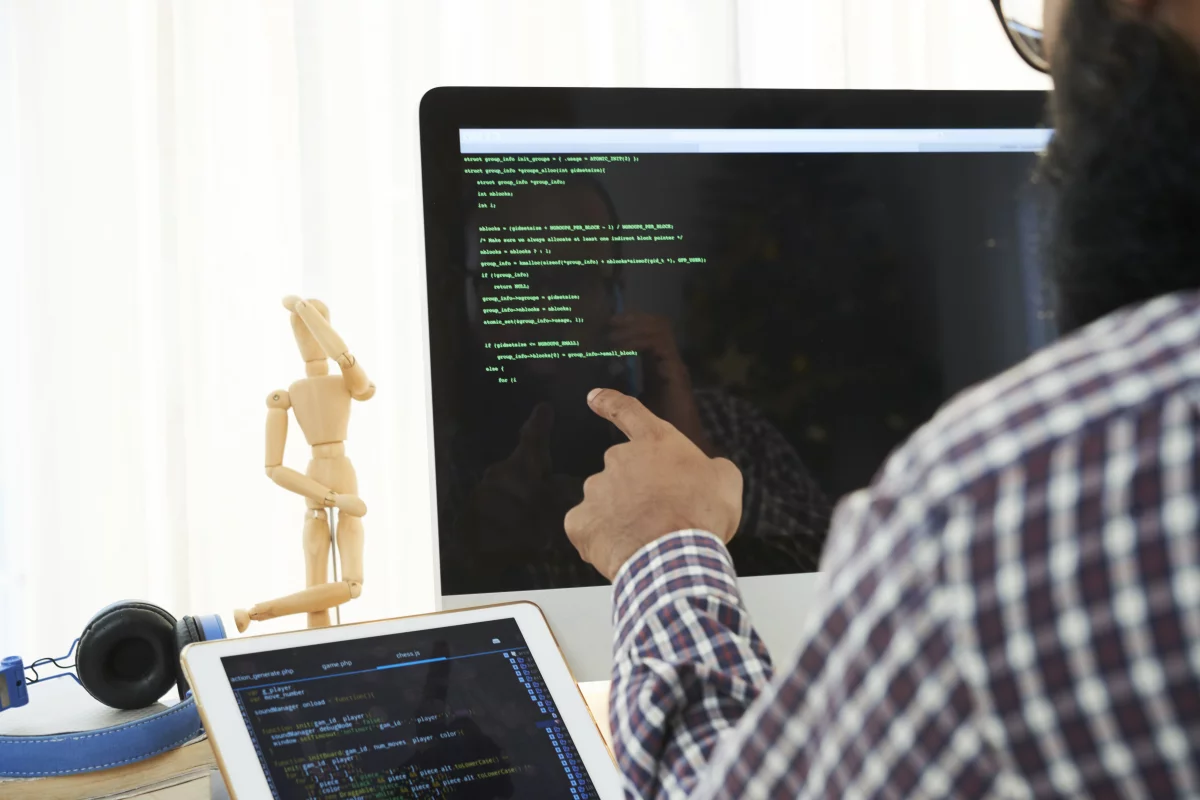
The male programmer looks at the monitor and points his finger at a line of code
With languages like Java, Go or Python, the work is easy.

Java benefits

Java benefits are the reason why it is one of the most popular languages when programming. Java benefits are:

  • absence of charges – Java is free, so you don’t have to pay anything extra to use it;
  • universality – since Java is universal, you can use it to program almost anything. It’s especially key for Android users, as most Android apps run on it. In addition, the language is also present in laptops, computers, game consoles and data centers;
  • functionality – Java works on a variety of operating systems, including Windows, Mac and Linux;
  • easiness – Java is perfect for beginners without any programming experience. It checks for errors before running, reducing the risk of various unnecessary complications. Learning Java is not difficult and can be mastered in a relatively short time;
  • security – we must not forget about security, which is achieved by the fact that Java does not have access to local programs.

Java disadvantages

Every programming language also has its drawbacks. In the case of Java, you may encounter the following:

  • It is demanding on memory. Unlike other languages, Java has relatively higher RAM requirements.
  • It is not suitable for creating complicated user interfaces. Complications and inconsistencies can arise when using this language.
  • Lack of backup. Java does not focus on backups, which can cause the loss of important data.
  • Requires detailed and complex codes. Java codes are detailed and composed of long sentences that reduce their readability.
A male programmer looks at a monitor and types into a computer
You can learn Python programming language quite quickly

What is Python programming?

The Python language is a modern and powerful general-purpose open source programming language copyrighted under a license compatible with the GPL certified Open Source Initiative. Python programming has a simple and easy-to-use syntax. This makes Python an interesting language to learn for beginners.

Did you know that…

…the Python programming language is also used by large companies such as the Wikimedia Foundation, Yahoo!, CERN and NASA?

At the same time, it is an object-oriented programming language suitable for processing large amounts of data, including complex mathematical calculations. It is used in fields such as bioinformatics, neurobiology or even astronomy. It is also one of the oldest languages – it was created in 1989. A key Python function is that you can easily extend it. You can use the language itself to extend existing applications. Many people mistakenly think that the name Python comes from the name of the snake. But the truth is that its developer, Guido van Rossum, was inspired by the British satirical series Monty Python’s Flying Circus.

What are Python functions?

In Python, functions are blocks of code that perform a specific task and can be called from other parts of the code. They are defined using the keyword “def”. Here are some aspects of basic functions in Python:

  • len(iterable): Returns the number of elements in an iterable object (e.g. list, string, tuple).
  • min(iterable): Returns the smallest element of the iterable object.
  • max(iterable): Returns the largest element of the iterable object.
  • sum(iterable): Returns the sum of the elements in the iterable object (usable e.g. for adding numbers in a list).

Python functions are very useful for organizing code and reusing it.

How to program in Python?

As a future Python developer at the beginning of your Python programming journey, it is essential to gain a solid understanding of the basic concepts that characterize the Python language. This includes a thorough familiarity with the principles of object-oriented programming (OOP), which is a key pillar for us if we program in Python. Understanding concepts such as classes, objects, inheritance, polymorphism and encapsulation is essential for effectively creating scalable and reusable code bases. Programming in Python and a few basic principles to get you started programming in the language.

  1. Python installation:

The first step is to install Python on your computer. Visit the official Python website (https://www.python.org/) to download the latest version for your operating system. Most modern operating systems already have Python pre-installed.

  1. Basics of the language:

Variables and data types: define variables and understand basic data types such as numbers, strings and Python lists.

  1. Conditions and loops: learn how to use conditions (if, else, elif) and loops (for, while) to control the flow of a program.
  2. Functions:

Define custom functions for code reusability.

  1. Data structures:

Learn about basic Python data structures such as lists, tuples, sets and dictionaries.

  1. Working with modules and packages:

The extensive library contains various Python modules and tools that extend the functionality of the language and that you can use effectively in your code. If we already know the Python basics and program in Python, it allows us to take full advantage of the benefits and functionality in a variety of areas from data analysis to task automation and artificial intelligence. We can efficiently and quickly build applications for a variety fields, including web development, which greatly increases the productivity of Python programmers. The best way to learn to code in Python is to code. Create your own projects, solve problems, and participate in the open-source Python community.

Python benefits

It has several advantages, including:

  • simplicity – learning the Python programming language won’t be a problem and you’ll be able to master it in no time. If you know English, everything will be even easier. Basic English verbs are all you need to use Python;
  • absence of charges – it’s open source, you don’t have to pay anything. It is available for free for users. This is a great advantage, especially if you just want to try it out;
  • productivityPython programming is highly productive. This means you don’t have to spend a lot of time understanding the syntax and you can get down to coding;
  • large library – the standard Python library is large and contains all the data you need. So you don’t have to worry about having to do some research using other sources.

Python disadvantages

When using Python, you also have to take into account a few disadvantages:

  • slow performance – unlike other languages, Python is a bit slower;
  • uses a lot of memory – you’ll need quite a lot of storage for Python;
  • weak on mobile devices – so it is not used very often on mobile devices, as it is not memory efficient and is slow.

Golang or Go programming language

Golang, often referred to as Go, is a multi-purpose programming language that is compiled and statically typed. Compiled means that its source code is translated directly into machine code, allowing for faster operation. The Golang programming language was designed by Google in 2007, but was only released to the market in 2009. The Go language was meant to be a solution for older languages that couldn’t handle large amounts of code. This is the reason why Go’s syntax is concise and its usability and readability is much easier. If you want to build bigger and better software, be sure to get clear on what Golang is as soon as possible.

Golang programming language advantages

There is a number of Golang benefits, which is why it is used by people all over the world. The main advantages include:

  • simplicity – Golang is one of the easiest languages to learn. You can learn the basics in a short time;
  • good documentation – Go has easy-to-read documentation, which you can find on the official website. It also has a large and active community behind it, which will be happy to help you if you have any problems;
  • versatility – you can use Go for different projects you have ahead of you because it’s multi-purpose. It’s also often used in cloud programming. For example, Amazon (Amazon Web Services) or Google (Google Cloud Platform) are popular;
  • absence of charges – since Golang is free, you pay nothing to use it.

Golang programming language disadvantages

The Golang programming language also has a few cons:

  • Creates room for minor coding issues. Although Go is easy to use, it sometimes creates room for unnecessary errors that can occur when a project grows to larger sizes. For large projects, it is therefore a good idea to choose more intelligent programming languages.
  • This is a relatively new language. Compared to other programming languages, Golang is relatively new, so you won’t find as much information about it as you will about Java.
  • It’s time-consuming. Golang isn’t the most complicated programming language, but it’s in last place compared to languages like Java or Python.

Comparison of Java vs Python vs Golang programming languages

If you want to choose the best programming language, you need to compare them all and see what advantages and disadvantages they have. For a better overview, we’ve prepared a handy table where you can find all the basic information.

Memory usage*

up to 40 MB

up to 14 MB

up to 3 MB

The biggest advantages
  • speed
  • easy to use
  • suitable for beginners
  • high security
  • free of charge
  • medium RAM memory requirement
  • easy to use even for beginners
  • free of charge
  • a large library of information
  • great documentation
  • large community
  • free of charge
  • easy to use
  • low RAM requirements
The biggest disadvantages
  • high RAM memory requirements
  • slower performance
  • lack of backup
  • slower performance
  • weaker on mobile devices
  • time-consuming
  • a relatively new language, which is not so much known about

*According to information from the portal Medium.com

Test a programming language

It is not possible to universally evaluate which programming language is the best. Each has its advantages and disadvantages. If you can’t decide based on the information we’ve given you, give each language a try. They’re all free, so you don’t have to worry about investing unnecessarily. Knowing at least one of the most well-known programming languages will give you the opportunity to respond to our interesting IT job offers and kick-start your new career in the world of technology.

International Father’s Day: what our colleagues say about their children’s future in IT

In many countries, the World Father’s Day has no fixed date and varies by country and culture. Celebrations are often associated with honouring fathers and fatherly attitudes towards children. In this article, we mark Father’s Day and ask colleagues at msg life Slovakia about their children’s future in IT.

When is Father’s Day in Slovakia?

Every year, the Father’s Day in Slovakia is celebrated the third Sunday of June. Father’s Day and its history dates back to 1910, when it originated in America and quickly spread around the world. It highlights the irreplaceable role of a father in a person’s life.A great way to express gratitude and love to your dad is to congratulate him on Father’s Day. Greetings can be expressed by a personal visit, sending a card or a gift, while even a small gesture can make this special day more enjoyable for him. We at msg life Slovakia also appreciate fathers and we have given them a nice gift for Father’s Day. We also interviewed our colleagues and asked them if they lead their children to information technology.

Original tips on what to give dads for Father’s Day

Here are a few ideas of what to buy or make for Father’s Day as gifts for you to consider, but keep in mind that it’s important to pay attention to his interests and tastes to make the gift personal and special for him.

  • Books: if your dad is a bookworm, choose a book by his favourite author or on a subject that interests him.
  • Clothing or accessories: a good quality shirt, tie, cap, hat or other clothing or accessories can be a suitable gift.
  • Sports equipment: if your dad is the sporty type, gift him some sports equipment or accessories such as a tennis racket, golf set, cycling helmet, etc.
  • Peculiarity: If he has a special hobby, think of a gift that goes along with it. For example, if he likes to barbecue, a quality barbecue set could be a great gift.
  • Technological devices: if your dad is technologically inclined, a new gadget, smart watch or other technological device could make him happy.
  • Relaxing Gifts: Give him a relaxing gift such as a spa pass, massage, aromatherapy oil or a quality coffee maker.
  • Personal Gifts: Create something personal for him, such as a photo book with family photos, a handmade gift or a piece of jewelry with a custom engraved message.

The concept of parental leave comes up many times in relation to the role of father. A father on parental leave is still something unusual for many compared to a mother. Although the focus is on the first three years of a child’s life, maternity leave (check also our article about return from maternity leave) is not the end of a child’s upbringing, quite the opposite. After the first stage of life, the son or daughter starts kindergarten and school, their first personality traits and qualities begin to emerge. Gradually, therefore, the question of their orientation, which will determine their future direction in life, also arises. All this can be influenced by the parent through the upbringing of the children, but also by providing them with a quality education and a future. And since, according to the latest surveys, IT is the field that will have a good perspective in a few years, we asked our colleagues whether they are leading their children in this direction as well.

Supporting children’s IT education

“I will definitely encourage my daughter to know her way around IT. IT skills will be a great asset to her no matter what life path she chooses,” says teamleader Lukas about his four-month-old daughter. Another colleague of ours – scrum master Michal, who has a 13-year-old daughter and an 11-year-old son, also sees potential in IT: The development of IT systems has real added value because it makes everyone’s work easier and more efficient. In addition, working on software development can also be quite fun and varied because it allows us to dive into the areas for which we develop software. What my children will eventually focus on is an absolute mystery to me for now. But I like to be surprised.” Consultant Richard, who has two daughters and a son, leaves the choice up to his children. “It’s better if this life direction grows on them naturally,” he adds.

The IT world is interesting for children

“With children it’s simple. When they like something, they come and ask what I’m doing, what’s in my notebook and why it’s like that. I think that kids are pushed towards IT by the current world situation. Being without a computer, phone or smart watch is probably an exception today. My oldest daughter had a period in life where she was constantly wondering what was running on the computer, where something was stored or why problems were occurring. She’s over it now, but she can still navigate it well,” describes our IT consultant Richard. On the other hand, team leader Lukáš says he will try to make sure his daughter gets IT knowledge: “We don’t plan to rely only on our school system in this matter.” Our colleague Michal, on the other hand, has decided to involve his son in a different way. He combines the pleasant with the useful: “My son and I like to go running together and often discuss an interesting topic in mathematics or physics. It’s time well spent.”

Our colleague Michal with his son at a running competition.
Our colleague Michal with his son at a running competition. (Source: Zuzana Sefcovicova)

According to Michal, interest in the chosen topic is the key predisposition for success. “The son and daughter are very different in this matter. My daughter is more of an artist, but at least sometimes she lets me talk to her about physics. Although she would never admit it publicly, I think she enjoys it. My son is an athlete at heart, but he is also very interested in technical topics. I think both children have a very good ability to understand technical problems. However, I think predisposition also includes interest, so if I had to put my money on anyone, it would be my son. He was drawn in that direction from a young age, asked a lot of questions and was usually very good at understanding connections and remembering. He successfully participates in mathematical competitions, such as the Math Olympiad or Pythagoriad. My daughter, by the way, is also good at these, but for her it’s more like a mandatory thing.” Children’s interest in IT can start at an early age when they are exposed to new technologies – as early as four months. “I think my daughter is starting to show an interest in IT, she’s fascinated by my mobile phone and laptop, she wants to look at them,” says Lukas. In contrast, colleagues with older children tend to reduce time their children spend with electronic devices. “We try to encourage children to see IT as a tool to help us solve our problems. I certainly wouldn’t want children to spend long hours playing computer games. They have a weekly schedule to play, which they manage themselves. They mainly use mobiles to communicate and listen to music. The installation of new apps has to go through our approval. The combination of children and IT can sometimes be harmful. For example, I don’t like to see a group of children spending time together sitting next to each other, each looking at their phone,” explains Michal.

IT is related to mathematics

IT is also very often related to mathematics and logical thinking. Some of our colleagues use maths at work on a daily basis, so we asked if they also help their children with it. “My wife and I are both trained teachers, so we have been trying to naturally develop mathematical thinking in children since they were young. However, they usually manage the school curriculum without our help. Rather, we try to show them some interesting things that would broaden their knowledge from school. When they do happen to need something explained, I try not to do it in a straightforward way. I ask them questions that gradually help them to find the solution themselves. I have to admit that I am always happy when I get such an opportunity,” says Michal. Proof that math is not for everyone is our colleague Richard. “For my eldest daughter, maths is fun, she doesn’t have to study and gets good results, but for my younger daughter, maths is a nightmare. It’s her biggest fear,” laughs Richard. “But if she asks for advice, I’m happy to help,” he adds.

Colleague helping a child
Our colleagues help their children with homework preparation.

Children’s IT knowledge and school curriculum

It is still true that children learn most of their lessons at school, so we were also interested in whether our colleagues are satisfied with the teaching of mathematics and the level of IT in schools. “It always depends on several factors, i.e. the school, the teacher and the diversity of the classmates. All of this affects the level of attainment. The most important thing is the teacher and their experience. There are not enough teachers that at the moment, which is reflected in the pupils’ knowledge. When in primary school, children sometimes encounter teachers who lack experience. If the class is diverse and the teacher does not create a positive relationship with the curriculum, the children do not have the will to acquire knowledge and it is difficult to change their mind at home when they do homework,” says Richard. The main focus is still in memorizing formulas and learning certain procedures, but the development of abstract and analytical thinking is lacking. Thus, pupils can only solve narrowly confined types of problems. When the task is varied slightly, they already have a problem because they cannot generalize and analyze the problem. However, in their lives and careers they will encounter these types of tasks,” adds Lukas. Michal also prefers a different approach to learning: “When it comes to maths, I’m a fan of the Heine method, which is designed to develop independent thinking using experience. Many Slovak schools are trying to get up to speed with this system, but it’s not easy, because it requires changes not only in the pupils’ attitudes, but also in the teachers’ attitudes. The biggest problem, in my opinion, is the low salaries in education. Many capable teachers leave to do other jobs in which they are paid several times as much as in teaching. This is especially true for teachers of mathematics or computer science.” However, according to Michal, the situation is slowly improving: “Mindset of responsible people is good in my opinion. New modern methods are being introduced in schools and there is a will to teach children so that they are able to think independently and courageously about the tasks they are given. In practice, however, it depends very much on the particular school and, in particular, on the particular teachers. At the school my son goes to, they have been trying to teach kids the basics of coding since the first grade, using children’s programming environments. These are games that teach children to think algorithmically.”

Is studying IT at university important for children?

On the subject of education, the question of the necessity of going to university has also come up recently. In job interviews (read about tips on how to prepare for a job interview), recruiters often prefer experience over education. We therefore asked colleagues if they would be happy if their children went to university. “I don’t consider graduating from university to be essential for working in IT. In general, however, I think that attending a university of sufficient quality is a great benefit for a young person, and I plan to support my children in their decision to choose and graduate, but not force them to do so,” says Lukas. Michal also agrees with his team leader: “IT can certainly be mastered without university, especially if one is passionate and likes to educate himself in the field. However, univesity brings much more than just knowledge that can be used on the job. The student gets a more general overview, they get to explore topics that they might otherwise have bypassed, and that opens up a wide range of possibilities. In addition, the university environment is stimulating because there is a large community of like-minded people. I will definitely be happy if my children decide to go to university.” Our colleague Richard, who is a trained chef, has a different opinion on this question: “Studying at university is important in terms of educational attainment, so in some cases it also opens closed doors. From my own experience, I have to say that it is not completely essential. If a young person can adapt and gain knowledge, they can achieve success without going to university. Even in the IT field. However, university provides deeper information through which one can see broader contexts. So I would be pleased if my children took that route. It can certainly help them in some areas.”

The future of the IT sector

As our colleagues’ children are still at a young age, the fact remains that by the time they graduate from university, the world around us, and especially the IT field, may look completely different. We therefore asked our colleagues if they dare to guess what problems their children will solve in the IT field in the future. “I am convinced that artificial intelligence will solve many things in the future. When I see the world our parents lived in and the world we live in, I think the changes are going to be really big. Even programming itself has come a long way since its beginnings. Programmers are becoming more and more comfortable in their jobs, modern programming languages do a lot of the ‘dirty’ work for us, technical proficiency is not as important as it used to be. This is the direction I think it will continue to go in. One day, maybe the developer will just be a kind of configurator whose job is to explain to the machine what to program,” says Michal. Lukas sees the future of IT in a similar way: “I expect artificial intelligence to play a much more important role. This trend is already evident. I can imagine that if my child one day decides to pursue a career in IT, he or she could, for example, program self-learning algorithms or be a neural network architect or something similar.” “It may be that in 20 years’ time, the IT worker will be one of the sort of elite, and the work will be done by computers,” concludes Richard.

Effective brainstorming activities: How to guide your team from brainstorming ideas to success

In this article we will discuss what brainstorming is, the importance of brainstorming, brainstorming methods and how to use them properly.

When people talk about teamwork, problem solving and interesting ideas, there is one term that is often repeated: brainstorming. This creative technique helps you achieve excellent results. It allows you to come to conclusions that you might not have come to on your own. Although there are many brainstorming advantages, not everyone knows or uses it. How to do brainstorming effectively?

What is brainstorming and examples

Brainstorming is a term composed of two words brain and storm. When you use it, you strain your brain to come to different conclusions. Brainstorming can also be described as a set of creative methods to help you come up with different ideas, which you then present to your colleagues. The basis of brainstorming is zero critical evaluation. This means that no one present should judge the ideas of others. In most cases, brainstorming takes the form of a spontaneous discussion on a given topic. A colleague’s idea may develop yours or inspire you to do something new. This method tries to relax the atmosphere among the participating group members. It is meant to create a safe place where no one judges anyone. This can be particularly helpful for quieter colleagues with less tendency to talk in a group.

Brainstorming in practice

Brainstorming focuses on new ideas and developing creative thinking. It can be used in marketing, IT sector or any other field where it is necessary to come up with something new. Although it is a more free-flowing discussion where ideas should flow, you should keep a few important brainstorming rules in mind. Use them to get the necessary results with the whole group.

Basic brainstorming rules for developing creativity and generating new ideas

  • Set a time limit. Depending on the complexity of the problem, set a time together with your colleagues. It takes usually between 15 and 60 minutes. A longer time makes it harder to concentrate and makes the meeting unnecessarily long. If you would like to spend more time with this activity, do not forget to take regular breaks.
  • Choose the main person of the discussion. If there are more than one of you in the team, it is a good idea to choose someone to lead the discussion.
    This person will choose the type of brainstorming, keep track of time, define the problem, and can award the floor.
  • Select the number of discussion members. Everyone can bring their own perspective to the discussion, but when there are many people, you may find yourself drowning in ideas as a group. The best number of people for a brainstorm activity is 2 – 6.
  • Define the problem. Each brainstorming session should have a defined topic or issue. An imprecise topic will cause you to move from one area to another. So, define the problem you want to find a solution to.
  • Avoid criticism. To foster creativity, you and your colleagues need to create an environment where everyone feels comfortable and safe. Don’t criticize any thought or idea, quite the opposite. Try to make use of their brainstorming tips.
  • Encourage crazy ideas. There’s nothing too crazy about brainstorming. Even though an idea may seem unrealistic, keep it open. It might help you come up with something interesting.
  • Focus on quantity. Although quality is better than quantity, this is absolutely not the case with brainstorming. Sorting through the ideas and choosing the best ones will come after you’re done with the discussion. Therefore, you and your colleagues write everything down and don’t leave out even the smallest detail.
  • Bet on the visuals. Some things encourage creative thinking more when they are drawn or in the form of a table or diagram. So get some clean, preferably unlined paper, pencils, pens or a whiteboard to draw on with your colleagues. Other options are handy UML diagrams, also known as “mind maps”, various sticky notes, stickers and other aids.
  • Avoid shouting. When someone speaks, others should listen and think quietly.
    If there are more of you in the group, agree that whenever someone wants to say something, they will speak up.
    That way everyone gets to speak and there is no chaos.

The rules and principles of brainstorming can be adapted to the needs of the group and the specific situation.

Recommend
We recommend:

Digital technologies can enhance the brainstorming process. Don’t be afraid to use them and make the most of the features they provide. As well as UML, you could use simple spreadsheets in Excel or classic lists in Word.

Basic brainstorming methods

Brainstorming has several methods. Choose one before starting the discussion. This will help you stick to the topic and ensure that you get the results you want.

You can also draw ideas as part of brainstorming
A white board or blank paper is great for brainstorming.

1. 6-3-5 Brainwriting method with six participants

This type is also known as the 635 Method. It is based on six participants. Each of them writes down three ideas on paper, which are then developed by colleagues to their right. The individual ideas circulate among the members five times. In this way, everyone participates in each idea and contributes their share. If you ask who the brainwriting method is best for, the answer is introverts. Their involvement in debates is usually minimal. It’s a shame, though, because their creativity is often unappreciated. However, the main idea behind the 635 Method is to encourage creativity and divergent thinking in the group, with each participant contributing to the creation of ideas through writing and sharing with other team members.

Recommend
We recommend:

If you can’t see the problem from a different angle, invite someone who works in a different field to join the debate. Since they don’t know everything about the topic, they can resolve the complication much more quickly.

2. The alter ego method – think like the target group

The method known as Alter Ego is great when you need to look at a problem from a different perspective. When brainstorming in this way, you need to put yourself in the shoes of a famous person or target group. When you start thinking like someone else, you look at the situation differently.

3. Wordstorming method – a waterfall of ideas

Innovative methods especially suitable for creating large numbers of words and original slogans include wordstorming. All you need is paper and a pen. Write a word or sentence related to a topic or issue and let your colleagues write more. You can then use the ideas to come up with an interesting whole.

4. Questioning method

This type of brainstorming is great for perfectionists. When you want the best results, have the group question all possible assumptions. See where the idea has a flaw or a minus. Using the opinions of others, you can uncover what else to improve and change.

5. Brainstorming and mind mapping for visualizing connections

A mind map is also an excellent brainstorming tool. It helps you to see things in context and notice the bigger picture, organise your thoughts and improve your memory. In fact, many people find it easier to remember information in visual form.

Did you know that…

A mind map is one of the few brainstorming options suitable for one person. In most cases, you need two or more people for the discussion.

Creating mind maps is easy.
All you need to do is get a pen and paper.
Write your main idea or problem in the middle.
From that problem, start making basic branches.
The number of them varies, but they should connect to the main idea.
Write whatever comes to mind.
Once you have the first branches, you can divide them into more.
There is no limit to creativity.
If you’re not comfortable writing on paper, use a mind map program.
You can find lots of them on the internet and most of them are completely free.
You can find them in our article Tools that make work easier.

Other brainstorming types

Other variants include:

  • Hobo method – in this method, a problem or topic is first introduced. Then each participant has time for self-study. After a certain amount of time, everyone gets together and starts discussing. The Hobo method is especially suitable if you don’t know much about the topic and are new to it;
  • carousel brainstorming – discussants divide into groups and solve different tasks. When they have completed them, they move to the next place where another group was before. The aim of this variation of thinking is to get everyone to comment on an issue or idea;
  • ping pong – this type is suitable for two people exchanging ideas and sharing their views.

How to avoid common brainstorming mistakes?

The most common mistake in brainstorming is its lack of regulation, which leads to a situation where extroverts talk a lot and introverts hardly at all. Therefore, the best solution is to choose a main member, i.e. someone who will lead the whole discussion. If you don’t want someone “superior” in the group, try a warm-up activity, often called icebreaker (a game designed to break the ice and initial shyness).

Brainstorming is a great solution even for introverts
Criticism must be avoided during brainstorming.

The warm-up activity can be anything.
The best is a simple question to think about, answered by all the judges.
For example, each person chooses an object and says at least five things they associate with it.

Did you know that…

Another risk of brainstorming is going off topic and addressing a different issue. The solution is to regularly return to the original idea. Write it down and put it in the middle of your desk or on a magnetic whiteboard. Whenever you feel like you’re going off on a tangent, ask yourself how your idea relates to the topic at hand.

Another risk of brainstorming is straying off topic and tackling a different issue.
The solution to this problem is to regularly return to the basic idea.
Write it down on paper and put it in the middle of your desk, or place it on a magnetic whiteboard.
Whenever you feel like you’re going off on a tangent, ask how your idea relates to the topic at hand.

Brainstorming to support creativity

In conclusion, if we ask the question “What is brainstorming?” it’s a great creative technique that opens the door to new ideas. It improves the results not only of whole groups but also of individuals. It can develop creativity and allows you to look at a problem from a different perspective. It can be used in almost every field, but in the IT sector or marketing it is crucial. Try it out with your colleagues or completely on your own and help your personal growth and career!