
Project Management Officer Zuzka will tell you about her job

Office manager Zuzka joined msg life Slovakia to support the project and program managers. She was looking for a job that would fulfill her in the long term and decided to use her experience with us. Are you curious about what a typical day looks like as a Project Management Officer – PMO and what qualities a successful candidate should have? Zuzka has prepared handy hints for you to help you on your way to your dream job.

How long have you been with msg life Slovakia?

“I have been with msg life Slovakia since March 2020.”

What job were you recruited for?

“I was recruited as a Project Management Officer.”

How did you get into project management?

“I was looking for a job that would fulfill me in the long term, where I could grow professionally, improve my PC skills and language competences.”

What attracted you to working at msg life Slovakia? Why did you choose us?

“The first thing that caught my eye was the job offer, which seemed challenging and I was hesitant to apply or not. I took it as a challenge, fought for it and today I am happy that I succeeded. Now I understand why I went through several rounds of interviews. Why did I choose msg life Slovakia? I knew I wanted the job and I had a good feeling about the people who interviewed me and the overall atmosphere. I was very pleasantly surprised by the personal approach and interest of my future employer. I appreciated and still appreciate his dedication and approach to the staff. In addition, msg life Slovakia is one of the few companies to offer a wide range of employee benefits. It’s also a baby/family-friendly company, so I’m able to combine work responsibilities with family and personal pleasures.”

Work environment at msg life Slovakia
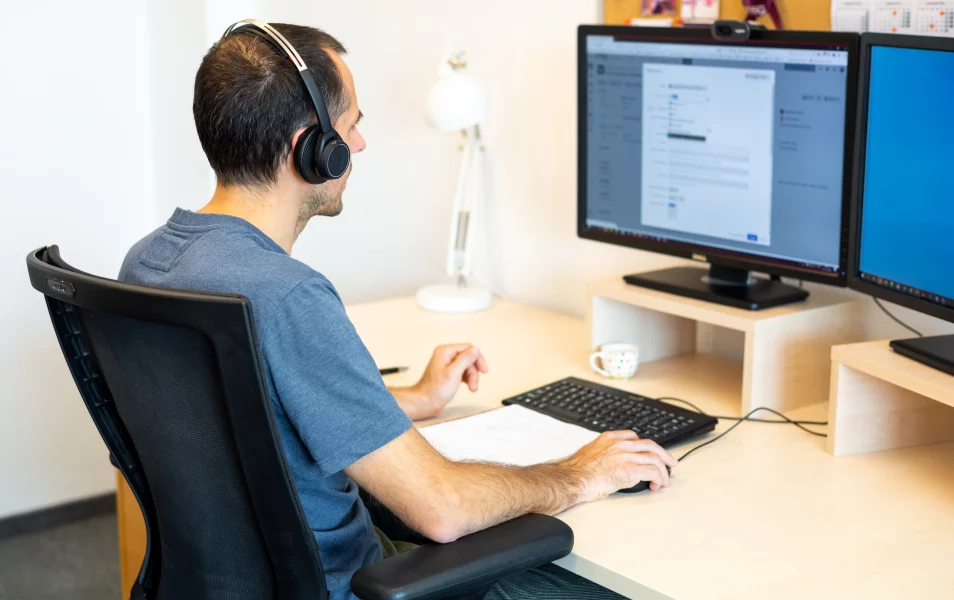
Project Management Officer says: At msg life Slovakia I can combine work duties and my private pleasures.

How is working for us different from previous work experience?

“Working conditions, the atmosphere in the team, the company philosophy and the value of the person. At msg life Slovakia I am a person, not a number.”

What does your normal working day look like?

“I admit that I have not experienced two identical working days in a row. Every day is different and brings with it many challenges, and that’s a good thing. Otherwise, I’d be bored. However, I do make coffee every morning and during the day and try to socialise with colleagues if work duties allow. I missed this activity when working remotely. Basically all day long I deal with agendas, tasks and requests that are either regular, but also with those that are related to specific meetings on a given day.”

What are you working on now?

“I am currently working on several projects, two customer and one internal. It is difficult to describe the job of Project Management Officer as we have a very broad portfolio of activities. It depends on how long a person has been in the job position and needs time to gain the necessary experience and knowledge of our industry. I make sure that the projects are clear from a controlling, organisational and financial point of view. And a lot of activities really fit under this characteristic. Project Management Officer is part of project management, is directly involved in its activities and supports the project and programme manager in their projects.”

What projects are you currently working on?

“Signal Iduna and VHV.”

With whom do you communicate and solve problems?

“I communicate with my project and programme managers but also with colleagues who are working on the project.”

Communication with project management
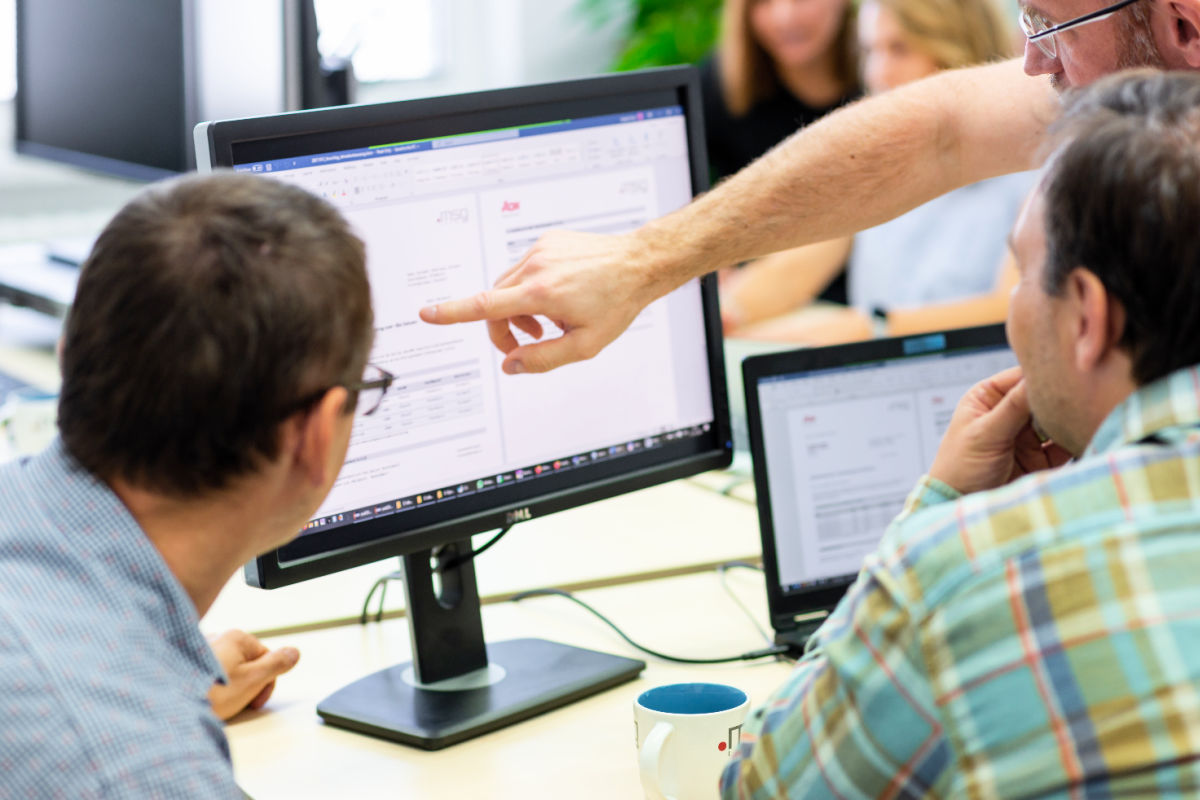
Zuzka communicates with project and program managers, as well as with other colleagues.

What programs do you use at work?

“I work with MS Office, most of the time – 99.9% – I work with Excel. Within the team we also use OneNote and of course PowerPoint. For communication and presenting StarLeaf, Unify, Fastwiever. I also work with ERP, JIRA and CRP.”

What skills/knowledge are important for your job?

“Good communication skills, language proficiency, proficiency in Excel at an advanced level is key. Those who are not spreadsheet types and hate Excel will be unhappy. You also need intrinsic motivation, a willingness to learn new things, calmness, consistency, responsibility, to be able to set priorities, to allocate time and energy to tasks correctly.”

What do you like most about your job?

“I am improving my skills in foreign languages and in working with programs, especially Excel. I can see a lot of progress in myself compared to my knowledge when I started working. The disadvantage is the time commitment.”

What are your colleagues like?

“My colleagues are really great. They are friendly, cheerful and always helpful. I can count on them.”

Office manager in msg life Slovakia
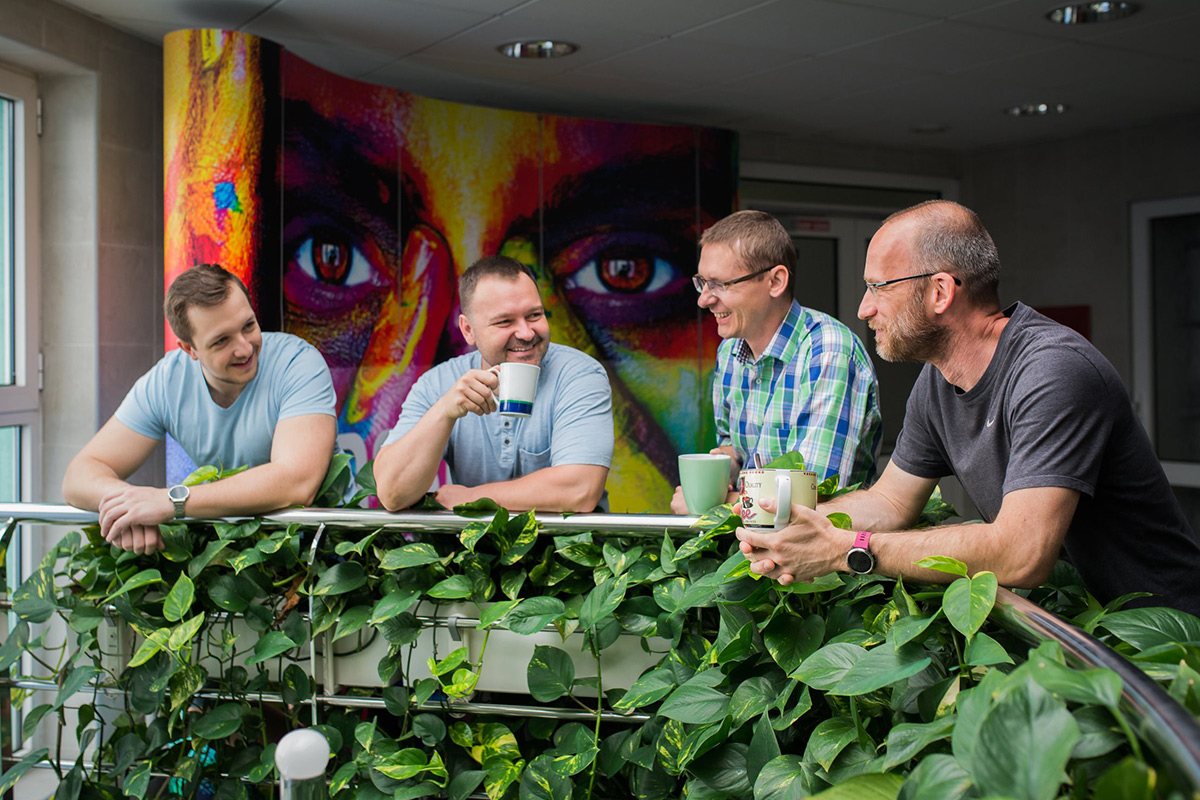
Friendly colleagues create a pleasant working atmosphere.

What qualities should your new colleague have to fit in?

“They should definitely have a sense of humour and a dose of enthusiasm.”

3 words that come to mind when you hear msg life Slovakia?

“Certainty, stability, progress, creative friendly atmosphere. (6 words, hope you don’t mind) :)”


Business Process IT Consultant wanted! Analysis, concept development and software testing

The role of the Business Consultant will be, among other things, to create expert concepts and detailed assignments that will tailor the software to the client’s needs. Find out more about the job offer.
Anyone who works in a software development company knows the huge gap between software developers and customers. We at msg life Slovakia are therefore looking for someone to fill this gap. The role of the Business Process IT Consultant will be, among other things, to create expert concepts and detailed assignments that will tailor the software to the client’s needs.

Developing usable and practical software is the goal of every developer. However, creating a program that is also user friendly is a bit more challenging. Especially when there are inaccuracies between the client’s expectations and the work of the development team. We are trying to eliminate this communication noise that occurs in many companies. That is why we are looking for suitable candidates for our Bratislava, Zilina and Kosice offices for the position of Business Process IT Consultant and Business Process IT Consultant / migration in the field of life insurance.

What will be your role?

In addition to working closely with the development team, the role of the Business Process IT Consultant will be to communicate and advise our customers. The successful candidate will have the opportunity to conduct training sessions, presentations or workshops to show clients how to use the msg life insurance contract management system.

Before the software is presented to the customer, it will also need to be tested. A Business Process IT Consultant should therefore be able to empathise with the client’s needs and analyse what needs to be improved on the project before it is handed over. The candidate should also be able to respond to production questions and be familiar with business processes, integration processes or software connections to related client systems.

A business consultant points to the whiteboard and lectures his colleagues
Presentations and workshops are an essential part of the job.

Necessary requirements

Due to the foreign orientation of our company, language skills are necessary/important for the position of Business Consultant, but they differ from branch to branch. This is due to the deployment of candidates on projects for different customers.

  • Bratislava: we require B2 level German, or B2 level English and A2 level German
  • Zilina and Kosice: we require B2-C1 German language skills.

Equally important is an education in mathematics, computer science or insurance or related fields at secondary or university level. Knowledge and work experience as a Business Consultant or three or more years of experience in software testing or the insurance industry is also required. A positive attitude towards the IT field is also welcome.

What extra do you get?

In addition to regular financial compensation, msg life Slovakia offers its employees annual and personal bonuses and rewards for long-term employees. Flexible working hours are also a matter of course throughout the year as well as five days of leave beyond the law. In addition, at the end of the year, our team will be happy to thank you with a day of paid time off.

The company also offers many non-financial benefits. These include, for example, a quarterly allowance for individual activities, various IT training courses, free online language courses and Multisport card to keep you fit. The company also offers its employees in Bratislava its own fitness centre, regular massages, a relaxation area in the exterior of the branch, teambuilding, great summer parties and Christmas parties. Find more about employee benefits on the Benefits tab.


Does this description fit you or are you interested in the job? See our job offers for the position Business Process IT Consultant.

What does a Scrum Master do? Michal will tell you

Scrum master Michal joined msg life Slovakia as a software developer. Find out what his role is. Michal has been working as a developer at msg life Slovakia for several years. As a graduate teacher in mathematics and computer science, he feels confident in his role as Scrum Master, as it reminds him a bit of the role of a teacher. His role is to take care of the Austrian-Slovak Danubius Scrum team, helping them to understand the principles of agile development in Scrum and creating the conditions for improvement.

How long have you been with msg life Slovakia?

“I can never answer that question off the top of my head. It’s been 9 years, I think.”

What job were you recruited for?

“I was recruited as a software developer.”

What is your current job position?

“I’m currently working as a Scrum master/developer.”

How did you get into programming?

“I’ve been into programming since I was in secondary school. I graduated as a teacher in the field of mathematics-informatics. I had been teaching for a while, but I wanted to try my hand at being a programmer. Later I took out a mortgage, so I won’t go back to teaching again for another 20 years, I think.”

What attracted you to working at msg life Slovakia? Why did you choose us?

“Before msg life I worked in Vienna for 4 years. I was fed up with travelling every day and moreover I had the feeling that I wasn’t moving any further. Work was becoming a boring routine. That’s when msg life contacted me and provided me with everything I was missing in my old job. I didn’t have to travel so much and I got the space to learn new things. Actuarial science won me over right away. Plus, they paid me what I needed.”

How is working for us different from previous work experience?

“I’ll be honest. My current job is not my dream job. I think there are only a select few in the world for whom work is actually a hobby. It is much more important for me that I feel good at work. I really like coming here, I look forward to my colleagues and the good atmosphere that we have.”

What does your normal working day look like?

“I get to work quite early to avoid rush hour traffic. I have a quiet breakfast, have morning tea with my colleagues and usually start working around eight o’clock. For lunch, we either go down to the canteen or head out for something good. Then I work until five o’clock most days and rush to see my family after work. I literally run away ☺. I try to bike, skate or run to and from work. I think sport is very necessary in our profession.”

Software Developer in msg life Slovakia
Michal starts the day with breakfast and tea with colleagues.

What is your job? What are you currently working on?

“As a developer, I implement new customer requirements, often enforced by new legislation, and fix bugs that are discovered. Probably like a developer in any other company. I also specialize in actuarial calculations. As a Scrum Master I take care of an Austrian-Slovak Scrum team (called Danubius). My role is to help the team understand the principles of agile development in Scrum and to create the right conditions for it to improve. For example, in efficiency, quality of development, communication within the team but also outside it, responsiveness to change, etc. My goal is to create a self-organized Scrum team that doesn’t need a Scrum Master ☺ .”

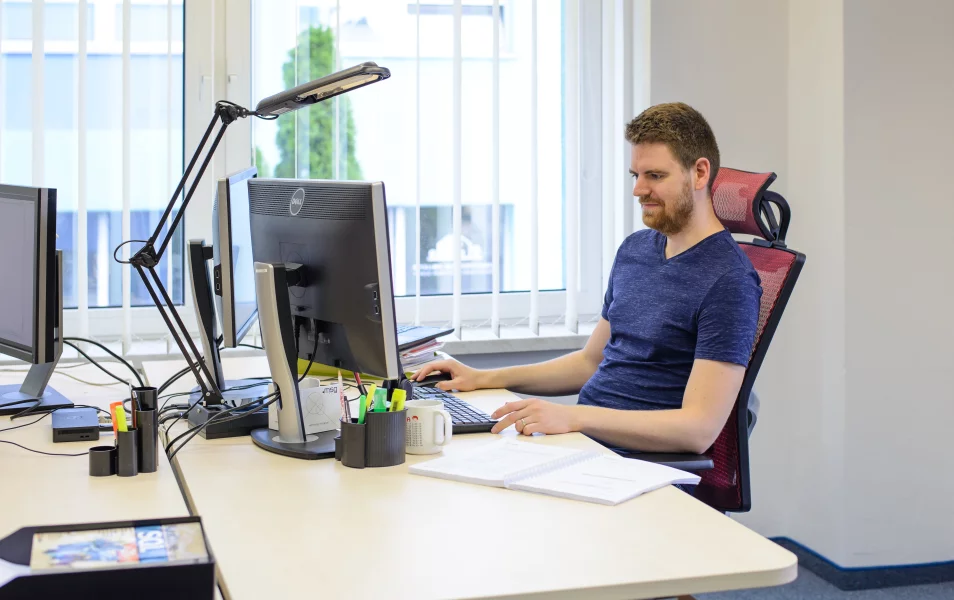
Scrum master Michal typing in his work computer
Michal specializes as a Scrum master mainly in actuarial calculations.

Who do you communicate with at work and solve problems?

“I communicate mainly with members of the Danubius team. In addition, with everyone who is in any way involved in the work of our team. For example, I organise meetings where we meet the people for whom the outcome of our work is intended and get feedback from them, on the basis of which we adapt our further development. One of the important roles of a Scrum master is to help the team remove obstacles in their work.”

What project are you working on right now?

“I’m working on a product called msg.Life Factory Standard. It’s a foundation that individual customer projects adapt to their own needs.”

Do you have experience with other projects within msg life Slovakia?

“I’ve been through several projects and roles at msg life. That’s one of the things I like about our company. Occasionally they’ll offer me a change and I usually don’t say no. I like to learn new things.”

What apps and programs do you use at work?

“I probably use MS Office, Eclipse and Visual Studio the most.”

What skills or knowledge are important for your job?

“This is a very difficult question for me. There are different types of developers and each of them may be suitable for different types of tasks. Personally, I would like to be deliberate, purposeful, consistent, creative and efficient.”

What do you like most about your job? And what don’t you like very much?

“I am a trained teacher and one day I would like to teach again. However, the role of a Scrum Master reminds me a bit of the role of a teacher and I like that. In addition, as a developer, I occasionally manage to get to some interesting algorithmic or mathematical problem. I like that too. And what I don’t like? The fact that I spend most of the day behind a computer.”

Who are your colleagues?

“My colleagues are very nice, friendly, helpful, funny. If I didn’t have such a wonderful family, I would definitely spend more time with them in private.”

What qualities should your new colleague have to fit in?

“I think the most important thing is that they are interested in the job and have the desire to be part of our team. Fitting in is not a problem, we are a good bunch.”

3 words that come to mind when you hear msg life Slovakia?

“Part of my life.”

What does a Java Developer do? Jaro will tell you

Jaro has been working at msg life Slovakia almost since its inception. He was able to see with his own eyes how the fledgling PIT Slovakia is growing and how far we have come as msg life Slovakia. He works as a Java software developer in a small team on a product that is developed only in Bratislava. In his work, he especially appreciates the friendly team, which is a great motivation for him. Read what a senior Java developer does at msg life Slovakia.

How long have you been with msg life Slovakia?

“I have been working at msg life Slovakia basically since its inception – since the summer of 2002.”

What job were you recruited for?

“I was recruited as a Java developer.”

What is your current job position?

“At the moment I work as Java developer. I am alsothe leader of our small team. But we are lucky that we are often involved in the creation of specifications, so we also have a direct influence on how things work.”

How did you get into programming?

“To tell you the truth, I don’t even know, but I remember that in secondary school I was still drawn to programming, even though at that time I didn’t have a good idea of what it was all about. Of course, since then, the programming has changed completely.”

What attracted you to working at msg life Slovakia? Why did you choose us?

“When I joined our company, it was a small, newly founded company with no name. It was recommended to me by a colleague who already worked there. My company at the time was in the midst of mass layoffs, I didn’t have much choice. I made my decision about my future employer based solely on my feelings at the interview. It would certainly be different today. I have been able to see first-hand how the fledgling PIT Slovakia has grown and where msg life Slovakia is going.

How is working for us different from previous work experience?

“I personally appreciate the friendly, even family atmosphere in the company the most. I don’t know what it is, but I have heard similar opinions from several colleagues.”

What does your normal working day look like?

“A quiet working day means I can get on with my tasks – either implementing new things or fixing bugs. A busy working day is marked by various phone calls, especially from Germany. This is usually due to a problem that needs to be solved immediately. If this situation is repeated too often, it sometimes causes stress. In addition, various brainstorming, consulting, tester support and similar tasks are on the agenda.”

What does a senior Java developer do? What are you currently working on?

“At the moment we are devoting all our energy to successfully managing the migration of a new customer. This is a large and successful company, which is matched by the pressure for speed and quality of execution.”

Developer work on IT project
The development team devotes all its energy to the successful migration of the new customer’s project.

Who all are you communicating with to solve any problems?

“Of course, I communicate with all our team members, our testers and I am also in daily contact with my colleagues from Germany.”

What project are you working on right now?

“Our team is developing a product msg.Pension. It’s a web-based application for managing accounts where employees save money for (early) retirement. We have been in charge of it since its beginning and its development is only taking place here in Bratislava.”

Do you have experience with other projects within msg life Slovakia?

“Yes, I was previously involved in GUI development for msg.Life.”

What apps and programs do you use at work?

“We program in Eclipse, we use JBoss and of course we use all the standard programs like MS Office and various tools.”

What skills and knowledge are important for your job?

“Of course, knowledge of the different technologies we use on our project is important. However, it is very important to have a good know-how in the field our product is related to. Since the specifications of new functionality are often very vague, it’s up to us to figure out how the thing will actually work. This often takes up most of the development time.”

What do you like most about your job?

“My favourite thing is when we come up with an elegant solution to a problem during a brainstorming session. This reinforces how good we are and what a brilliant system we are making :). Of course, the afternoon coffees and debates are also priceless. Sometimes the conversation turns to a work topic, and it has often happened that we have solved a long-standing problem over coffee.”

Afternoon coffee at work
There is a friendly atmosphere in the company.

Who are your colleagues?

“I’m lucky with my colleagues and I wouldn’t change my job because of the atmosphere in the company.”

What qualities should your new colleague have to fit in?

“Personally, I think the most important thing is what kind of person they are. Technical skills can be taught, but if people don’t get on with each other, the team will never work well, even if it is made up of qualified experts.”

3 words that come to mind when you hear msg life Slovakia?

“Friendly atmosphere, good mood, fairness. I can’t sum it up in 3 words.”

Are you interested in Jaro’s work?

Do you have experience with Java programming and do you enjoy mathematics? See our latest job offers in IT development:

What does a Software Tester do? Our colleague Peter will tell you

Are you interested in the job of IT software tester in msg life Slovakia? Peter will tell you how he got into this job and what he is currently working on. Are you interested in working at msg life Slovakia? Get to know our colleagues and find out more about how they got their jobs, what their roles are and what a typical day is like. Peter has been with us since 2017 and works as an IT tester. Read what he is currently working on.

How long have you been with msg life Slovakia?

I have been working at msg life as an IT tester consultant for the insurance industry since 2017.

How did you get into testing?

“I was inspired by my acquaintances, by whom I concluded that
testing is interesting and suitablefor me, as I have the right IT knowledge for the position, as well as knowledge of the German language.”

What attracted you to working at msg life Slovakia? Why did you choose us?

My current colleague recommended me to work at msg life Slovakia. He told me that the working environment here is great and the work he does is interesting and motivating. In addition, the company supports employees in their further development and career growth. His words were confirmed for me in the end.”

Work in IT at msg life Slovakia
Pete was recommended to work at msg life Slovakia by a current colleague.

How is working for us different from previous work experience?

“Now I work in a less stressful environment for me. I manage stress at work, communication is freer and I don’t have to deal with an angry customer on a daily basis.”

What does your normal working day look like?

“I make coffee when I get to work and collect regression and manual tests as needed. The tests are run after every software change, to verify that everything is running as it should. I also solve JIRA tickets and use JIRA to report newly discovered bugs. Subsequently, the bugs found are fixed by the developers. After they are fixed, I test the software again to see if it’s really OK.”

What are you currently working on?

“My job is to prepare regression tests for our customers’ various products. Then I evaluate these tests.”

Who all are you communicating with to solve any problems?

“Most often I am in contact with my colleagues from the development department and with the testers, with whom I consult any questions about testing and bugs found. I also communicate with colleagues from Germany and Austria.”

IT tester and their work
Peter communicates with colleagues from the development department and testers.

What project are you working on right now?

“In addition to my current project, I have been transferred to the NLV – NÜRNBERGER Versicherung project. This is a German insurance company based in Nuremberg, offering life and non-life insurance products as well as products in the financial services sector, mainly in Germany and Austria.”

What programs do you use at work?

“I mostly work with Eclipse and DBVizualiser. I also use internal company applications for test automation.”

What skills or knowledge are important for your job?

“For me, the most important skills are XML and SQL. Of course, I also know German. I acquired this knowledge before I started this position. I learned German in high school :).”

What do you like most about your job?

“I’m sure it sounds like a cliché, but I like that I am always learning new things.”

Who are your colleagues?

“My colleagues are really great. They’re helpful and friendly, I think we’ve got a really nice team here.”

What qualities should your new colleague have to fit in?

“A colleague should have a sense of humour and a sense of adventure in addition to some knowledge for the position. We are a good bunch, we go to interesting
teambuilding events, but we also meet privately outside of work.”

What comes to mind when you hear msg life Slovakia?

“Fitko, Germany, super
working team.”

Are you interested in Peter’s work? Do you have experience in software testing or would you like to try something new? Check out our latest consulting and testing jobs.

What is an IT Tester job about? My colleague Lukas will tell you

Are you interested in working at msg life Slovakia? Get to know our colleagues and find out more about how they got their jobs, what their roles are and what a typical day is like. Today Lukáš, a software tester and currently also a test manager at msg life Slovakia, answered questions about his job.

How long have you been with msg life Slovakia?

“I joined msg life in November 2016.”

What job were you recruited for?

“I took up the position IT tester consultant.”

What is your current job position?

“I am currently working as IT test manager and at the same time I’m still on two projects as test engineer.

How did you get into testing?

“Ironically, it was almost by accident. After more than a year abroad, circumstances forced me to return to Slovakia. As I wanted to stabilise my financial situation first, I wanted to ‘play it safe’, as they say. I saw the tester position as a good stepping stone. The offer from msg life Slovakia was definitely the most interesting among the other offers, so I sent my CV.

What attracted you to working at msg life Slovakia? Why did you choose us?

“It was definitely an opportunity to use my knowledge of the German language. In addition, I saw a wide range of possibilities for further career paths, which after all proved to be true for me. Last but not least, it was also
very good financial evaluation and for me interesting company benefits.”

How is working for us different from previous work experience?

“I don’t have much work experience yet. I worked for a year in the state sector as a researcher. I definitely see a difference in the ratio of work done and remuneration. By that I don’t just mean the financial aspect, but also the other benefits.”

What does your normal working day look like?

“My job is very varied. My day is divided into two phases. The first phase lasts from 6am to 10am. During this time I have my ‘peace of mind’ because I can work on tasks that do not require anyone else and I can do them alone. In the second phase, my calendar is already full of deadlines. These tend to be demanding but constructive, we solve various problems and together with my colleagues we try to find the optimal course of action. At the end of the working day, I always take stock of the tasks and prepare an approximate agenda for the next day.”

What are you currently working on?

“As a team leader, I am primarily responsible for organizational matters – I coordinate the team’s activities, plan, prepare various documentation and presentations, and last but not least, I try to optimize processes and improve the quality of work in the team. In addition, I work as a technical test analyst on two Austrian projects, where most of the tasks consist in supporting colleagues and solving various technical problems with test applications, or with the database, test environment, etc. I also often work as a ‘liaison’ between testers and developers, especially when it comes to tests that are more technically demanding. For example, even when something needs to be written directly into the database, multiple scripts and programs need to be called directly and so on.”

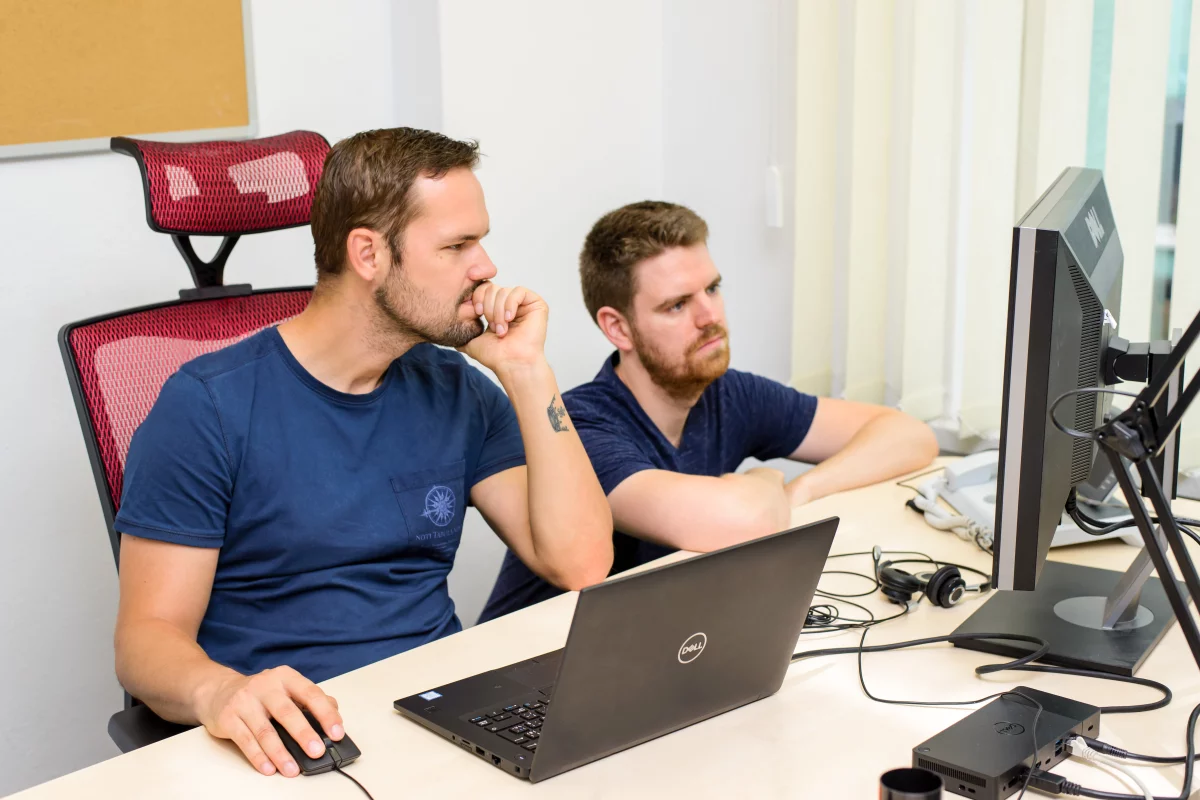
Lukas from msg-life Slovakia sits at the computer and work together with his colleague
As team leader, he is primarily responsible for organizational matters.

Who all are you communicating with to solve any problems?

“Of course, mostly with members of my team. In addition, I am in contact with skillmanagers, other teams and, of course, on a project level with colleagues from development, whether they are Java programmers, integrators or mathematicians.”

What project are you working on right now?

“The two Austrian projects I come into contact with the most are the two already mentioned. As my team provides support and coaching for testers on multiple projects, as a team leader I am in contact with many other projects, so it’s very varied and dynamic.”

What programs do you use at work?

“Apart from classic office stuff like MS Office, I work very often with Eclipse, GIT, Putty, Jenkins, DBVizualiser and various benchmarking programs like BeyondCompare or DiffDog. Of course, we also have several enterprise applications used for test automation. In addition, I also use a number of small applications that can sometimes make life easier, such as FileLocator, Greenshot, and similar little things.”

What skills/knowledge are important for your job?

“It may sound like a cliché, but I consider analytical thinking to be clearly the most important for my work. In addition, it is necessary ability to quickly make connections a not being afraid to take responsibility. As far as knowledge is concerned, in my opinion, it is necessary to have a certain insurance and IT literacy, everything else can be learned very quickly on the fly.”

What do you like most about your job?

“What I love most about my job is definitely the ability to solve problems and optimise processes. And I don’t like monotony without visible results. Fortunately, this happens very rarely in my position.”

Who are your colleagues?

“Of course, we have a mix of personality types and moods. But I have to say that
I get on very well with many of my colleagues. Of course, as in any other workplace, I get on with some colleagues more and others less. But I think that’s perfectly natural and okay.”

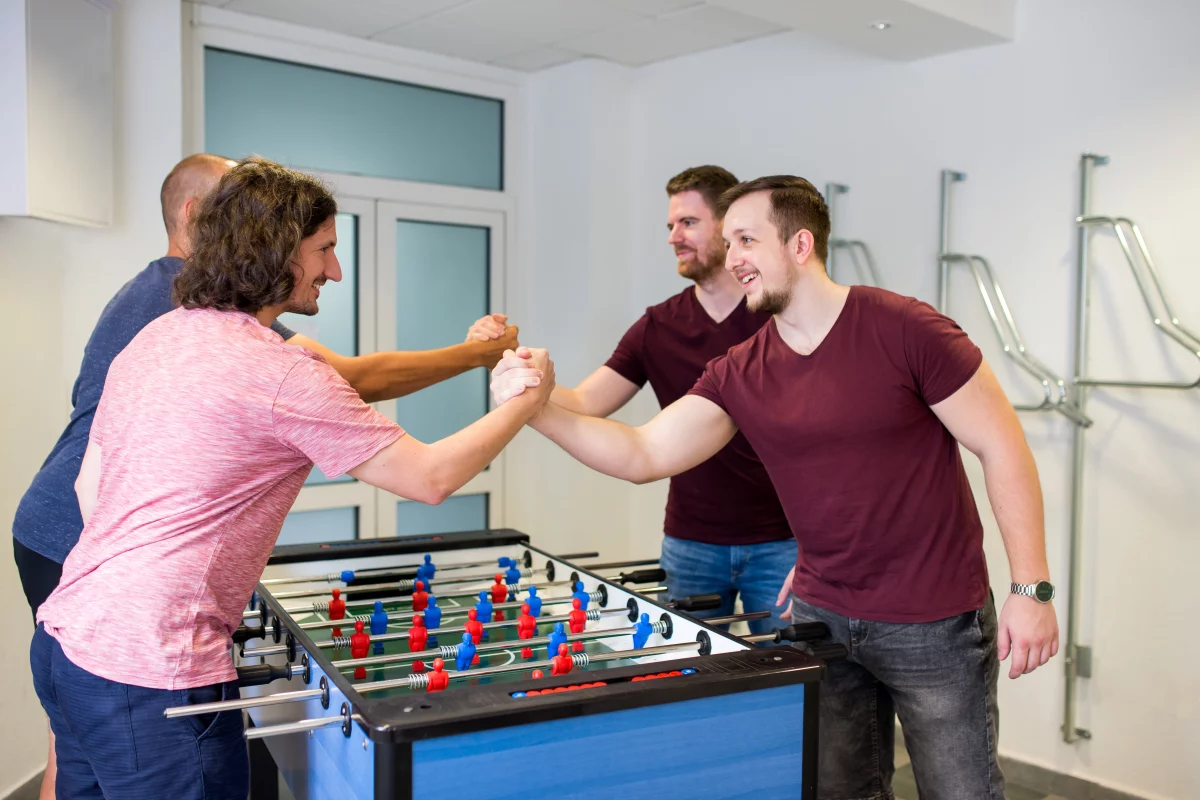
Lukas plays table football with his colleagues
He gets on very well with many colleagues.

What qualities should your new colleague have to fit in?

“In my opinion, anyone who is interested in integrating into the collective will fit in.”

What comes to mind when you hear msg life Slovakia?

“IT, insurance, my employer ?” Are you interested in Luke’s work? Do you have experience in software testing or would you like to try something new? Check out our current vacancies in consulting and testing.

Tips from our colleagues on how to cope with stress at work

We asked our colleagues at msg life Slovakia which situations at work are the most challenging for them, how they cope with stress and what helps them to prevent it. Workload causes stress, which can affect our mood or even our health. There is no doubt that work-life balance is an important basis for a sense of fulfilment and satisfaction. We asked our colleagues at msg life Slovakia which situations at work are the most challenging for them, how they cope with stress and what helps them to prevent it.

How do you perceive the pandemic and home office period? Was it too stressful for you or relatively calm?

Jaro: “I spent the home office period mostly at work, so apart from the loneliness in the workplace and the difficulty in communicating with colleagues, nothing has changed. Of course, the various restrictions (cancelled cultural and sporting events) had a negative impact on me.”

Lucka: “At the beginning, when we didn’t know what exactly was waiting for us, everything was new and unknown. I had both of my kids homeschooled online as well. It took us a while to get into a routine that was both functional and to everyone’s liking. After some time, we all got along and enjoyed the time we spent together at home after our daily chores. And although I consider this period to be quite difficult, in hindsight I also remember it in a good way – we became closer and we were intensely together as a family. But, of course, after all the restrictions were over, I was looking forward to going back to work, to the team of my colleagues. The children also enjoyed seeing their schoolmates.”

Michal: “I did experience a bit of stress during that period, but it had nothing to do with the pandemic. I was just starting in a new position and had my head full of new tasks. Thanks to the home office, I’ve cut out almost 3 hours of travelling a day, which I invested mainly in sleep and time with my family, so I think the pandemic has helped me with my stress management. At the moment I alternate between home office and office work, which is absolutely optimal for me. This way I get both – a good night’s sleep and a chance to spend time with my dear colleagues.”

Veronika: “I perceive the period of the pandemic negatively, I was very limited by the restrictions, but one tries to adapt over time. This was also true with the home office, if you don’t know why you can’t connect or something doesn’t work, stress comes right away. But at this point I’m feeling quite calmer about the whole situation and trying to think positively, which helps a lot. :)”

Dominika: “At the beginning of the pandemic I returned to my hometown – Trencin. Since I have been living in Bratislava for 5 years now, I was very excited about the opportunity to spend more time with my parents and loved ones. This period was very peaceful for me. The only negative was the long hours spent on the computer due to online learning and home office.”

Lukas: “The pandemic period was not very stressful for me. Of course, after some time I felt a lack of social contact and cultural activities. Many of my favourite activities had to be interrupted. I spent my free time reading books, building family relationships and other important things that sometimes don’t get enough time in the ‘normal course’ of life.”

How often do you experience stress during the working day?

Jaro: “I deal with stress (especially at work) almost every day, but of course there are also calmer days.”

Lucka: “It depends – my work is rather spasmodic. Sometimes the days are freer, when I can catch up with my regular duties and old stuff, sometimes it’s just the opposite and I don’t stop from morning until the end of the working hours.”

Michal: “I experience real stress only very rarely.”

Veronika: “There are days when I don’t feel stress, but there are also days when I am stressed all the time. If I plan my tasks wisely, the stress goes away and the day goes better. At the same time, my work requires communication with the outside, so I don’t feel the stress of missing social contacts.”

Dominika: “I try to stress as little as possible. Unnecessary stress will not solve anything faster, quite the opposite. At least that’s been my experience.”

Lukas: “It’s very diverse. Since I work on multiple projects at the same time, I find the most stressful times to be when I accumulate high priority tasks on multiple projects. That’s when I often find myself in a time crunch. These are mostly just a few days, but they are extremely demanding. In general, however, I can say that apart from the aforementioned stress related to the lack of time, I do not feel ‘captive to stress’.”

Colleagues pulling rope

What situations are the most stressful for you?

Jaro: “Switching between the different problems that some German colleagues approach me with. Most of the time it’s about solving urgent production problems and it always takes a while to switch from the current problem to another one. Everyone expects problems to be solved immediately, but that is not always possible!”

Lucka: “Since I’ve been in msg life for a few years, I dare to say that I have already learned and mastered many things. However, when a lot of responsibilities pile up that are demanding on thinking and time, that’s when I find myself going home with a full head of thoughts.”

Michal: “The worst situations for me are when the deadline is approaching and suddenly there is some unforeseen problem that at first glance will not be easy to solve.”

Veronika: “The most stressful situations for me are when I have a scheduled meeting and I’m late or I have a problem with the connection. I’m trying to be conscientious, and that’s very stressful for me.”

Dominika: “I feel less comfortable with more time-consuming tasks. I don’t like to do things rashly and at the last minute.”

Lukas: “The worst thing for me is the lack of time due to the accumulation of several important tasks on different projects.”

How do you cope with stress? Do you use employee benefits (gym, massages, table football, relaxation zone, etc.) to handle stress?

Jaro: “Running helps me to clear my head. However, I really like to go to our company gym to work out.”

Lucka: “About a year ago, I started exercising intensively every morning and I really appreciate it – it helps me clear my head before coming to work.”

Michal: “My experience is that “everything has a solution” – and that helps me a lot. I try to do everything I can to get rid of the stressful situation as soon as possible. Sometimes it is enough to stay a little longer at work, sometimes to ask for help from colleagues, and sometimes nothing helps. If it’s clear that the outcome can’t be salvaged, I’m relieved to talk to someone about it. It’s also nice to be able to see what I can do differently next time so that the same situation doesn’t happen again.”

Veronika: “I try to deal with stressful situations with positive thinking. To combat stress, of course, I use employee benefits, namely massages. They give me incredible energy and especially my back will thank me in the future.”

Dominika: “I try to do sports regularly in our company gym, I also go for massages. It helps me to be in touch with close friends who I can confide in with my problems and worries.”

Lukas: “I cope with stress by trying to redirect my thoughts and put work out of my head for a certain, inevitable period of time. I usually use the relaxation zone or the gym. When I work from home, I usually run out in the front garden or sit at the piano and play something.”

Do you have any proven tips on how to prevent stress?

Jaro: “I don’t have a guaranteed tip, but if anyone has one, please share it. Most often, however, I chase away stress with sport.”

Lucka: “Work-life balance. We go out with our children very often to the countryside, to various huts and trips, and we also meet friends who have children the same age as us – this always gives us positive energy.”

Michal: “It’s probably very individual. I think it’s important to realise that failure is also a part of life. Some people take it as an opportunity to move on and do things better. It is also important to maintain your mental well-being. Personally, the best way to clear my head is to run in the woods.”

Veronika: “Definitely, I find going to the fitness centre, snowboarding and especially swimming very helpful. During these activities, I am able to switch off perfectly and not think about anything. There is an ironic Slovak saying: ‘sport leads to permanent disability’. I cannot agree. Sport is so important to me, that my motto is ‘sport leads to joy’.”

Dominika: “Do not take things too seriously.”

Lukas: “You just have to remember that as long as it’s not about life, you don’t need to overdo it and stress yourself unnecessarily when something doesn’t go 100%. Of course, it’s important to try to do your best, but it’s really not worth spoiling your whole working week or weekend with stress.”

Snowboarder Veronika poses for the camera
Veronika likes to fight stress in the gym or in the snowy mountains.

We hope our colleagues’ tips on how to cope with stress at work will help you too. Want to know more about us and our work? Read about online interviews at msg life Slovakia. We are always looking for new colleagues!

Digital transformation of insurance companies, insurance products and services

Increasing digital transformation can be found in all walks of life and is of great importance to the insurance industry. Customer behaviour, needs and demands have changed fundamentally. The internet generation, who are now in their 30s, have long since stopped thinking about what digitalisation actually is, and are instead using it directly. They are used to communicating and shopping with smartphones. They also prefer to communicate with insurers through them. This effect is also known as digital transformation.

If members of this ‘digital’ generation are interested in insurance products, they search the information on the web via consumer and advice websites, consult relevant blogs and look for the best deals on comparison websites. Finally, they conclude the contract online, for example via an insurance app they have downloaded on their smartphone.

In general, laws regulate insurance products to protect the interests of customers. They ensure that customers are adequately informed about the terms and protection offered by a particular insurance product.

What is digital literacy and digitalisation in insurance

Digital literacy is becoming an essential factor when it comes to insurance companies. These companies have to adapt insurance services to the reality that an increasing number of customers are digitally literate and therefore prefer digital services. The generation that asked questions like what is digitalisation or what is digital technology is being replaced by a new age of customers. And that is what we need to adapt to.

In addition to digitalisation, there is another challenge to be overcome. Small and agile insurance companies are moving into the insurance market with innovative ideas and concepts. They are finding new and exclusive approaches to customers and in the process putting pressure on the huge sales structures of insurers.

Finger pointing in the air
Digital transformation has also affected customer requirements.

The age of the customer has begun

Customers are becoming more and more demanding. They expect insurers to provide the same convenient and easy experience they know from online shopping, as well as the ability to quickly compare prices, services and products of all kinds. Information, advice, contracting, claims reporting or contract management – all contract management should be available 24/7 in digital form. For this reason, the insurance industry’s understanding of changing customer needs and behaviours, as well as how to adapt products and processes accordingly, is crucial. Caution in the online space should not be forgotten either. Companies must do everything they can to ensure digital security.

What is digital transformation in the insurance industry: IT is becoming the core

Digital insurers need to maintain digital ecosystems, build digital insurance products and services. To be successful, they need to automate all processes extensively – the information technology and systems used to develop, distribute and test insurance products need to work as smoothly as in a factory. Every insurance analyst and digital insurer relies on processes built specifically for the internet – 100% seamless, with no wait times, automated and equipped with powerful analytics and artificial intelligence capabilities.

Essentially, this means that the insurer’s business model is primarily an IT issue. This applies to all areas and does not depend on the market in which the insurer operates. The potential and opportunities associated with digital transformation, such as sales, communication channels, customer relations or collaboration platforms, can only be fully exploited with a modern IT infrastructure.

Data – the source of 21st century

The same goes for another important topic that dominates the headlines in relation to digitalisation – big data. Data is often referred to as the new oil. This means that it is one of the most important raw materials and acts as a fuel for entire value chains, industries and economies. It is no coincidence that Google, for example, has surpassed the stock market value of many traditional businesses, demonstrating how desirable data-driven companies are to investors.

In keeping with that metaphor, analytical information systems are often referred to as refineries that refine valuable raw material and generate information and insights from data. The insurance market has a vast amount of data on customers, products, claims trends and so on. Using intelligent analytical processes and proven algorithms specific to the digital insurance industry, these huge data sets can be structured and evaluated in a meaningful way.

The information gathered provides valuable insights for the company. This means more than just predicting general trends and developments. It also means having a 360-degree view of the customer. This knowledge is invaluable to all areas of the insurance industry – from product development, marketing and sales activities, pricing to value-driven corporate governance. Overall, data analytics can be used to minimise business risks and improve products and services.

Be successful with an experienced partner by your side

Digital transformation in the insurance industry is transforming IT into the cornerstone of a successful insurance company. With msg life , insurers have a partner with global experience by their side. We understand that IT and data are the keys to success and that customers today have different expectations of their insurers than they had before. Digitalisation, as we understand it, means streamlining and automating processes, taking into account trends and the desire for greater flexibility in product development and, not least, to stay close to the customer. This means that insurance data must be mobile and constantly accessible.

With our comprehensive solution msg.Insurance Suite, digital transformation works immediately after deployment. Our innovative, comprehensive, component-based system offers continuous digital processing of core business processes in all segments: from life and health insurance to property and casualty insurance – for the entire insurance sales process. For example, the contract management system for life insurance msg.Life Factory enables fast product implementation and efficient processing of all business processes.

The solution supports not only traditional business models, but also new digital forms of insurance through B2C sales on the portal. With our portal solution msg.Online Insure, insurance company customers can manage almost all relevant aspects of their insurance policies themselves. Easy-to-understand technologies actively engage customers in business processes – correspondence between the insurer and the end customer is conducted exclusively digitally. In addition, dealers and other partners can also be involved in the communication with the customer.

Standard software msg.Ilis which is also integrated into the complete msg.Insurance Suite solution, offers an ideal starting point for analysing large amounts of data. The integrated solution also includes insurance migration, which is a comprehensive expertise in insurance contract migration (including all data between systems). Software msg.Ilis provides a framework for a central analytics solution that makes projections, analyses and other available. The solution also includes a cluster-based portfolio compression method.