
Deepfake – what it is and how to tell it from the original

We are entering a new digital age where we can no longer trust everything we see and hear. What was once considered irrefutable proof that something really happened, captured as a photograph, video or sound recording, is increasingly becoming a potential tool for manipulation. With the advent of deepfake technology, the line between reality and illusion is blurring, as in the film The Matrix.

With the computer equipment and software tools available, anyone can alter any image, sound or even video to make it look completely realistic, even if it is a fake. Fake news, manipulated political speeches or defamatory videos that damage the reputation of others make it difficult to distinguish truth from deception.

Once used to create stunning film effects, these technologies are becoming a dangerous tool in the hands of fraudsters. The creators of fake videos can easily create realistic situations that influence public opinion, spread misinformation online and disrupt fair political competition. Conversely, consumers of this fake media make themselves vulnerable to deception, manipulation and lies that can have serious consequences for their lives.

Trust in digital media is increasingly fragile. We are witnessing a plethora of new false information spreading through virtual space with astonishing speed. They look all too real. Can these digital scams be detected and can we protect ourselves from deepfake threats? Read on to find out.

Deepfake technology – example 1

Definition of deepfake

Deepfake is an advanced form of digital manipulation that uses artificial intelligence (AI) and machine learning (ML) to create or edit audiovisual content. The quality of fake content is determined by how faithful and realistic it is to us, and how difficult it is to distinguish from real content. Data scientists ( AWS Data Scientist) play an important role in this process, analyzing vast amounts of visual and audio data, training AI models, and optimizing algorithms to make deepfakes outputs look as convincing as possible.

The term deepfake itself is a combination of the words deep a fake.. Deep comes from deep learning AI technology (which is a subset of machine learningand uses neural networks to process information in layers), and fake. refers to fake content.

The beginning of deepfakes

Synthetic media technology has its roots in the field of computer imaging and artificial intelligence, which began to develop in the 1990s. During this period, technologies such as Computer Generated Imagery ( CGI) were developed to enable realistic animations and simulations of human faces. Although these technologies were primarily intended for the film industry, they represented a future form for more advanced image and video manipulation systems.

Once used for stunning film effects, they are now becoming a dangerous tool in the hands of fraudsters. The creators of fake videos can easily create realistic situations that can influence public opinion, spread misinformation on social networks or even disrupt fair political competition. Conversely, consumers of these fake media make themselves vulnerable to deception, manipulation and lies that can have serious consequences for their lives.

The foundations of deepfake technology were laid with the development of neural networks. In 2014, machine learning scientist Ian Goodfellow introduced the concept of generative adversarial networks ( GANs). These networks work on the principle of two algorithms that compete.

Generator algorithm

The primary role of the generator is to create initial fake digital content such as audio, photo or video. The goal of the generator is to mimic the target’s appearance, voice or behaviour as closely as possible.

Discriminator algorithm

The discriminator then analyzes the content produced by the generator to determine the extent to which it appears authentic or fake.

Repetitive feedback between the generator and discriminator creates a continuous process of incremental improvement. This technology has become the basis for creating realistic deepfake videos and images.

Deepfake technology – example 2

Origin of the term deepfake

The name itself first appeared on the Reddit platform in late 2017. A user who chose the nickname ‘Deepfake’ began sharing edited videos of celebrities with pornographic content, using machine learning algorithms to swap the faces of celebrities and porn actresses. Although these were amateur experiments, the fake videos immediately sparked widespread public interest, but also concerns about how the technology could be used to turn innocent entertainment into unethical or illegal activity.

Did you know that…

deepfake videos were used to “bring back” Michael Jackson? Using deepfake technology, videos have been created of Michael Jackson “singing” or speaking again, even though it is a digital simulation. These technologies can mimic his voice and facial expressions so accurately that it is difficult to tell the difference.

Rapid development of deepfake technology

As of 2018, deepfake technology has started to improve dramatically, mainly due to the availability of powerful computing devices such as GPUs and Ryzen Threadripper, and the development of the cloud. Cases of deepfake videos being used to spread misinformation, influence public opinion, or create erotic content without the consent of those involved have become more common.

Deepfake – exponential growth of fake content

However, in recent years we have seen an exponential increase in the quality and availability of deepfake technology. Last year alone, deepfake content increased by 1,700% compared to the previous year. The quality of fake material has improved to the point where over 75% of people now have difficulty distinguishing between real and fake content. While initially over 95% of deepfake material was adult content, today up to 80% of all deepfakes are related to cryptocurrencies.

Elon Musk is the most common choice of scammers to promote various dubious investments. People have lost billions of dollars in this way. The largest number of fake ads encouraging people to invest in fictitious assets can be found on Facebook, but the X network (formerly Twitter), YouTube or Instagram are also used for this purpose.

Deepfake technology – example 3

The deepfake creation process

The process starts with collecting a large amount of data, mainly photos and videos of the person we are trying to recreate. The more material we collect, the more realistic and convincing the end result will be. We feed the data into an AI system that uses deep machine learning techniques to analyse and determine the characteristic features of facial expressions and movements of facial parts such as eyes, ears, mouth, eyebrows, etc.

Then another set of data is used. This consists of material such as the image and sound of the person we want to imitate. Most often it is our own image and sound that we want to transfer to the person we want to imitate. Artificial intelligence uses complex algorithms to merge the two sets of data and create a realistic-looking representation.

Of course, this process is not straightforward, but rather iterative and requires constant adjustments. To create a convincing deepfake, we need to work on the synchronization of lips, facial expressions and overall lighting. We also need to play around with the audio, especially if we are creating a video where the person is supposed to be speaking.

Deepfake tools are now available that can create a fairly convincing digital impersonation from a single photo, or imitate a voice from a few minutes of audio recording. Deloitte reports that deepfake software can be purchased on the dark web for as little as $20. On the other hand, better, more professional solutions cost several thousand dollars. Of course, the result is directly proportional to the amount of work and time involved.

Did you know that…

… voice cloning can accurately mimic the speech of a particular person? Using artificial intelligence and deep learning, it is possible to create a digital voice clone that can speak new sentences even if the person has never said them. This technology is used in dubbing, assistive technology, and even fraudulent phone calls.

Deepfake vs. original – AI-generated faces

With advances in artificial intelligence, we are seeing the emergence of technologies capable of creating synthetic faces so realistic that it is almost impossible for humans to distinguish them from real ones. A study by Sophia J. Nightingale and Hany Farid, published in 2022 in the Proceedings of the National Academy of Sciences (PNAS), looked at this very question.

In the study, the authors found that faces generated using advanced algorithms, specifically StyleGAN2,, are almost indistinguishable from real faces to ordinary observers. In experiments where participants judged whether a face was real or synthetic, they achieved accuracy of only about 48.2% to 59%, which is at the level of chance estimation. Even providing training and specific instructions for identifying synthetic faces did not lead to a substantial improvement in accuracy. Synthetic faces are now so accurate that one has no way to detect them effectively with the naked eye. Click on the picture with the faces.

Credibility of synthetic faces

As well as being indistinguishable from real faces, the study found that synthetic faces were, on average, rated as more trustworthy. Participants in the experiment were asked to rate the trustworthiness of the faces on a scale of 1 to 7 (with 1 being the least trustworthy face and 7 being the most trustworthy face), with the synthetic faces scoring an average of 4.82, compared to 4.48 for the real faces. This difference, although small, was statistically significant. The reason for this phenomenon may be that the synthetic faces often show a subtle smile, which also has a positive effect on their ratings. Click on the picture with the faces.

These findings have serious implications for the digital world. The availability of this technology opens up opportunities for abuse – from the creation of false identities and fraud to the anonymous dissemination of misinformation. In a situation where any photo or video can be faked, the authenticity of digital content can be questioned from the outset.

Although the authors of the study suggest, for example, implementing watermarks in the generated images, this does not solve the problem, as AI algorithms can easily remove them. A better solution would be to use cryptographic verification, where a private encryption key or digital signature is attached to the content and the corresponding public key is made available to decrypt the signature.

Deepfake trends 2024

Let’s take a look at the year 2024. The Deepfake Trends 2024 study reveals that deepfake messages have thrived this year, thanks largely to freely available generative AI tools. Deepfake lies have spread across a wide range of sectors, impacting businesses of all sizes and raising the issue of effective identity verification.

Important findings

  • Deepfake scams are on the rise. Up to half of businesses worldwide have experienced a fraud attempt using audio or video deepfakes.
  • Average financial losses are as high as $450,000, with large companies often reporting losses in excess of $1 million.
  • In terms of risk perception, up to 66% of executives consider deepfake a serious threat, with identity theft (42%) and phishing attacks being the most common concerns.

Global overview and trends by sector

Deepfakes are having the greatest impact in countries such as the United Arab Emirates and Singapore, where more than 50% of organizations have experienced one in the last year. The sectors most affected include IT, crypto firms and financial services, but healthcare and aviation companies also report significant risks.

Business safeguards

Biometric verification and multi-factor authentication (MFA): More than 84% of organizations have deployed advanced deepfake detection technologies, with biometrics such as fingerprints and liveness detection playing the most prominent role.
Advanced AI algorithms: Nearly half of companies are using machine learning to improve the accuracy of deepfake detection.

People already lose billions of dollars a year by handing over their money to fraudsters. The Centre for Financial Services at consulting firm Deloitte predicts that generative artificial intelligence could cause $40 billion in fraud losses in the US by 2027, up from $12.3 billion in 2023, an increase of 32% per year.

In the future, it will be interesting to see how companies manage to adapt to increasingly sophisticated fraud.

Deepfake technology – demonstration 4

The positive side of deepfake technology

Although deepfake technologies are often associated with fraud and threats, their potential goes far beyond crime. Let’s take a look at how the application of deepfake can greatly enrich various industries and improve the quality of our daily lives.

Innovative entertainment and arts

Deepfakes are transforming the film and television industry. They make it possible to create realistic special effects, bring historical characters to life or even replicate actors for scenes that would otherwise be impossible to film. They also offer artists new ways to express their own creativity, for example by transforming still images into vivid portraits.

Personalisation and communication

Personalisation and communication In marketing and advertising, deepfake technology can be used to create personalised campaigns that better reach target audiences. For example, creating videos in which familiar faces address individual customers by name can increase engagement and build stronger brand relationships.

Educational tools

Deepfake technologies also have applications in education. Schools and universities can use realistic simulations to teach history, where historical figures “come to life” and tell their stories, or to train professionals such as doctors or pilots by simulating real-life situations.

Protection of cultural heritage

Deepfakes can be used to reconstruct damaged or lost cultural artefacts. They can help to digitally restore sculptures, paintings or other historical monuments and make them accessible to a wider audience. They can also serve as a tool for preserving memories, for example by creating realistic models of people for family archives.

AI research and development

Deepfake technologies are also helping to improve artificial intelligence in the areas of fraud detection and privacy. Research into deepfake fraud detection is providing new ways to improve security in the digital world.

How to spot a deepfake

How to spot a deepfake A few years ago, I could have told you how to spot a deepfake. Nowadays, it’s almost impossible for anyone to take the trouble to find all the possible details. Even AI systems designed to find deepfake patterns in content have a problem with this. This applies to deepfake material where the person isn’t making fast movements. For example, it is still a problem for deepfake technology to generate a realistic gymnast in an exercise – gymnastics has been called the modern Turing test for deepfakes.

Deepfake technology – demonstration 5

How can you protect yourself from misinformation?

Cybercriminals and scammers know that many people, especially the older ones among us, can’t tell the difference between a deepfake and a real thing. They don’t check whether the content they are presented with is authentic. The only protection that nature has given us is critical thinking. Before we believe anything we see, hear or read, we need to stop and ask ourselves a few questions. You’ve probably heard them before.

Who? Who is presenting this information and what is the source?
What? What is said or shown? Is the information shocking? Does it sound too good to be true?
Where? Where does the information come from? Is it possible to find out where it was first published?
When? When was this information recorded? Can it be verified?
Why? Why is this information being presented? Could there be an ulterior motive?
How? How do I know it’s real?

Quiz

As you can see from this quiz, it’s getting harder and harder to tell the difference between deepfakes and real content.

Deepfake – risk or opportunity?

Deepfake technology is a fascinating demonstration of how far human creativity and technology can go hand in hand. It allows us not only to create realistic images and stories, but also to confront the very nature of what we take to be reality. It forces us to re-evaluate our trust – in what we see, hear and read.

But there is an opportunity in this illusion. It teaches us to look deeper, to ask critical questions and not to give in to first impressions. With critical thinking, fact-checking and a cautious approach, we can not only master this technology, but also use it for the benefit of society.

Deepfake is an extraordinary phenomenon, like fire, which can be dangerous but also extremely useful if we know how to control it. It opens the door to new forms of creativity, learning and innovation. The challenge is not only to protect ourselves from its risks, but also to find ways to integrate it into our lives so that it serves us, not harms us.

The future belongs to those who can tame technology and turn it into a tool for good. Critical thinking is our greatest weapon. With it, we can overcome illusion and create a digital world where truth is stronger than lies. Deepfake is both a challenge and an opportunity – it is up to us to deal with the illusion.

FAQ

What is deepfake?

Deepfake is a technology that uses artificial intelligence to create realistic fake video or audio recordings. These recordings can show people saying or doing things they never actually did.

How does deepfake work?

Deepfake uses machine learning algorithms, in particular techniques such as generative adversarial networks (GANs). These networks learn from large amounts of data to reproduce faces and voices with high accuracy.

What are the potential uses of deepfake technology?

Deepfakes can be used for a variety of purposes, from entertainment (e.g. in films and video games) to education and advertising. But it can also be misused to spread misinformation or create fake news.

Is it possible to spot a deepfake?

Detecting deepfake technology is a challenge, but tools and techniques are being developed to identify fake videos. These tools look for irregularities in motion, lighting and sound.

What are the legal and ethical issues associated with deepfakes?

Deepfakes raise many ethical and legal issues, including privacy, copyright and the potential for misuse to spread false information. Many countries have already begun to pass legislation to regulate this technology.

Can deepfakes compromise security?

Yes, deepfakes can be used for fraud, blackmail or political manipulation. There have been cases where deepfake videos have been used to discredit public figures or spread fake news.

How can I protect myself from a deepfake?

It is important to be vigilant when consuming online content. Check sources of information, follow official channels and be sceptical of videos that look suspicious or are circulated without context.


How to write a developer CV + IT CV templates

A developer CV should be clear and concise. It gives a potential employer an overview of your work experience and the skills you can use in the IT field. But how do you write it in a way that will help you land your dream job? We’ve put together all the key information and a clear guide to help you do just that.

How to write a programmer CV?

A Curriculum Vitae (CV) is a document that introduces you to a potential employer and makes a first impression. You should therefore take the time to prepare it and include all relevant information about yourself.

The CV should be polished but concise. Provide recruiters with basic information about yourself, your education, work experience and skills. You can also briefly describe your interests or hobbies, but don’t go into too much detail.

Less is more. Write only what is really relevant. Avoid ‘waffle’ and unnecessary information that could spoil the first impression. If you want to elaborate, include a covering letter with your CV.

A developer CV shouldn't be long
An IT CV should contain only relevant information

What format should I choose for my CV as a developer?

Before you start writing, find out what an IT CV should look like. The design should be simple, with a white background and black font. The most suitable fonts are Times New Roman, Arial, Calibri or Cambria in size 12. Section headings can be slightly larger.

If you write your CV in Word, set your margins to 1 to 1.5 cm and your line spacing to 1.15 to 1.5 cm. You can leave larger spaces between paragraphs so that the document doesn’t look cluttered and is easy to read. You can also create your CV in a graphic editor such as Canva. Just choose a template and overwrite the details. Alternatively, you can start with a blank canvas and create your programming CV yourself.

When you have completed your CV, save it as a PDF. This format ensures that sentences, paragraphs and headings stay in place regardless of the device on which the document is opened.

Did you know that…

For better clarity, you can separate the different sections of your CV with a horizontal line.

What structure should I choose when writing an IT CV?

To keep your IT CV clear, follow one of three basic structures:

1. Chronological structure

This is the most common structure and is suitable not only for IT but also for many other fields. It is based on your work experience, which is given the most space. Other sections, such as education or skills, are more concise.

The chronological structure is the best choice for a developer or IT specialist. When creating it, stick to the following division:

  • bio (optional),
  • personal and contact details,
  • work experience (describe it in no more than two or three sentences),
  • education (indicate school, course and period of study)
  • skills (list only),
  • optional sections such as interests, hobbies, etc.
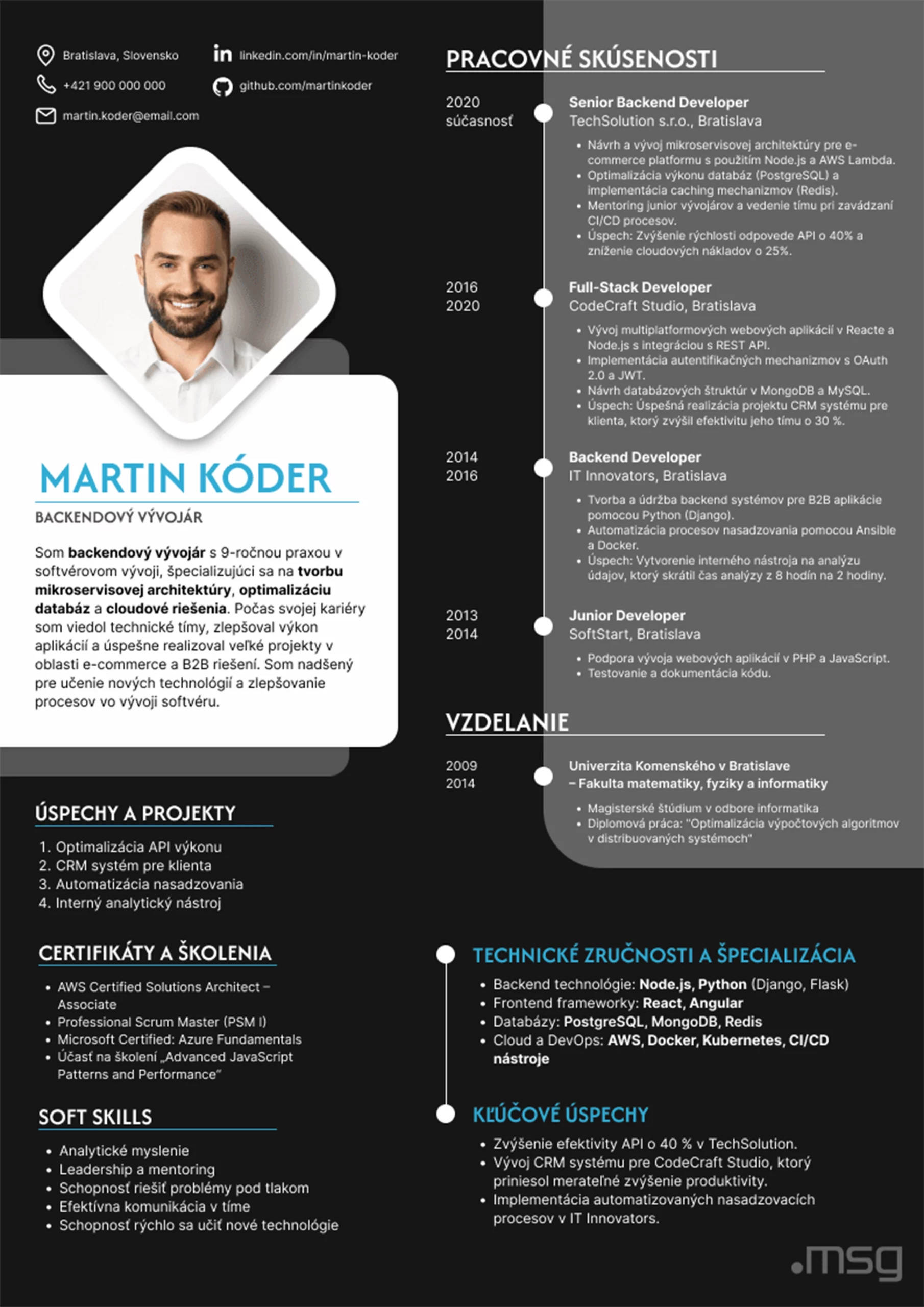
Example of a developer CV
A professional CV is also known as a functional or skills-based CV.

2. Professional structure

In English, this type of CV is also called a skills-based CV. It aims to highlight your skills and strengths, leaving your work experience in the background. It is ideal for recent graduates or those with large gaps in their work history.

The professional structure consists of the following parts:

  • bio (optional),
  • personal and contact details,
  • skills (choose a few main ones and describe them in detail),
  • education (state briefly),
  • work experience (describe briefly and concisely),
  • optional sections.

Did you know that…

You can learn more about the appropriate structure of a CV in the article: Structured CV: What are its characteristics and what does it look like?

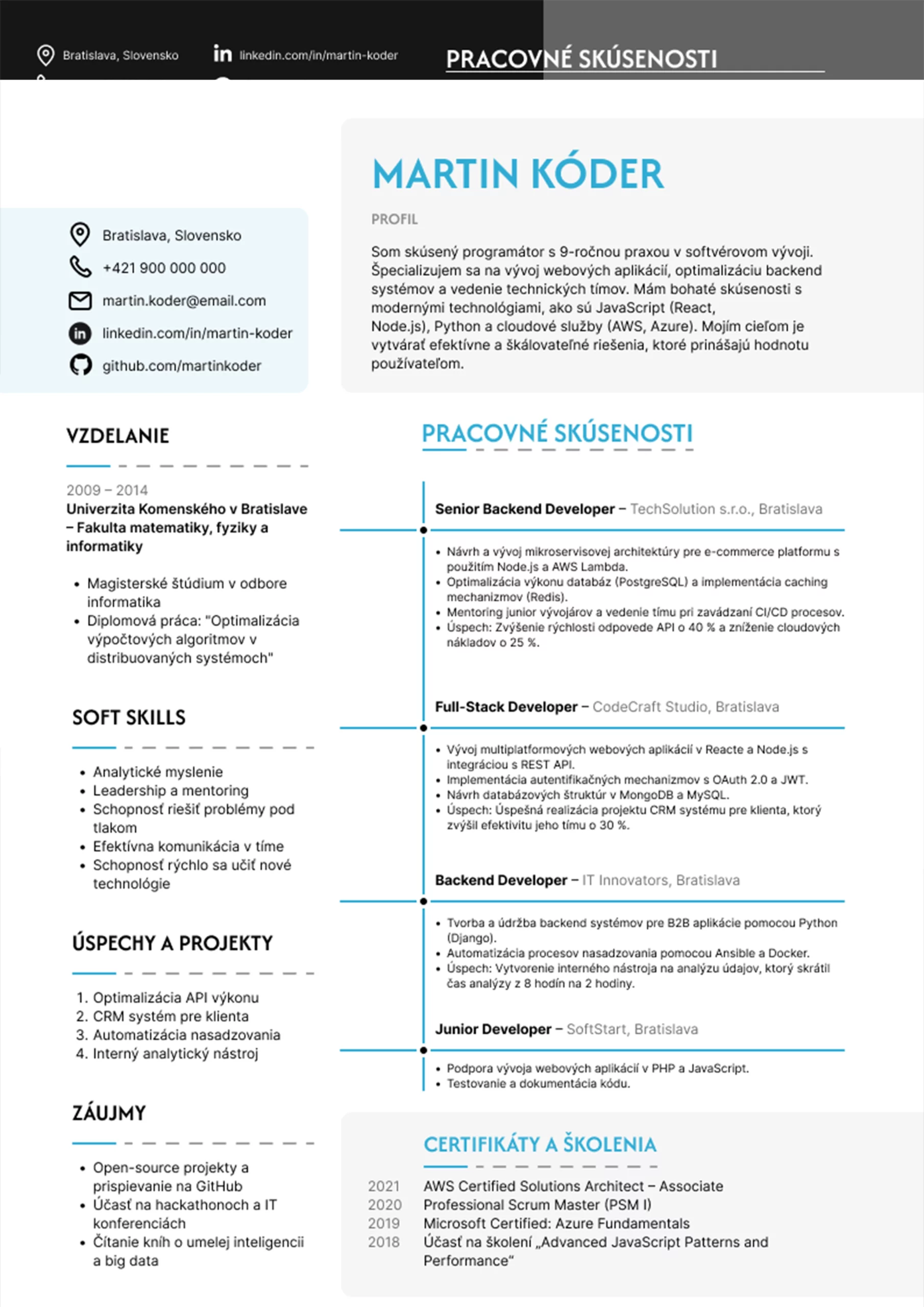
Structured IT CV is the most popular
An IT CV can have different structures

3. Combined structure

The combined structure combines a chronological and a professional structure. This means that skills and work experience are given equal weight.

The combined structure includes:

  • bio (optional)
  • personal and contact details,
  • relevant skills,
  • work experience,
  • education,
  • optional sections.

What to include in an IT developer CV?

An IT CV should contain a few basic sections, which can be supplemented with additional optional sections. These include:

Short bio

A short bio is not a required part of a developer’s CV, but it is a handy introduction that quickly gives recruiters important information about you. Since not everyone writes one, it can make you stand out.

The bio should be short, to the point and clear. It is usually 3 to 6 sentences long, and can look like this:

“I am an experienced developer who loves new technologies and is interested in software development. I specialize in website and mobile app development, with expert-level Python and JavaScript skills. I have more than 10 years of experience as a Java developer, I take pride in details, I am reliable and I like to work in a team.”

The bio should match the requirements of the advert. Emphasize the strengths that potential employers are looking for so that you stand out at first glance.

Did you know that…

You can add a photo to the top of your CV (usually next to your BIO). This will give the document a more personal and friendly look. However, be careful when choosing a photo – avoid blurry shots or selfies. If you don’t have a professional photo, dress formally, stand in front of a white wall, and ask someone to take your picture.

Personal and contact details

This section is an essential part of any programmer’s CV. This is where you list your:

  • first and last name,
  • date of birth,
  • address,
  • phone number,
  • e-mail,
  • social media/web link.

Social networking sites are optional. However, if you are active on LinkedIn, be sure to include it – recruiters can learn more about you from it.

Did you know that…

Read more about how to fill out your Linkedin profile: How to find a job on LinkedIn? Fill out your profile to the max

Work experience

In this section you can show a potential employer that you have enough experience to get the job.

In your CV, start with your job title, followed by the company you worked for, your dates of employment and a brief description of what you were responsible for. Keep the job description brief and clear.

Example:

Java Developer
msg life Slovakia
2020 – 2024

– development and programming of computer and mobile applications,
– website development,
– design and implementation of software components,
– cooperation with software testers and project architects,
– application of agile software management methods.

Provide only relevant information that recruiters are likely to be interested in and that confirms that you are the ideal candidate. For example, if you have more personal projects in your portfolio, you can list your website or project URL on GitHub.

Education and certificates

You don’t need to write too much about your education. Just mention the school, the subject or course you studied and the time you studied it. If you have space, describe what you studied in one or two sentences.

You can also include courses, certificates or awards in this section.

Skills

Education is followed by soft skills and hard skills, which are key skills for employers. They are often more important than education itself.

Soft skills that you can list as a developer and are in demand on the job market can be:

  • teamwork,
  • communication skills,
  • creativity,
  • patience,
  • detail orientation,
  • the ability to solve complicated problems,
  • responsibility,
  • openness to learn new things.

Hard skills:

  • proficiency in programming languages (Python, Java, C#, PHP, Ruby, Node.js, HTML, CSS, JavaScript),
  • OS management (Windows XP, MacOS, iOS),
  • software development,
  • knowledge of algorithms and data structures,
  • mathematical and computational skills,
  • machine learning and the use of AI,
  • cloud computing.
Did you know that…

Read more about the hard skills developers should have in the article: 6 most important software developer hard skills.

You can list a variety of skills on your IT CV
Show a potential employer what skills you have

Optional sections – interests and other information

If your IT CV isn’t too long, you can also add optional sections such as leisure activities you enjoy. You can link these activities directly to the job posting.

For example, if a company is looking for someone who can think outside the box, mention the creative activities you do. This will show that you can look at things from a different perspective and come up with unconventional solutions.

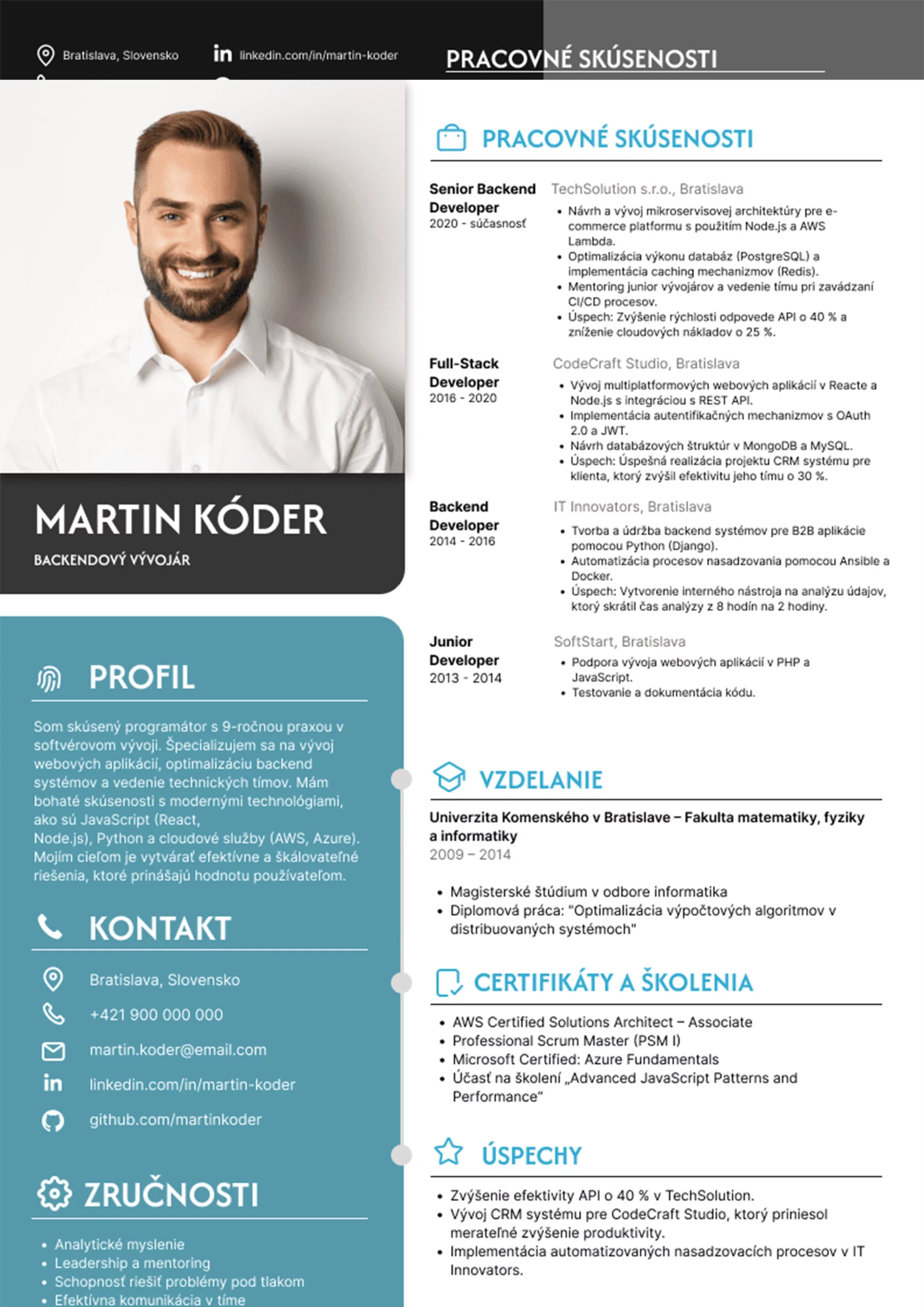
Sample developer CV
Sample developer CV

IT developer CV template

A template can help you write an IT CV where you simply fill in your details, save it and send it to the potential employer. There are many templates available today.

You can create a universal CV on Profesia.sk. If you’re looking for something different, try Canva, which offers both basic and advanced templates. You can also find inspiration in our article.

Attachments to IT developer CV

You can attach three basic types of attachments to your IT CV:

  • Motivation letter – allows you to describe some of your work experience and skills. It also shows why you are interested in the job and why you are the best candidate.
  • Cover letter – serves as an introduction to the CV. You can use it to give recruiters a brief introduction to who you are and what your strengths are. It is sent either as a separate document or directly in the body of the email.
  • References – provide evidence of your qualities and skills through testimonials from previous bosses, managers or others in a position of responsibility.
Did you know that…

You can create a universal CV on Profesia.sk. If you are looking for something different, try the tool Canva which offers both simple and advanced templates. You can also find inspiration in our article.

Attachments to IT developer CV

You can attach three basic types of attachments to your IT CV:

  • Motivation letter – allows you to describe some of your work experience and skills. It also shows why you are interested in the job and why you are the best candidate.
  • Cover letter – serves as an introduction to the CV. You can use it to give recruiters a brief introduction to who you are and what your strengths are. It is sent either as a separate document or directly in the body of the email.
  • References – provide evidence of your qualities and skills through testimonials from previous bosses, managers or others in a position of responsibility.

What to avoid when writing a developer CV?

Avoid these unnecessary mistakes when writing a developer CV:

  • Changing fonts – once you’ve chosen a font, use it consistently throughout your document. If you want to set off certain sections, increase the size of the text or use a bold font.
  • Too much colour – IT recruiters expect a simple and clear CV, not a document full of colour that can look chaotic. So don’t go overboard with colours. It’s best to use a white background and black font.
  • Irrelevant information – read carefully what the employer is looking for in a candidate and tailor your CV accordingly. For IT roles, emphasize your technical skills and relevant education.
  • Typos and mistakes – grammar errors or missing letters look unprofessional and indicate that you haven’t taken enough time to prepare your CV. Employers may get the impression that you are similarly sloppy with the code text. Always have someone else proofread the finished document.
  • Versatility – Every job is unique and requires different skills or knowledge. It is therefore important to read the advert carefully and tailor your CV to the employer’s requirements. For example, highlight the skills the company is looking for in candidates.

Get your dream job with an IT CV

Writing an IT CV follows a few basic rules. If you follow them, you can be sure to produce a quality document that will help you get an interview and land your dream job. Get inspired by our tips and start working on a clear, concise and easy-to-read CV today!

How to write a good CV and what mistakes to avoid?

How to write a CV? A question asked by many people looking for a new job. The CV is a key document that can make or break your chances of getting a job. It gives potential employers a better insight into you and your work experience. So don’t underestimate its importance and invest enough time and energy in it.

What is a CV?

A resume, often referred to as a curriculum vitae (CV), is a document that contains your personal and professional information. It usually includes :

  • first and last name,
  • address,
  • contact details (phone, e-mail),
  • Information about your education (school and university, courses, certificates),
  • professional experience (previous positions held and dates),
  • skills and competences (language, technical and other skills relevant to the job)
  • other information (volunteer activities, awards, interests and other details that might interest a potential employer).

A well-written CV is your calling card, so make sure it is clear, concise and free of grammar errors.

CV is a key document in the job search
A resume is often referred to as a curriculum vitae

The main purpose of a CV is to introduce you to a potential employer and show them your experience in the field. It is usually short and contains only the most important milestones in your life. This is why it is often accompanied by a motivation or cover letter.

Nowadays, CVs are mostly in electronic form, and there are many templates and ready-made forms that make them much easier to prepare.

Recommend
We recommend:

There are several tools that can make the process of creating a CV easier. For example, if you don’t want to start from scratch in a text editor like Word and want to create an attractive document, try Canva. It has a number of interesting templates to choose from. However, if you are looking for something simple and minimalist, a template from Profesia.sk will suffice.

How to write a good CV for a job?

Want to know how to write a CV that will impress employers and increase your chances of landing your dream job? Many people make the mistake of creating cluttered documents with lots of graphic elements, unconventional fonts, and multiple colour combinations. However, this is often not the best solution.

A quality CV should be:

  • simple,
  • short,
  • concise,
  • transparent.

Give information about yourself in bullet points, using just a few words or short sentences. Avoid long sentences or paragraphs. Recruiters usually scan them and don’t have time to read them in detail.

What about the design? The best solution is a white background with black text, ideally in Times New Roman size 12. The exception is in creative fields where original design is expected. Again, keep it simple and avoid overly graphic elements.

A CV for a job should be simple and concise
Recruiters only scan CVs, so write them in a structured way

What to include in your CV?

A CV is made up of several parts, each containing different types of information. To make sure you don’t miss anything, follow the structure below.

1. Personal data

A CV starts with your personal details, which should include:

  • first and last name,
  • address,
  • phone number,
  • email address,
  • date of birth (if you want to include it)

You can also add a photo to your CV to make it more personal. However, avoid selfies or other unprofessional photos. Portraits against a monochrome background are ideal.

Recommend
We recommend:

You can also add your LinkedIn profile to these details. There, the recruiter will also find additional information that didn’t fit on your CV, your activity, case studies, portfolio or other content you create or share on this professional social network. At the same time, you can network and look for jobs on LinkedIn. For more info on why be on LinkedIn, read our article, What is the LinkedIn platform and why have a LinkedIn profile?

2. Work experience

This is one of the most important sections, so pay close attention to it. List your experience in reverse chronological order, i.e. the most recent job should be listed first.

Indicate in this section:

  • the title of the position,
  • the period from when you started to when you left (only the month in which you started and ended your employment),
  • the full name of the company,
  • a brief description of the job (please give only the main duties).
Recommend
We recommend:

If you have had many jobs during your career, detail the last three or four positions. Mention the others only briefly so that the CV is not too long. You can provide more detailed information during the interview.

3. Education

As with work experience, this section should be written in reverse chronological order. List your highest level of education first (e.g. university), followed by lower levels (e.g. high school).

State:

  • the name of the school,
  • period of study,
  • the field or programme of study (if relevant).

You can also use this section to list courses, training and certificates you have completed. This will show your employer that you are active and learning beyond your formal education. Be concise and include information that is relevant to the position you are applying for.

5. Knowledge

This part of your CV is designed to show recruiters that, in addition to the theoretical knowledge you have acquired at school, you also have practical skills that can be used in the job. For example, you could include knowledge of:

  • operating systems,
  • various programs (e.g. Word, Excel, Photoshop, Canva),
  • typing,
  • programming languages.

For each skill, indicate the level, e.g. expert, advanced or beginner.

Language skills form a separate category, often separated by a subheading or a horizontal line. For each language, be sure to indicate the standardized level of proficiency – from A1 (beginner) to C2 (expert). As with all sections, it’s definitely not worth getting confused! At the interview, employers will usually switch to English and check your language skills in person.

6. Interests

This section is optional, but it can spice up your CV and add a personal touch. It makes the document seem more human. However, only list hobbies that are relevant, appropriate or otherwise related to the job.

In this section you can include:

  • the sports you play,
  • creative activities such as drawing or taking photos,
  • interest in culture,
  • travelling and discovering new places.

Be careful not to give overly personal or inappropriate information.

7. Driving licence

Important information, especially for jobs that involve regular travel. You only need to indicate your licence group (e.g. B). No other details are usually required.

8. Additional information

At the end of your CV, you can briefly mention the qualities and skills that distinguish you. For example, focus on qualities that might be important to an employer:

  • ability to work under stress,
  • flexibility and adaptability,
  • a love of challenges,
  • meeting deadlines.

This information should complete the picture of you as a reliable and capable candidate.

CV mistakes – avoid these faux pas

If you want to know how to write a CV that will impress, you need to be aware of the most common mistakes people make when writing a CV. These include:

  • Giving irrelevant information – this unnecessarily lengthens the CV and often looks unprofessional. If there are skills or qualities you will not be using in the role, do not include them in the document. Also avoid overly personal details such as marital status or political affiliations.
  • Messy design – a CV should look professional. Be minimalist and uncluttered. Avoid cluttered templates, different fonts, multiple colours, etc.
  • Typos – always proofread your text to remove grammatical errors and typos. Ideally, have someone else read it too.
  • False information – only give true information that you can back up with a diploma, certificate or references from previous jobs.
  • Universal CV – each CV is tailored to the specific company and job you are applying for. Don’t send the same document everywhere – it won’t impress the recruiter.
  • Too many pages – the ideal length for a CV is between 1 and 3 pages. Don’t stretch the text and focus on the essential information.
  • Unprofessional email – An email address is important contact information. If you have an email with a nickname or funny name, create a new one. The best choice is an email in the form of your first and last name.

How to write a university CV?

When applying to university, you often need to include a CV that is different from a normal job CV. Instead of work experience, focus on:

  • learning achievements,
  • sporting achievements,
  • projects,
  • extracurricular activities.

List these data in reverse chronological order.

If you have worked somewhere during your studies, you can also mention this work experience, especially if it is related to the field you want to study. If you are applying for a postgraduate degree or other higher ‘scientific’ qualification, you can also include the title of your dissertation.

Recommend
We recommend:

References for your university CV can be provided by a teacher, professor, or coach who knows you well. They can mention qualities such as discipline, conscientiousness, activity, skills, e.g., that you are a good presenter or a team player. This can significantly strengthen your application. You can find out how to write references in our article: A sample reference letter from employer: how and when to include a job reference on a resume?

CV attachments

Some information should not be included in the CV as it may increase the length of the document. When CVs are first screened, recruiters can evaluate them very quickly and read the additional information later. For this reason, we only include the basic and most important information in the CV and include additional information such as a covering letter or references separately in appendices. The following attachments are often included with the CV:

Cover letter

The cover letter can be a separate document or part of an email. It serves as an introduction to your CV and any other attachments you are sending. It should be brief and to the point.

You can attach several attachments to your CV
The motivation letter provides more detailed information

Motivation letter

The purpose of a motivation letter is to introduce yourself and explain why you are the right candidate for the job. It gives you space to fill in and expand on some of the information on your CV. It is usually only sent if the company asks for it.

References

You can attach references as a separate document or include them directly in your CV or motivation letter. They should be written by someone from your previous work environment, ideally someone in a senior position such as a manager or boss. Only include references if the employer asks for them or if you think they can help you.

CV formatting

Send your CV in PDF or DOCX format so that it can be easily opened on any device. Use one or two fonts (e.g. Times New Roman) and a font size of 12. You can separate sections with larger or bold subheadings, but don’t go overboard with formatting.

Recommend
We recommend:

The individual sections of your CV should be clearly divided and organized. You can read more about how to write a structured CV in the article: Structured CV – what it is and what it looks like?

Of course, if you plan to create your CV in Canva or another graphic editor, you can refine the format and design much more to your liking. However, don’t forget to keep a logical structure, use only 1 or 2 fonts, and keep the design minimalistic. For example. write the CV chronologically from the most recent information to the oldest.

Focus primarily on your achievements and strengths that might interest a potential employer.

Classic vs modern CV – which alternative is better?

There are two types of CV, depending on how they are processed:

  • The classic CV – a simple, concise and clear CV written mainly in bullet points. This style is used in almost all sectors, such as administration or public services.
  • The modern CV – redesigned and more detailed. Particularly suitable for creative fields such as graphic design or marketing.

We have also compared these types of CVs in the article: The classic CV template: How does it differ from the modern one and which is better?

Create a professional CV that’s sure to get you an interview

Now you know how to write a CV. Put this theoretical knowledge into practice and create a CV that will catch the eye of potential employers. As you write, watch out for small mistakes that could make you look unprofessional. Make sure you get the font and design right, but don’t forget the content. This should highlight your achievements and the value you can bring to the company.

Podcast #5: Working from home and its impact on wellbeing

The ability to work from home is one of the essential benefits of any modern company. However, this way of working brings us not only many advantages, but also challenges. Our guest in today’s podcast is psychologist Dominika Neprasova from the online platform Ksebe.sk.

The pandemic has changed the way we work. What was impossible before it has become commonplace – many at work started and still work in home office mode. On the one hand, this way of working gives us some flexibility, but on the other hand, it can have a significant impact on our health, productivity and overall wellbeing.

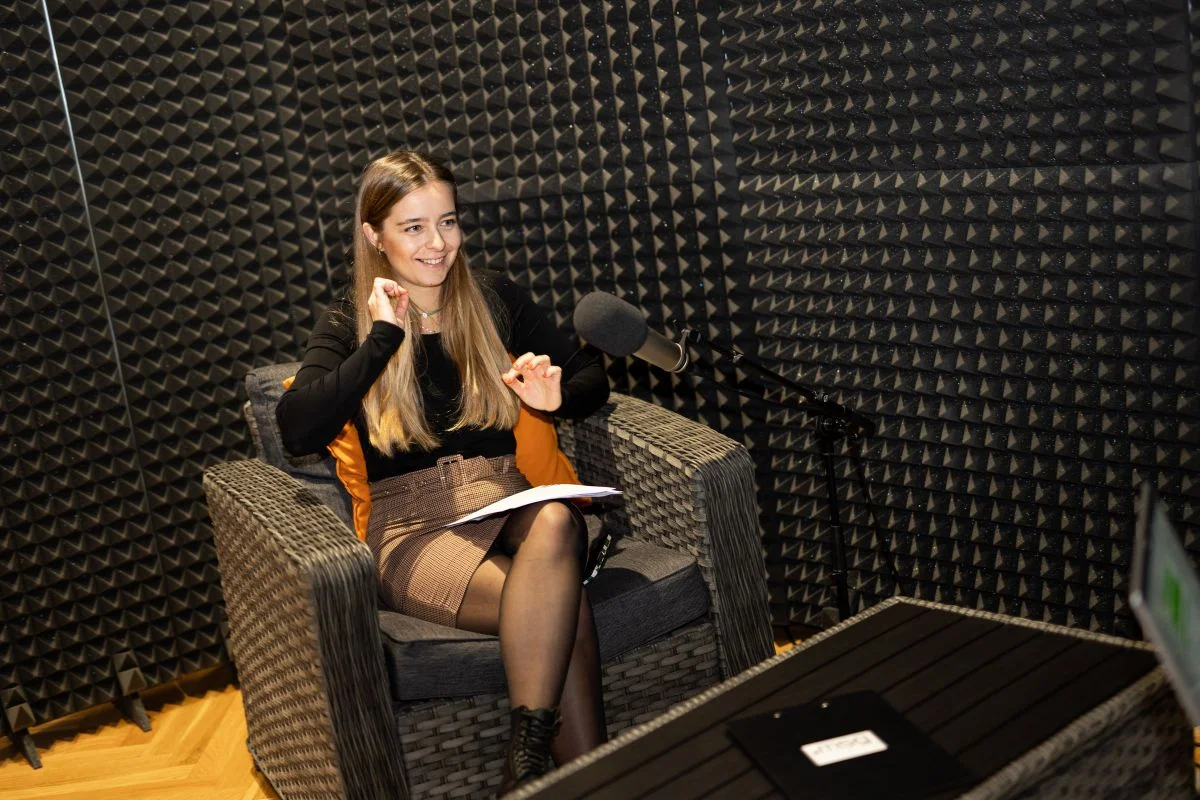
That’s why today we’ll be looking at both the benefits and challenges of working from home, and we’ll also be looking at ways to keep yourself physically and mentally healthy, whether you work in the IT world or anywhere else. Listen in to the episode titled Working from home and its impact on wellbeing with our HR manager Ivana Hricova or read the transcript.

Did you know that…

Na Vlne Kodu Podcast (in English “On the Wave of Code” podcast)

Na Vlne Kodu is an IT podcast from msg life Slovakia, which regularly brings you topics from the field of psychology, HR and news from the IT world. Listen to other episodes of the Na Vlne Kodu podcast.

Dominika, how do people manage to work from home? Aren’t we getting lazy?

Since the pandemic, working from home has been a highly debated topic not only in the world of human resources, but also in general. Are we becoming lazy? I’ll answer that simply. Those who want to get lazy, let them get lazy. Those who don’t want to get lazy can work efficiently and productively from home. There are certainly some specifics, advantages, disadvantages. But I’m forging the path of the happy medium, and I bring a certain relativism to this topic, as well as to our podcast today.

Do you think working from home will become more and more common? Or are we due for a return to the office? How are employers approaching this?

When I was still working in HR, there were still companies that were staying at home on remote or starting to create a hybrid working model. There were also companies that went back to a traditional office working model right away. But there were also companies that forced employees to go to the office even during a pandemic, which was perhaps even life-threatening.

How a company goes about this is its own decision. But the times are moving forward, and from the perspective of Generation Z, but also overall, the music of the future is definitely remote, or at least a hybrid working model. Because it wasn’t entirely comfortable for people to have to go to the office after spending time at home. I think the hybrid is the answer – that trend is really strongly at the forefront.

When I was hiring, I did it for other locations in Europe, not only for Slovakia. If I told the candidates that they couldn’t work from home, the work was not interesting for them at all. So also from a recruiting point of view, I know that people want to have flexibility and they want to be able to at least choose when they are in the office and when they are at home or in a coworking space.

Working from home provides us with both opportunities and unexpected complications. How do I find out what really benefits me and what exhausts me? What do you think is the biggest benefit of working from home?

In order for us to find out how we are doing, we should observe ourselves and find out what works for us, when we feel like it. Some people know exactly, others need to do more digging to find out what and how affects their wellbeing.

In my opinion, there are several advantages of working from home. The first is time-saving – we don’t have to move around, which also makes it a greener alternative. Plus, there are so many stimuli influencing us nowadays that we are overstimulated. When we are at home in our comfortable environment, there are fewer stimuli. Because we’re not on a tram or a bus, we don’t have to make small talk with anyone, etc.

Recommend
We recommend:

Read also: Home office vs full remote.

At the same time, there is a degree of flexibility. If we have meetings that we all have to be at, the early birds can get up as early as 6:30, start work and then finish early. Conversely, someone might prefer to sleep longer because they don’t have to travel and start work later.

From a psychological point of view, we also develop skills that we might not have developed in that office environment – our own time management, setting boundaries, independence. These are all things we need to learn so that we don’t get lazy, so that our productivity and efficiency doesn’t drop. It is a challenge for us.

A lot of research says we’re more productive at home because even if we’re doing laundry or washing dishes, it’s still a shorter time than going out for lunch, coffee, a cigarette – we’re a little sleepy after lunch, so we slow down… These scales are equivalent – we want to socialize in the office, and that takes away from our time and it takes away from our efficiency.

Home office productivity is comparable to office productivity.

These were the biggest advantages of working from home. What are its pitfalls?

From my point of view, social isolation is a big issue. We don’t have direct face-to-face contact with colleagues, we only have virtual contact. Then there are the technological challenges of making meetings work, of making ourselves heard, of having good internet. Because the technical challenges reduce the effectiveness. If somebody is doing a remote, for example in Bali, we have to reckon with time delays.

Then it’s also such a personal test of resolve – if we can stand up from Netflix and stop at two episodes and not continue on for three more. Those are the kind of personal skills that are nice to develop.

From a managerial point of view, it’s definitely a control of work – how employees are meeting KPIs, how to set goals and overall collaboration when everything is done virtually. And ultimately, it can also be a stereotype when we’re always at home, in the same room. Depending on our personalities, we respond better or worse to the stereotype.

Why is the feeling of isolation so strong when working from home, even though we have technology that supposedly connects us?

Because a screen will always be a screen and physical contact will always be physical contact. Even small talk, which may not make sense to introverted IT people, is important. We meet people in the kitchen or other common areas, we can consult problems, play table football, ping-pong, whatever. We need to be around people psychologically and professionally. It’s always easier to go to someone with a question than to type it into a chat and wait for an answer. Physical contact is dominant and is very important to us.

IT professionals were among the first to make the big switch to the home office. However, working in this sector often requires constant availability and coping with demanding deadlines. How does this affect their wellbeing and how do IT professionals cope?

There is very often just the theme of healthy boundaries – to be aware of when to turn off the computer, when they may not be available. There is also a theme of technology fatigue per se. Computers, monitors, screens and blue light make us tired in general. And when you add on top of that the mental work that developers have, it’s a huge package.

It’s also always about the fact that each of us is different and has different predispositions. Someone is energized by the amount of work, another is very tired. It depends on the individual person, how they cope with it. Someone needs frequent breaks, someone will pump up the work and then quit early so they can rest. A lot of it has to do with who is what and how they need what.

Do a lot of people come to your therapy sessions with the problem of digital fatigue?

Digital fatigue, in my opinion, exists both in the office and in working from home. The question is which environment is easier to manage. I would say – but this is purely my subjective view – that it is easier to manage at home because we don’t have other stimuli influencing us there (colleagues, turmoil, etc.).

But digital fatigue is a big separate topic that we need to learn to work with, for example in therapy with a coach. It’s also very important to talk about it in an HR context.

What techniques would you advise IT people to switch off and find their lost balance? Can you recommend any tools that can promote wellbeing when working from home?

Too much of everything is harmful. The more different tools we have, the more complicated it gets. I see the way out in simple things. When I’m overworked and need a break, I turn off my computer and phone and do something else, the work can wait for me until tomorrow. If it’s very urgent, I can get back to it.

With digital fatigue, movement and being outdoors go hand in hand. You need to be physically involved in your work. Especially for IT specialists who sit a lot, hunched over, staring at displays, short breaks are extremely important. You need to get some air, even if it’s only for 10 minutes. That refresh can not so much reduce fatigue, but better manage it psychologically and physiologically. Otherwise it will manifest itself in health problems, migraines and so on.

What steps can we take to protect ourselves mentally when working from home? Can you recommend any tricks or classic routines?

When we worked from home during the pandemic, my friend had a routine of getting up, changing, making her bed, making coffee, and sitting down at her computer. This was her way of trying to avoid the laziness of being at home but having to work. She created something of her own.

And that’s what I think is best – when everyone creates something that works best for them. Because we know ourselves best, we know where our limits are, our strengths, what works for us. There are a lot of those routines. They’re to-do lists, for example. I know people who normally get dressed for work at home in the clothes they would be in at the office, put on makeup, groom themselves. Even when they’re at home, they’re just at work. And when work is over, they put on sweatpants and do other things.

In my opinion, the best routine or the best trick is to take care of yourself. Whatever that means to you. It can be a good meal, a tea break, a walk, a morning workout or something else. We have to find what works for us. General advice and tips are fine, but when people read them they can get frustrated because they can’t put them into context. That’s why I don’t like to give tips either, they’re more like inspirations. I can tell you what helps me, and you can try to analyze it and figure out what helps you.

How can we better cope with the feeling of isolation if we only work remotely?

If the company has the capacity or budget or other possibilities, it is very nice to go to the offline world. To meet, for example, once a week or once a month, to go somewhere out, so that we are not just behind those displays. It’s very good if the company culture or the HR department supports that.

At the same time, if IT specialists work completely remote and have colleagues only in India, for example, they can also socialise with people from their own environment, not just with colleagues. We also have other people around us – family, friends… For someone, it’s still nice to have that contact just in the online space, which is not a bad thing if it’s okay for them. Everyone has to deal with their situation in a way that suits them.

Did you know that…

…at msg life Slovakia we also take care of our colleagues who work online? We go on group hikes and have team-building events such as go-karting, rafting, and more. We believe in a strong corporate culture and support the growth of our employees. We offer a range of employee benefits, including flexibility and mental health care. Take a look at our job offers, join us and become part of our successful team!

Dominika, do you have any examples or personal experiences with people who have managed to set healthy boundaries and improve their well-being when working from home?

I think my personal experience is the most telling. I was able to get my work from home to a level where the work was done, I was productive and efficient. My life changed 180 degrees because I had time to myself, a tidy household, I started running, I was training for a half marathon… It just suited me, I had no boundary issues.

Maybe it’s about decisions, about consciously setting when to turn off the computer. I learned how to function that way, it was completely comfortable for me and I got a lot out of that period. But all the things we talked about – social isolation, laziness, routines, rituals – all of those things I had to laboriously set up and learn.

But I liked it very much. I felt like I could do five times more work at home than in the office. I’m quite a social person and when I was in the office I wanted to have fun with everyone. But I didn’t feel socially isolated at home either. I always had colleagues on the phone or on online chat platforms. And the people I wanted to be with were after work. I was able to set a boundary and go for a walk, run, skate with them after work… I was able to incorporate exercise into my life because travel was cut short and I had already done two laps around the lake instead.

Working online from home has changed Dominika's life 180 degrees.
Working online from home has changed Dominika’s life 180 degrees.

Can you share with us a specific real-life example of how someone managed to transform working from home into something that really empowered them mentally?

Not entirely out of practice, but my mom’s examples come to mind. The important thing about working from home is time – what we do with it, how we use it. She realized that this time can be devoted to many things, not just work. That she can do her work and then devote herself to the activities she likes. She started going to different clubs and doing different activities.

Recommend
We recommend:

Read also: Working from home with kids.

It is up to us how we choose to deal with time. I think we can use every situation to our advantage. As well as we can do that, we will be successful.

What would be your advice to our listeners?

If they were my clients in a therapy room, I would tell them that work is just work. Also think about what other things can make your life better and happier.

If I were in an HR position again, I would ask the staff how they need it. Or what they would need to go through, set up. And I would trust them to know what’s better for them – whether to be at home, hybrid mode, remote or be in the office. I would try to actively broach the subject with them, because I think it’s very beneficial to analyze yourself. It will give us a lot of answers to what works for us. The key is to be kind to myself, to find my way to myself and figure out where I feel comfortable and where I don’t feel comfortable. But work is just still work. We have to do it wherever we are, but it’s still work.

Last question – what trends do you see with employers who offer work from home? Will employers help employees in this sphere?

I think it’s going to be about management setup and company culture. There will remain firms that will have an office-only model, firms that will be hybrid and also firms that will be maybe only remote or mostly remote.

It depends on the recruiter’s needs. There are positions that we cannot fill in the regions and it is worth thinking whether we can fill them in other European cities and give the job to remote recruiters. This is a wide-ranging issue that affects several sectors. But it’s all about the set-up of the company – whether it trusts the employees, whether it sets an example for them.

Thank you Dominika for today’s interview. I hope that you, dear listeners, have learned something new and practical that will help you to manage working from home in a way that is conducive to your mental health. Dominika Neprasova was in the studio with us today. I am Ivana Hricova from msg life Slovakia and until next time, goodbye.