
Workaholism: When enthusiasm for work turns into addiction

How to recognise the symptoms of workaholism early and how to fight and prevent the disorder? Having a job that is fulfilling, meaningful and makes us happy is a rare thing indeed. There’s nothing better than coming to work feeling excited and not wanting to leave. The problem comes, however, when work becomes too much to handle and instead of being a way to fulfil ourselves, it traps us in never-ending duties and tasks. Are you a victim of workaholism too?

The meaning of the term workaholism is a constant need to work. It is not an addiction to a substance, but it manifests itself in the same way – an inability to stop a certain kind of behaviour. As in the case of substance abuse, work addicts achieve a blissful feeling resulting from the fulfilment of this need, which makes them repeat the same kind of behaviour so that the pleasurable feeling is repeated over and over again. The workaholic, the person with a constant urge to work, cannot stop this morbid behaviour, even though it has negative consequences for his physical and mental health or personal life. For a workaholic, work is the meaning of life, with family or hobbies always taking second place.

Addiction like any other

Work addiction often stems from a compulsive need to achieve success or a certain status, but for many it is also a way to escape unpleasant emotions or stress. It is typical especially for perfectionists or people who have high and often unrealistic expectations of themselves and others.

Although work-related addiction is often described as a serious problem, it is not classified as an occupational disease in Slovakia. In some cultures, workaholism is seen as a normal engagement and instead of prevention, such a person is praised and rewarded.

Another reason why work addiction is increasingly overlooked is that even excessive work is often seen as a positive rather than a problem. Many employers welcome people working long hours with high commitment with open arms and even praise them for it. So-called workaholics are sometimes perceived in a rather positive light, even though their behaviour interferes with their lives and can affect them negatively.

Did you know that…

You can receive similar articles directly to your email? Become a member of the msg IT community and we will regularly provide you with IT news, interesting podcasts, important events and current job offers. As a member you can also take part in our competitions! With our community, you’ll never miss a thing in the IT world!

How to recognize work addiction in time

Typical symptoms signalling workaholism are:

  • obsession with work and success,
  • intense fear of failure at work,
  • excessive fears and worries about performance at work,
  • defensive attitude and making excuses of excessive work,
  • experiencing strong negative feelings,
  • avoidance of dealing with other problems (family crisis, relationship problems) or using work as an escape from a life crisis or trauma, etc.

Do you think about work before going to sleep or do you even dream about it? Do you get very irritated when someone interrupts you when you’re working on something you haven’t finished? These are common signs of workaholism. Although many of these symptoms are easy to spot, they are very difficult for the workaholic to admit. Such a person is usually unaware of their actions and often explains their morbid behaviour as necessary or required. Moreover, in the current post-pandemic situation, there is a risk of workaholism, especially during home office, when some of us tend to work all the time.

That’s why it’s also important to watch out for these signals that may indicate that our loved one is having problems with workaholism:

  • more time spent at work than normal or planned,
  • difficulties with falling asleep and lack of sleep due to workload,
  • neglecting leisure activities because of work,
  • isolation, etc.
Workaholism negatively affects relationships and health
Workaholism is the cause of weakened immunity,

As with any addiction, with workaholism it is important to be aware that we have a problem and that our behaviour is getting out of control. Not being afraid to turn to family and loved ones, talk openly about your difficulties and worries is not a sign of weakness, but a willingness to face your problem and work on it.

Don’t be ashamed to seek help

If possible, it is better to avoid addiction than to fight it. However, if you are noticing some signs or often listen to comments about your work dedication, it’s good to stop for a moment and think about whether you really don’t have a problem.

It is family and our close ones who can provide the help and support that we need although we often don’t realise it or we are too afraid to ask for it. Bad work habits and problems can be addressed with a professional, psychologist or coach, who can help us to look at the problem from multiple perspectives and understand why we behave and act in a certain way.

Experts help with solving the problem
A psychologist or coach looks at your problem with empathy and insight.

How to prevent work addiction

If you don’t suffer from workaholism but feel like you’re always thinking about work and can’t unwind, here are some tips that can help.

Digital detox is important

Digital devices can really exhaust us, especially when we tend to be online 24/7. If that’s the case for you, it’s time to change that. When you get home from work, instead of browsing the internet and social networks or watching TV, try to pay attention to the real world around you. Talk to your partner, play board or card games with the kids (no computer or video game consoles).

Simply make time for yourself by doing your favourite activity or doing something good for yourself. For specific tips on how to clean up your life with a digital detox, check out our article.

Practice mindfulness and calmness

There are many articles about meditation, the practice of mindfulness and its positive impact on our overall health, proving that it is worth incorporating into your daily routine. Meditating and practicing mindfulness needs some training, but after a few weeks it can help you with a busy mind. Our colleagues could also try meditation or “mindfulness” during the event Health Awareness Month at msg life which helped them to leave the hustle and bustle of work and relax for a while.

Health as a priority

Throughout life our priorities change, but our relationship with ourselves and our health should remain at the forefront. We have to remember that we can only work productively and creatively for a certain amount of time, which we can’t regain without rest and a healthy lifestyle.

Workaholics, according to one Norwegian scientific study, have a higher chance of having to cope with a certain mental illness. In particular, they are at increased risk of ADHD (attention deficit hyperactivity disorder), OCD (obsessive-compulsive disorder), anxiety and even depression. Emotional problems can come with extreme work addiction.

So if you notice that you value your work achievements more than you value yourself and your health, you are probably at risk of being diagnosed with workaholism. Fatigue, headaches and sleep disorder are also warning signs. In the second stage, anxiety, high blood pressure and eventually heart failure or stroke can join them.

Several studies have shown that people who make health a priority – eat healthy, take breaks, take time off and get plenty of exercise – have more energy and concentrate better. This is then reflected in their performance. Let us therefore be kind to our body, mind and ourselves. Let’s give our body healthy food, plenty of exercise and sleep, and let’s not forget to be respectful towards it. The first results will be visible soon. There is and always will be only one health. Therefore, let us not underestimate the risks.

Don’t skip breaks at work

Taking breaks during working hours has a beneficial effect on mental well-being as well as on concentration. Short regular breaks promote productivity and work efficiency. In our article on procrastination you will learn about the Pomodoro technique. It recommends dividing your work into shorter sections, for example 25 minutes long, followed by a five-minute break. During the break put your phone down, take a walk, make a coffee and talk to your colleagues.

At msg life Slovakia we support the mental health of our colleagues. They can relax during a massage, for example, or they can go to our relaxation area where they can relax from work stress in a hammock or on a swing. We know that for people working in an office behind a computer, the so-called. micro-breaks, so it is recommended to change the object of attention every 30 minutes, deepen your breathing, or look out the window for a few seconds.

Work as an IT Software Tester while studying

Msg life Slovakia strives to give opportunities to everyone regardless of their age or education. The most important thing while working in IT is the desire to learn new things and the enthusiasm for further personal and professional development. We often encounter young applicants who are looking for a part-time job while studying at university. For such candidates, the most suitable position is usually IT Tester junior – student.

We asked our colleague Pato, who works as an IT test manager, what qualities are necessary for this job.

Software Tester job is an important and responsible part of software development. Our products are designed for large insurance companies and it is very important to catch all their bugs before putting them into production at the client.

The role of the IT Tester junior – student is to create and run manual or automated tests, analyze them, optimize them according to the latest trends or report the errors found.

But your working day won’t be filled with just testing. On a daily basis you’ll be communicating and collaborating with managers, developers and consultants to ensure the best quality of our software products.

What matters are your skills

If you don’t think your technical skills are up to the job, don’t worry. At msg life Slovakia we will give you enough time and opportunities for full training. Working with programs like Zephyr Scale, Eclipse, MobaXterm, Git Extensions or DbVisualizer can sound intimidating, especially if you haven’t come into contact with them before.

Are you skilled but have no previous experience? It doesn’t matter, technical knowledge and previous experience are not that important in this job. What is important, however, are your skills. And which ones are they? “For example, logical and analytical thinking, reading comprehension, the ability to identify requirements or define test cases so that the requirements are sufficiently tested,” says Pato, test manager at msg life Slovakia. However, orientation in the IT field, technical skills and knowledge of testing programs are a great advantage.

Student tester's job with German
A good IT Tester should have an eye for detail.

What prerequisites should an IT Tester – student have

  • According to our test manager, a skilled novice IT Tester should especially have the ability to asses whether the software behaves as expected. “It is therefore essential to understand the insurance industry context,” adds Pato. For this job, it is therefore important that you are able to use logical and analytical thinking in order to be able to navigate the issues quickly and easily.
  • Not familiar with the field? Never mind, you don’t have to worry at all even if the insurance industry doesn’t tell you much. The training process includes a training plan to help you gain the knowledge you need.
  • However, what is a prerequisite for this job is your knowledge and communication skills in the German language. You can use it especially when communicating with our international teams in Germany, Austria and other countries where we have offices.
  • Are you a team player? Great! A sense of teamwork as well as flexibility, independence and accuracy are also important for this job. “A tester should have an eye for detail, but also the right amount of curiosity and a willingness to learn new things,” explains Pato.

The key is to have an eye for detail

According to Pato, people often think that a tester is a person who sits behind a computer, gets a manual with detailed steps that he clicks through, and at most reports an error. “There’s a lot more to it than that,” he says. With younger, inexperienced applicants, he often sees that they lack intuition, the ability to invent or make connections. “It’s important to pay attention to the little things and think about what I’m doing and what I’m testing. Testing is not about clicking through an app. You have to think comprehensively, be slightly sceptical and pay close attention to every single detail,” adds Pato.


Are you interested in the IT Tester job? Get a part-time job for university students!

Do you meet these criteria?

  • you are studying at university
  • you have an excellent knowledge of MS Office
  • you can communicate well in German
  • you learn quickly
  • you have a sense of teamwork
  • you have logical and analytical thinking, flexibility, independence, accuracy

Working while studiyng at the university has the advantage of getting experience and earning money. This is one of the main advantages of being an IT tester. In addition, an IT tester job offer can open the door to an IT career. So if you’re wondering what the best job where you can work from home would be, it’s definitely the part-time job as a tester.

Don’t hesitate to send us your CV! You can read what you should not forget when creating your CV in our recent article Tips for skills to put in your CV, resume.

If you have a sharp mind, speak German and have good ideas, be sure to take a look at our job offer for IT talent with German language and send us your CV. We might create a position specifically for you, or we might add you to our database and if we open a new position, you’ll be among the first to know.

Trends in IT jobs – the most common myths from the past

Is working in IT only for men? Prejudices about working in IT still resonate today. Let’s debunk 7 myths about the work of an IT developer. Information technology is one of the fastest growing sectors today. Nevertheless, working in the IT sector is subject to many myths and stereotypes that are often not true. Since a career in IT is one of the most sought after, we decided to prepare an article about common IT jobs myths.

It will be useful for everyone – whether you are thinking about Slovakia or abroad, working in IT is the same in many cases. So what are the most common prejudices that arise in relation to working in the IT sphere?

Working in IT is not creative

In many cases, myths about working in IT involve the assumption that a developer’s job consists only of mindlessly writing clearly defined code. However, this is not true. Although computer code follows its own strict rules, designing new solutions definitely requires a good amount of creative thinking.

In addition, we also need to focus on the fact that working in IT does not automatically mean only programming. The job of a Java developer revolves primarily around the ability to create algorithms and find effective uses of them. Of course, no one can do without properly created code, but on the other hand, it would be too easy to condemn the work of a programmer or developer to just mindless writing.

There are other positions in the IT world, such as web designer, that definitely can’t do much without creativity. Similarly for the work of an IT tester who has to think in a broader context and simulate the behaviour of software users. The IT sector is constantly evolving and new jobs are being created where you have to demonstrate your creativity, whether they are design, business or project-based.

IT education is essential for a successful career

Education and experience are two different things, although in the most common myths about working in IT they are merged into one. University is undoubtedly a good step. It will allow you to learn new things, open doors to the world of programming and also allow you to make important contacts. On the other hand, however, it should be pointed out that when working in the IT sector, no one should rest on one’s laurels and experience plays here an important role.

Experience is important in IT
More emphasis is placed on your IT experience than your education.

Finding a job in IT without experience is a difficult task. It is in practice when the most interesting innovations and ideas are born, not to mention that trends in IT are subject to change very quickly. When working in IT, enthusiasm and a willingness to continuously learn are important along with working on yourself. However, you can also have these qualities as a self-taught learner who has taken certified online courses and continues to work on their soft skills. Independence, passion and the effort to understand things in depth are sometimes valued more than a diploma. As they say, school provides the ideal conditions, practice the real ones.

Developers work alone and are disconnected from society

The myth that developer is an antisocial individual or lone wolf is one of the most common ones we encounter. Filmmakers and social media feed it with their jokes. To pigeonhole developers as people who hate socializing, work alone, ideally in a small dark room with no windows, belongs to the computer prehistoric age. However, it is normal that among developers and other people working in the IT sector there are those who love company and those who do not seek it out.

Working in IT also involves tasks that require teamwork. Members of the team communicate with each other and try to find solutions to individual problems in a given project. It’s definitely not about everyone just working on their own agenda or project. A developer today is therefore required to have good communication skills, team spirit and good behaviour. And by the way, the teams of developers go out for beers after work like everyone else and have similar problems.

The work of a developer is teamwork
Work in IT is mainly teamwork, colleagues from different teams work together on the project

Working in IT is especially for workaholics

Myths about jobs in IT say it is a personal life killer and the average IT person spends up to 16 hours a day at work. This, of course, is not true. On the contrary, few professions allow such flexibility of working hours or location as IT. Programmers, designers and developers are also just people who equally need a rest. Although working in IT is also about enthusiasm to a large extent, each of us likes to take a break.

At msg life Slovakia, the situation is no different. We believe that the right form of relaxation will allow us to look at the projects from a different perspective and come up with innovative solutions. Rest belongs to IT job as much as to any other job. The concentration of workaholics in this profession is similar to any other job.

Women do not belong in IT

It is very difficult to say where the myths about the women’s work in IT come from. They certainly have their origins in the stereotypes in which we were raised, which tell us that men think better and women don’t understand technology. It is also assumed that women have an ingrained need to help, so they see a deeper meaning in other professions. Another problem is perhaps the lack of female role models in this area. The truth is that the gentle sex is as much a part of IT as men, and the number of women is constantly increasing. Nowadays, there are a lot of communities on social networks that bring ladies from the IT world together. According to Lenka Hlinkova, the author of the book The Female Algorithm, the Western economies are struggling with a lack of women in technical positions.

Paradoxically, Romania and Bulgaria, for example, have done well in recruiting women for technical positions and schools as part of the country’s efforts to maintain self-sufficiency. Eurostat data shows that in 2019, women accounted for only 12% of the total number of IT specialists in Slovakia, compared to 33% in Bulgaria and 24% in Romania.

There are 66 female colleagues in msg life Slovakia, which is 32% of the total 209 employees. This number may be less than ideal, so we are always happy to see CVs of smart women interested in working in the IT sphere and in our company. Any profession can only benefit from gender balance.

Working in IT and as a developer is not just for men
The number of female colleagues in msg life Slovakia is still growing.

People in IT either program or play computer games

One of the most well-known myths about working in IT, which, like the previous ones, is not based on truth. People in IT can enjoy sport as much as employees in other sectors. They are active in cycling or running. For many, sport is a form of psychological hygiene that allows them to keep their mind and body in good shape.

Working in IT is primarily a sedentary job. Many articles have already been written about the disadvantages of sedentary work. Its main problem, for example, is that it increases the risk of outbreaks of certain diseases. That is why we at msg life Slovakia try to include sport in our daily schedule.

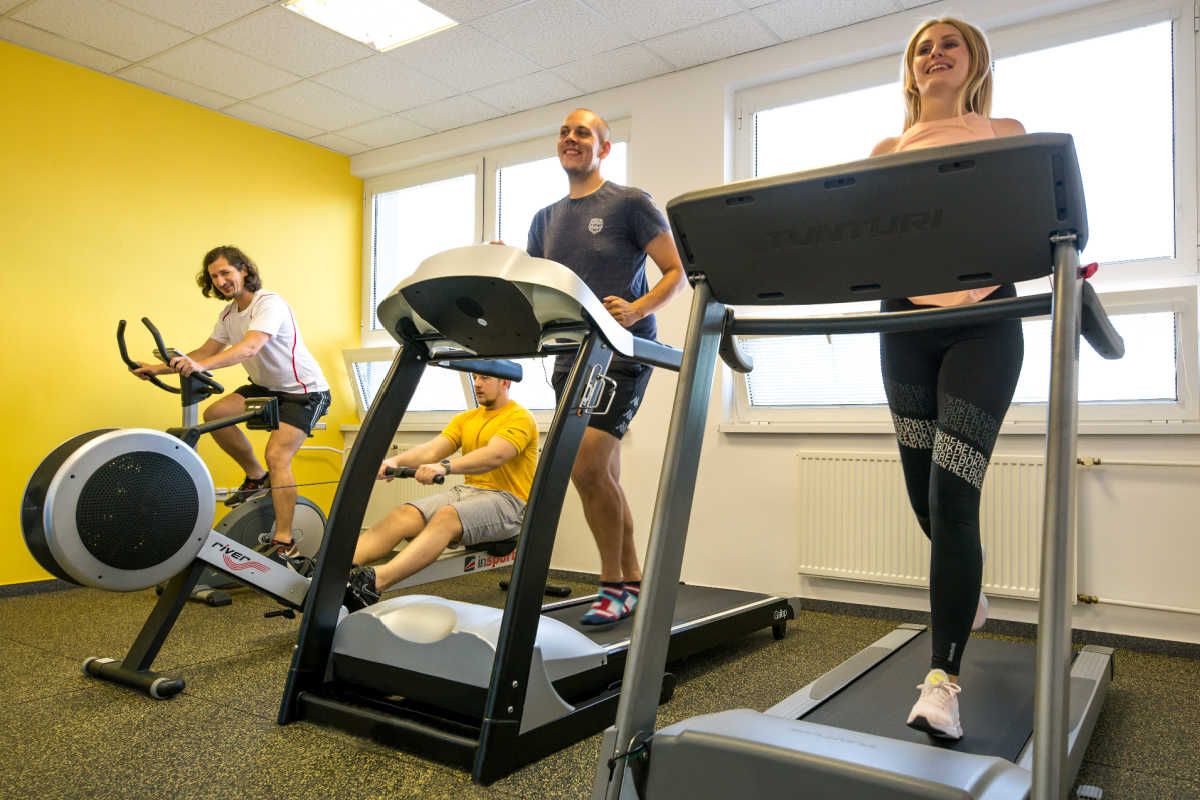
We have our own fully equipped gym and colleagues can order a MultiSport card. Even a short stretch or a walk will help to perfectly circulate the blood through the body and help to feel better again. We certainly do not agree with the myth that IT people do not do sports.

Own fitness room on the premises
Since IT work is mostly sedentary, our colleagues can work out in the fitness room.

IT jobs are especially for young people

How do we define a young person? When it comes to myths about working in IT, we encounter the belief that only people under 30 work in IT. However, this is similar to the claim that women don’t work in IT. The field of information technology has its doors open to everyone, and it is certainly not true that there is no diversity. When working in IT job, enthusiasm and the desire to keep up with the fast-paced development of trends are important. Working in information technology has never been age restricted and there are people who have built and lived their entire careers in IT. The variety of positions and rapid progression ensure that you’ll never be bored in IT. At msg life Slovakia, for example, we have 44 colleagues under the age of 30, which is “only” 21% of the total number of employees. 74% of our colleagues are between 30 and 50 years old and the remaining 5% are over 50 years old.

Most people don’t become a good programmer right out of school, there is hard work and experience behind everything. With time comes depth and range of experience.


MythBusters in msg life

We believe we have thoroughly debunked all myths about IT. Each sector has its advantages and disadvantages. And there are some prejudices about every industry. However, it is wrong to think that there are more of them in IT than in others or that they are all true. If you really enjoy information technology, you don’t have to be a maths or science genius.

We’ll be happy to convince you about it. Browse our job offers and find the right job just for you!

Join us!

Useful programs for PC that make our work easier: 7 of our colleagues recommend these

Some will make our work easier, others will make it more difficult. However, the broad market offers a multitude of tools and many times it can be difficult to navigate them at all. To prevent you from having to research and test programs for a long time, we’ve listed the apps we can’t imagine a working day without. We looked for proven “helps” in the ranks of analysts, testers, consultants and office managers.

Outlook and MS Teams – Pato, Test Manager

Pato has been working for us for more than three years as a test manager and test leader. No wonder that the classic paper diary was not enough for him already in the early days and he replaced it with more modern tools.. “I can’t do without Outlook and Microsoft Teams while I’m working because, as they say among managers, making phone calls is work too,” says Pato.

Thanks to these programs, he can not only instantly connect with international colleagues, but he can schedule online meetings and resolve acute issues quickly and efficiently, which pays off not only when working from home. Despite the fact that these are quite well-known tools, many people have not come into contact with them yet and thus have not discovered all of their advantages and simplicity. “I think both Outlook and Teams are pretty intuitive tools, so no one should have a problem using them,” he says.

Power BI – Arnold, Excel/PW Analyst

Arnold has been working at msg life for over a month as a Power Query Analyst and cannot imagine his working day without Power BI. How does it make his job easier? “Power BI allows me to easily combine different data sources into data models for further analysis and reporting,” says Arnold.

Although, unlike Outlook or Teams, you need knowledge of SQL, MDX, M or DAX to use this tool, the application is full of features and there is always something new to discover. “I’ve been using the program for more than three years and I’m still learning,” says Arnold. If you’re interested in this program, you’ll be happy to know that PBI is free for the desktop version, but you’ll have to pay extra to back up your data to the cloud or use PQ and PP.

Excel – Laura, Student, Analyst

Laura is one of the youngest and newest members of our team, she has only been working at msg life for two months, but she quickly found out which program makes her work the easiest. Since she is an analyst, Excel has become a very good program for her. “I use it every day, it always helps me to be organized,” says Laura.

Although she is only using the program at a basic level for now, she says it can be learnt immediately. “Excel works with its own formulas. The basic ones that almost everyone uses are very intuitive and easy to learn, but if you want to get the most out of Excel, it takes some time to understand the more complex formulas and functions,” adds Laura. Although the tool is chargeable, it is very useful for the analyst’s work and worth investing in. Alternatively, there is also a very similar, freely available online application called Google Sheets.

Canva, Loomly, Mindmap – Zuzka, Office Manager

Zuzka has been working for msg life Slovakia for almost eleven years. She currently holds the position of Business Office Manager and her long tenure with the company, as well as her varied job position, is matched by a list of favorite programs. “At work, I use Outlook calendar, Canva, Loomly, Mindmap, Gimp, Greenshot and I wouldn’t believe I’m typing this, but I also use Excel,” laughs Zuzka. “Canva, Pickmonkey, Gimp and Greenshot help me prepare graphics for copywriters and graphic designers, which I then upload to Loomly. This is a program designed for social media. Mindmap is an amazing thing for creating mind maps and storing ideas digitally,” adds Zuzka.

Despite the long list of applications, she admits that her most faithful help is still just a pen and paper. Among the basic programs for her is a task manager, where she allocates her time and schedules tasks. All of these applications are simple, she says, so anyone can try them out. Although no special knowledge is required to use them, according to the office manager, knowledge of graphic editors is definitely useful.

In addition, the programs are freely available, but the paid versions greatly expand their possibilities. There are several alternatives in this area, such as Adobe programs, but according to Zuzka, it depends on who is comfortable with what and what they have learned to work with.

Snagit – Tomas, Data Analyst

Tomas has been part of our team since September 2O2O and one of his favourite tools is the Snagit app. What is it for? “The program helps to create printscreens, record the screen but most importantly it offers a panoramic view that can be used to capture an enormously large area on a web page, for example. It’s possible to scroll in all possible directions and the program can process a large image,” explains Tomas.

Data analyst, but also other employees will use this program, for example, when storing data and information from web pages. “The program also has its own editor, where I can quickly and easily colour-code important parts, cut them out or write notes,” adds Tomas. If you didn’t know about this useful program for PC, you should give it a try. According to Tomas, it is a very intuitive, so it is not difficult to learn how to use it. Although it is a fee-based tool, the analyst says the price is adequate for its capabilities. A freely available alternative is Greenshot, but according to Tomas, it doesn’t offer as many features as Snagit.

Outlook, OneNote, Jenkins – Zuzka, Business Consultant

Zuzka has been working in our company for ten years as a Business Consultant. This demanding position can be made easier by various useful programs including Outlook Calendar, Jira, StarLeaf, Teams, as well as programs such as OneNote and Jenkins/Bitbucket. “Thanks to the calendar, I keep track of my activities and deadlines. I mainly use Jira when working on a project. StarLeaf or Teams make it easier for me to communicate, because you can’t deal with everything by email, and that goes for the non-pandemic period as well,” explains Zuzka.

OneNote helps the business consultant as a notepad, which has the advantage of being shareable. Zuzka uses Jenkins/BitBucket when working on a project. “I check commits here or what state the builds are in, what is being tested, etc.” Although some of the applications sound complicated, Zuzka says they are very simple and anyone can use them. Moreover, the programs are freely available, so test them right away!

8 tips for effective time management during home office

Can’t organize your working time effectively when working from home? Our colleagues at msg life Slovakia will advise you on how they manage work on demanding projects and how they use their working time efficiently even during home office hours. Eight of them we dedicate under ideal circumstances to sleep. This leaves us with 16 hours, which we divide between working or productive time, and leisure time. With flexible working hours, it is often difficult to balance work and leisure time so that we don’t have to work overtime at the expense of our free time and our interests. We asked our colleagues how time management is important when working from home.

Excel at work, be a good partner, have time for family, friends and favourite hobbies, keep fit and get ahead. These are goals that most of us have, but we don’t always manage to achieve them all. Sometimes we are tired, lazy, chaotic at work and in our personal life. However, most of these problems can be solved by effective time management. If we give ourselves enough time to sleep, we will fight off fatigue. When we see the results of our work, it motivates us to overcome laziness. And if we plan everything well, we will have more free time. Is this also the case in real life? We asked our colleagues in different roles how they manage all the home office duties and what helps them.

1. The early riser makes it further

It is not for nothing that it is said that getting up early in the morning goes hand in hand with good performance. Getting up early on a regular basis improves and optimizes your performance , not only in the home office. “I like to sleep in, but it’s a fact that I get a lot more done by waking up early and starting work earlier,” says our software developer Jaro. Our HR manager Veronika confirms it: ‘I am an early bird. My day is longer, and thus more efficient!”

If you’re not one of the early risers, sometimes it pays to get over yourself. And even when working from home, when we tend to relax from all our habits: “Since we switched to ‘covid’ mode and work from home, I wake up two hours later, but then I work longer,” admits test manager Pato.

Getting up early and working efficiently
Getting up early in the morning increases work efficiency.

2. Don’t forget to move

Waking up and getting started can sometimes be challenging. A little warm-up, a run, a swim or a fitness session can often help our body and our mind. Physical activity also has an impact on mental health. After it, a person is not only more efficient, but also happier thanks to a flood of endorphins. “I feel more energized and positive after exercise,” confirms our developer Michal. Extra exercise doesn’t just have to be an obligation: “I see exercise as a great relaxation. I can say that after a morning warm-up, the day is much more pleasant and duties become a breeze,” says HR manager Veronika.

If you prefer to exercise in the evening, it’s definitely better than not exercising at all. Avoid stiff muscles after a day at the computer: ‘I tend to get tired after a workout, so I don’t do it until after work, with the exception of my morning warm-up,’ admits Michal, a migration technician. For morning and evening workouts, our employees have the opportunity to use the company gym. “Before the lockdown, I used to regularly go to our gym at six in the morning so that I could spend the evening with my family,” says Zuzka, our office manager.

3. Work without unnecessary distractions

Not all devices that are supposed to make our work more efficient do so. An example is a smartphone. Although it contains many helpful apps that help us at work, it’s easy to get distracted by irrelevant notifications. Thus, one can easily succumb to procrastination and pay attention to a completely different activity than what was planned.

The easiest solution is to put your phone away. “The smartphone is both a helper and a curse at work,” says developer Tomas. There are many apps that let us know when we’re spending too much time on a device. Sometimes, however, mobile notifications can be useful in other ways: ‘I use my mobile phone for reminders to get up from the computer and stretch for a few minutes every hour,’ says Maros, a software engineer.

However, there are also colleagues who say that they are not distracted by their mobile phones. “I have my phone with me at work, but I don’t use it actively until I get a call from the delivery man delivering my package. That’s when I like to be distracted,” says test manager Pato.

The mobile phone as a distraction not only when working from home
Mobile can be a helpful but also distracting element when working not only at the home office.

4. Create lists

You can also save a lot of time by scheduling tasks. A clear to-do list helps you get all the tasks you need to do out of your head and onto paper or an app. Is there a nicer feeling than an empty to-do list? Sometimes it even motivates us. “I make checklists and sometimes I get more done than I planned,” says HR manager Veronika. Their form is up to you. Our office manager Zuzka uses a workbook, migration technician Tomas prefers small sticky notes and test manager Pato uses different applications. “I use Outlook Tasks and Xmind very actively. You can also set reminders in Outlook or use the invitation function,” she says.

But if you can’t do everything in one day, that’s okay. Your list will wait for you, the important thing is that you don’t forget anything. “There are things that happen that need to be dealt with immediately, and that disrupts the plan. Sometimes I get less done because of that. But it doesn’t matter, what I can’t do today, I’ll start doing first the next day,” says our Zuzka.

5. Motivate yourself

We have devoted a separate article to the topic of how to properly motivate yourself during the home office. But the bottom line remains that goals and rewards are the drivers that spur us on. ” Sometimes I reward myself with a massage, a meal, or I order a little something,” says software developer Michal. “Sometimes it helps my psyche when I reward myself. Most often it’s books or a good lunch,” says office manager Zuzka.

However, some colleagues say that they prefer to feel good about the work they had done or to be praised. Recognition is very important at work. “I like to pamper myself and indulge in anything pleasant, but I like the feeling of a job well done more,” says Tomas, a migration technician. “I’m more motivated if my work is appreciated,” agrees our HR manager Veronika.

Motivation and rewards for a job well done at home
The reward after a job well done is motivational.

6. Save your time

Many people like the meetings because it is an opportunity to socialise. “I prefer to meet in person, I’m the sociable and talkative type,” admits our migration technician Tomas. “A face-to-face meeting is less formal and more pleasant,” agrees test manager Pato. However, the pandemic and working from home has forced us all to learn how to work online, and in doing so has taught us something. “I found that online meetings are more effective,” says HR manager Veronika. “Online communication is faster,” agrees software engineer Maros.

Others prefer this form because it makes them feel more comfortable. “I prefer email communication, I really don’t like to make phone calls. However, if there is a bigger problem to be solved, or a larger topic to be discussed with several colleagues, I prefer an online meeting or a face-to-face meeting,” says the manager Zuzka. Did you know, for example, that the Queen of England’s appointments usually last only 20 minutes? If in this time Elizabeth II. solve serious socio-political-economic issues, surely you can do it too.

7. Order or organized chaos

Organization is a prerequisite for good time management, but it is not only about the division of labour, but also about the environment. If we work in a chaotic environment, not only do we waste time looking for things, but we also get distracted by the clutter. “I can’t work like that, it annoys me,” says developer Michal. “I can only work efficiently if I have order. That’s why I created my own office at home,” says HR manager Veronika. “I have to keep it tidy otherwise it makes me nervous,” agrees developer Maros.

However, people understand the term clutter differently. If it is chaos that you are familiar with, then we could call it your own personal system. “I have my own organized chaos around me, which I manage successfully,” says office manager Zuzka. “Einstein also worked in his ‘organized’ mess,” agrees migration engineer Tomas. “Proper ‘work’ clutter is important,” adds developer Jaro.

8. Create rituals

Rituals and established customs do not exist by chance. They serve for organization and discipline. That is why every working week starts on Monday and every working day at approximately 8.00 a.m. If you establish similar norms in your life and follow them, you will have free time for other activities. “My long-standing routine is checklists with deadlines. I functioned that way during university and I was able to catch up on assignments ahead of time,” says HR manager Veronika. “They helped me set a good regimen. Humans are creatures of routine,” states engineer Maros.

Routine helps on organization
Maintain discipline and organisation through routines and rituals.

For other colleagues, their habits help them mentally or with concentration, which is also directly related to better performance when working from home. Our Zuzka, for example, likes to listen to music that relaxes her and she is not disturbed by ambient noise. Migration technician Tomas prefers to warm up in the morning and test manager Pato prefers to rest. “It helps me to go for a walk on the terrace several times a day and have a good coffee. I also try to give myself a full half-hour lunch break during my home office to switch off a bit,” she says.

What to take from this?

Working from home can be effective if you stick to a few important principles. These include getting enough sleep, getting up early, creating your own rituals, regular exercise, eliminating distractions, planning your tasks consistently, having good motivation to drive you forward, and discovering your own way of keeping things and tasks in order. This way you can effectively fight procrastination, fatigue or the rush of work, but still leave room for free time.