
How to write a job-winning cover letter: Templates and tips

A cover letter is one of the key documents used to introduce yourself to a potential employer. Unlike a resume, it provides additional information about you and your skills. While writing a cover letter is not difficult, it is important to know what information to include and what to avoid. We have prepared all the essential information for you, along with practical tips to help you make a good first impression.

What is a cover letter?

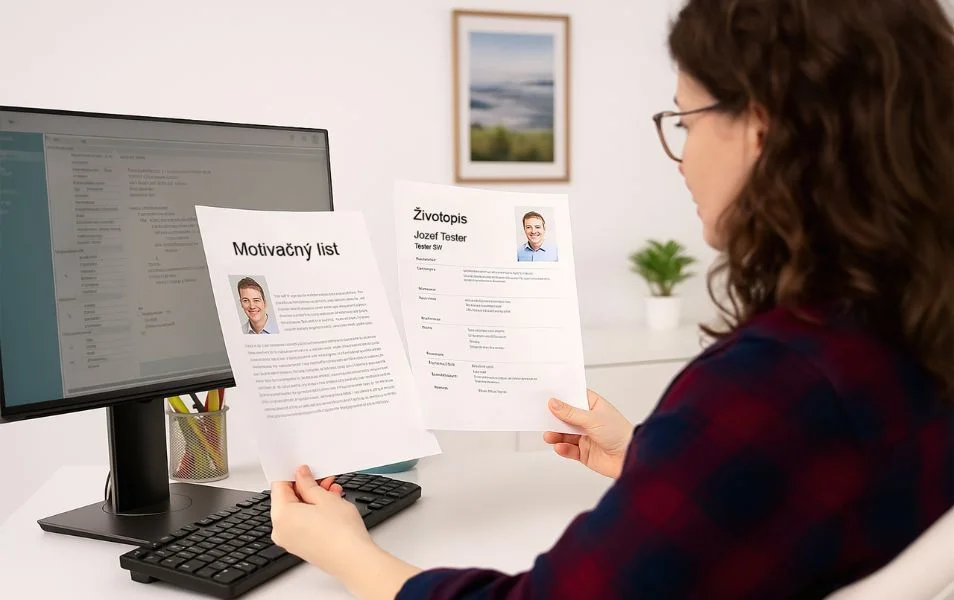
A cover letter introduces you to the people who will decide whether to hire you. This additional text accompanies a resume and enables job applicants to highlight their motivations, skills, and interest in a particular role. It also gives applicants the opportunity to present their experience and aspirations for the role. When writing a cover letter, it is important to be concise yet persuasive — the aim is to demonstrate why you are the ideal candidate.

A professional cover letter is more personal than a resume. It gives you the opportunity to share more information about yourself and your personality. However, it’s not just about the content — the structure and style of your letter are also important. Although it is just a text document, you can still make a cover letter original.

13 min.CV samples: tips and inspiration for writing a CV quickly and easily.

CVs – Templates, mistakes, and tips on how to write them correctly

CV templates – choose a template and use our tips and inspiration to create an unmissable CV quickly and easily.

Short cover letters containing short sentences or bullet points can indicate to a recruiter that you have an analytical thinking. Conversely, a slightly more comprehensive writing style can demonstrate your creativity.

A cover letter is not compulsory when applying for a job. Many companies do not require a cover letter in the first round of the selection process due to time constraints. If it is not mentioned in the job description, the job seeker does not need to send one. Only do so if the company specifically asks for it, or if you are invited to the next stage of the process by the HR department.

Way to write cover letters

While a resume describes your past work experience, a compelling cover letter demonstrates how your skills and knowledge are relevant to the position you are applying for. A well-written cover letter will make a recruiter want to read your resume.
8 min.ako-napisat-zivotopis-cv-954x600

How to write a good CV and what mistakes to avoid?

In this article you will learn how to write a CV and the most common mistakes to avoid.

Tailor your cover letter to the role you are applying for

Write a personalized cover letter for a particular job offer. Read the job advert carefully so that you can respond directly to the requirements listed in it. This demonstrates to the employer that you are genuinely interested in the job, rather than just sending out a generic document to several companies.

Follow the cover letter format

Most companies prefer a simple cover letter. Stick to a clear structure and avoid overdoing it – whether in content, length, or email design. A clean document with black text (no italics or bolding) is ideal. Divide the information into paragraphs and use shorter, concise sentences rather than complex phrasing.

Stay on topic

If you’re wondering how to create a cover letter, the answer is simple – focus on relevant information. Avoid information that may not be interesting or useful to the employer. This not only makes you look professional but also shows that you’ve studied the job posting and understand the company’s needs.

Mind the proper structure

A cover letter should be divided into three basic sections, no longer than one page (about 300–350 words). Use classic fonts like Times New Roman or Arial in size 11 or 12. Don’t forget margins—ideally 1 to 1.5 cm. Send the finished cover letter as a PDF attachment.

Don’t forget the header

Every cover letter should include a header with your personal and contact details, followed by the recipient’s (the company’s) contact information. Next comes the salutation, the body of the letter, and a closing (e.g., „Sincerely…“).

Watch your grammar and typos

A great cover letter represents your skills and abilities to recruiters. To make the best impression, proofread the text multiple times and have someone else review it – even a close friend might catch mistakes you’ve missed.

A signature is not necessary

Standard cover letters are usually sent electronically via email, so a handwritten signature isn’t required. Simply end with „Sincerely…“ followed by your name.

As mentioned earlier, a cover letter serves as a supplement to a resume, highlighting the applicant’s personal and professional goals, ambitions, and values. It can also include information beyond a direct summary of work experience, such as personal and professional development plans or a commitment to continuous skill improvement.

What cover letter examples look like: Cover letter templates

At first glance, a cover letter (sometimes also called motivation letter) appears to be a simple document you can write in a few minutes. While writing it isn’t generally difficult, you should always set aside enough time to include all the necessary information.

A cover letter template usually consists of several sections. The first is the salutation. This is followed by the body of the document, which is divided into three parts, and finally comes the closing and sign-off.

To make writing easier, we’ve broken down each section in detail:
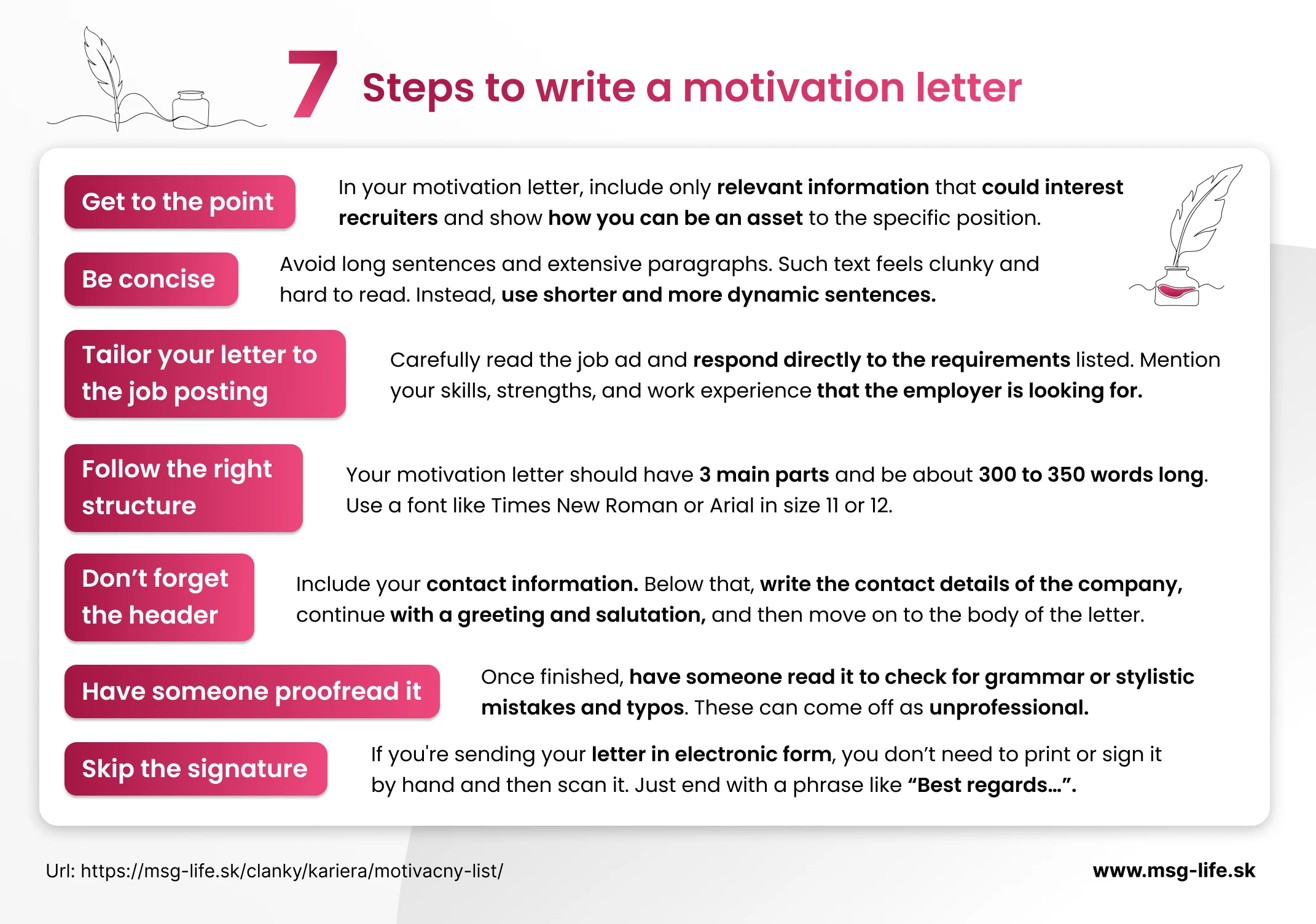
cover motivation letter 7 steps to write it
How to write a simple cover letter for a job in 7 steps

Directly address the contact person

Always address your letter to a specific individual, e.g., „Dear Mr Bruckner…“ This makes the cover letter feel more personal and shows you’ve researched the company.

You’ll usually find the contact person’s name in the job posting itself – often listed alongside email or phone details.

First section: Explain your interest in the position

In the introduction, state why you’re applying for the position and why you want to work for this company. Briefly mention your relevant experience and highlight how it could benefit the employer.

This section is crucial – it sets the tone for the entire letter and shows recruiters why you’re reaching out. Keep it concise and dynamic, using short, impactful sentences without unnecessary fluff.

Second section: Demonstrate your knowledge of the company

Research the company and explain what motivated you to apply for the position, what appealed to you about the company, and how you can apply your skills and knowledge. Be brief, but include specific examples, figures and relevant achievements.

Be specific – use numbers, achievements, or examples that prove your suitability. This shows the letter isn’t a generic template but tailored to the job.

Third section: Highlight your strengths

Describe how you could contribute to your employer. Have you noticed any problems within the company? Describe it and suggest a possible solution. Describe your vision for the role. Highlight your qualifications for the position. Imagine you already worked for the company – what could you improve? How would you go about it?

This section is designed to showcase your strengths and key skills. Mention the most important ones that would be an asset to the company, and feel free to provide a brief explanation of each one. However, be careful not to appear overconfident or arrogant, as this could have a negative impact on recruiters.

Closing: Call the recruiter to action

How should a cover letter end? Don’t forget to encourage the recruiter to take action. Don’t be too eager; show courtesy and respect. For example, you could say, „If you need any more information, please feel free to contact me at [phone number] or [email address]. I will be happy to answer your questions at the interview. Thanks for your time.“

This shows the recruiter that you would like to meet them in person, or at least have an online interview.

22 min.pracovny-pohovor-ako-sa-pripravit-954x600

How to prepare for a job interview? With us, you can handle it with ease.

The search for a new job has several stages. One of them is the interview, which is usually not very popular among applicants. Stress and tension can often be overwhelming. […]

Sign-off

A short and formal form, such as “Sincerely, First Name Last Name”, is sufficient. There is no need for a signature or any additional text.

Perfect cover letter: Job search mistakes to avoid

When creating your cover letter template, always ensure it is tailored specifically to the job and the company you are applying to. Recruiters can easily identify generic cover letters that have been mass sent to multiple employers. Therefore, dedicate sufficient time to researching the company thoroughly so you can craft a letter that will genuinely capture their attention. Show that you have read the job description and make sure your cover letter relates to the job offer. A cover letter is a great place to show that you are a good fit for the position.

Adapt your tone to match the working environment. If the organisation communicates in a more relaxed manner, you may adjust your style accordingly. Conversely, if it is a formal corporate environment, maintain a professional and respectful tone throughout. The recruiter needs to feel that you would fit well within their team and understand the company’s values.

There are several key mistakes you should be careful to avoid:

Spelling and grammatical errors

Read your text aloud several times and consider asking a friend or family member to review it as well. Use polite and respectful language, addressing the recipient properly. While incorrect grammar or poor style might seem like minor issues, they can significantly impact how potential employers perceive you – even if you are not applying for a writing or editing position.

Formatting errors

Your letter must be easily readable in any format. Use short, clear sentences and divide your text into logical paragraphs. Recruiters often have limited time and may only skim through applications. To ensure they notice all the key information, make your content as clear and well-structured as possible.

Self-promotion

While you should highlight your relevant achievements, be careful not to exaggerate or misrepresent your experience. During an interview, any false claims may be uncovered. If you have multiple relevant skills or experiences, rather than listing them all, select a few key ones and describe them in more detail. This approach will give recruiters a much better understanding of your capabilities.

Generic clichés

Phrases like „I’m a team player“, „I enjoy working in a team environment“ or „I love learning new things“ are overused and don’t provide any specific information about you. Instead, give concrete examples – mention that you worked successfully in a large team in your previous role, or describe specific training courses you’ve completed that enhanced your skills.

Repetition of resume information

The cover letter provides additional insights about you and your abilities that complement your resume. Focus on expanding aspects that weren’t fully covered in your resume, presenting yourself in the best possible light to increase your chances of securing the position.

Too much text

Aim for between 300 and 350 words – cover letter should be one page long. As demonstrated in our cover letter template, this is not meant to be a lengthy essay but rather a succinct document that recruiters can quickly scan.

Missing specific examples

For each skill you mention, provide a real-world instance where you applied it successfully. Show situations where you utilized these abilities and how you implemented them in practice.

Inappropriate information

This includes reasons for leaving previous employment or any negative comments about former employers. This is not what a cover letter is used for.

Salary and working time requirements

These matters should only be discussed during the interview process.

Online cover letter builders to help you write

The way you choose to write your cover letter is entirely up to you. The classic approach is to create your cover letter from scratch using Microsoft Word or Google Docs, where you can customize everything yourself – from font type and size to margins and line spacing.

If you’d like some assistance with the writing process, you can opt for various customizable cover letter templates where you simply insert your text. You won’t need to worry about anything else. Once you’ve included all the necessary details, just save the cover letter to your device and send it off.

If you choose the second option (online cover letter builders), make sure the final cover letter design looks professional and well-structured. Avoid overly complex templates that might make the text difficult to read.

Final proofreading

By now, you know how to write the best possible cover letter. You don’t need exceptional writing skills – just follow the proper structure, focus on the prospective employer, and highlight how you can contribute to their success.

And don’t forget about spelling and grammar! Steer clear of generic clichés and inject some of your personality into the text – as if you were already working in the position. At the end of your cover letter, you may also include consent to process your personal data, allowing the recruiter to keep your details on file should a suitable position become available in the future. Best of luck!
The best IT podcasts: both interesting and entertaining. Which podcast is worth listening to?

IT podcasts are undoubtedly one of the most popular ways to get the information you need quickly and easily. You can listen to them anytime, anywhere – while you’re driving, exercising or having your morning coffee. If you’re looking for a quality IT podcast but can’t decide which one to go for, we’ve put together our list of the best. We also mention interesting and entertaining podcasts in both English and Slovak.

What are podcasts?

More and more people are finding their way to podcasts. However, it is not such a widespread medium that everyone is familiar with them. If you haven’t come across them yet and you’re wondering what a podcast is, we’d be happy to explain.

A podcast is an audio recording, usually in audio format (or in video format if published on YouTube), that can be recorded by one or more people. Once recorded, it is often edited and accompanied by music, although this is not the rule. Most podcasts come out regularly – on a certain day and at a certain time.

Podcasts can be general in nature or dedicated to a specific topic. Some of the most common are interviews with people in various fields – from art to technology to business. In addition, they are often available in different languages. Although English has the largest representation, a number of Slovak and Czech podcasts have been added in recent years.

Did you know that…

… podcasts haven’t been around for very long? The word ‘podcast’ first appeared in 2004, when it was popularised by Apple.

Where to listen to podcasts?

If you’re wondering where and how to listen to podcasts, the answer is very simple. Currently, you have several options. The most popular alternatives are streaming services such as Spotify, Apple Podcasts or Youtube. You’ll probably find the widest selection of podcasts in their libraries.

In addition, these services have the advantage of allowing you to listen to podcasts wherever you are. All you need is an internet connection, or you can download your chosen episode in advance.

Another listening option is the official websites of the companies that produce the podcasts. There you can listen to older and newer episodes. The downside is that they’re not always as convenient, especially if you want to listen to a podcast on your mobile phone.

Recommend
We recommend:

Although streaming platforms may charge a fee for their services, this is not always the case. Some companies offer their employees a subscription to these platforms as part of their benefits package.

Which podcast to listen to?

There are a large number of podcasts available nowadays, which means that everyone can choose something to suit their preferences. On the other hand, too wide a choice can make finding the best session a complicated and lengthy process. Do you want to listen to a good podcast, but don’t have time for a lengthy search? Use our practical tips.

IT podcasts

They can not only provide you with interesting news from the world of information technology, but also teach you something new. There is so many choices of what you can listen to. For a better overview, we have divided the individual tips into two categories:

  • podcasts in Slovak and Czech,
  • podcasts in English.

Let’s take a look at them.

IT podcasts in Slovak and Czech

If you’re not very good at English or just don’t want to listen to it, choose one of the Slovak or Czech IT podcasts. We recommend these ones in particular:

#1 Na vlne kódu

In the podcast Na vlne kódu from msg life Slovakia we regularly bring you not only IT topics, but also topics from the field of psychology or HR. In interviews with experts from the field, we like to discuss current trends and challenges. All this with one goal in mind – to provide our listeners with valuable information and inspiration for their professional and personal development.

Recommend
We recommend:

You can find the ‘Na vlne kodu’ podcast on the PodBean and Spotify podcast platforms. Transcripts of each episode are also available to read on our blog.

Informatika s Mišom

Informatika s Mišom is a practical podcast that teaches you all the basics needed for programming. This includes things like working with the command line and explaining the differences between Java and Python, which will make programming in Java much easier for you.

Not only the audio track of the podcasts, but also the video courses are available on YouTube, which will make it much easier for you to study and practice the theoretical knowledge you have acquired.

Check out Mišo’s interview with our Java Developer Senior Matúš:

Our tester Xenia also talked to Mišo:

29 min.Women in IT - The story of Xenia - Na mojom kompe to ide podcast

Podcast: Women in IT – less stereotypes, more opportunities

How can you work in IT without experience? In this inspiring interview, Xenia talks about her beginnings in testing and coding, and the reality of being a woman in IT. This inspiring interview is a must-watch for aspiring female programmers.
Recommend
We recommend:

You can find the ‘Informatika s Misom’ podcast on streaming platforms such as Spotify and Apple Podcasts under the title ‘Na mojom kompe to ide‘.

Klik

Klik belongs to the daily SME and is published weekly. The presenters David Tvrdon and Ondrej Podstupka discuss events from the world of technology, media and social networks. You can listen to it on your favourite streaming platforms or directly on the SME.sk website.

Shape the Future

If you’re more interested in cybersecurity and digitisation, listen to Microsoft’s Shape the Future podcast. The presenter duo consists of Lukáš Okál and Vladimír Hruban, who invite interesting guests to each episode.

The Shape the Future podcast is divided into several miniseries containing several episodes. For example, you can listen to a miniseries on current cyber threats, digital skills or digital businesses.

Online Plus

Online Plus is a Czech podcast focused mainly on IT and new media. In individual episodes they cover topics such as:

  • the future of AI,
  • new IT regulations and laws
  • cryptocurrencies,
  • news from social networks and new media and many more.

Each episode is usually under 30 minutes long and full of interesting information, so you don’t have to worry about getting bored after a short time.

SCRIPTease

Another CZ podcast for testers, developers and all IT enthusiasts. Host Jirka Bachel invites guests from different companies to each episode, who reveal various interesting facts – for example, the latest technologies implemented in workflows and so on.

You’ll have to set aside at least an hour of your time for most of the episodes, but it’s definitely worth it. You’ll learn new information that you can apply to your projects or work.

IT podcasts in English

Want to listen to a quality podcast in English? Choose one of our tips:

Linux Unplugged

Linux Unplugged is a podcast focused on the latest events and important information from the world of Linux. It’s perfect for anyone who works with the operating system or plans to.

Floss Weekly

Floss Weekly is a podcast focused on everything related to open source. Host Doc Searls speaks with different specialists each week, which makes all the episodes very interesting. In addition to the free version of the podcast, there is also a paid version that offers bonus content and is ad-free.

Darknet Diaries

Among the TOP podcasts from the IT field is certainly Darknet Diaries, which is dedicated to the darker side of the Internet – the one that the average user does not see when browsing the web. Host Jack Rhysider talks about cybercrimes, collusion and scams. His podcast is ideal for both professionals and laypeople interested in mildly controversial topics.

Daily Tech News Show

Excellent podcast for developers, programmers and other IT specialists. It comes out on a daily basis and has approximately 30-minute segments discussing everything related to information technology – from artificial intelligence to cryptocurrencies.

The podcast is designed to be listened to by everyone – beginners and experienced professionals alike.

Decoder with Nilay Patel

A great podcast that you’ll love if you want to learn more about the latest happenings in the IT world. You’ll find out what experts think about the future of certain industries, what’s happening at big companies like META and Google, and what we can look forward to in the weeks and months ahead.

Host Nilay Patel conducts the podcast in the form of interviews with renowned IT experts, making the episodes very information-rich.

Podcasts about AI

With the growing popularity of artificial intelligence, more and more podcasts are coming out that discuss the topic in depth. Most of them are in English, but you can also find some in Slovak or Czech.

It’s also important to say that the topic of AI is not only covered in dedicated podcasts, but also in many general technology-focused shows. We have mentioned several of them above.

Slovak and Czech podcasts about AI

The best Slovak and Czech podcasts about AI include:

Žijeme sci-fi

Excellent podcast with Kamil Aujesky, who mainly covers news from the world of AI. The host and his guests discuss topics such as AI’s ability to reduce crime, manage finances and educate students in primary and secondary schools.

The podcast is very engaging – based on current events, the presenter and his guests predict where artificial intelligence may go in the future.

Hloupější to nebude

One of the great AI podcasts is the Czech one, Hloupější to nebude. Hosts Eliška Zimová and David Strejc look at how AI works, what its strengths are and what its limitations are.

They take a realistic view of AI – looking not only at its benefits in personal and professional life, but also at the drawbacks and potential complications in its implementation.

Vygenerováno AI

Generated by AI is a limited podcast series with seven episodes that aims to explain the basics of artificial intelligence. For example:

  • how language models work,
  • what are the most common myths about AI,
  • how ethics are addressed in conjunction with AI,
  • what is the predicted future of artificial intelligence.

The episodes are only about 10 minutes long, so you’ll quickly learn all the basics you need to build on.

16 min.What is artificial intelligence, history, trends, risks of AI

Is AI really intelligent? What is artificial intelligence, types, trends, risks of AI

In this article you will learn whether AI is really fully intelligent, its types, its impact on the market, the future and jobs.

Objavuj AI

Moderator Luki Zajo covers not only the basics of AI, but also the latest news, trends and practical tutorials – from working with ChatGPT to Perplexity and other tools.

A big advantage of the Objavuj AI podcast is the short length of the episodes(5 – 7 minutes). They’re short, to the point, and free of unnecessary fluff – the author gets straight to the point to save you time and show you how you can use artificial intelligence effectively.

Foreign podcasts about AI

If you’re not interested in Slovak or Czech podcasts and would like to listen to the ones in English, we have good news for you. The range of foreign podcasts on the topic of artificial intelligence is much wider than the domestic ones. What’s more, they are often treated in much more detail and depth.

Popular foreign IT podcasts on AI include:

High Agency

High Agency is a podcast about IT with AI designed more for professionals. It provides practical advice and tips on how to develop products successfully and without much complication using AI.

The podcast was founded by Raza Habib, CEO of Humanloop, a company that helps companies use artificial intelligence more effectively. Most of the episodes are conducted through interviews with experts in various fields, covering breaking news, new trends and much more.

Latent Space

The Latent Space podcast has a very wide range of topics. Hosts Alessio Fanelli and Swyx cover the basics of AI, the latest trends and more challenging topics like multimodality and GPU infrastructure.

The podcast can be listened to by anyone interested in AI, but it will be most appreciated by advanced IT specialists and enthusiasts who already have a foundation in AI.

No Priors

The No Priors podcast takes you through a variety of AI topics – from the latest trends to questions about the future of culture, society and business in the AI era.

Podcast hosts Sarah Guo, founder of investment firm Conviction, and entrepreneur Elad Gil invite guests into the episodes to give you a unique perspective on the impact of artificial intelligence on our world.

Deepmind: Podcast

If you want to look at artificial intelligence from a different perspective, Deepmind: The Podcast is the right choice. Mathematician and celebrity Hannah Fry interviews experts on topics such as:

  • AI ethics,
  • using AI in education,
  • AI regulation,
  • the use of AI in science and many more.

The podcast offers approximately one-hour segments full of practical information useful in both professional and personal life.

AI Today

AI Today is a podcast that covers the latest happenings in the world of artificial intelligence. It follows developments in AI and how the new technology is being used by the world’s experts and major companies.

Each episode is short, usually lasting up to 20 minutes, and contains a summary of all the key ideas.

More English podcasts

Looking for more tips on AI podcasts that are in English? You can try these:

  • The AI Podcast – a versatile and general podcast that covers all areas of AI – from the basics to news and interesting trends. Host Noah Kravitz invites different experts to each episode to bring a fresh perspective on artificial intelligence.
  • Data Skeptic – the main task is to show you how artificial intelligence uses the data it has access to. In addition, it also focuses on other details such as machine learning or statistics. The good news is that despite the difficulty of the topics mentioned, the presenter Kyle Polich explains them clearly and in a way that even a beginner can understand.
  • Eye on AI – a podcast from journalist Craig S. Smith focusing on everything related to artificial intelligence. You can look forward to interviews with IT experts and episodes on ethical considerations, implementation, and the impact of AI on various fields.
  • This Day in AI – As the title suggests, this podcast covers the latest trends and happenings in the world of artificial intelligence. The hosts usually invite guests with whom they discuss various topics in depth and follow the latest technology developments.

Interesting podcasts

Do you want to relax with a podcast or learn something new, but not in the field of information technology? We’ve prepared a list of podcasts from various fields, available in Slovak and English.

Interesting podcasts in Slovak

There are some interesting podcasts in Slovak too. The current most popular include:

  • Mozgová atletika – one of the most listened Slovak podcasts in recent years. It is popular due to the fact that it deals with the topics of personal development and science in an entertaining way. In short episodes lasting 30 to 40 minutes, you will not only learn something new, but also have a good time. Many episodes feature experts who approach the subject from a professional perspective.
  • Dejepis Inak – if you enjoy history, this podcast is a great choice for you. It will introduce you to important historical events in a concise and short form. If you would like video content, you can find it on YouTube.
  • Doktor ma Filipa – are you attracted by the backstage of Slovak hospitals? Listen to this podcast, hosted by Dr. Jozef Fatrsík from the emergency room of Svet Zdravia Hospital in Galanta. In each episode he describes his experiences in an interesting, sometimes even funny way. That way you can be sure that you won’t turn off the podcast after a few minutes.
  • Vedátorský podcast – covers interesting topics and answers questions that you may not have thought of, but after listening to them, you’ll want to know the answers. For example, find out if light can be slowed down, how the universe was created, or how the internet is speeding up.

Interesting podcasts in English

If you’re not interested in the Slovak podcasts, you can choose from international ones. From the ones in English that are worth listening to, we choose:

  • The New Yorker Fiction Podcast – Each of the magazine’s current staffers reads a short story by a former staffer and then discusses it with editor Deborah Treisman. The pieces are both entertaining and informative, showing different perspectives on a single story or idea.
  • Stuff You Should Know – a podcast from iHeartRadio that comes out several times a week. It educates and provides nformation from different fields in an entertaining way. Individual episodes are shorter and usually last no more than 60 minutes.
  • Conspiracy Theories – one of the most listened to podcasts in the world. It focuses on conspiracy theories linked to major historical events. You can find it exclusively on Spotify.
  • You Must Remember This – If you enjoy the behind the scenes of Hollywood, this podcast is perfect for you. Host Karina Longworth breaks down the secrets and scandals associated with celebrities and movies.

Funny podcasts

There is no shortage of entertaining podcasts on streaming platforms. A list of the most popular ones is presented below.

Funny podcasts in Slovak

Slovak listeners can’t get enough of these four podcasts:

  • Piatoček – satirical podcast of the daily SME, which in most cases reacts to current events in Slovakia. It comes out every Friday and its episodes usually last up to 30 minutes.
  • Lužifčák podcast – this podcast has been one of the best in Slovakia for several years. In the individual episodes, well-known guests appear with whom the presenters wittily discuss various topics. You can be sure you’ll have a great time.
  • Kuriéris – in the list of top funny podcasts, the Kuriéris podcast must not be missed, which will entertain you with funny stories of couriers.
  • REcast by Duklock – popular youtuber Duklock entertains his fans with a podcast featuring famous celebrities. He and the host talk about a variety of topics, with plenty of entertainment to keep you entertained.

Funny podcasts in English

For anyone who wants to have fun while listening to podcasts in English, we have another inspiration:

  • Conan O’Brien Needs a Friend – a podcast hosted by Conan O’Brien who invites famous celebrities such as Will Ferrell, Ben Stiller, Mila Kunis and Michelle Obama to each episode. He discusses their lives and new projects with them, with a heavy dose of humour.
  • How Did This Get Made – Presenters Paul Scheer, June Diane Raphael and Jason Mantzoukas watch a poorly rated film before recording each segment, which they then discuss. If you want to enjoy each part to the fullest, we recommend you to watch the movie as well.
  • Good One – a podcast in which host Jesse David Fox interrogates comedians about the origins of their jokes. There are also interesting guests who bring the podcast to life.

Armchair Expert – In this podcast, actor Dax Shepard interviews various guests about their successes, failures and personal growth in a very relaxed and humorous style.

What does a Business IT Consultant do?

A Business IT Consultant helps connect business with technology. Simply put, they understand the language of both customers and developers and can align them to make things work smoothly and efficiently. Are you interested in what an IT Business Consultant does here at msg life Slovakia? Read on – in the following sections, we’ll take a closer look at their tasks.

Developing usable and practical software is the goal of every developer. However, creating a program that is also “user friendly” is a bit more challenging. Especially when there are inaccuracies between the client’s expectations and the work of the development team.

At msg life Slovakia, we aim to minimise this communication gap, which occurs in many companies. That’s why we need someone to bridge the divide between software developers and customers.

For this reason we are looking for suitable candidates for our offices in Bratislava, Zilina and Kosice for the position of Business IT Consultant – Process Specialist.

Business IT Consultant job description

The role of a Business Consultant is diverse and includes the following key tasks:

  • Communication with customers: The Business Consultant regularly communicates with our insurance clients to analyze their needs and goals or current issues.
  • Creation of technical specifications: They create technical specifications, including a functional part for users (clients, testers) and a technical task for developers.
  • Configuration and parameterization: They ensure the software is tailored to the client’s requirements, consulting on deployment, customisation of our system, and insurance product queries.
  • Support and consultancy: They provide support, conduct training, and hold workshops to introduce clients to new functionalities in our life and non-life insurance contract management systems.
  • Testing and analysis: They handle software testing, bug analysis and use case reviews.
Recommend
We recommend:

Are you interested in what requirements a successful candidate for this position should meet? Read the details in the job offer Business IT Consultant – Process Specialist.

Business Consultant vs IT Consultant difference

Business consultants and IT consultants share many similarities. Both roles:

  • Focus on problem-solving and process optimization
  • Require strong communication and analytical skills
  • Demand staying updated on the latest industry trends and technologies

At the same time, however, they differ in their focus, roles and expertise:

Business Consultant

  • Focus: Business consultants are involved in the analysis and optimization of business processes, strategic planning and development strategies.
  • Tasks: Listen to client requirements, identify their real needs, and make strategic decisions regarding solutions with an emphasis on the efficiency and effectiveness of business processes.
  • Expertise: depending on the focus of the project, domain knowledge is important, such as accounting, economics or marketing.
  • Communication: The consultant’s basic tool. They consult with the various users of the software – whether it’s the clerk sitting behind the counter who will be working with the software on a daily basis, or the CEO/CTO who makes the decisions on software usage. They have to adapt the style, level and content of communication accordingly.

IT Consultant

  • Focus: IT consultants deal with technical aspects such as computer systems, software and hardware.
  • Tasks: The IT Consultant assists clients in identifying and implementing technologies that increase productivity, efficiency, and profitability.
  • Expertise: Knowledge of software, hardware and IT infrastructure is required.
  • Communication: The IT Consultant works with technical personnel, management, and end users.

Business IT Consultant

A Business IT Consultant operates exactly at the intersection of business and technology. The role is essentially a connection between IT and business. The consultant understands business processes while also having an overview of technical solutions. This allows them to translate “business language” into “IT language” and vice versa. Therefore, the role requires a combination of solid business insight and technical thinking in order to bring both clients and developers onto the same page.

Related positions you can apply for:

Business Process Consultant / Business Process Analyst

A Business Process Consultant is a professional who has extensive experience in a given area of expertise. They help organisations improve their processes and build effective documentation strategies.

The Business Process Analyst analyses and optimises business processes, identifies areas for improvement and proposes changes that increase efficiency and effectiveness.

Key responsibilities:

  • They identify client needs and propose strategic solutions.
  • They improve the efficiency and effectiveness of business processes.
  • They provide support to senior leaders in strategic decisions.

IT Business Analyst / Business IT Analyst

An IT Business Analyst or Business IT Analyst is a person who combines the world of business and IT, but with an emphasis on the in-depth analysis of client needs. Similar to a Business IT Consultant, they connect business with technology. Their main focus, however, is to thoroughly understand what the business needs and translate that into specific technical requirements.

Key responsibilities:

  • They analyse business processes and looks for opportunities for improvement.
  • They identify client needs and designs solutions that make sense from both a business and technical perspective.
  • They act as a liaison between management and the IT team – ensuring that everyone speaks the same language.

What is the salary of a Business IT Consultant?

The salary of an IT Business Analyst or IT Consultant generally depends on previous experience and is the result of mutual agreement. For the position of Business IT Consultant at msg life Slovakia, the salary starts at €2,600 per month. The position also includes a starting bonus equivalent to the base monthly salary, as well as additional motivating rewards and bonuses (e.g., a Christmas bonus of up to the value of one month’s base salary).

Meet our colleague Ada: How a financial analyst became a business IT consultant

To get a better idea of what a typical working day for a Business IT Consultant looks like, we interviewed our colleague Ada. She has been working at msg life Slovakia for more than 8 years. Read our interview with a Business IT Consultant.

Ada, try to give us an idea of your normal working day. What does it consist of?

A normal working day and job of a business IT consultant consists mainly of a lot of conversations and phone calls, whether with developers, testers or other consultants. We discuss what problems and bugs are being solved in projects, what is right and what is wrong, and how bugs should be fixed to avoid damaging the system further—i.e., whether a bug is fixable or not.

Then there are managerial and organisational responsibilities. When we create new functionalities, it requires extensive communication with the customer. In meetings, the customer presents requirements, such as what they expect from the system and the criteria it should meet. From this, we derive a specification, written in plain language that even a layman should understand—clear, descriptive sentences. The second part of the specification is more technical, aimed at developers. It’s essentially software documentation for those who can read code.

The Business IT Consultant is involved in every stage of the specification process, from communicating with the customer to using it in development and testing.

So you’re also involved in the documentation. What is this specification actually for?

The specification is sent to the customer; they review it, and then we hold review meetings to gather their feedback—what they like or would add. Once approved, we share the specification with developers, other consultants, and testers to implement new functionalities.

Do you also solve bugs in systems and functionalities or is it more a job for other testers?

Compared to an IT automation tester, a business consultant focuses more on the client’s needs. Many bugs are reported directly by customers. We use Jira for ticketing, where we evaluate the severity of the bug based on its description. If it is valid, we escalate it to the relevant team for fixing. If it’s not a bug – which happens – we explain to the customer how the functionality works as intended.

You mentioned Jira. What other tools do you use?

Jira is our primary tool for ticketing. All our systems and data outputs are stored in databases. I use Oracle SQL Developer, but we can use any tool to manage and read databases. For languages, I use SQL regularly. I’m also improving my Java skills, which helps me communicate with developers.

Several of our colleagues encountered the IT sector for the first time here at msg life Slovakia. What was your previous work experience?

I worked as a financial analyst in a large corporation for almost ten years. A friend told me that msg life Slovakia was looking for people with German language skills and a logical mindset. Although English was my priority language, I supported the German market, so I used German actively. I’ve always had a knack for German – even as a child in central Slovakia, I watched more cartoons on German channels than Slovak ones.

I applied and succeeded. Despite coming from a different sector with minimal technical experience, my passion for the job and logical thinking – alongside language skills – were key.

As a financial analyst, I had no technical background relevant to msg life Slovakia. I only used Excel and macros, extracting data automatically into sheets. Financial analysts in corporations are typically casual users. It was routine work, nothing too technical.

This scenario repeats itself quite often. How would you compare working in a corporation with working at msg life Slovakia? What conclusions do you draw?

I’ve worked at msg for eight and a half years. There’s very little staff turnover here, unlike in a corporate environment where people burn out every other day. It’s a million to one. A few colleagues have left, but overall, people tend to stay for a long time. This is certainly due to the employee benefits, but it’s mainly thanks to the environment and atmosphere that the company has worked hard to create.

As an employee, I feel valued as an individual, not just as a number. I can see that management cares about my satisfaction. Their approach is great. Even the director of the Slovak branch of msg makes time for me — we can chat in the hallway, for example. And our department manager? I’ve never had a better boss.

They focus on what’s important, not trivialities. I feel that anything is possible. If someone has personal problems, for example, all they have to do is go to management and explain their situation. We always find a compromise. At msg life Slovakia, we value and welcome employee initiative. This is in stark contrast to the corporate world, where any attempt to increase efficiency or improve processes is frowned upon.

How would you describe your colleagues and your working relationships with them, both Slovak and German?

We have excellent relations with our colleagues in Slovakia and Germany. Everyone finds time to help each other. I’ve been working with the German market for 18 years, so I can’t assess whether it’s a different mentality—after all this time, I don’t see any differences between us.

But I can say for sure that our cooperation is very effective, human, and pleasant. Recently, a German colleague told me that he was pleasantly surprised by the conscientious approach to work we have in Slovakia. Every Slovak colleague is able to answer questions, explain things, and guide him. And he appreciated it very much. So the satisfaction is mutual, and I am sure that it’s the company culture that msg life Slovakia has created that makes the difference.

We are always looking for new colleagues, and a lack of experience is often not a barrier. However, some people are afraid to change career. What would you say to them?

If I had to give some advice to newcomers, I would tell them to come and try it out. The IT world is much more relaxed than it seems. It’s all about what you know and can do, and whether you’re willing to learn new things. I feel a sense of openness here — I can say and suggest anything. If you like logic, detective work and finding out what works and what doesn’t, then a job as a business IT consultant or IT tester is right for you. If you enjoy thinking about logical problems, it’s a wonderful job. I’m much happier in this role than I was before.

Personality typology: all temperament tests in one article

Personality typology is a great tool to help you divide people into a few basic categories according to their traits and characteristics. This can be done based on a variety of theories, including Hippocratic, Goldberg, and Jungian. The advantage of personality typology is that it allows you to get to know your strengths and weaknesses and use them, for example, when looking for a new job.

What is temperament?

Temperament is, from a psychological point of view, the totality of certain qualities by which a person is characterized. At the same time, it indicates how you view the world and what decisions you make.

Temperament has been of interest to many prominent personalities over the years. The first to address this topic was Hippocrates in the 4th to 5th centuries BC . His theory was later taken up by Galenos and then by Carl Gustav Jung, who brought his own view of temperament. Unlike Hippocrates, he divided people into two main groups – introverts and extroverts.

Regardless of the particular theory or personality, it is generally true that temperament is innate, manifested from childhood and does not change significantly throughout life. As a rule, only minor changes occur as a result of experience, new experiences, upbringing, education, and other external factors.

Did you know that…

Some experts claim that temperament is simply another word for personality. However, others believe that they are two distinct concepts, with temperament representing the fundamental basis of personality.

What are personality tests and why are they important?

Personality tests are a practical tool to get to know your personality as well as your strengths and weaknesses. You can then work with these to achieve better work results and improve your personal relationships.

Tests are also great in that they give you objective feedback based on your answers. They can also help you identify weaknesses or negative traits that you may not be aware of, but may be holding you back in many ways.

Did you know that…

… identifying your strengths and weaknesses can help you find your dream job? Many personality tests offer recommendations on suitable job types.

However, to get a relevant result, you need to fill in the temperament test truthfully. Therefore, always think carefully when answering the questions.

Basic stages of personality development

Each of us develops and grows throughout our lives. We go through several stages that influence us greatly and change our view of the world in certain ways.

The stages vary depending on what source you are getting your information from. For example, Erik Erikson talks about 8 stages:

  • Trust vs. distrust (0 – 1 year)
  • Independence vs. shame and doubt (2 – 3 years)
  • Initiative vs. guilt (3 – 6 years)
  • Diligence vs. inferiority (7 – 12 years)
  • Ego-identity vs. role confusion (12 – 18 years)
  • Intimacy vs. loneliness (20-25 years)
  • Generativity vs. stagnation (30-65 years)
  • Integrity vs. desperation (50+ years)

At each stage, different relationships influence a person. For example, in the first three it is relationships with parents and family, while in the sixth (intimacy vs. loneliness) it is friends and partners.

Sigmund Freud also spoke about the stages of personality development and divided them as follows:

  • Oral stage (0 – 1 year)
  • Anal stage (1-3 years)
  • Phallic stage (3 – 6 years)
  • Latent stage (6 – 12 years)
  • Genital stage (12 years and older)

If you were to look at the stages of personality development from a biopsychosocial model, you might also encounter such a division:

  • Prenatal period
  • Newborn period (1 month)
  • Infancy (up to 1 year)
  • Toddler period (2 – 3 years)
  • Preschool age (3 – 6 years)
  • Younger school age (6 – 12 years)
  • Adolescence (12 – 20 years)
  • Early adulthood (20 – 40/45 years)
  • Late adulthood (40/45 – 60 years)
  • Old age (60 years and over)

4 types of temperaments according to Hippocrates and Galen

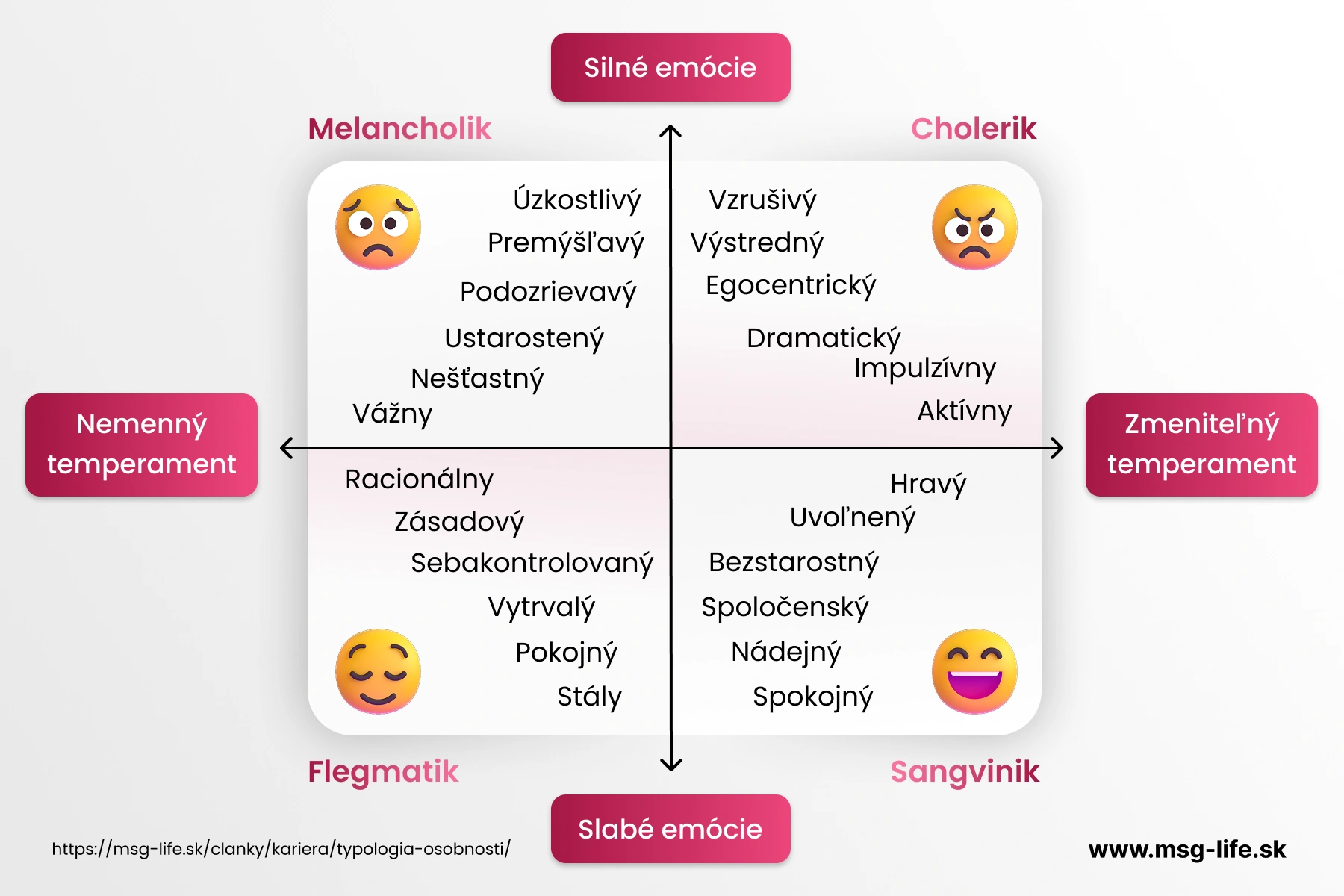
The importance of temperament was first explored by Hippocrates, who came up with the division into four personality types. He assigned to each the bodily juice that was supposed to have the greatest influence on it. However, to make using this theory easier, Galenos named all four personalities:

  • Sanguines (blood) – are known for being sociable, energetic and communicative. This makes it easy for them to make friends, they have no problem working in a team, and they know how to inspire others. Their downside is that they are not always consistent, can be too impulsive and are easily distracted.
  • Cholerics (bile) – they are ambitious, self-confident and dominant, which makes them perfect leaders. In addition, they know how to solve problems very well, they are direct and honest. Their weaknesses are impatience, explosiveness and difficulty accepting criticism.
  • Phlegmatics (phlegm) – tend to be calm, reliable, patient, empathetic, loyal, loyal, organized, and emotionally stable. On the other hand, they can be lazy, reserved, introverted and lack initiative.
  • Melancholics (black bile) – are thoughtful, sensitive, creative, artistic, loyal and have a sense of justice. Their weaknesses are emotional vulnerability, a tendency to pessimism, anxiety and melancholy.
Hippocrates was the first to define four types of personality.

Eysenck’s typology of personality traits

Hans Eysenck was also interested in personality traits and came up with the following division:

  • Extraversion – introversion – while extraversion is known for sociability, impulsiveness and self-confidence, introversion is described by aloofness, quietness and a preference for solitude.
  • Neuroticism – emotional stability – Eysenck argued that neurotic persons are prone to stress, emotionally unstable, and often experience anxiety and mood swings. Conversely, emotionally stable people are calm, balanced, and resilient to stress.
  • Psychoticism – conformity – people with high psychoticism are impulsive, aggressive and egocentric. The exact opposite is low psychoticism, or conformity, characterized by sociability, sensitivity, and moral principles.

For a better understanding, Eysenck combined his theory with Hippocrates’:

  • Extraversion + emotional stability = sanguine
  • Extraversion + neuroticism = choleric
  • Introversion + emotional stability = phlegmatic
  • Introversion + neuroticism = melancholic

Pavlov’s typology

Ivan Pavlov created his own typology based on higher nerve activity. He divided the personalities in the same way as Hippocrates, taking into account the strength of the nervous processes, their equilibrium and ability to adapt.

  • Sanguine – has a strong nervous system, quick reactions and can easily adapt to changes.
  • Choleric – his nervous system is strong, but not balanced. That is why he is explosive and impatient.
  • Phlegmatic – has a strong nervous system, is emotionally balanced and calm.
  • Melancholic – unlike all three, he has a weak nervous system, which makes him unable to cope well with stress and prone to anxiety.
9 min.Why it pays to improve emotional intelligence

Why emotional intelligence in the workplace is so important

In this article, we'll tell you about emotional intelligence and why it's so important.

Big Five – The Big Five by Lewis Goldberg

Lewis Goldberg created one of the world’s most respected theories of personality. It is called the Big Five or OCEAN model and breaks down personality traits as follows:

  • O – Openness – curiosity, originality, creativity and innovative thinking are prominent. Less pronounced is a preference for routine and conservatism.
  • C – Conscientiousness – dominated by discipline, reliability, organization, precision and goal orientation. Minimal recklessness or impulsiveness appears.
  • E – Extraversion (extraversion) – energetic, sociable, assertive and self-confident. Conversely, introversion and a preference for solitude rarely show up.
  • A – Agreeableness – empathy, cooperation, trustfulness and willingness to help others prevail. Only occasionally is there mistrustfulness and stubbornness.
  • N – Neuroticism – predominantly prone to stress, anxiety and instability. Calmness and emotional stability are less pronounced.

Personality typology according to Jung

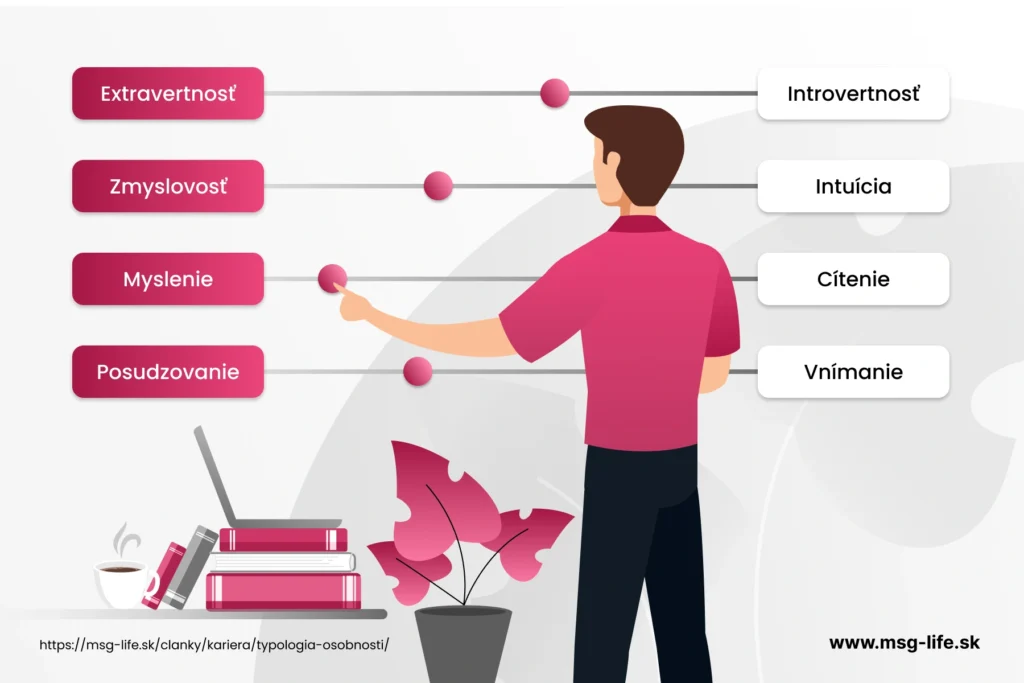
The Swiss psychologist Carl Gustav Jung distinguished people according to two criteria:

  • Attitude to the world – introversion (I) or extroversion (E)
  • Psychological functions – thinking (T), feeling (F), perception (S) and intuition (N)
The difference between an extrovert and an introvert.

By combining these two factors, he created eight basic personality types:

  • Extroverted Sensing (ES)
  • Extroverted Intuition (EN)
  • Extroverted Thinking (ET)
  • Extroverted feeling (EF)
  • Introverted Sensory (IS)
  • Introverted Intuition (IN)
  • Introverted Thinking (IT)
  • Introverted Feeling (IF)

On the basis of all the information from Jung’s theory mentioned above, we can divide people further into so-called dichotomies :

  • Extroversion vs. introversion
  • Sensory vs. intuition
  • Thinking vs. feeling
Did you know that…

… there’s also such a thing as an ambivert? This term describes a person who exhibits traits of both introverts and extroverts.

MBTI – 16 personality types according to Myers and Briggs

16 personality types according to the MBTI (Myers-Briggs Type Indicator).

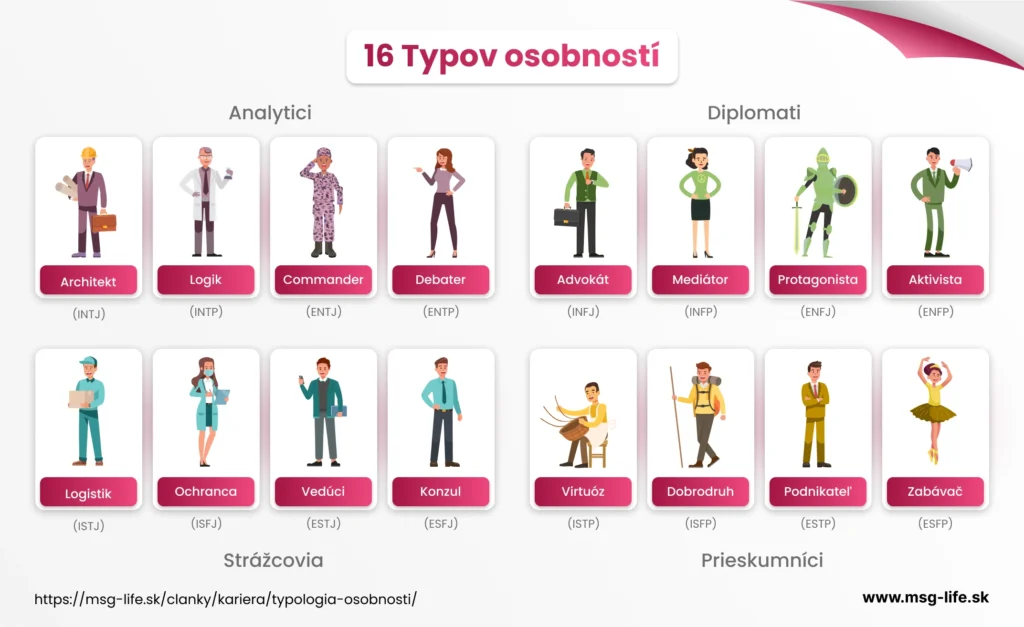
Jung’s temperaments, or personality types, were later expanded in the so-called MBTI (Myers-Briggs Type Indicator), as follows:

  • Analysts:
    • Architect (INTJ)
    • Logician (INTP)
    • Leader (ENTJ)
    • Debater (ENTP)
  • Diplomats:
    • Defender (INFJ)
    • Mediator (INFP)
    • Protagonist (ENFJ)
    • Agitator (ENFP)
  • Guardians:
    • Logistik (ISTJ)
    • The Protector (ISFJ)
    • Head (ESTJ)
    • Consul (ESFJ)
  • Explorers:
    • Master (ISTP)
    • Adventurer (ISFP)
    • Entrepreneur (ESTP)
    • Entertainer (ESFP)

16 personality types according to Socionics

Personality typology is also dealt with in the field of Socionics, created by Aušra Augustinavičiūtė. The division of personalities is very similar to Jung’s, as it is based on it.

Socionics speaks of 16 personalities, which are divided into four groups (blocks):

  • Quadra:
    • Don Quixote (innovator)
    • Dumas (matchmaker)
    • Robespierre (analyst)
    • Hugo (enthusiast)
  • Quadra:
    • Zhukov (leader)
    • Jesenin (romantic)
    • Maxim (inspector)
    • Hamlet (actor)
  • Quadra:
    • Balzac (critic)
    • Napoleon (politician)
    • London (entrepreneur)
    • Dreiser (guard)
  • Quadra:
    • Gaben (master)
    • Huxley (motivator)
    • Stierlitz (director)
    • Dostoevsky (humanist)

Personality types according to Holland

John Holland believed that every person belongs to one of six personality types. His model is called RIASEC and it looks like this:

  • R (Realistic) – realistic – mechanical and practical type of person.
  • I (Investigative) – researcher – an intellectual who can solve a variety of scientific problems.
  • A (Artistic) – an artistic – creative person who is original and independent.
  • S (Social) – social – a friendly person who is interested in social problems and likes to help others.
  • E (Enterprising) – entrepreneurial – an ambitious and sociable person who is a born leader.
  • C (Conventional) – conventional – organized person who likes order and structure.

Personality typology by color

The color personality typology uses four basic colors to define you as follows:

  • Blue – objective people with minimal prejudice
  • Green – peaceful and quiet person
  • Yellow – well-adjusted, positive and lively person
  • Red – courageous people who are not afraid of different challenges

Eight personality types were also created based on the colours:

  • Red – Leader
  • Red-yellow – motivator
  • Yellow – inspirer
  • Yellow-green – helper
  • Green – supporter
  • Blue-green – coordinator
  • Blue – Observer
  • Red-blue – reformer

Where can I find interesting personality tests?

You can find interesting personality typology tests on several websites. Popular ones include:

And as a bonus, check out high5test.com to find out what you’re good at.

Benefits of using personality typology in companies

When you know your strengths and weaknesses, you can work on them and improve them. This is a big plus not only for yourself, but also for the team you work within. By improving certain qualities, you will make it easier to work in the workplace and from your home office, and you will easily achieve both smaller and larger goals.

12 min.8-tipov-na-efektivnu-timovu-pracu-954-600-listing

8 tips for effective teamwork

Teamwork is very important for the effective functioning of the company. Read our tips. If you work as a team leader and are responsible for the functioning and results of […]

When a supervisor knows the personality traits of subordinates, it makes it easier for him to communicate with them and divide tasks. This minimizes conflicts and increases productivity.

Did you know that…

Personality typology helps companies find employees who are truly suited to the position they are applying for. HR professionals can assess their behaviour and work performance.

Risks of using personality trait typology in companies

Although the typology of personality traits has many advantages, there are also disadvantages to be considered. These include, for example, stereotyping and pigeonholing of employees, bias in job and performance appraisals, discrimination against candidates, hindering career progression and underestimating skills.

The results of personality tests should be viewed with detachment. They can give you a lot of important information, but on the other hand, they are not always accurate and a person often has dozens of other valuable traits that the test does not reveal.

Podcast #9: AI mind reading – how close are we to AI reading our minds?

Today’s podcast episode On the Wave of Code is on the border between reality and science fiction. Is mind reading a reality or just a technological utopia? Michal Bystrický, an expert in data science, has once again accepted our invitation to join us in the studio and will tell us what is really possible today and what remains only in the world of fantasy. Listen to him or read his abridged transcript.

In Slovakia, this area has not yet been treated in detail, but at the suggestion of our listeners, we decided to open up this – partly controversial – topic, which is provoking increasingly intense discussions in the world.

How close are we to being able to decipher human thoughts? What technologies are being used today – EEG, MRI or others? Can AI mind reading help in medicine or education? Or can it degenerate into a tool of manipulation? And where is the limit of our privacy?

Did you know that…

…Na Vlne Kodu (En. “On the Wave of Code”) is an IT podcast of msg life Slovakia, which regularly brings you topics from the field of psychology, HR and news from the world of IT? Listen to other episodes of the podcast Na Vlne Kodu.

Michael, let’s look at mind reading from different angles. Nowadays, technology and research in neuroscience and artificial intelligence have reached a level where they are able to recognize certain patterns in brain waves that can indicate a person’s thoughts or intentions. Nevertheless, there are still many questions as to whether direct and complete access to thoughts can be achieved. Michael, is this really just a myth, or are we so far along that it is actually possible?

I think of mind reading as the ability of a system, such as a computer or artificial intelligence, to interpret the signals we measure. These signals correlate with the thought processes of individuals. They are time series that show when and through which neuron an electrical impulse is passing. Artificial intelligence can recognise these signals and assign meaning to them in a computer.

Just imagine you’re thinking about a car. And 300 times we record brain activity and 700 times we don’t. It creates a pattern. This pattern is then “car” and the artificial intelligence can learn it. However, it should be stressed that this is not a literal mind-reading. Rather, it is about identifying patterns – for example, reactions to stimuli or intentions, such as the movement of a limb. That’s when a particular part of the brain is activated.

So, to summarize – the computer monitors brain activity. If I repeatedly think about the car, the brain always reacts the same way. The computer remembers this pattern and can recognize it. But that doesn’t mean it can read what I’m thinking specifically, for example, that I want to drive a car. Rather, it knows that that thought is related to a particular object. That is, it is pattern recognition in the brain, not direct thought reading.

Yes, exactly.

On the subject of mind reading, not only is there a lot of different information being spread, but unfortunately also misinformation. I can think of a moment during the pandemic when there were heated discussions in Slovakia about the introduction of microchips into the brain using test sticks. I am sure you remember that, too – it was during the pandemic. Can we talk a little more about that? Would something like that even be technically possible?

Yes, there was once a hoax that the test sticks used to collect samples for COVID-19 diagnosis contained microchips. These microchips were supposedly to be inserted into the body, specifically the brain, through the nose, and then used – by who knows who – to control thoughts or monitor actions. It has to be said, however, that no mind control or Internet access via such a thing is technically possible yet.

16 min.What is artificial intelligence, history, trends, risks of AI

Is AI really intelligent? What is artificial intelligence, types, trends, risks of AI

In this article you will learn whether AI is really fully intelligent, its types, its impact on the market, the future and jobs.

Nowadays, we have various technologies such as electroencephalography (EEG) or fMRI – functional magnetic resonance imaging – that allow us to monitor brain activity. How do these technologies work? On what principle are they based? And which technologies do you consider the most important when trying to decode thoughts? What makes them unique?

If we are talking about mind reading, there are three basic methods. Measuring the electrical activity of the brain – for example, when we think, do an activity, it produces electricity. The second is measuring the oxygenation of the brain – for example, with a magnet or infrared light. So, when we think, we have different amounts of oxygen in different areas. And the third is the use of X-rays.

In electrical activity EEG, for example, which we measure using electrodes placed on the scalp. These pick up the electrical potentials, i.e. the voltage differences on the surface of the head, which are generated by the activity of neurons. The brain is still processing information, for example, regulating bodily functions and so on. Interestingly, artificial intelligence is being programmed in a similar way today. It actually works like a loop. An agent in artificial intelligence processes information and makes decisions within this loop. In the same way, the brain is continuously processing information. Electrodes on the skin can pick up the electrical signals that are generated when neurons communicate with each other. They pick up the electrical changes that occur when large groups of neurons are activated.

This electrical activity can be divided into waves – delta, alpha, beta, gamma. That is, when I’m in deep sleep, when I’m relaxed, when I’m in an active state of mind, or when I’m in a high state of activity.

The BCI, Brain-Computer Interface, is also based on electricity. An example is Neuralink, which was founded in 2016. It uses microscopic electrodes that are implanted directly into the brain. It’s then much more accurate. In this group there is also the MEG, which is a rather expensive device that measures the magnetic fields generated by the electrical activity of neurons.

Then we have another group – technologies based on brain oxygenation. This includes, for example, fMRI. This is a large magnet that uses hydrogen atoms in water (or therefore in the brain) that are exposed to a magnetic field. These atoms react and give off weak signals. The idea is that the active parts of the brain consume more oxygen, so we can see which areas are more active. Another method in this category is NIRS. This method uses infrared light to measure oxygenation. The light penetrates through the tissues and reflects differently according to the oxygen level.

The last method is by X-ray, i.e. CT scan or computed tomography. These are X-rays, with the computer producing cross-sectional images from multiple angles. The idea is that bones absorb more X-rays than soft tissue, so they appear whiter in the resulting image. By taking images from different angles, the image can be reconstructed into 2D sections.

I’ll summarize. EEG measures the electrical activity of the brain via electrodes on the head. Some people have already encountered this test in practice – it is the monitoring of brain activity, for example in the diagnosis of neurological conditions such as epilepsy. During the examination, we are given a special cap that is placed on the head and brain activity is picked up using electrodes. It’s quick, but doesn’t show details of the deeper parts of the brain. Do I understand this correctly?

Exactly.

Then you mentioned BCI, which allows direct communication between the brain and the computer. It uses EEG to decode signals from the brain. How can I imagine that? What is the difference between EEG and BCI?

Talking about the difference between EEG and BCI, under BCI I mentioned specifically Neuralink. In this project, the electrodes are directly implanted in the brain, which means that surgery has to take place. So the accuracy is much higher than when we just take signals from the skin. EEG captures overall electrical activity, whereas Neuralink captures extremely fine details, that is, individual neurons or small groups.

And then there’s MRI, which measures blood flow in the brain associated with brain activity. It provides high spatial resolution, but on the other hand, MRI is slow and delayed compared to EEG.

Yeah.

And then we have a CT scan. It uses X-rays to create images of the brain. It’s fast and gives a clear view of anatomical problems like fractures or bleeding. But on the other hand, it doesn’t show brain function. Hence, each technology has its pluses and minuses. And why did we stop there? It’s to get to the heart of the subject. Are some of these technologies being used today to map human thoughts?

We’ve already mentioned that we have technologies that can capture brain activity. So we have some signals. Imagine, for example, an EEG recording from one person. We have him do different activities, for example, when he sits still or when he moves his arm.

We will record and mark these sections. When the hand moves, some activity occurs and we mark it as movement. When a person does nothing, we mark the stretch as stillness. Using these labeled segments, we can train artificial intelligence, specifically neural networks.

The artificial intelligence then goes through the EEG recording and learns to discriminate these activities. It can identify what is hand movement and what is stillness. Later, it can identify sections associated with hand movement quite accurately on new, unlabelled recordings based on a pattern.

18 min.Machine Learning - the basics, benefits and challenges of machine learning

What is Machine Learning (ML) – Definition, Models and Difference from AI

Discover what machine learning is, how it works, and how it’s used in real life. Learn about key models, AI basics and practical examples.

Should we be worried that mind-reading will one day invade our privacy?

The closest thing to what you mentioned is just Neuralink, founded in 2016. It uses microscopic electrodes that are inserted directly into the brain. This means the patient has to undergo surgery. The first human clinical trials are already underway as of 2023.

The first patient was a man with quadriplegia, a dysfunction or loss of motor and sensory function in the cervical spinal cord. He was implanted with a chip that enabled him to move a cursor on a screen, for example. This allowed him to control music, play games like chess.

The study also included another patient who could create 3D designs using CAT Fusion 360 software. So we’re already at the level where human clinical trials are underway.

So in this way it could help people with physical disabilities to communicate better.

Yes, especially in the medical field, this technology can help a lot.

Apart from medicine, where could mind-reading be of most benefit? The field of education comes to mind. Will we be able to learn languages more easily, for example? Or could it help in the area of security?

This topic is very broad. The biggest contribution I see is in medicine, as I have already mentioned. For example, the restoration of motor function – the patient who was able to move the cursor on the screen using only his thoughts. Next, prosthetic control – the brain interface may allow bionic limbs to be controlled with greater precision and speed. This is a more precise technology.

In the treatment of neurodegenerative diseases such as Parkinson’s disease, the implant can help control tremors or improve motor coordination. For Alzheimer’s disease, such technologies could help boost memory processes or recover lost memories. Perhaps in the future, Neuralink could store important information directly in the brain or assist in its recall.

In general, as you mentioned, mind control of devices could have a multifaceted impact on all aspects of our lives and society.

When we were explaining the EEG, I also mentioned epilepsy. I had read that in epilepsy there is excessive activation of neurons, which can lead to a seizure. In artificial intelligence, again, it can happen that a certain part of the system gets too much signal and the output is nonsensical or extreme. Do you see a similarity between this overload in the brain in epilepsy and in artificial intelligence systems?

Yes, I do see some similarities in behaviour in epilepsy and in AI. I will mention two examples. In AI, when you intentionally or accidentally modify inputs, it can lead to nonsensical or extreme outputs. In AI, this is called adversarial attacks. Such attacks can disorient the system. Similar to how abnormal electrical activity can disorient the brain during an epileptic seizure.

Second example: in AI, it may happen that a certain layer or neural pathway receives too much signal or activation. This can lead to the output being unnaturally extreme or beyond what we expect. This phenomenon is conceptually similar to excessive neural activity during a seizure.

Could mind reading be a tool for manipulation? How can we prevent this?

So far we have talked about mind reading. That is, we read what we measure and interpret information from that. But we haven’t yet talked about notation. Right off the bat, it should be said that so far this is only about stimulation. It is not possible to write down an actual thought or concrete information.

So what is stimulation? The aim is to affect neurons in a specific area, which can then be used to restore functions that are impaired due to, for example, neurological disorders. This is used to improve motor skills, to stop seizures or to aid memory and learning.

There are already technologies that are being used for this. For example, Deep Brain Stimulation (DBS), i.e. deep brain stimulators. These are medical devices that deliver electrical stimulation to certain parts of the brain.

As for stimulation in AI, there we can amplify scales that are weak. This means that a certain part of the neural network has a higher probability of being activated. A simple way to think of it is that if we stimulate a certain part of a branch of the neural network that is related to reinforcement, that part will be more active and “talk about it more often”.

Michal Bstrický, data scientist at msg life Slovakia, talks about AI mind reading
Michal Bystrický, data scientist at msg life Slovakia, talks about AI mind reading

It is interesting to mention how these deep brain stimulators are implemented. This uses techniques such as MRI or CT scans, which precisely identify the target area related to a particular disorder or symptoms.

Small electrodes are surgically implanted in specific areas of the brain, which are selected by MRI or CT. Then there is a generator that sends controlled electrical impulses through the electrodes to the targeted areas of the brain.

These impulses change or modulate abnormal electrical patterns, which can relieve symptoms such as tremors or stiffness. Specifically, these are the manifestations of Parkinson’s disease. Then the doctor and the patient work together to set the right parameters for the stimulation – intensity, frequency and duration.

I’ll still mention the AI parallel. We can measure which parts of virtual neurons are activated and amplify their weights, that is, stimulate them.

I’ll summarize. It is impossible to write down specific information because the brain is extremely complex and we don’t fully understand how it works. Transmitting specific data would require an accurate understanding of how neurons encode different types of information. And that’s where machine learning comes in to help decode at least the patterns.

Another problem is that if something were to be written down, it would have to be done in such a way that the neurons would correctly interpret the new signals without disrupting existing processes. So we don’t know how to write down specific information yet. The benefit, as has already been said, is more of a medical nature.

Do you think it would be possible to manipulate our thoughts? Because I already sometimes feel like someone is reading my mind – for example, when I want to buy a ski hat and suddenly all I see all winter is ski hat ads everywhere. So someone might be reading my mind, but no one has bought me one yet.

About that ski cap – sometimes it can seem like the current systems are already reading our minds. The way it works is that if you’re talking about ski caps with a friend, for example, and you’re also active on different devices such as a mobile or a computer, algorithms can connect you through information such as location, IP address or network. They’ll then show you ads for ski caps even if you weren’t looking for them before – it’s just that you’ve been talking about it.

If we were to speculate why mind reading might be possible in the future, perhaps it would be related to neuroplasticity. That is, the brain has the ability to adapt and reorganize its structures and functions in response to new experiences, learning, or damage. Perhaps one day the brain will be able to learn to receive new external information, such as from Neuralink.

A good example is playing a musical instrument. When we play when we are young, we see physical changes in the brain, i.e. more activity in specific areas, improved connectivity and lasting changes.

“Sometimes it can feel like the systems are reading our minds – for example, when we see ads everywhere after a conversation about a ski cap. It’s not magic, but a combination of data, devices and algorithms.”

Do you think we should use mind reading to expose lies? Wouldn’t that be too dangerous?

I will give my opinion. I think we should never allow anyone to read our particular thoughts. They could be misinterpreted or misused, which would violate privacy. When we talk about controlling a computer by the subconscious mind, that’s different. But when reading specific thoughts, there is the problem of mistranslating those patterns into reality.

With mind-reading technologies also come various ethical dilemmas, particularly with regard to privacy. If these technologies are used without consent or proper oversight, we could run into problems. What precautions would you recommend to be taken to prevent the possible misuse of these capabilities?

Again, this is a big topic, so I would like to mention here just some of the important aspects. It is mainly about privacy. We should ensure that our thoughts remain private, and that is very important. Any intervention in the brain should be voluntary and informed, that is to say, the user should give consent for such intervention.

Then you have to ask, what happens if someone changes your thoughts or memories? How will this affect your identity and personal autonomy? These are questions of identity, integrity and free will. Finally, there is the risk of misuse of these technologies, for example, for unethical purposes, manipulation or mind control.

Do you think these technologies will become a normal part of our lives or will they remain only for a small group of professionals?

Let me use an example from history. When cars began to appear in the early 20th century, many were sceptical. Cities were full of horse-drawn carriages leaving litter in their wake. Despite the initial mistrust, the practicality and efficiency of cars overcame this scepticism.

Similarly, today we have blockchain technology. Despite the initial difficulties, they are already changing the way we store value (e.g. bitcoin) or trust, as they enable transparent execution of contracts without intermediaries. The practical benefits may in time ensure that blockchain will be as much a part of our lives as cars.

When we talk about Neuralink and similar technologies, they are still at the very beginning of their development – just like cars in their early days. Neuralink is currently the subject of discussion and research, and it is possible that it will eventually become integrated into our daily lives. But that will take some time, in my opinion.

Michal, how would you sum up today’s topic in a nutshell?

I see the theme in two main levels – reading and writing information. In terms of reading, we currently have only very limited ability to measure and interpret patterns of what is going on in the brain. Writing is not currently possible – we can only stimulate certain areas. So these technologies do not allow for literal mind reading, let alone writing. The benefit so far is mainly medical.

Very close to this topic is artificial intelligence, specifically neural networks. There are still many unknowns there, but it is artificial neural networks that can help us better understand how the real brain works. The difference is that we can easily do experiments on an artificial neural network – for example, activate or deactivate certain areas – and observe how the system behaves. With a human, of course, it’s much harder. If anyone is interested in this topic, I recommend you start researching artificial neural networks.

Hard skills vs soft skills – which skills will help you get your dream job?

Hard skills vs soft skills – which are more important? If you’re asking yourself the same question, the answer is clear: both. Both hard and soft skills are an important set of qualities that can help you perform better at work, impress recruiters and land your dream job in fields like IT, marketing or even developing futuristic technologies for space missions. But before you set out to improve them, you should find out what these English terms actually mean and what the difference between them is.

The difference between hard skills and soft skills

The biggest difference lies in the way they are acquired and developed. You can learn hard skills directly at school, in workshops, training or courses. They are known for the fact that they can be measured in some way. A great example is language level, which is assessed from A1 to C2.

Soft skills are their opposite. Either a person is born with them and has them naturally, or he acquires them later through various life situations and experiences. This does not mean that they cannot be developed – quite the opposite. Soft skills are just as important to employers as hard skills, and in many cases they even favour them. So definitely don’t underestimate them.

The difference between hard skills and soft skills is also reflected in where you list them on your CV. Hard skills belong in the “Skills” section, which also includes information about the certificates, courses and workshops you’ve taken. You can also mention some in the ‘Education’ section, especially if you are describing your major or degree programme and the skills you have acquired.

hard skills vs soft skills

Read more in the article: How to write a good CV and what mistakes to avoid?

And where to put soft skills? You can add them in the “Skills” section, which is usually under education on a CV, or mention them in a cover letter or cover letter. However, they are best presented directly at the interview and then at work.

Recommend
We recommend:

Recruiters will notice your soft skills even if you do not explicitly mention them. For example, you demonstrate punctuality by arriving on time for an interview, active listening by maintaining eye contact and giving relevant answers.

What are soft skills?

As we have already indicated, soft skills represent skills that are more natural to humans. Many of these skills you have from birth, but you can develop them over the course of your life thanks to the different situations you find yourself in.

They are very difficult to measure. Their main role is to facilitate your functioning in society, improve interpersonal relationships and strengthen cooperation with others. They are important not only in work but also in personal life.

Although measuring and defining soft skills is challenging, it’s important to pay attention to them and continually develop them – especially during periods when you’re changing jobs or going through major life changes. For example, if you’ve worked remotely for years, your skills like teamwork or team leadership may not be at the same level as someone who has been in a team all the time.

Don’t underestimate the power of soft skills. They may seem less important than hard skills, but they play a key role in the work environment. They help you communicate effectively, understand colleagues, resolve conflict and think critically. This leads to better job performance, which can mean a promotion, a pay rise or a move to a better position.

hard skills vs soft skills

Examples of soft skills

Imagine a situation where you have to solve a difficult task under time pressure. It is not enough to know how to program or analyse data, but also how to communicate effectively, manage stress and organise your time well. Soft skills include:

  • empathy,
  • communication skills,
  • stress management,
  • presentation skills,
  • support and teamwork,
  • time management and organisation,
  • proactivity and initiative,
  • conflict management,
  • positive attitude to work and adaptability,
  • motivation and dedication,
  • assertiveness and expression of opinion,
  • problem solving,
  • critical thinking (“out of the box”),
  • Leadership,
  • creativity,
  • analytical thinking,
  • personal development and learning,
  • perseverance and finishing tasks.

You don’t have to master them all to succeed. All you need is a combination of a few that you actively work on.

Interestingly, some soft skills can help you develop others. For example, if you focus on empathy, you’ll understand your colleagues better, which will help you improve communication.

Did you know that…

… companies that until recently prioritised hard skills are now increasingly recognising the importance of soft skills? Recruiters are now looking for people who are reliable, empathetic, able to work in a team, adapt to change and are not afraid to tackle more challenging problems.

What are hard skills?

Hard skills, also referred to as hard or technical skills, are skills you can learn throughout your life. You learn them either at school, on courses or on the job. They are known for being relatively easy to measure, most often through a variety of tests and tasks.

Since hard skills can be learned, you don’t have to have any special predisposition for them. However, it’s an advantage if you’re familiar with the field – learning new knowledge is much easier and more natural.

Another characteristic of hard skills is their specificity. Each profession requires a different set of skills that you should master (at least at a basic level) because they are needed to perform a specific job. This is a marked difference from soft skills, which are more universal and many of them, such as empathy or communication, can be used in any job field.

Examples of hard skills

They are mostly related to technical knowledge, working with tools or professional practices in the field. Here are some of the most important hard skills that can increase your value on the job market:

Did you know that…

… some skills fall into both categories? A good example is sales skills. In terms of soft skills, this is the ability to communicate with the customer, persuade them to buy and empathise with their needs. In terms of hard skills, we are talking about knowledge of the products being sold, sales techniques or CRM systems.

How to acquire and improve soft skills and hard skills?

Acquiring and developing hard skills and soft skills is not difficult if you know how to do it. The following tips can help.

Hard skills

You can gain and strengthen them in the following ways:

  • Take online courses – a great way to improve your existing hard skills or learn something new. It’s best to choose certified courses, for which you’ll also get a certificate upon completion.
  • Join a community of people with the same interests – you can find lots of practical information on websites, Facebook groups or forums where people with similar interests meet. You can discuss with them, ask questions and get valuable advice or tips. At the same time, you’ll expand your network of contacts and increase your chances of getting interesting projects or job opportunities.
  • Ask for feedback – feedback from a supervisor, peers or experts can be helpful in improving your hard skills. If you don’t get it automatically, don’t hesitate to ask how they rate your work and where they see room for improvement.
  • Practice your skills and knowledge (find more in our article on “Resume skills tips”)regularly – to be good at your job, hard skills are not enough to acquire. You need to practise them all the time, for example through tests, courses, workshops, professional books or websites.
  • Start working – have you completed the course and have the basic knowledge? Don’t wait and start looking for a job. Many companies are looking for juniors with minimal experience to train. Don’t be afraid to send them your CV.

Soft skills

For acquiring and improving soft skills, you can do the following:

  • Choose the skills you want to develop – the list of soft skills is usually longer than the list of hard skills. So it’s important to choose just a few (ideally two or three) that you want to work on in a targeted way.
  • Find information on your chosen soft skills – find out more about the soft skills you want to improve. Read books and articles, listen to podcasts or watch documentaries and videos.
  • Put it to the test – technical knowledge is important, but even more important is its application in real life. Skills such as active listening, empathy and expressing your opinion can be practised in everyday interactions with people.
  • Be open to feedback – even with soft skills, feedback is the key to improvement. Ask colleagues, supervisors or loved ones to give you objective feedback on your strengths and weaknesses.
  • Don’t be afraid to step out of your comfort zone – soft skills are best practiced by exposing yourself to new situations. If you usually work alone, try teamwork. If you’re worried about public speaking, try presenting a project in front of colleagues.

Hard skills vs soft skills – which is more important?

Hard skills and soft skills are equally important for career success. They influence each other greatly and enable you to achieve the best possible results at work. While hard skills make the technical side of the job easier, soft skills help you fit in with your team, work with others and communicate your ideas and goals effectively.

The best way to do this is to try to improve both types of skills – not only on a theoretical level, but also in practice.

Which skills to add to my CV?

Which skills you should put on your CV depends on the job and the requirements stated in the job advert. For some employers, empathy, communication, team leadership and foreign language skills are key. Others are looking for a candidate who is a natural leader, has an analytical mindset, can solve problems and is proficient with a variety of technical tools.

So make sure you read up carefully on the job offer and the employer and tailor your CV accordingly.

Also, remember that you should only highlight the main hard and soft skills that you know best on your CV. You can describe them briefly or say more about them in the interview. However, be sure to avoid a long list of qualities that tells the recruiter nothing about your real skills.