
Podcast: Women in IT – less stereotypes, more opportunities

She learned about programming from her sister, found her first IT job in testing, and today she’s diving even deeper into software development. In his podcast Na mojom kompe to ide, Michal Hucko interviewed our very own Xenia. Tune in to hear more about why testing can be the ideal entry point into the world of IT, what skills are essential in this field, and how women are thriving in the IT world.

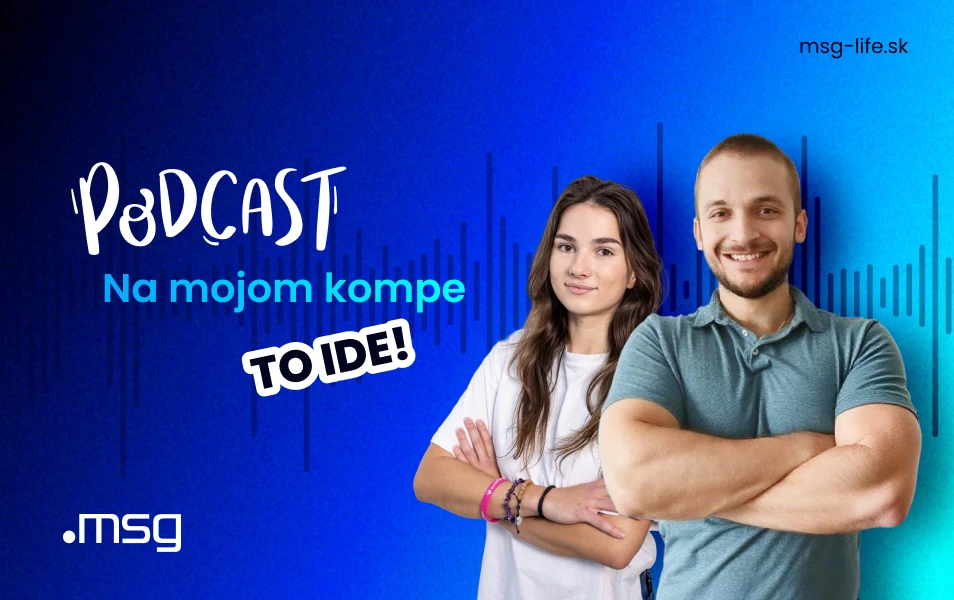
Welcome to the podcast Na mojom kompe to ide. My name is Miso Hucko, and in this podcast, we discuss interesting IT topics and interview people who have something to say about the world of technology.

Today, we welcome Xenia Richnakova, with whom we will talk about women in IT in Slovakia and what working in software testing looks like. Let’s start broadly – how did you actually get into IT? When did you decide that this was your path?

Truthfully, it wasn’t that I told myself back in high school: “I want to get into IT.” I originally wanted to study chemistry or biotechnology. But the more I learned about it, the more I realised that working with data, data mining, and automating different processes plays a big role there. And that’s when it started to make sense for me to understand at least the basics of programming.

Then, my plans changed a bit – I wanted to go abroad to study, ended up taking a gap year, and I also spent some time in Germany. And that’s where it all turned around. Thanks to my sister, who is a programmer, I learned that there was a tester job. I had no idea that such a role even existed, but it sounded interesting – so I gave it a try.

And I found out that I actually enjoyed it. I started learning more, discovering new things, and eventually, I went from chemistry to the IT world.

Recommend
We recommend:

Would you like to listen to a podcast directly from msg life Slovakia? Check out our podcast Na Vlne Kodu, in which we regularly bring you topics from the fields of psychology, HR and news from the world of IT.

So, it was your sister who got you into IT. That’s very similar to my experience with my brother. When I started programming, he did too. I think it’s perfectly normal for people at secondary school not to know what they want to do yet. It often emerges and takes shape naturally. So, was your first contact with IT really thanks to your sister? Or was it already present in your family? Did your parents encourage you to use technology?

I would say it came mainly through my older sister. However, when I was 16 or 17, I started to take a greater interest in the job market. Since then, I’ve had part-time jobs wherever I could find them. I wanted to travel, so I earned money for my own trips. At the same time, I observed the expectations placed on people in different roles.

I came across terms like Python, SQL, started researching more about it, watching videos and tutorials. So even in high school, there was a spark of interest, even though I hadn’t yet decided that I was going to dive into programming fully.

25 min.Gender equality in IT: How to improve equal opportunities for women and men?

Gender equality in Slovakia: What do the latest statistics say and how to contribute to gender equality in IT?

Are you interested in the topic of gender equality in IT? Read our article for the latest statistics and interesting facts.

That’s great. When I was in high school, my life revolved around computers and games. After school, my friends and I would turn on League of Legends, and that was it. Was it the same for you?

I used to play games, but more in elementary school. It was also League of Legends. In high school, it was more about friends and traveling; I didn’t have as much time for gaming anymore. I was more interested in how things worked – the technical stuff – rather than the actual gaming. As you say, the vast majority of people come to programming through games, which I think is really cool.

Sure, so the best way to get into programming is to play League of Legends. The next step is to go to a IT university and study something related to programming. Just kidding! The path to IT can come from many different directions. Now tell me – what do you like best about IT? What do you enjoy most about this field?

For me, the number one thing is that I enjoy the work. I get up in the morning and look forward to it – and I think that’s what matters most. I see programming as a game – it’s like solving logic problems or puzzles. You have challenges in front of you that are sometimes difficult, but the feeling when you solved something is amazing. That’s what I enjoy most about it.

Exactly – it’s about finding solutions, exploring, and discovering. And if you enjoy it, you’ve won. Btw, are you studying programming at university or have you already finished?

I’m currently in my first year. I am studying at an online university in Prague; the field is called Software Development. I think it’s nice to have formal education, but it’s not essential. You can be a good programmer without it. It’s more about what you want – your expectations and where you want to go in the IT world.

I often compare it to being an eye doctor, for example. You can do a specialised course on laser surgery, learn the technique, but without knowing how the whole body works, you lack context. And it’s the same with programming. You can specialise in a specific thing – frontend, backend, databases – but some knowledge gaps simply remain without formal education. Formal education can give you the foundation you need sometimes.

I see, so it’s mostly about what you expect from it. Specialisation can be nice, but a broad overview is also important. Another thing – you mentioned that you started working while you were still in high school. How did you actually get your first IT position?

Those first part-time jobs were not in IT. They were retail jobs – Kaufland, clothing stores, etc. I didn’t start in IT until after I graduated from high school. First, I went to Germany for half a year, but I came back earlier than planned. And then I “accidentally” got a position as a tester. I was in the right place at the right time – companies were hiring aggressively at the time. This was before the AI boom.

My advantage was that I speak German. The company wasn’t looking for someone with a technical background; rather, they wanted someone who could learn the business and understand how the product should work from the user’s perspective. This is often more important in testing than coding itself.

“You can enter the IT industry without university – all you need is motivation, language skills, and the right opportunity.”

This is a great example of how you can get into IT without a degree. Sometimes you really just need to pursue opportunities, be prepared, and know the language. And at the same time, testing often acts as a gateway – a lot of people start there. Do you agree that you can get into IT through testing without being a programmer?

I totally agree. I know several people who came into IT this way, indirectly. Because the whole software development cycle isn’t just about writing code. There’s a huge process behind it and many different roles – from analysts to testers.

And that’s exactly what’s great: you can gradually choose the direction that suits you. You start as a tester, and if you find you’re more interested in communicating with people and business, you move into an analyst or team leader role. If you’re drawn to the technical side, you can shift towards programming. It’s all about what you want and where you want to go.

8 min.zivotopis-programatora

How to write a developer CV + IT CV templates

Read our new article to find out what a developer CV should look like and what it should contain.

A lot of people don’t even know what testing actually is. How would you describe it to someone who has no idea?

Testing is basically quality assurance. Imagine a team of programmers. Every day they commit something to the repository, i.e., they add new code or make changes according to the requirements from the customer, product team, or analysts. Those developers are like “builders” – they assemble the application piece by piece.

Then there’s the tester. Their role is to verify that what’s been programmed works as intended – and, most importantly, to ensure that no unrelated parts of the code were accidentally broken in the process.

It’s a critical role because IT is a relatively young industry. For instance, twenty years ago, testing was very different. In the 1990s, there was little focus on testing. Often, developers would just click through the software briefly, and that was it. The result? Customers received applications that didn’t work as expected, were full of bugs, and required users to test the software themselves. That’s far from ideal because customer-side testing is the most expensive form of testing.

Today, testers play a vital role in the team – they safeguard quality, ensure functionality, and prevent unintended side effects. The earlier a bug is caught, the lower the cost to fix it.

Testers are essential – they ensure everything works. The earlier a bug is found, the cheaper the fixes are.

Does one have to know programming to be a tester?

It depends on the company. Some positions require no programming knowledge – just curiosity, a willingness to learn, and strong communication skills. For example, when I started, the only requirement was fluency in German. The technical skills came later.

What were your first months like?

The initial two to three months involved onboarding, learning the application, and understanding the business processes it supported. Testers typically join projects that are already underway, not when only three lines of code exist.

In my case, it was a project for a German health insurance company, so I had to familiarise myself with the concepts of healthcare, understand the business logic, and read a lot of user stories. Shortly after that, I also started learning test automation tools, so I later moved more into automated testing. In practice, this means that every day you troubleshoot the application, keep track of the changes the programmers have added, test them, look for bugs, and monitor what failed where. And that’s essentially the day-to-day work of a tester.

So, if I understand correctly, you are testing user stories – that is, specific scenarios of what the customer does in the app. For example, in a bank it would be sending money; in your case, it’s features specific to an insurance company. So you’re effectively playing the customer, clicking through the app, and when something goes wrong, you document it and send feedback to the developers.

Exactly.

Many people mistakenly think that testing is just about clicking and finding bugs, but you also mentioned testing through code – automation. Can you explain this in a simpler way?

The point of automated tests is to verify that something that worked before hasn’t been broken by the new feature. This all clicked for me when I was making my own basic video library app. I had video uploading, searching, specifications. And when I added a plain combo box with preset genres, it broke my search. That’s exactly it – you change one thing, and it breaks something completely different. And this was a very simple app.

And that’s what automated tests are all about: ensuring that what worked once still works. This way, testers don’t have to manually repeat the same sequence of steps over and over again. It’s more efficient than clicking through it manually repeatedly, and it saves time and stress considerably.

So the idea is to find the bugs through an automated process so you don’t have to keep doing it over and over again. And if anyone would like to become a colleague of Xenia – msg life has job offers, particularly for German speakers and Java developers.

Yes, exactly. And testers are welcome too – we’re always looking for new people.

And how many of you are currently in the team?

There are a lot of us together on my project. It’s really a mega project. But I mostly work with four other Slovak colleagues. And I use German every day – the whole app and user stories are in German.

Great, language skills are a really big plus. At least English and German open even more doors. Now for a classic question – if a team has a tester, does it mean that developers don’t have to write tests?

No, that’s definitely not the case. Every developer should test their part – do unit tests. The tester then deals more with integration – i.e., whether the new feature broke something else, or whether all the components still work together. Both roles are important, and everyone should test their part.

Exactly. You complement each other. I know the feeling. My tests always pass until someone else gets involved. The tester looks at it from a different angle – more through the eyes of the user. And that’s what makes their role valuable. Do you have a lot of testers in your company?

Yes, we have many. This is precisely what highlights their importance. If that were not the case, it would be a significant loss for the company.

Testing on customers is the most expensive. In insurance software, this could mean a real problem for the client – and the company can’t afford that. What about you personally – do you want to stay in testing?

I’m basically already in that transition phase. I knew from the beginning that I was going to be drawn more to the technical stuff. I’m attracted to programming. So yeah – my goal is to eventually go fully into development.

And what language are you currently programming in?

Until recently, we only worked on the project in our internal automated testing tool, which is Selenium-based. But it wasn’t quite proper programming yet. At the moment, we are looking for a more suitable modern tool.

If someone wants to start testing, what should they learn? A programming language or something specific to testing?

The best way is to look at job portals like Profesia.sk and find out what companies really require, what they want a person to know. And orientate yourself accordingly.

Sometimes those adverts are written in such a way that one should know 20 technologies, which isn’t quite normal. In your company, which technologies are preferred?

It definitely depends mainly on the project. Everyone has their basic requirements – somewhere, basic SQL work is expected, somewhere else, at least the basics of some programming language. This can vary not only among companies but also within different teams in the same company.

Exactly as you said, getting into testing is often easier than, say, a programming position. And once you’re in testing and you’re thinking about moving further into programming – what’s the next step? Does one need to improve in a particular language? Is it easier from a tester position, or would it be easier to go straight into a programming position?

The fact that I had no technical skills at all at the beginning made testing a great start for me. It helped me understand the basic concepts, how a computer actually works, and what the mental processes are in the code. And most importantly – you can learn a lot there without immediately starting to dive into the code. Sure, if someone knows they want to go into pure programming, they can go straight into it. But if they’re still exploring what they enjoy, testing is the perfect starting point.

“If you don’t know exactly what you want to do in IT, a tester position is the perfect place to start.”

Do you want to become a programmer? Are you going in this direction full-force? You mentioned that you program in JavaScript. Why JavaScript?

We started with JavaScript in the very first year at university. And it suited me – it’s the language of the web and it connected perfectly with what I was doing at work. Work and school went hand in hand.

So are you planning to go the frontend route, or are you also attracted to the backend?

Hard to say. We’re just at that stage now where I’m also terribly curious to see how things will develop in IT, mainly because of artificial intelligence. For now I’m into websites, so more frontend, but I’m keeping the door open. I still want to try a lot of things. That’s what university is great for, it shows you what different areas there are in IT. And then you can choose where you want to see yourself.

So you’re leaving the door open. Is it hard to get started with JavaScript?

It’s hard to say if there is an ideal language to start with. But JavaScript is pretty high level. There are all sorts of things that don’t need to be addressed. Those are exactly the mental processes and concepts I was talking about. You don’t see how the computer works. For example, in JavaScript, I don’t care that I’m overflowing an array now, because I have some dynamic array that changes itself. I don’t deal with it like in C. And it’s questionable whether it’s better to start with a high-level language and go into programming more superficially or start with a low-level one like C and go from the basics all the way in. Everyone has a different path.
14 min.Najväčšie rozdiely medzi Java a Javascript

The biggest differences between Java and Javascript

Java and JavaScript are popular programming languages, they have a similar name but are different in many aspects. Both have their strengths and weaknesses, and each has different uses. What […]

Was it easy for you to switch to JavaScript? You’re studying maths now, but before that, you were at an online university where you didn’t really get much exposure to those low-level languages like C and C++. It’s quite likely that now at your faculty, those lower-level languages will pile up on you. It will then be interesting to compare whether JavaScript is actually easier, or just looks easier because it solves a lot of things for you. In my experience, if one goes the route of high-level languages like JavaScript, one may never even get to C – and often there’s no need to.

I definitely think so. In hindsight, it was a good decision for me. But it certainly wasn’t easy. It took me a long time to grasp the concepts of promises, synchronous code, and the mental processes required for programming. It was like being told to calculate an integral when you’re still learning basic fractions at school.

I think that’s one of the biggest frustrations when someone starts programming. I’d like to learn the very basics first – like “if statements” or “for loops” – but the internet is full of tutorials for much more advanced stuff. And then you don’t know where to start.

That’s exactly what I see in comments under my videos. I do content about the very basics, and people ask, “How do I turn this into a website?” Well… you need to go through dozens of other steps, watch a hundred other videos, and build on that over time. The basics are really important, and without them, it’s hard to move on. You’re getting ready for university – are you excited?

Very much so. Especially since it will no longer be online but in person. I’m very much looking forward to it.

I am a proponent of formal study. I like that you chose a Slovak school. Have you considered going abroad?

I definitely have – I even studied there for a while. It was a motivation for me to learn better English and German. I think it will soon be almost essential to know at least two or three languages in Europe. We are quite limited to our region, and it is languages that open up new possibilities.

And what finally convinced you to stay in Slovakia?

Probably the fact that, for me, home is not about the place but about the people. If I feel like going to explore the world and live somewhere else, I will. But for now, I don’t feel like it. And the big benefit of this industry is that you just need a laptop and the internet – and you can work from anywhere.

I know very well what you’re talking about. I work for a foreign company, and it really doesn’t matter where I am. That’s the beauty of programming – you can work from anywhere. And languages? Those are absolutely essential. I’m not even going to ask if a programmer needs English. In your case, even German. It’s great that you motivate people to improve their language skills.

But let’s move on to another, very topical subject – women in IT. When you say “programmer,” most people still think of a man sitting behind a computer all day. I have a video on my channel, and it’s very popular. Many agree that we just love stereotyping programmers. Do you think programming is only for men?

Certainly not. I think the first programmers were women. During the Second World War, when there weren’t enough men, they were replaced by women. And they did it brilliantly. But that huge gender gap is still rooted in historical and social patterns. We live in a patriarchal society – most company directors are men, and politics is dominated by men. It is something that has been going on for hundreds of years.

“Women in IT need more role models and fewer stereotypes.”

Little boys are told from childhood: “Be strong, be smart, take care of others.” Girls are told, “Be pretty, take care of the house, be a good mum.” These traditional roles have been shaped and passed down for generations. Society functioned as it was most efficient for survival at the time. The man was physically stronger, providing, and the woman raised children and managed the home.

And now we can’t expect that, in the last couple of decades, everything would change overnight. If we want a shift, we need to start with young children. And I feel that this is already happening – for example, even in kindergartens today, children are being guided differently.

10 min.zeny v it listing

Software testing interview: Is IT a healthy working environment for women?

Hanka studied interpreting, but now works as a tester in an IT company. In this testing interview with Hanka from msg life Slovakia, you will find out what it’s like […]

I totally agree. By the way, how does it actually happen that two female programmers come out of the family? It’s not really common. What did your parents do differently? Were they part of the IT world as well? Or did they have a goal from the beginning to raise female programmers?

I suppose they just bought us a Nintendo at the right time, and that’s where it started.

I take that as top parenting advice! I’m a dad now, and I’m considering buying my kid a Nintendo. But seriously – were your parents supportive?

100% yes. Dad was a big gamer – in fact, he still is. So throughout my childhood, we played games, solved logical problems, and always tried something new. And that stayed with me. In our house, it was never suggested that “this is not for a girl” or “play with dolls.”

And that’s the difference. Boys are encouraged to think logically, to solve problems, to challenge themselves. Girls are often steered more towards aesthetics, dolls, or kitchens. And these differences shape how a child thinks and what they enjoy, right from childhood.

So it wasn’t like that with you. The parental influence was oriented in a different direction.

Exactly. And that was probably the key difference.

Okay, it was the parents, but parenting isn’t just about them. It’s also about the environment in which one grows up. When you look back at your classmates – did your school encourage you to go into IT?

Absolutely not. When I was in primary school, such things were not talked about at all. I hope it’s different today, that schools are modernising their approach and encouraging children more in logical thinking and coding.

And if you look at your classmates from high school, there probably aren’t many female programmers, right?

No. From my childhood, it’s just my sister.

A lot of people think that if they don’t get into programming in high school, they’ve missed their chance. What high school did you go to?

I went to a grammar school.

There probably weren’t programming classes every other day where they taught you Pascal or Python?

No, our IT education was pretty weak. We messed around with Excel and Word, nothing special. Yes, those are useful skills, but that’s only a fraction of what we could have learnt.

That’s a shame, if we don’t teach kids in high school the basics of algorithmic thinking, like what a condition is, etc. That’s such a hard concept to understand later…

You can hardly expect someone to teach what they don’t know themselves. They haven’t been guided to do so and don’t have the mental processes they can pass on. It’s just challenging.

I’ve come across companies that have quotas – for example, they must have a certain percentage of women in their team. Do you ever get the feeling that women are given preference not because of their abilities, but just because they are women? And do you think that’s the right way to go?

Honestly, I don’t really want to comment on that because I don’t have direct experience with hiring. Maybe HR teams or recruiters would have a better perspective. But I do know, for example, that in the Nordic countries, they’ve implemented a law requiring every company to have at least 40% women.

Now imagine I have my own company, with a stable team that I know works, and suddenly I have to fire someone or hire inexperienced people just to meet a quota? That would probably be pretty uncomfortable for me. But somehow they’ve managed it – and it’s working.

It’s great that women have been given the opportunity and have taken it. And today, it’s quite common there – women work in many traditionally male-dominated roles without anyone finding it strange. But I think the transition must have been quite difficult.

I totally agree with you. How are you perceived by your surroundings, by your friends? Do they sometimes look at you strangely because you’re in IT or are they supportive?

They support me. And I think I’ve already inspired at least one person to go into IT as well. So yes, the support is there and I really appreciate it.

I think it is important to talk about these experiences. Just as you mentioned – women often think that IT is not for them. The societal dialogue is not quite set in that direction yet, but the numbers don’t lie – women are still underrepresented in the field and need to be encouraged. I recently listened to a Czech podcast on the topic of women in IT. There was a female manager talking about how being a woman in IT forces her to be perfect. Not to make mistakes. Do you feel that way too? That you’re under more pressure to do everything flawlessly?

I’ve always had a mindset of avoiding mistakes rather than making one – but that’s about personal preference. If someone wants to look perfect in front of everyone and pretends to handle everything perfectly, they are just making their life unnecessarily complicated. It’s that person’s decision.

All of us make mistakes. What’s important is what a person brings to the team – new ideas, a different perspective, something positive. That’s how I look at it.

And your future plans? Do you plan to stay working in Slovakia or would you like to go abroad someday?

I don’t think about it. I used to think I would have a precise plan – at this age this, at that age that. But life doesn’t usually work according to plans. I also got into this job by complete accident. And maybe it will be like that with other things too. I’ll see what comes – I’m keeping the door open.

That’s a great approach. And now another question – a lot of people think that programmers just sit behind the computer, hunched over, they get fat… Do you have time for other things besides programming?

I try to do a lot of sports. I take care of myself. The mental rest during sports is very important for me. And honestly – I recommend it to everyone.

It is true that most programmers are also gamers. And when you sit behind a computer for 8 hours and then in your free time you’re back behind the computer playing games… that’s a bit much.

You don’t play at all anymore?

No, I don’t. Unfortunately, there’s no time for that anymore. I prefer active recreation.

After leaving work, do you return to unfinished work in your free time? Do you work on any mini-projects of your own? Or do you prefer to watch an online course or YouTube video?

When I have time, I love to program. And especially with my boyfriend, who is literally my mentor in this. He studied theoretical computer science at at the Faculty of Mathematics and Physics and he really teaches me a lot. We often sit down and program together in the evenings – it’s great. And honestly, I recommend pair programming to everyone.

That’s great. We’re slowly coming to the end of our interview – is there anything you’d like to say to women who are thinking about IT or are already there and would like to push themselves more?

The biggest piece of advice is not to compare yourself too much with others. Not to give in to the idea that I’m slower, someone else is further along, that they already know something and I don’t yet. The best comparison is with myself – where I was a month ago, six months ago, a year ago. That’s when you see most how you’ve progressed. And that’s the real motivation, I think.

“The best motivation is to see your own progress.”

And what do you think society could do to be more supportive of women in IT? Should we focus on schools? Kindergartens?

Definitely start as soon as possible. Already in kindergartens and primary schools. Introduce girls to the world of IT. Show them that it’s not just for boys. There’s nothing special about watching a YouTube tutorial on coding instead of a beauty video. Or when you read an article about technology. And the sooner you get into it, the sooner you’ll get interested.


7 min.girls-day-954-600

Girl’s Day 2025 at msg life Slovakia: Opening doors to IT

Girl's Day 2024 is an initiative to support girls and women in IT. Read the stories of our female colleagues.

Podcast #8: The impact of sport on physical and mental health – how movement affects our mood, motivation and resistance to burnout

We all know that movement is literally vital for our bodies, but most of us don’t have the time or energy. Physiotherapist Braňo Mišovič fromFitclinicwho is the guest on the next episode of our podcast Na vlne kódu, believes that the body and the mind are one. Listen to the inspiring interview that movement is not only about a healthy body, but also about a balanced mind, resistance to stress and a better mood.

The link between physical and mental health is not esoteric, but a very practical reality. When our bodies feel well, we can handle pressure, challenges, and even harder days much more easily. When we are in psychological well-being, we also perceive physical pain in a completely different way.

You may have already noticed that if you do any sport regularly, your mental health will improve. It is also true that after a good night’s sleep, you can handle a busy day with greater ease. And that’s what today is going to be about. How what we do with our bodies affects our motivation and also our resistance to burnout. And in this episode, we’re going to look at what physical habits can make us mentally stronger, how to improve our mood, what movement does to the brain and hormones, and also how to set up our day so that we feel better in the long run and most importantly, without any extremes.

If you feel that the office chair is getting to you, this is the episode for you. Together, let’s see that even small changes can make a big difference. Our host Ivka Hricová, HR manager at msg life Slovakia, talks to our guest.

Did you know that…

… Na vlne kodu (On the Wave of Code) is a podcast by IT company msg life Slovakia that regularly brings you topics from the fields of psychology, HR, and news from the world of IT? Listen to other episodes of the podcast Na Vlne Kodu.

Today, it’s probably no surprise that when we take care of ourselves physically, we feel better mentally. But why is that? What happens in the body when we go for a run, do some exercise or take some steps? Is it just our mood that improves or how does it all work?

It is not for nothing that it is said that movement is the engine and originator of psychological well-being. The underlying principle is the release of certain hormones – specifically endorphins and dopamine, which are key hormones that are linked to feeling good. When we move, these hormones are produced at an increased rate and create good feelings in our bodies. Endorphins induce a feeling of euphoria, reducing the perception of pain – and that’s actually what makes us feel good. This effect is often referred to as “runner’s euphoria”; runners know it. Of course, other physical activities also create and release large amounts of endorphins and make us feel very cool indeed.

“Movement is the engine and originator of psychological well-being.”

Is there any other way to support such a good mood? By eating, sleeping or something normal that we can fit into our daily routine, even if we don’t exercise?

Basically, yes. There are various other methods that can help us. For example, hardening, cold water, the Wim Hof method, a good diet. When we eat something we like, we also feel happy. And endorphins are not only released when we move. It’s with anything that makes us feel good. So basically, what makes us feel good is also healthy for our bodies.

Did you know that…

The impact of sport on physical and mental health is manifested by the release of hormones? Regular physical activity – such as 10,000 targeted steps a day – significantly improves blood flow and oxygenation to the brain, which immediately boosts our well-being and releases endorphins and dopamine, hormones that induce feelings of euphoria and relieve pain.

Is there evidence that the body and the mind are much more connected than we once thought, or is this still in the realm of hypothesis?

It is also confirmed by scientific studies that a real healthy, strong physical body simply makes us feel good. We have self-confidence and when we have self-confidence, we also have a certain peace within ourselves. And when we have peace within ourselves, we also have a certain humility. So it’s such a nice little train that builds on itself. I don’t want to make it sound like only a strong person is the right person. Because I know that a lot of people, when we talk about this topic, they think of this kind of swell guy from the gym who has more muscle than brains.

Physical well-being in a healthy and strong body is not at all related to muscle size. Even if we look at calisthenic athletes, they are very strong, but they are not extremely muscular. But they will confirm that when I am physically strong and resilient, or I am in good shape, I also have a certain amount of confidence and belief in my abilities. And the psyche works for me, not against me. I’m coping better stress at work, in the family, because I have the comfort of that health in me. When a person is ill, weak, not feeling comfortable in his body, he may be wise in his own way, educated in his own way, but it will reflect on that psyche in the form of discomfort.

I also have patients who are medically disadvantaged and have to work very hard on their fitness. Since I am with them often, I see the physical amplification in them significantly in how their mood improves. Conversely, when there is a period when they go down physically, it automatically affects the psyche a lot. I experience the same thing with professional athletes and with ordinary people in practice. When we make them physically healthy people, they literally shine – in their personal and professional lives. So it’s absolutely connected.

Movement is not only about a healthy body, but also about mental resilience. What physical activities reduce stress the most? Is it better to sweat during an intense HIIT workout, or to indulge in a longer walk in the woods?

It is individual. But something completely different in the body is created by high-intensity interval training – the HIIT or tabata, which is also interval training, just with a different interval setting. HIIT created in me in a very short time a feeling of well-being, happiness, because I get sweaty, I breathe, I get pleasantly tired. In a very short period of time a large amount, even a rush of endorphins is created. So when I need to save time and I want to take the stress out of myself, I go to something like this.

But the question is whether it is healthy for the posture, for physical health, bones, muscles and joints. Because HIIT is an exercise that targets something precisely. If I take exercise really just to improve my psyche, HITT is a very good system in a short time. While I would induce a similar amount of endorphins when walking, for example, I would have to dedicate a lot more time to it. In order to accumulate as many endorphins while walking as I do in 30 minutes with HITT, I would need to walk three to four times longer – so at least 2 – 2.5 hours. And not a slow, shuffling walk, but a bit more brisk.

Ideal is Nordic walking, where I also engage my upper limbs, because people don’t normally engage their upper limbs when walking. And yet engaging the arms to move the legs is an absolute natural thing to do – that’s when I can even get close to HIIT. So if I were to answer your question strictly, HITT will provide a great supply of good hormones in a short period of time. Walking a bit slower and I have to dedicate more time to it.

Recommend
We recommend:

Need advice on how to combat stress and anxiety? Read our article: Tips from our colleagues on how to manage stress at work.

Which kind of movement do you consider the most underrated? Or on the other hand, what is overrated and doesn’t make as much sense?

Now I’ve picked up HIIT a little bit and I’ve sort of put walking on the back burner. But when you put the question like that, I’ll answer it quite accurately. Walking is the most underrated and yet it has huge health benefits. It just needs to be dedicated to for longer periods of time. The most overrated, in turn, is HIIT exercise, because it has the benefit of quickly draining you. I’ve knocked stress off of myself, but the effect on the physique as a whole is debatable.

“Walking is the most underrated movement, yet it brings huge health benefits.”

Let’s go back to walking and to steps. Those 10,000 steps we should take every day, are they for the whole day?

10,000 steps means to tense the muscles of your body 10,000 times in some way, i.e. to activate them. It’s a number that is calculated maybe in a very general way – for somebody it’s more, for somebody it’s less. One larger study found that 10,000 steps is ideal for maintaining cardiovascular health. Careful, cardiovascular, meaning the blood vessels of the heart. That doesn’t mean that if I walk, I’ll have a healthy posture or anything like that.

In the field of cardiovascular health, the 10,000 steps are ideal for all the biomechanisms that need to work in the human body. But they need to be done purposefully. If I look at my watch in the evening and there are 20,000 steps, it doesn’t necessarily mean anything. Is it really 20,000 steps that I’ve done cyclically and purposefully? That I walked for two hours straight and did 20,000 steps? Or is it just 20,000 random movements, because the watch is based on the principle of gyroscopes and counts any shaking as movement?

So for me, those 10,000 steps have to be the 10,000 strict steps. I set aside time to walk, start watching the counter, and walk. Otherwise, it’s just random hand-generated movements and random steps. We need a cycle. Then the body will work in certain intentions, because I won’t do 10,000 steps in 35 minutes, I’ll do them in maybe an hour – an hour and ten minutes, and the body after 30 – 35 minutes will trigger completely different biomechanisms. Exactly the ones that we want. The ones where it starts to burn continuously, where the fluids in the body start to flow steadily, etc. These are not randomly generated movements. I’m going, I’m just going. Foot in front of foot, hand in front of hand. So that’s the way to see it. 10,000 purposeful steps. All the others are random.

I’ll also bridge to the drinking regime, because it is very important during the day. How about drinking water?

In the drinking regime, the split occurs again. Again, there are many studies, so let us agree on this one. If our body is to have something to cleanse the intestinal apparatus and for what it has to go into the blood vessels, we cannot count tea, coffee, soup, juice in there, because there are so many supplements that the stomach has to deal with. Thus, what it has is no longer going into the intestinal circulation. That purifier, that something pure, that’s just water.

So, if I have to drink 2.5 litres of fluids a day, it means 2.5 litres of pure water. Tea, coffee, soup – that’s something else. We should not put these two things together. If I’ve had 3 dcl of soup, another soup in the evening, half a litre of tea, these are things that the body has to work with again and has to put in the work to process them. And on top of that, there’s the product that goes into the gut. I need the gut and the stomach to have to work as little as possible. That’s why I need to drink that amount of plain water, so that I’m always clearing those “pipes” as best I can.

The Wim Hof method, which we have already mentioned today, is also quite popular. Cold plunges, breathing exercises, body work, perhaps sometimes to extremes. In your opinion, can it also be useful as a prevention against burnout? Isn’t it already too much of a shock to the body?

Talking about cold in general, it has great benefits for the body. To put it in technical terms, even a computer needs cooling for the processor. Because when it overheats, it does not perform and can be destroyed. And it is the same with the human body. The human body has certain cooling processes, but it has to put some work into them. That is to say, when we cool the body, we relieve it from having to do a lot of work in warming up when it is cold outside. That is, we prepare and train it for something that it then has less work to do.

The Wim Hof method is primarily based on breathing. Fibrillated breathing, rapid intermittent breathing, etc. There are many techniques. I am absolutely not an expert on the Wim Hof method, but purely from my experience as a hardy swimmer, I know that the cold and the subsequent warming of the body after coming out of the cold water simply has to cause an influx of endorphins for one simple reason. The body needs to warm up and just like any other movement, the blood vessels will dilate. So they dilate really considerably. That vasomotion, that vasodilation, causes a lot of blood flow. And because it causes proper blood circulation and we breathe, we bring a much greater volume of oxygen into the body. This makes the body come alive.

And this is the principle. Oxygen is absolutely the most important commodity for the human body, in the sense of supplying oxygen to the tissues. And I’m going to feel significantly better. If I’m not breathing, I’m breathing shallowly, I get a headache. We say I don’t have enough oxygen, I’m out of breath. Well, then let’s do the cold plunge, because cold plunges are all about breathing. And the cold is just an aid to make the blood vessels constrict and then stretch. We use the cold to constrict the blood vessels because we can’t constrict them any other way. So water is just an aid.

For me, working out is excellent for stress relief because it actually creates a similar environment to when I run, walk or exercise. The blood vessels start to dilate and constrict, thus the body starts to get better blood flow and oxygenation. And when I give my body all this, what I don’t give it for hours and days, I automatically feel better.

“An excellent thing to relieve stress is cold plunge.”

Is it similar with the sauna, when I go from the sauna to the ice water?

Yes, the cold water is the most important part of the whole sauna experience. If people forget this, they don’t sauna as they should. There are the terms positive and negative thermotherapy. Negative thermotherapy is the cooling down, it’s actually the cold plunging. Positive thermotherapy is warming up. For example, a Finnish sauna is called a cardio sauna, there you don’t relax the muscles at all. My body can’t warm up that deeply there because the temperature is so high that the body expends enormous energy to cool itself. That’s what sweating is. That’s extreme sweating. That’s why I’m only in the Finnish sauna for a little while, 10 to 15 minutes. And that’s when my heart is practically working, because then I go into the cold water, the blood vessels contract again, they stretch, and therefore the heart is working. That vasomotion, vasodilatation – that means my blood vessels are dilating, contracting. That’s what the Finnish sauna is all about.

But when I go to an infrared sauna, where the temperature is much lower, more than half, in the range of 50, 55 to 60 degrees, the body has time to heat up more slowly. It doesn’t open up the self-cooling mechanism as profusely, so our muscles get warmed up to a much greater depth. That’s why we don’t use a Finnish sauna after sports, but an infrared sauna, because it actually relaxes our muscles to a greater depth. Or saunas with a lower temperature, where the body gradually absorbs the temperature and relaxes the muscles down to the deeper structures.

I don’t go to the cooling pool after these saunas. It’s enough if I go to the air, to the tepidarium. So yes, sauna has the same effects as cooling down, it’s just from the opposite end. After cooling off in the cold water, I go out in the air, so I usually start to warm up because I have to cover up. I should cover myself in something warm. And this one is just the opposite. I go from warming up to cooling down. So the principle is basically similar. Also, before a normal sauna, there were certain rituals when I’m supposed to warm up. Same as before cooling down. I should take a breath according to the Wim Hof method. If you look at some of our other polar bears in different shows, they’re jumping in that water because they’ve gotten used to it over the years. They’ve already practiced it. But when I start, I have to start with breathing. Even in that positive thermotherapy, that means sauna or cooling down. It’s all about breathing. That’s the first point.

But let’s go back to the movement itself. Is just 5-10 minutes of exercise a day enough to make us feel better, or do we need to work out for at least half an hour – an hour?

Sometimes even a little is better than nothing at all. Just do something. In fact, in 10 minutes, I could destroy you so badly, you wouldn’t know where north is. Really, there’s an exercise called the MREP type – do as many reps as you can in the time given and I’ll have you do three exercises in a cycle. You’ll do this one twice, this one twice, this one twice. If you do as many as you can in 10 minutes, you’ll reach your limit and you’ll be done. But then again, we’re back to that high-intensity interval training.

I’ll tell you how I do it. The less time I have to train, the more intense my training is. If I have more time, I go more into endurance development. If I only have half an hour, I go almost to the edge – interval training. And if you take that person just a regular everyday, untrained person, in those 10 minutes they’ll do the exercises at a high intensity and really get a good workout.

Researchers have calculated that the equivalent of 8 hours of sedentary work is one hour of purposeful cyclical movement. One hour of walking. So, make your own judgement as to whether 10 minutes will be enough. Still better than nothing, that’s how I’ll sum it up.

“The equivalent of 8 hours of sedentary work is one hour of purposeful cyclical movement.”

Let’s go back to the office now. After every hour we should exercise. How can I exercise? Can I just walk to get a coffee, for example?

No, it’s not enough. I have to do targeted exercise. It’s not enough to go purposely for coffee, that’s an alibi approach. Because if you go for that coffee on purpose, are you really going to walk that beautiful walk? Left hand in front of the right foot, right hand in front of the left foot, right? Are you going to keep an eye on it ? You’re gonna turn on your heel and you’re gonna go.

Isn’t it more sensible to actually take those two or three minutes? I have them all to myself. I sit and breathe for a minute. Now, Ivka, if we close our eyes for a minute and we go to breathe together, in that minute you can feel that at least you are pleasantly dizzy, because you have oxygenated yourself. A little more than normal. And after that minute, we stand up and go stretch ten times right, ten times left. We’re gonna do ten lunges. Ten times we stand up from the chair, shake our head. There’s no substitute for walking for coffee. I’ll say again, it’s better than nothing, but let’s not look for escapes.

Which is better for our mood and for our head? Is it running or fast walking? For example, I’ve heard that running burns more carbs and walking burns more fat. Is that true? And what has any effect on our psyche at all?

It is said that we burn more fat when walking than when running, because if it is an ordinary untrained person, he will have a lower heart rate base when walking. And because he has a lower heart rate base, he doesn’t necessarily need to use fast sugars. That means when I take a doboche or a gel, that’s a fast sugar. The body is going perfectly fine, struggling to cover energy expenditure from what it burns from fat. Of course, something goes from the fast sugar as well, even though we have a lower heart rate base when we walk, but it has plenty of time to make the energy we need from that fat. Because it’s a little slower to make it from that and it takes longer for the body to do it.

But when running, a person who is untrained and goes out to start running has a much higher heart rate. So the body automatically needs a faster supply of fast energy. He doesn’t have time to process the fat. Because when he is running, his heart rate is 150 and I need to supply him with energy quickly. But in turn, as a well-trained endurance runner, when I run at a slow pace for me, for example 6 minutes 30 seconds per kilometer, I have a heart rate of 111. For you, that’s a borderline pace where you have a heart rate of 150. What do you think, am I burning sugar fast while doing that? I’m not.

So it’s individual. I’ll show you x number of people who have health problems and they’re 150 when they walk. Those go on fast sugar all the time. So you’ve got to adjust your walking speed as well to keep your heart rate at a level where you’re burning fat. For example, there are zones Z1 – Z6. We know that in the Z1 zone, for example, we’re only using 50% of our body’s potential. In the Z5 – Z6 zone, we use 100%. So by those zones, I know that when I’m in Z1 – Z2, I’m going quasi on fat. That I don’t need that fast sugar. But as my heart rate goes up into zone Z3, 4, 5, I need that energy more and especially fast.

Which types of exercises do you think are the best if you are mentally exhausted and no longer have the strength for big performances, but want to at least move your body a bit and turn off your head?

For me, these are such “lazy exercises” as walking, Nordic walking. There I clean my mind beautifully and the body does not work in high intensity. It goes along with the same intentions, in that cyclical way where it can tune in to everything and everything becomes in sync. Then stretching and breathing exercises, pilates. Just where I’m engaging the body in a kind of quasi isometrics, like those dynamic exercises.

I mean, yes, HIIT will get you pumped up in a short period of time, it will quickly knock everything out of your head. But sometimes it can also make the psyche worse, because it may not go the way I want it to. After just three minutes I feel tired, I’m not in the mood for that explosiveness. So I leave the training more disgusted than when I went there. After walking, I have nothing to be more disgusted about. When I walk, I don’t stress the body as much, but at the same time I do an incredible amount for it. There are a lot of studies on that.

Walking is often underestimated because it is not as intense as other forms of exercise. Yet regular walking improves cardiovascular, muscular, mood and reduces stress. Precisely because there’s that cycling. I might put on some music or a podcast to go along with it and my thoughts will drift somewhere else entirely. Whereas with that high-intensity cardio, maybe I really can’t, I don’t feel like it, I have to listen to the coach. I’ve dealt with that, I’ve been doing those HIITs for years. It’s a lot harder to motivate that person then. So for me walking, stretching, breathing exercises.

How does sitting for long periods of time affect our body and mind? Could it be the silent thief of energy?

It’s true. Sitting is an unnatural position for the body, prolonged sitting means prolonged inactivity. Even if I have those slots in there every hour, it’s a totally unacceptable position for the human body. It’s just not moving. So yes, sitting is a silent killer in every way, and it definitely needs to be compensated for as much as possible.

6 min.Proti bolesti chrbta ti pomôžu správne sedenie a cviky

Back pain from sitting at a computer: tips for correct posture and workout

Almost every person who has a sedentary job is familiar with back pain problems. Hours without movement, stiff muscles, incorrect sitting position or a poorly adjusted monitor. These are all […]

Why are we more tired after a day in a chair than if we had physically worked?

Precisely because nothing happens in the body. We don’t have it sufficiently oxygenated, we have clogged, clogged blood vessels. You’re not doing anything, you’re not putting out energy. Most people who are sitting are probably working mentally. When I’m working mentally, I have to engage my brain and my brain threads. And the brain is a machine that needs a lot of sugar. So I automatically reach for something. So I’m messing up my health by not moving, plus the intake of nutritious foods that aren’t appropriate.

There is a so-called tree theory. For a tree to be healthy and resilient, it needs to grow upwards and have no obstacles. Because when it has them, it weakens it, the trunk is crooked, leaning. It is the same with the human body. It needs to stretch and move as much as possible so that the biomechanisms that need to be triggered in it are also triggered. This is myofascial movement, movement between fascia, musculature, then other structure. Everything is driven by movement.

So I must feel tired when I sit for a long time because I have an unnatural position, my muscles are in unnatural positions and tensions, or the opposite of tensions. A lot of my muscles are then weakened, other muscles are in turn shortened, so I have huge disproportions in my body. Nothing works as it should. So the fatigue just has to set in. Fluids don’t flow in the body the way they should. We’re not getting enough blood flow. We’re not vascularized enough in the acral areas. The body goes like half throttle on supplying the body with beneficial substances.

We are talking about movement. Is it just about blood circulation or is there something deeper going on there, chemically, hormonally, or mentally? How do the processes in our body actually work?

everything is connected. Let’s try to imagine it as a kind of mechanism on old trains, a “backstage” mechanism. When a wheel moves, the driven wheel through that scenery moves another wheel. That is, I’m setting the whole scenery mechanism in motion.

When I’m not moving, none of those mechanisms work. Thus, the physical tied to the mental doesn’t work for me either. The bad mood, the feeling of emptiness, of not being satisfied will come to everyone at some point. I know a lot of people who work in the IT sector, which is probably where they sit the most, and there are those who will say they are absolutely fine with it. But when I ask why you came for a massage – well if it suits you, your back doesn´t hurt or anything. And they’re already chatting. I say, so basically it doesn’t suit you.

The fact that it suits him for the psychological side, well, fine. He’ll be fine with it for a while. And there are even some people that it doesn’t do anything to their psyche. They’re perfectly OK with sitting. But they have a completely broken body. And then that starts to make them angry and suddenly their mood is spoiled again. That their body is not working, which is where the soul and the brain reside.

Either way, it’s loading up.

Ivka, it’s always related. Absolutely all mechanisms. When I don’t move, my vascular supply doesn’t work. When there’s no vascular supply, the muscles don’t have elasticity. The fibers aren’t sufficiently vascularized, nourished. When they don’t have enough blood supply and I stand up, it hinders my movement. I’m hunched over, I can’t bend over. I have pain behind my knees. I can’t do this movement, that movement. I go to play catch a little bit with the kids and I can’t do it anymore. So it then follows all the processes in the human body – from the mental to the dissatisfaction of not being able to do something.

We already know why we move. Now let’s figure out how to do it. Let’s give some simple tips on what we can do every day, even when we have a busy calendar. Can we try some breathing exercises?

100% yes. Breathing exercises are a very popular exercise that many physiotherapists include, as it is quasi-physically demanding unless the body is used to the movement. It has a beneficial effect on the whole body just by getting it properly blooded and oxygenated. In this way I will finally bring oxygen to the most remote areas of the body, it will finally start to live and function there. And most importantly, through breathing exercises, one will slowly work up to the essentially physical exercise as well.

I would definitely put breathing exercises on the very first step when I want to start doing something for my body. To try, those tutorials are relatively many. The simplest one is to try to breathe in as long as possible, breathe out as long as possible. There are a lot of apps where I can set a time and meditate in peace. Work with the breath. Learning to breathe into the shoulders. Learning to breathe into the diaphragm. For diaphragmatic breathing, it’s better to have someone teach you, because you can hardly test yourself if you’re really breathing into your diaphragm. But in any case, breathing is such a first step.

“Breathing exercises have a beneficial effect on the whole organism just by making it properly supplied with blood and oxygen.”

What simple physical exercise can anyone really do? Whether at work or at home, without having to spread out a mattress between chairs?

Every healthy person should be able to do one key, one squat, do a deep squat, hold it.

What if someone has problems with their knees, spine, etc.?

Then I just go into as deep a squat as my knees will allow. Quite normally I engage common sense. I don’t have to give up the squat. Because that squat, that movement in my knees, gives me health in those knees. Because when my knees don’t move, it creates changes in the cartilage that then cause problems. I still have to work with that knee to get the articular surfaces in there to ride out the way they’re supposed to be. So that various osteophytes and stiffening of the knee don’t develop there. And especially when I move, my knee also naturally lubricates with synovial fluid, which seeps in when the knee moves.

And this applies to every joint. When I’m not moving, I’m just not. And at home, I can do whatever my body allows me to do. I can move my arms, my legs, I can stretch them, bend them. I can squat, I can bend over, I can lie on my back. I can move my limbs calmly and chaotically. Just to do something.

And if you want specific exercises, different types of squatting exercises, exercises where I’m extending my limbs in a seated position, forefoot straddling and straddling in a seated position, straddling in a standing position, forefoot straddling in a standing position, straddling in a seated position, straddling in a supine position, lifting both lower limbs in a supine position, we have abdominal exercises. There is a huge amount of exercises. When someone asks me which three exercises I would single out, it’s the squat, the kneeling squat and the sit-lie. Or rather, not the sit-lie, but the shortcut. I mean, some sort of core exercise. Just the simplest.

Don’t complicate things unnecessarily.

For what? Everybody says that sit-ups are not a thing anymore. Yes, they do what’s called shortening, where I go for that upper abdominal muscle and I just do that chest lift. When I want to strengthen that lower part, I put my hands under my butt while lying on my back and lift my extended lower limbs, or legs off the ground in a perpendicular direction. So I can really do any exercises that are very simple.

How do we set up our daily routine so that we don’t feel like a jigsaw puzzle? To keep our mental and physical in balance?

It is necessary to set aside time during the day just for yourself. This time, these 10, 15, 20 minutes, is just for me. And this is the balance to what I have behind me after a full day of work.

I have a workout habits at work. In the morning before work, I have a warm-up. In the evening, I do a little stretching, which prepares me for a restful night’s sleep. And if I have a consistent system of doing 5 Tibetans in the morning, doing something else during the day, then after work I take 10, 20, 30 minutes and go walk, go work out, go on the treadmill, go bike, I’ve practically done the best I can and I can’t feel like I’m a jigsaw puzzle afterwards. Because I’ve got a system in place. If a breathing exercise makes me feel better for the evening, some mantra I’m reading while I do it, complete relaxation, some yoga exercise, I do that. If I’m a more dynamic type of person than that and a routine of those 100 push-ups and 200 abdominal exercises does me good in the evening, I do that and I look forward to it. I’m perfectly happy to have a 10 o’clock time and go work out. And then I’m even more happy because I kept it. So I really have to set aside time. There’s probably no other way to do it, Ivka, there just isn’t.

I understand, basically everyone has to find their own thing.

Exactly, your system. But it should be sustainable in the long term. That is, not to set unrealistic goals. If I can’t do more than 10 reps of that exercise, I’m not going to give myself an unrealistic goal like I’m not going to go to sleep until I’ve done 10 reps of the whole thing. I’m fine going with what I’ve got. I’m packing some motivation and strength and gradually increasing that.

Definitely need to start. That’s where it all starts. An awful lot has already been said, there is an incredible amount of motivation and guidance on the internet, and I guess I’m just repeating some of it now too. But you need to have, or you need to try to build that routine within yourself. It’s hard, it takes time.

“You need to set aside that time during the day for yourself and only yourself. Sometimes even ten minutes is enough.”

If you had to pick some kind of exercise to relieve pain, what would it be? My neck hurts at work, what should I choose?

I really like pilates, so I would probably go in that direction. I would definitely go to a Pilates class, possibly a physiotherapist who does Pilates and there is a wide variety of exercises I can learn. He can be a huge help to me with a lot of postural problems. Stiff neck, lower back, weakened abdomen, etc.

What if my hand hurts, for example, because of working with a mouse?

The hand mostly hurts people who work a lot on the computer or even seamstresses. Mostly it is carpal tunnelwhich arises precisely from the inactivity of the variety of movement of the palm and finger parts. So I try to stretch my forearm, stretch my fingers in all possible directions, use simple strengthening exercises, for example, squishing a rubber ball or a strengthening ring, opening my fingers to the absolute largest possible opening, spreading my fingers, clenching my fists and especially stretching my forearm.

It is there that the movement binds, it stiffens there, so expressly stretching the whole forearm is paramount. I push my fingers backwards, also the whole palm part, then in the opposite direction, that is to the bottom, I move left, right with the whole wrist, circular movements in the wrist. This I would say is general yet very effective for everyone.

22 min.Na-vlne-kodu-Work-life-balance-954x600

Podcast #1: Work-life balance and healthy work-life boundaries

Listen to the first episode of the Na Vlne Kodu podcast, where topics like burnout syndrome, work-life balance and the art of saying no are discussed.

What would you recommend to everyone who wants to start moving a little bit? Maybe even ten minutes in the morning is enough? Or some stretching in the evening with Netflix, or did we mention like those Tibetans, yoga?

100% yes. Whatever movement they are going to do, let them do it in the sense of some cyclical movement. So feel free to start with five Tibetans, feel free to start with a 10-minute warm-up in the morning, add to that some other exercise for 10 minutes in the evening.

I don’t see the problem in how much time to devote to it, but mainly to get started. Stretching, those Tibetans, is totally awesome for the morning, but cool for the evening too. After a full, sedentary day, too. Stretching rather than that intense exercise. If we’re talking about people who sit a lot. And who are just starting out. In the evening, I’d also opt for stretching exercises.

If you came to me as a client and asked me what to do in the morning, I’d tell you to do this stretching exercise in the morning, you’re going to do lunges. You lean your butt against the wall and you slowly lean forward, you rub your palms up your thighs to where your back lets go. You repeat ten times. If you don’t have a problem with that, keep going. You’re back against the wall, arms outstretched, you rest your palms facing forward against the wall and do half-arches. You stretch your arms above your head, doing circles. There’s a lot of exercises. I’m moving my shoulders, my shins, my whole body. Those are the deep squats. I can grab the table, the door, the radiator, if I can’t get into that deep squat. Or I just go within where my knees will let me so I don’t fall. But I’m trying to get all my joints moving.

How to stand properly at the sliding table?

We are not standing on one leg. I always stand nicely on both legs and with my tummy tucked in. The moment I retract my belly, my pelvis sits up slightly. So from antiversion to retroversion, that’s where we should have it.

If you had to give one main message to everyone who wants to improve their life through healthier movement, what would it be?

Move. To find the time, the space, the routine to just do a few of those simple exercises every day. And let’s say what they can start doing today is during their busy day, try to take those two, three minutes every hour to exercise. And to not pay attention to the fact that somebody’s giving me some weird look. After all, it’s my health, not his.

Web accessibility – WCAG 2.2. and new EAA rules from June 2025

Web accessibility is one of the hottest topics currently being addressed by medium and large enterprises. That’s because from 28 June 2025, a new European directive comes into force that will require almost all websites (with a few exceptions) to be accessible to absolutely everyone – including people with a disability or impairment. Who all needs to prepare for the new changes and what to look out for?

Web accessibility for users with disabilities

Web accessibility, or web accessibility, allows any user – including those with a disability – to view and use a website. Such sites are usually designed to be enlarged, to be controlled by keyboard or voice, or to allow individual texts to be listened to. In this way, they do not restrict people who have:

  • visual impairment,
  • hearing problems,
  • movement limitation,
  • learning disabilities or cognitive problems.

Accessibility is also beneficial for other user groups. This includes seniors who don’t have a lot of experience with websites, or who may be bothered by shaky hands. Nor should we forget those who have only a temporary health or other handicap – for example, a broken arm, a poor internet connection, and so on.

Did you know that…

IT news

Are you interested in IT and AI news and trends?

Subscribe to our msg IT community and receive newsletters about IT news, events and job offers.

If you are looking for a chronological record of the latest news and trends, don’t hesitate to read our article IT news from the tech world.

The good news is that accessibility can be ensured in a number of ways. In addition to enlarging the font or screen reader support as mentioned above, the following can also help:

  • subtitles in videos or moving pictures,
  • clear and logical structure of the content,
  • simple texts that even a layman can understand,
  • sufficient colour contrast, etc.

The importance of accessibility

Accessibility may seem like a less important factor that many people don’t think about when creating a website. However, the exact opposite is true. It is a key element – not only because of the new law, but also because, according to statistics from 2023, certain disabilities have up to 27% of the EU population. That is approximately 101 million people, almost one in four adults in the EU.

This data only confirms that when creating a website or e-shop, you should definitely think about people with disabilities. By ignoring their needs, you could be missing out on a large number of potential customers who would be interested in your products or services.

Did you know that…

According to EU statistics, Latvia has the highest proportion of people with disabilities (40.7%). Denmark (36.7%) and Finland (34.8%) round out the top three. Slovakia is in the middle of the ranking with 30.5% of people with disabilities.

Technical accessibility standards – what’s new?

The topic of accessibility was not much discussed until 2022, when the new law was passed. The most important document in this area was a decree of the Ministry of Investment, Regional Development and Informatisation of the Slovak Republic. However, this concerned mainly state websites and websites of municipalities or schools.

However, this was not enough, and the European Union issued the so-called. European Accessibility Act, also known as EAA. It includes the EN 301 549 standard, which is based on WCAG 2.2 at level AA. This standard will not only apply to state websites or websites of local governments, but according to the Act 351/2022 Coll., also to:

  • websites and apps that provide air, bus, rail and water passenger transport services,
  • websites and apps providing information on transport services,
  • financial services such as mobile banking and internet banking
  • eBooks and specialised software,
  • online shops and the like.

WCAG 2.2 standards

Web accessibility is a very general term that can be interpreted differently by everyone. This is why several norms or standards that give a better idea of what an accessible website should look like.

One of these standards is the Web Content Accessibility Guidelines – WCAG 2.2. According to them, accessibility is divided into three basic levels:

  • A – these are the most basic and minimum requirements that you must implement in your website to make it accessible. This includes things like alternative image descriptions, keyboard control, or proper contrast. However, according to EN 301 549, this level is not enough – to avoid the risk of a fine, your website must meet level AA.
  • AA – WCAG 2.2 AA is a higher level that makes the web clear and understandable for most users. Requirements include, for example, the logical arrangement of content, structuring using subheadings, and consistency of elements that influence how users navigate the site.
  • AAA – the highest and most difficult level to achieve within WCAG 2.2. For some websites it may not be realistic, but it is advisable to incorporate as many of the solutions as possible. This includes, for example, sign language in a video or its text transcription.

What can I do to make the web accessible?

There are several ways to create an accessible website that is clear and easy to read. For a better overview, we’ve prepared a WCAG 2.2 checker to help you make at least basic changes.

  • Proper contrast and font size – when creating a website, always choose the right combination of colours that won’t clash with each other and ensure good readability of the text. Also make sure the font is large enough. Text that is too small can be a problem not only for users with visual impairments, but also for ordinary visitors.
  • Text transcription or subtitles – provides a transcript from the video into separate text, making it accessible to people with hearing problems or those who can’t currently play the audio. Subtitles perform a very similar function.
  • Zoom option – this can be to enlarge text, images or any other elements found on the site.
  • Clear design – makes it easier to navigate the site and find information. This advantage is especially appreciated by users with lower technical skills.
  • Keyboard control – The WCAG 2.2 checklist must include the ability to control the site using keyboard shortcuts, which is essential for people with mobility limitations.
  • Clearly labelled elements – this includes, for example, CTA buttons or links to other subpages. They should be clearly visible and clearly labelled so that visitors can easily spot them.
  • Alternative text – images and graphic elements should contain alternative descriptions that can be easily read by a screen reader. People with visual impairments will always know what is on the page.
  • Zoom option – this is the ability to enlarge text, images or any other elements on a web page.
Recommend
We recommend:

Make sure your website is responsive – meaning it displays correctly and is easy to use not only on a computer or laptop, but also on mobile devices or tablets.

Exceptions

The new law will affect a large number of companies and businesses. However, there are exceptions that will not be affected. This group includes:

  • micro-enterprises with fewer than 10 employees,
  • micro-enterprises whose annual turnover does not exceed EUR 2 million,
  • content that was published before the date of entry into force of the Act (i.e. before 28 June 2025),
  • websites that have only archive content – remember that to fall within the exceptions to the law, their content must not be updated in any way after 28 June 2025.

Sanctions

The Slovak Trade Inspection (SOI) will be in charge of controlling compliance with the new directive and will have the power to impose sanctions. Their amount will depend on the specific situation. However, fines should start at EUR 200, while in particularly serious cases they can reach EUR 20 000 to EUR 30 000.

It is therefore important to prepare for the law as soon as possible to avoid unnecessary inconveniences that could cost you dearly.

How to prepare for the new rules?

There are several ways to prepare for the new rules. First of all, read up on all the important information about accessibility. You can get it from professional articles or courses. For example, you can find a free course at Web.Dev, where all the details are written down.

Then do an accessibility audit. Find out where your website currently stands. Do you have any solutions in place? If so, are they working as they should? Several testing tools will help you with the audit, as listed below.

Did you know that…

Read also:
What is Accessibility Testing

In the last step comes the implementation of the solutions into the web. Find out what all it lacks according to WCAG 2.2 AA standard and fix it as soon as possible.

What can cause accessibility problems?

Modern websites today offer a large number of features. However, some of them can cause problems in terms of accessibility. This includes, for example, entering passwords. Many e-shops and websites require passwords to contain a variety of special characters and numbers in addition to letters. However, this can be a major barrier for people with visual impairments. In such cases, it is ideal to incorporate code-based authentication into the site, which the system automatically sends via SMS. Biometrics may also be a suitable solution.

Another accessibility challenge is CAPTCHA. It can be easy to tick the box and prove you’re not a robot if you don’t have a disability. However, if you have a visual or cognitive impairment, you may not be able to solve the logic puzzle correctly. Many people therefore opt for the honeypot method in such cases. In this method, web developers insert hidden fields into forms that are not supposed to be filled in – but the bots don’t know this.

Don’t forget about the various animations or pop-ups, which can be difficult to read for some groups of people. In addition, they may also be difficult to close. It is therefore ideal to omit these elements altogether.

Tips on testing tools

The best way to find out if your website meets the necessary standards is to use tools that automatically test it and provide important information.

Practical automated tools include:

If you want to check the colour contrast, you can use for example:

Tools like SARRA or Google Text to Speech can help you transcribe audio. There are also a number of plugins available for accessibility testing, such as Lighthouse or Web Developer Tools.

Recommend
We recommend:

Some tools are free, others work on a freemium model. . This means that basic features are free, but if you want to use more advanced features, you’ll have to pay for them.

A modern accessible web is essential

Accessibility is important not only because of the new law, but also because of the large group of people with disabilities. Whether you already have a website or are still planning to create one, be sure to keep this area in mind. Incorporate all the key elements we’ve mentioned and test your site regularly. This is the only way to ensure it meets all the necessary standards and avoid the risk of heavy fines.