

Work-Life Balance: Proper Setup, Proven Tips, and How to Live in Harmony

Work-life balance is important not only for overall well-being but also for productivity and achieving both personal and professional goals. Maintaining a healthy boundary between work and leisure time is far more difficult today than it was in the past. If you feel that you lack life balance, we have prepared a few tips to help you break free from this vicious cycle.

What is work-life balance?

The dictionary defines work-life balance as the ratio of hours spent working to the number of hours dedicated to family, friends, and leisure activities – such as exercising, reading, travelling, and the like.

While work-life balance was once a normal part of life that people rarely thought about, in today’s world it is an increasingly important topic, highlighted by many experts. With the advent of technology, hybrid work models, and home office, the lines between professional and personal life are becoming blurred. Employees are working longer hours, leaving them with less and less time for hobbies or loved ones.

It is not just technology or changes in the way we work that complicate maintaining a balanced work and personal life. Often, it is employers themselves who disrupt this balance by expecting 100% flawless performance and constant engagement from their employees. In pursuit of perfect results, many overextend themselves and spend extra hours working.

The key issue to understand is that a lack of rest and free time leads to both physical and mental exhaustion. This automatically affects work performance, which begins to decline. Employers should therefore pay attention to work-life balance and offer benefits that support it.

Why is work-life balance important?

Balance in life – both personal and professional – is crucial for programmers, testers, and all other IT specialists for several reasons:

Preventing stress and burnout

Stress is now a common part of life for most IT professionals. And it’s no wonder – heavy pressure from superiors, excessive workloads, long hours at the computer, countless tasks on the to-do list, and ignoring one’s own needs are just a few of the contributing factors.

However, everyone has their limits, and if you ignore them for too long, you risk reaching the edge of professional burnout. Burnout syndrome is a serious problem that can affect you for months or even years. It manifests through emotional and physical exhaustion, a loss of motivation, and reduced performance. It should not be taken lightly – incorporating rest into your daily routine as soon as possible is essential.
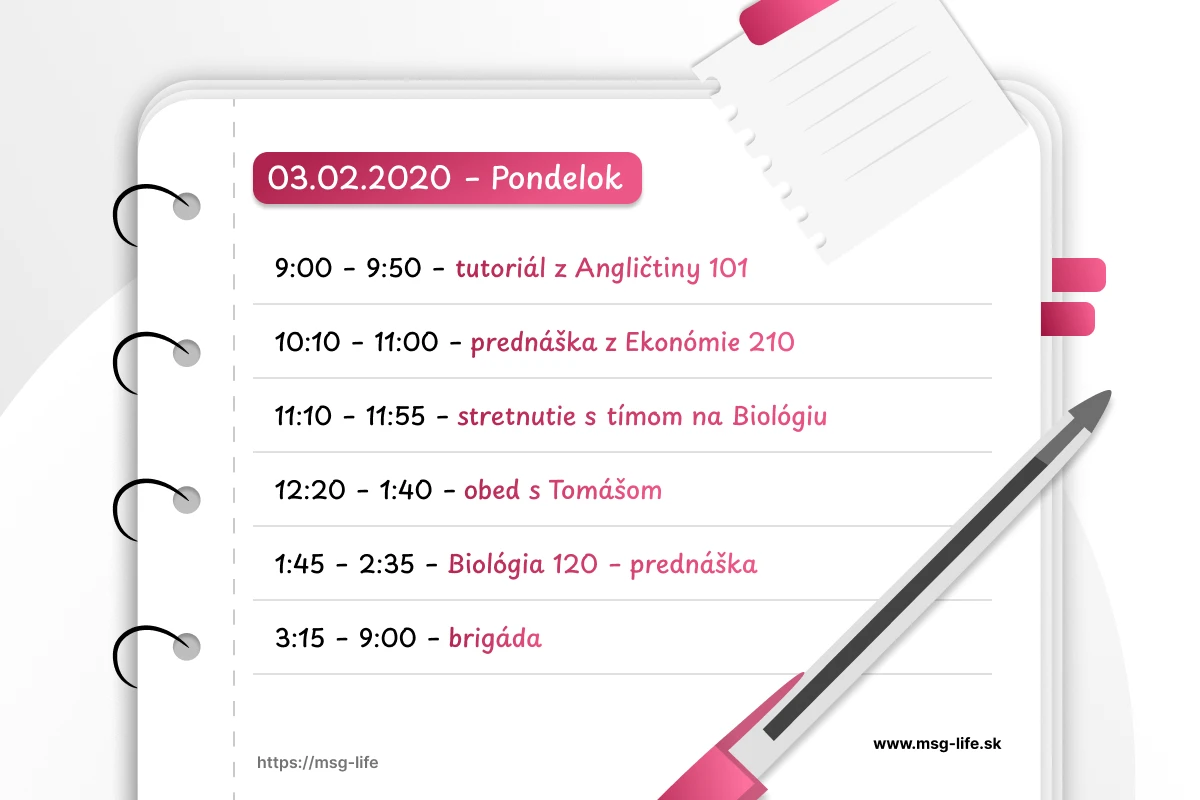
A crowded calendar

Improved mental health

A poorly set or completely missing work-life balance may initially show no adverse effects. That is why many people ignore it for months or even years. A shift usually occurs only when the first warning signs appear, such as:

  • anxiety
  • irritability
  • depressive moods
  • feeling of overwhelm
  • lack of motivation and productivity

The sooner you include enjoyable leisure activities and time with loved ones in your life, the sooner you can get rid of these unpleasant feelings and start feeling better.

16 min.maju firmy zodpovednost-za dusevne zdravie listing

Interview with a psychologist: Do companies have responsibility for employee mental health?

Learn why your work environment needs to be healthy, when it’s time to see a psychologist and how to get rid of acute stress. Alena Jancigova is a psychologist and […]

Stronger interpersonal relationships

If you do not have enough time, it is not only you who suffers, but also your relationships with family, friends, and close ones. Work obligations often push them into the background, which can lead to tension, arguments, or even losing certain people from your life.

However, with the right balance in place, you do not have to fear this. You gain enough time to spend with those you care about, strengthening your mutual bonds.

Higher productivity and motivation at work

If you work continuously without breaks, your productivity will inevitably decline over time. This is a natural consequence of overwork and lack of rest. To perform well, you must also know how to rest – not only in the evening before bed but also during the day, for example, through sport or another relaxing activity.
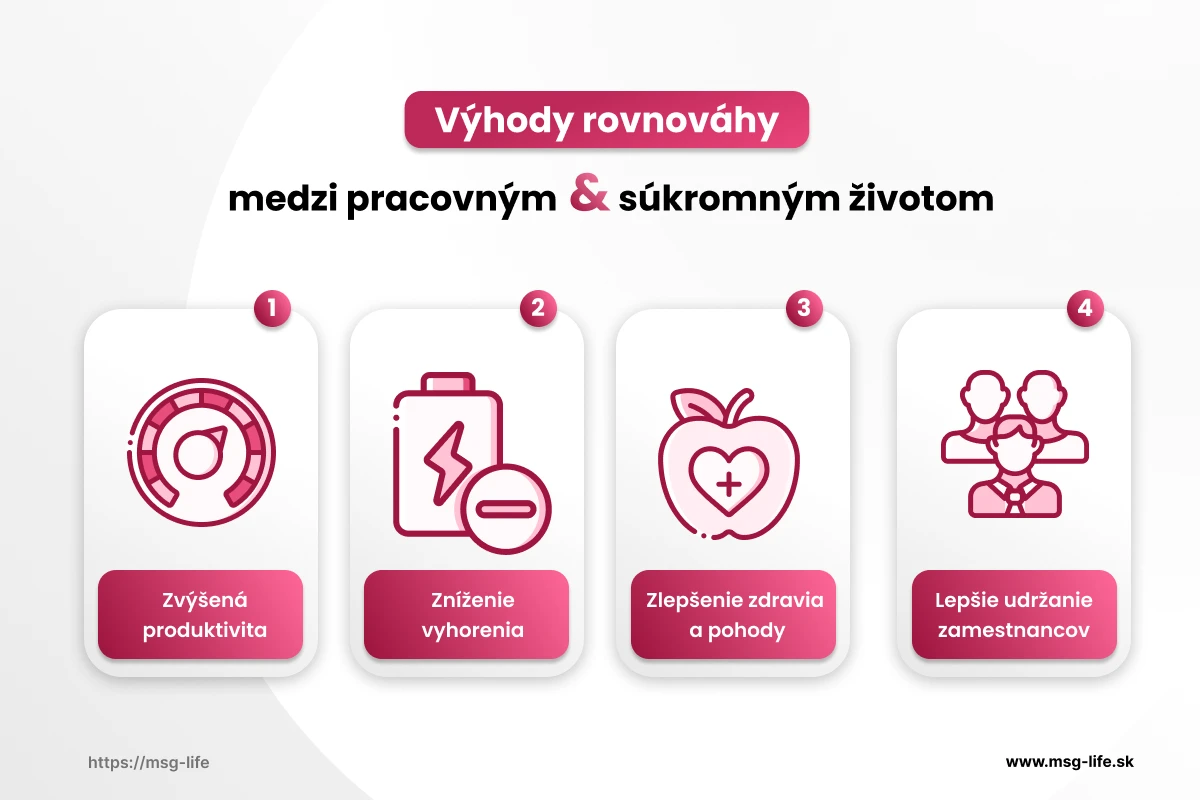
4 benefits of living in balance

Better physical fitness and health

A chronic lack of free time causes stress, which weakens the immune system and leads to issues such as digestive problems, back pain, migraines, and other health complications. However, regular and quality rest can help you prevent these and ensure greater comfort and physical well-being.

Personal growth and self-realisation

Work is undoubtedly a significant part of life, but it is not the entirety of it. Your mind and personality need more – spiritual growth, new knowledge, skill development. These aspects are important not only for mental well-being but also for career advancement. What you learn in your free time often proves useful at work.

A sustainable lifestyle in the long run

Your lifestyle should be set up so that it is sustainable in the long term without major sacrifices or extreme changes. Constant work, however, is not sustainable. If you do not put a stop to it yourself, sooner or later your health will.

Therefore, set clear boundaries and respect your needs. This approach is not selfish and does not make you a lazy person. On the contrary – it helps you progress and achieve better results.

Proper work-life balance setup for remote workers

Maintaining work-life balance while working remotely is more challenging than it may initially seem. Employees bring work into their homes – spaces that previously served only for rest and leisure. This blurs the physical boundaries between two essential areas of life, which begin to overlap.

Home office comes with many advantages – it saves time and money and allows work in a pleasant and familiar environment. In the IT sector, which is more flexible than many others, it has become a standard. However, for those unaccustomed to it, it can significantly disrupt daily rhythms.

Work can very easily intrude into regular domestic activities or relaxation. All it takes is working longer than usual for a few days or postponing tasks until the weekend – and your daily rhythm gradually changes.
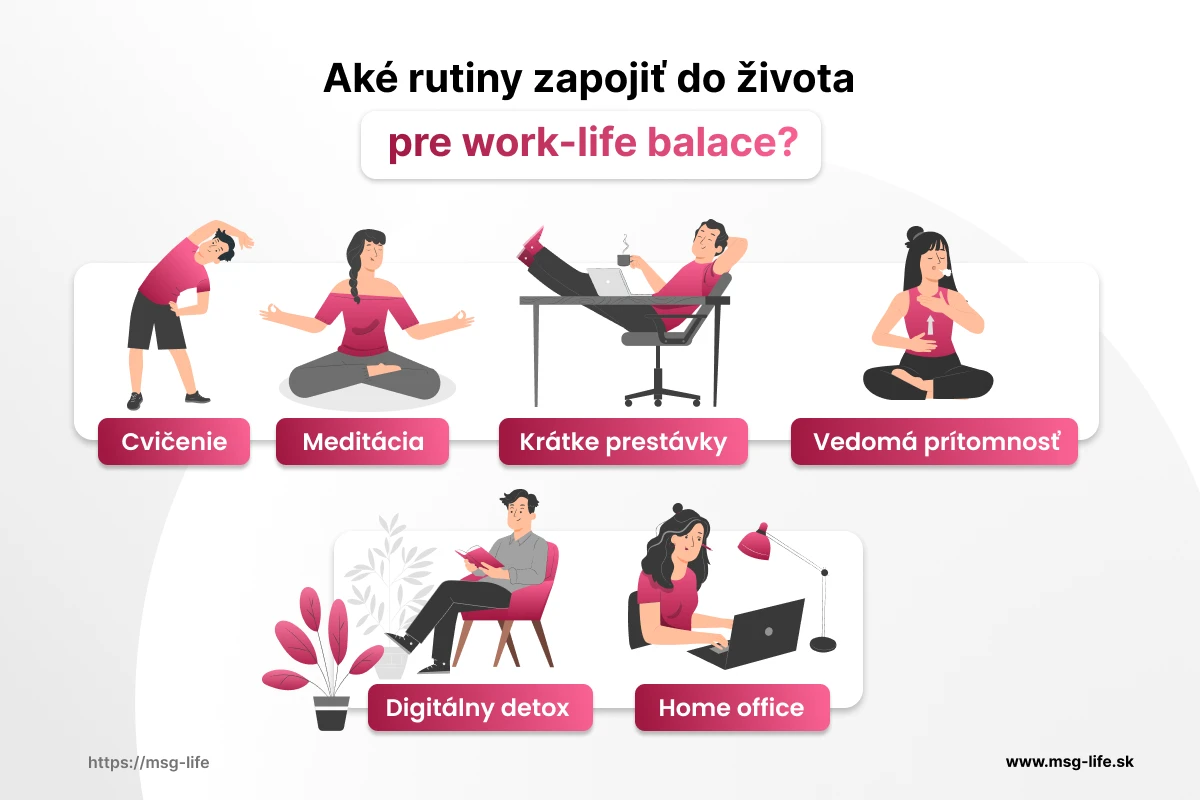
Six figures that show healthy routines

When working from home, it is important to stick to the basic principles of work-life balance outlined below. In addition, do not forget the following tips:

1. Create a dedicated workspace

Do not work from bed, the sofa, or the kitchen table. Instead, designate a small workspace where you will programme, test, and carry out other work tasks.

2. Set a fixed work schedule

When working from home, it is easy to lose track of time, and you may end up working an hour or two longer because you do not need to rush home. Therefore, set a clear schedule – when you start work and when you completely disconnect from it to focus on yourself.

3. Do not do housework during working hours

Did you suddenly remember to put on a wash, empty the dishwasher, or vacuum the flat? Leave these tasks for later, after you have shut down your computer. During work hours, focus solely on your work assignments.

4. Go outside

It is not healthy to spend entire days shut in your flat or house. Once you finish work, go for a walk, exercise, or meet with friends.

5. Use modern platforms

The rise in remote work requires the ability to coordinate schedules, communicate instructions and feedback clearly, and use tools that improve efficiency and boost productivity. This leaves more room for rest. These tools enhance communication and organisation through intuitive interfaces and dashboards. They also reduce administrative workload, allowing the team to focus more on the actual work. Do not hesitate to use them to the fullest – they can only help you.

Recommend
We recommend:

The same rules apply to work-life balance in hybrid work. This can be even more confusing because you spend some days of the week in the office and others at home.

What are the signs of a missing work-life balance?

The fact that you do not have properly set boundaries and that work is encroaching on your personal time can be indicated by several details:

  • feelings of anxiety
  • too much tension
  • pressure
  • sleep problems
  • deteriorating interpersonal relationships
  • exhaustion
  • lack of motivation and/or productivity
  • problems with concentration

If you experience one or more of these symptoms, it is quite likely that your work and personal life are not in balance – and it is time to do something about it.
22 min.Na-vlne-kodu-Work-life-balance-954x600

Podcast #1: Work-life balance and healthy work-life boundaries

Listen to the first episode of the Na Vlne Kodu podcast, where topics like burnout syndrome, work-life balance and the art of saying no are discussed.

Proven work-life balance practices

Whether you are troubled by feelings of anxiety, excessive stress or sleep problems, do not wait. A poorly set work-life balance and the symptoms associated with it can only worsen over time.

Unsure how to organise your schedule and priorities in a way that maintains a healthy balance between work and private life? Use these practical tips:

1. Set healthy boundaries

It does not matter whether you work from home or from an office – what is important is that your work and private life are clearly separated. Handle work tasks only during designated working hours. Do not respond to emails or messages outside of this time. Ideally, turn off notifications completely during your time off.

This way, you will establish healthy boundaries and protect yourself from burnout, anxiety and other negative effects.

2. Plan your free time

This tip is especially important for programmers, testers and other IT specialists. Fill your free time with meetings with family and friends, trips, sport, IT courses, technical workshops or other activities you enjoy. Many people tend to fill an empty schedule with additional work tasks – and that is not healthy.

Free time does not have to be precisely planned. It is enough if you think in advance about what you would like to engage in. These can also be small activities, such as reading a book, organising your wardrobe or cooking. By thinking about them, you reduce the risk of ending up back at work again.

3. Set manageable goals

Overly ambitious goals can create pressure and decrease your motivation and performance. If you have big dreams – such as learning a new programming language or building your own website – break them down into smaller steps. That way, you can work on them gradually, without burning out or taking time away from your free time.

4. Take breaks

There is no IT specialist who can concentrate for 8 to 12 hours without a break. Everyone needs to switch off from time to time, clear their mind and get a fresh perspective.

Breaks are important not only for recovery, but also to reduce the risk of burnout and improve concentration. A short switch-off from work can offer a new perspective on a problem or inspire an interesting idea.

To achieve work-life balance, it is necessary to alternate between two types of breaks:

  • Short breaks during the working day – for example, for lunch, coffee or just a short rest between individual tasks.
  • Longer, multi-day breaks – classic time off, during which you completely switch off and do not even think about work. How you spend this time is entirely up to you. Ideally, travel somewhere and change your environment.

5. Take care of yourself

An important aspect of finding balance between the work and personal world is devoting time to self-care. This can include steps such as:

  • regular physical activity or exercise
  • taking sick days, holidays or mental health days as needed
  • adequate rest every night
  • seeking help from friends, family or professionals

Your mental and physical health is far more important than completing a work task or ticking off every item on your to-do list. That is exactly why you should not ignore it.

6. Improve your time management

To maintain work-life balance in the working environment, especially in the IT field, thoughtful time management is essential. If you can plan your working day properly, you will not end up having to do some tasks during your free time simply because you did not finish them earlier.

However, do not overdo it with planning. Only plan as many tasks for one day as you know you can realistically handle. Start with those that need to be completed as soon as possible and then continue with the less urgent ones.
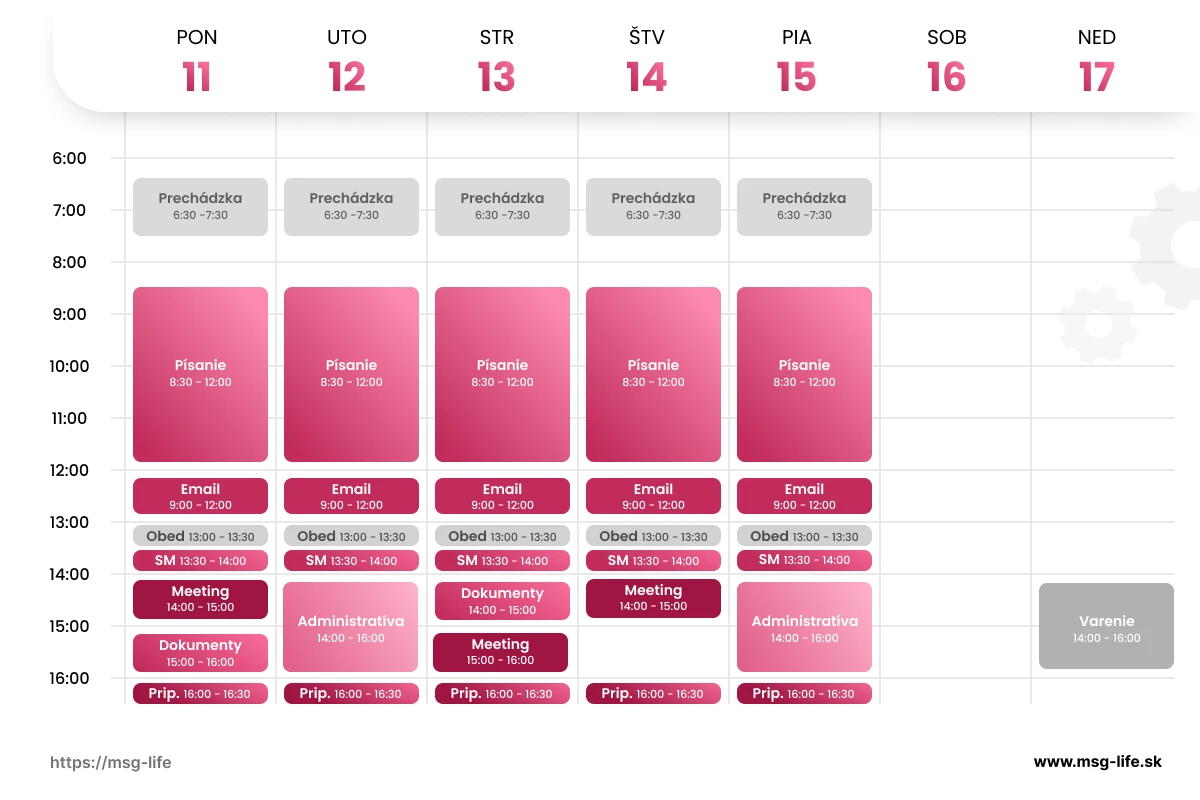
Calendar of tasks

7. Learn to say no

Are you the type of person who always says “yes” to the boss or supervisor? Even when the request or task interferes with your free time? In that case, you should learn how to politely but firmly say “no”. It is fine to occasionally do something for the good of the team. However, if you do this regularly, it is not healthy and can lead to burnout.

8. Let go of excessive perfectionism

Many people have a tendency towards perfectionism in their younger years, when they dedicate all their free time mainly to school or hobbies. At this stage, it is in some ways easier to be a perfectionist, but as one grows older, builds a career and starts a family, life becomes more complicated and responsibilities increase rapidly.

Perfectionism can often do more harm than good. If it gets out of control, it can become destructive. The key to preventing overload and managing stress at work is to let go of the unhealthy desire for perfection. Instead, focus on precision in what you do, and abandon nit-picking for good.

9. Disconnect “from the network”

In the pursuit of better life balance, try to regularly switch off completely and allow yourself a digital detox. Today’s world creates in people a feeling of constant availability. The workday seems to have no end and often intrudes into personal time. All it takes is the sound of a notification, and you immediately feel the urge to check what it is. There are moments when you should simply turn off your phone and enjoy the present moment. Simple – yet for some almost impossible.

Robert Brooks, a professor of psychology at Harvard Medical School and author of a book on work-life balance The Power of Resilience: Achieving Balance, Confidence and Personal Strength in Your Life, once said something wise: “Notifications that keep coming in interrupt your supposed ‘offline mode’, where you’re only pretending not to be online.” This means these influences bring a constant stream of tension into your life. Forget about work matters and devote yourself fully to your family and hobbies. Make your seemingly free time truly quality time spent according to your own wishes.

By not responding to work notifications, you build a stronger habit of resilience. Resilient people feel a greater sense of control over their lives, while reactive ones lose that control and are more prone to stress.

Zuzana Kocáková, msg life Slovakia

10. Get moving and meditate

Even if you are busy, it is essential to find time for the most important things in life. Regular exercise is an effective way to reduce stress – it pumps endorphins into your body, making you feel much better.

Every day, set aside at least a few minutes for yourself. Great and undemanding activities that you can do almost anywhere include exercise, yoga, meditation or any other activity that fulfils you. Start with deep breathing, for example. Breathing exercises, a short 5-minute meditation or limiting alcohol and unhealthy food are key to a clear mind. It is an effective way to relieve tension through small lifestyle adjustments.

Mindfulness

If you want to achieve a balanced work and private life, a good feeling from completing a work task is not enough. This concept also includes caring for yourself – body, mind and soul. You do not need extreme effort to make a change – it is enough to open yourself to the present moment and stop thinking about what would have happened if…

To rediscover harmony between your inner and outer world, it is important to stop worrying unnecessarily about things you cannot influence. Do not have prejudices or excessive expectations. As the saying goes – if you expect nothing, you cannot be disappointed.

Instead, calm down, slow down and focus on your immediate surroundings – on smells, colours, sounds, tastes, scents, feelings and emotions they evoke in you. Live in the present and pay attention to the little things you would otherwise overlook in the rush of everyday life. That is where the beauty and peace of a content mind lie – in perceiving the present moment.

Remember – you cannot trick your nervous system

The autonomic nervous system has two branches:

  • the sympathetic nervous system (the body’s stress response)
  • the parasympathetic nervous system (the body’s rest and digestion response)

The key to activating the parasympathetic system includes short meditative exercises, deep breathing or “grounding” your senses. The more frequently you practise them, the more you will activate the parasympathetic system – and it will calm everything down. Not only in that moment, but gradually, permanently.

Over time, you will notice that the parasympathetic system starts to dominate in your life over the sympathetic one. This is what your balanced lifestyle might look like in practice.

11. Spend your time on people and activities that fulfil you

Have you ever thought about what is truly important in your life? Create a list of priorities and make sure they genuinely reflect your values. Set firm boundaries so that you have enough time for people and activities with high priority. Thanks to this, it will be easier for you to identify what can be crossed off the list and more quickly achieve a balanced lifestyle.

If browsing the internet pulls you into a spiral that wastes your precious time, set clear rules to separate work from free time. To boost productivity, you can try tools like Freedom, LeechBlock or RescueTime. If specific people are taking up your time, try to limit interactions with them in a diplomatic way. Focus on relationships and activities that bring joy into your life.

12. Slow and steady wins the race

Imagine you want to start running and on the first day you run 10 km. The next day, your whole body will ache and you will likely develop a negative attitude towards running. Drastic changes – such as cutting your working hours from 80 to 40 per week or daily intense training without rest – are more likely a recipe for failure. Gradual change is healthier and more sustainable in the long term.


Gender equality in Slovakia: What do the latest statistics say and how to contribute to gender equality in IT?

Gender equality is a sensitive topic, yet it is important to discuss. It does not only mean equal opportunities for women and men but also actively eliminating discrimination stemming from prejudices. However, women are in demand in the IT sector, yet according to the latest statistics, they are still woefully underrepresented. There are multiple reasons for this. Many women still believe that IT is only for men, while others do not feel welcome or accepted in a male-dominated environment. Additionally, stereotypes still prevail in our society. How can we combat outdated and long-irrelevant perceptions of IT?

What is gender bias and gender equality?

To begin, it is important to define two key terms we will discuss in this article – gender bias and gender equality. Gender bias refers to a certain prejudice that people hold against one gender. Based on this bias, they may act in ways that lead to unbalanced and unfair treatment of individuals in the workplace, at school, or in other group settings. Currently, gender disparities are mostly experienced by women, who in the professional sphere may encounter situations such as:
  • Being overlooked
  • Not having the same opportunities as men
  • Receiving lower salary
  • Lacking support from superiors or colleagues
  • Being perceived as insufficiently competent, and similar issues
Gender bias is closely linked to gender equality, which advocates that all people, regardless of gender, are equal and should have equal opportunities, rights, and fair treatment from others. However, gender equality does not automatically mean that we are all the same or capable of the same things. It highlights that the two genders are different, and based on these differences, approaches should be adjusted to ensure fairness and prevent favouritism towards one side. Moreover, it is part of human rights – ensuring dignified and fair treatment for all, regardless of gender. Both of these topics are important in the IT sector and must not be ignored. They significantly influence the development of new technologies, their efficiency, and the direction this field will take. Therefore, it is crucial to discuss them and propose solutions that promote balance and ensure women have the same opportunities as men in the IT world.

Why do we need more women in IT?

There are several reasons why the representation of women in the IT sector should increase. The main ones include:

Reducing gender bias in technologies

Many cutting-edge technologies, such as artificial intelligence, are improved and trained using vast amounts of data. However, this data may contain biases, leading to technologies becoming prejudiced. Bias in technologies, especially artificial intelligence, is highly undesirable. If AI is used, for example, in employee recruitment, it may favour men over women based on the data it has been trained on. One solution to combat this problem is to increase the number of women in IT, who can bring fresh perspectives and more easily identify hidden biases.

Diversity of perspectives

A new and slightly different perspective on a problem, situation, or task was hinted at in the previous point. Women can bring fresh and innovative ideas, different ways of thinking, and alternative approaches to male-dominated teams, which can help solve even complex challenges. They also notice details that others working on a project for days or weeks might overlook. This can strengthen the team and contribute to achieving better results.

Breaking gender stereotypes

The IT sector has long been considered a space primarily for men. This is also why only a very small percentage of women work in this field today – according to the portal Womentech.net, in the USA, only 3.7 million women work in IT, representing approximately 23%. However, the truth is that the IT sector is not just for men – quite the opposite. Women can also be developers, testers, or UX/UI designers and excel in these roles. Greater representation of women in IT is therefore not only inspiring but also helps dismantle deep-rooted stereotypes that many still believe.
8 min.zivotopis-programatora

How to write a developer CV + IT CV templates

Read our new article to find out what a developer CV should look like and what it should contain.

Creative solutions

Work teams composed of men and women with diverse experiences generate much more creative and high-quality ideas than teams consisting solely of men with the same or similar education, work experience, and perspectives.

Better consideration of all users’ needs

An all-male team will struggle to create an app, website, or other product that meets the needs of all users, regardless of gender. This is why it is important to include a female perspective in the team, ensuring the product reflects women’s needs and achieves success.

How does gender bias arise in technologies?

In IT, it primarily arises due to societal prejudices and the significantly higher representation of men involved in technology development. Prejudices and stereotypes are currently so widespread and ingrained that many people do not even realise when their everyday behaviour unconsciously reinforces them. Gender inequality manifests differently across various areas of IT:

Data and AI algorithms

For artificial intelligence to improve, it needs existing data. However, this data often contains biases – for example, that women earn less, have fewer opportunities, or are unsuitable candidates for the IT sector. Artificial intelligence processes and perpetuates this data, which can negatively impact not only women working in IT but also their overall standing in society.

UX/UI design

Men perceive topics, problems, and products differently than women. If they work on a project intended exclusively for women or the general public regardless of gender, the final product may not be sufficiently effective, engaging, or functional. The best solution is to include women in the team who understand the needs of female users and incorporate them into the design and implementation. Alternatively, the final product can be tested with women, who may notice overlooked biases or weaknesses.

Software solutions and work environment

In some companies, the work environment is still primarily tailored to male teams, and disparities in remuneration are also common. Women in the same positions as men may receive lower salaries, highlighting a systemic imbalance that we may not always recognise. Women may feel uncomfortable in such environments, negatively affecting their motivation, productivity, and overall job satisfaction. Managers, team leaders, or company owners should strive to consider the needs of both men and women and create working conditions that suit all employees.

How to eliminate gender stereotypes in IT?

There are several ways to eliminate stereotypes in the IT sector. Some of them –such as creating a pleasant working environment for women or integrating women into work teams – have already been discussed in previous sections. Other approaches include:

Highlighting women in IT

Ideally through social media, traditional media, or online articles. This can demonstrate that the IT sphere is not just for men and that women can also succeed in it.

Supporting young girls in education

Providing access to various training sessions, webinars, specialist articles, or courses for girls in primary and secondary schools can kickstart their careers at a young age.

Raising awareness about gender equality

Disseminating information about gender bias and gender equality within and outside the company (via social media, traditional media, articles, or studies) is crucial. Many people are aware of this issue, but few understand its true extent.

Using appropriate language, terminology, and visuals

When communicating and sharing information related to gender bias and equality, it is important to be mindful of how we do so to avoid reinforcing stereotypes. Visuals and the way the IT sector and IT professionals are portrayed are equally important – men are most frequently depicted in advertisements and billboards. If a company wants to support gender equality in IT, talking about it is not enough – it is essential to have a clearly defined strategy that includes recruitment, training, mentoring, and creating an inclusive work environment. Such a strategy should be based on the real needs of employees, built on data, feedback, and long-term planning. A systematic approach is key to sustainable change.

The benefits of women in IT and solutions to reduce gender bias

Women can bring a great deal to the IT sector. First and foremost, they often have a more sensitive approach to consumers and users. Some problems require a more empathetic and emotional response, which is often a strength of women. This approach introduces new perspectives and ways to steer development in the right direction. Women are also much quicker at identifying stereotypes and biases in the early stages of a project because they are more frequently exposed to them. This allows such issues to be addressed immediately – before they can influence the final product delivered to the customer. Additionally, women bring other benefits, such as broadening team perspectives, changing workplace culture in IT, fostering innovation, and improving work outcomes.

What is the current situation in Slovakia?

Gender equality between women and men is one of Slovakia’s critical issues, showing little improvement over the years, despite being an integral part of the fight for human rights. This is confirmed by the European Institute for Gender Equality (EIGE), which gave Slovakia 59.9 points out of 100 last year, placing it 22nd in the 2024 Gender Equality Index. Whether this result improves and Slovakia moves forward in 2025 will only be revealed by future statistics. Globally, progress is slow – evidenced by the regular reports of the UN Commission on the Status of Women, which tracks developments in gender equality and the status of women in society. Over the past three years, Slovakia has moved up just one place and gained 0.7 points – a very small improvement. Beyond the overall score, the Gender Equality Index also includes individual areas such as work, money, knowledge, and time. Slovakia’s highest scores were in health (85.5 points), money (74.5 points), and work (72.5 points).

Slovaks’ view on gender equality at work, in politics, and at home

How do Slovaks themselves perceive gender equality? According to a survey by Go4insight, most believe gender equality is most evident at home – 66% of men and 61% of women agree with this statement. In the workplace, these numbers are lower – 46% of men and 40% of women. Slovaks perceive the lowest level of gender equality in politics – only 31% of men and 24% of women consider it sufficient. Statistics show that Slovakia has work to do – not just in the IT sector but in other areas of working life. First and foremost, it is important to raise awareness about gender bias, as many people do not even recognise it – according to the Go4insight survey, 13% to 25% of respondents were unable to comment on various aspects of gender equality. The next step is to propose practical solutions that can be realistically implemented. In the workplace, this could involve measures mentioned earlier – supporting equal opportunities, fostering a pleasant team environment, promoting education for girls and women, and increasing the visibility of women in IT. Equally important, however, is actively working towards balance in filling positions – especially technical and managerial roles, where women are often underrepresented.

How is the situation at msg life Slovakia?

Statistically, at msg life Slovakia, we have seen a thirtyfold increase in the number of female colleagues between 2005 and 2020. In 2005, two women worked with us; by 2020, there were 59, and since the beginning of 2021, five more female colleagues have joined. We are delighted that the representation of women in our company is growing. They are not afraid of the IT sector – on the contrary, they see it as a career opportunity that allows them to fully utilise their skills. In addition to the growing number of new female colleagues, we have also seen an increase in the number of CVs sent to us by women. In January 2020, 11 women applied to us; in 2021, there were already 44. Both graduates and women seeking a career change are showing interest in working in this sector. We believe these numbers will continue to rise. Are you interested in working in IT? Do not hesitate and check out our open job positions!

What do our female colleagues say about working at msg life Slovakia?

Women are always welcome in our company. Our female colleagues confidently handle even the most demanding tasks, and each of them contributes to team successes. We asked them what brought them to this job, how they feel working in a team and in a field that many still consider a male-dominated domain.

Miska, Software Testing Consultant, Bratislava

Miška joined us in September last year. She does not believe in coincidences, but by chance, a job offer for a Business Consultant/Tester position literally “popped up” for her on LinkedIn. “What drew me to IT was my unquenchable curiosity about information technology. I’ve been inclined towards it since childhood and loved computer games. In my free time, I worked with computers and could solve problems on my own,” she recalls. In a predominantly male team, Miška says she works excellently: “My colleagues are easygoing and have a great sense of humour.” And in what way does she think women in IT are better than men? “It’s hard to say: each of us has a unique personality and approach; everyone is one of a kind.” She believes everyone contributes uniquely to the collective effort. She adds: “It’s good to sometimes feel feminine energy in IT, too.” Women, she says, approach work more sensitively and with greater emotion – which is not entirely common in this field.

Lydia, Software Testing Consultant, Kosice

Lydia has been working at msg life Slovakia for almost 13 years. She was the first woman in our Kosice office. Although she studied finance, she couldn’t find enough suitable job opportunities in her field in her hometown. At that time, the IT sector was beginning to gain momentum in Kosice – and we’re glad that Lydia chose to join us. Better financial compensation was also a motivation for her. For many years, she was mostly surrounded by male colleagues in the office, but last year our office on Werferova Street welcomed two new female colleagues. “I enjoy working with men – they’re very helpful and friendly, they don’t overcomplicate things, and generally they’re less prone to conflict. But my new female colleagues are just as great, and I’m happy that they’ve enriched our predominantly male team.” Lydia believes that women are thorough and precise, which helps them thrive in IT. “They also tend to have better communication skills,” she adds.
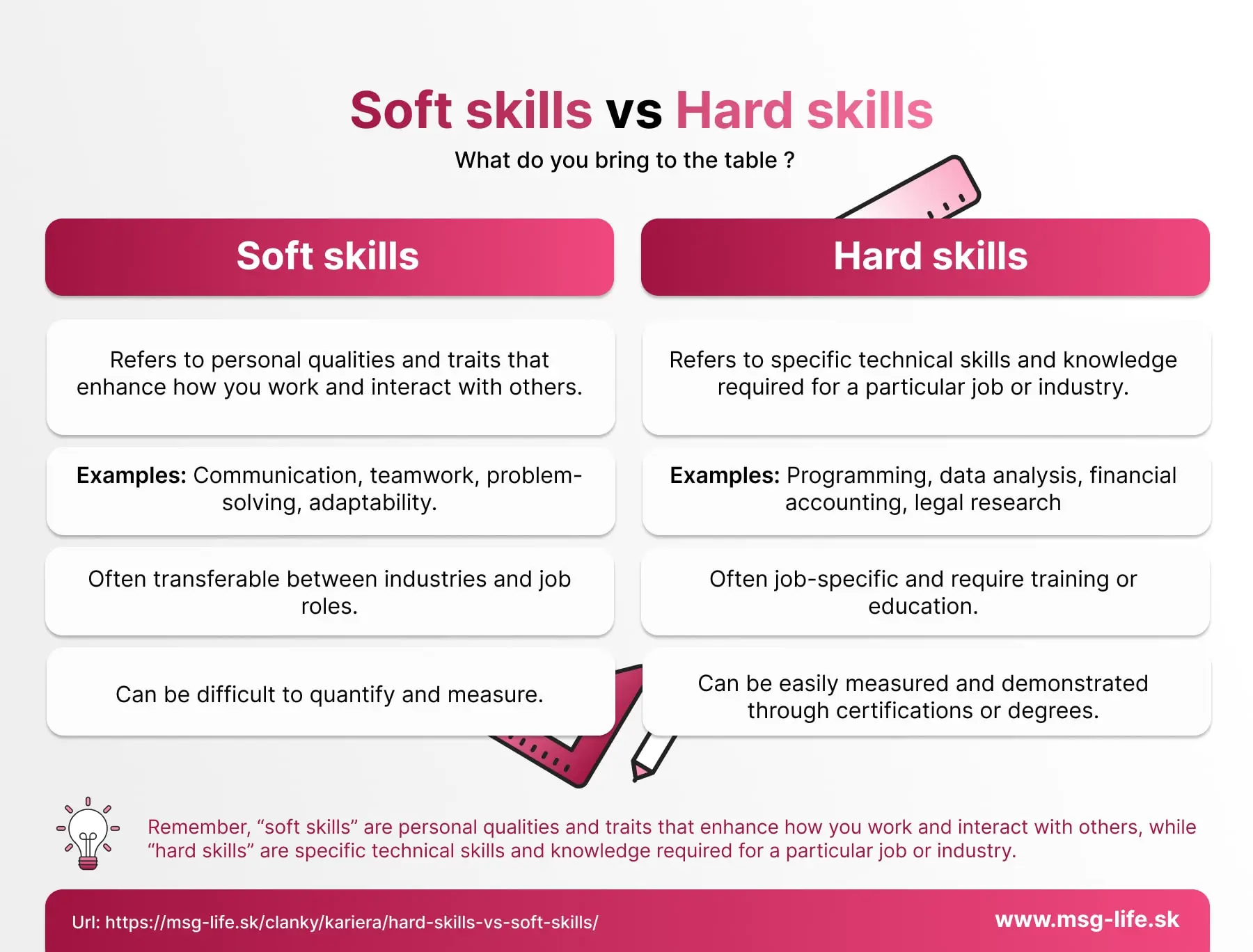
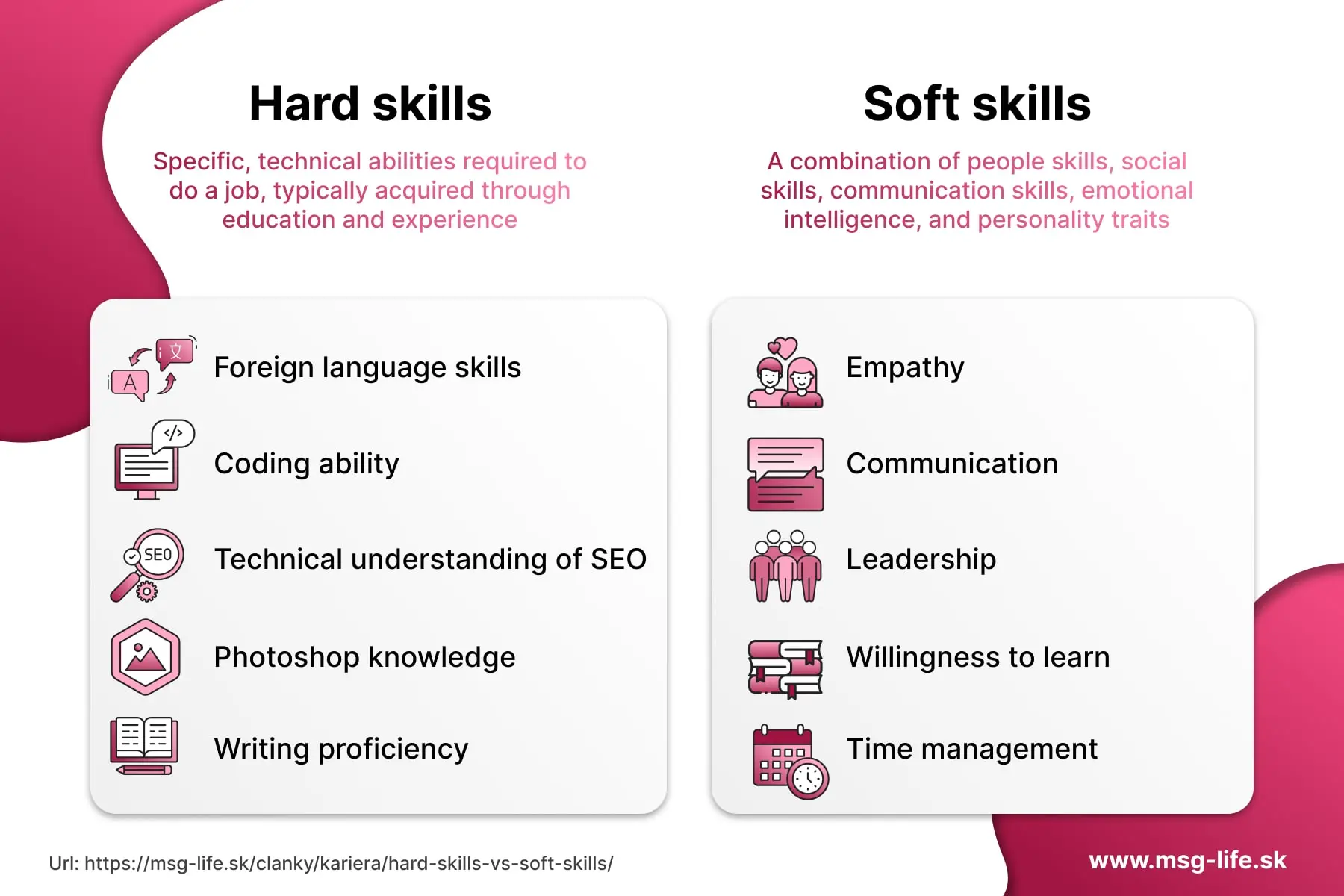
10 min.Hard skills vs soft skills - which skills will help you get your dream job?

Hard skills vs soft skills – which skills will help you get your dream job?

Do you know the difference between hard skills and soft skills? Which ones will help you get your dream job? Take a look at our overview.

Kristina, Software Testing Consultant, Bratislava

Kristina has been with us for almost two and a half years. After a long period in her previous job, the time came when she needed a change of environment. She worked in sales, and her position was demanding. She felt that the only way to avoid burnout was a complete change of job and field. She decided to move into IT, even though it was once “Greek to her” – and to some extent, it still is. “I learn something new every day, but I couldn’t be happier with my decision to jump headfirst into something new and unknown. I’m very satisfied.” She is the only woman in her team. She admits that she had concerns at the beginning, but they turned out to be completely unfounded. “My colleagues are always willing to help, and their technical skills – not just at work – are a huge advantage. Whenever I have a question, they always advise me.” Kristina is convinced that it doesn’t matter whether someone is a man or a woman. “In my opinion, anyone can pursue any profession.”

Gabika, Business Consultant, Bratislava

Coincidence also played a role in Gabika’s professional life. She studied international financial management in German and, in her own words, never dreamed of working in IT. “I didn’t know exactly what I wanted to do, but I imagined something in the economic field. I wanted to stay connected to the German language. Fresh out of university, I got a good reference for msg life, and since the emphasis was on German and logical thinking, I decided to give it a try. And I haven’t regretted it,” she says.
17 min.vzor-referencie-od-zamestnavatela-do-zivotopisu-954x600

A sample reference letter from employer: how and when to include a job reference on a resume?

Learn how to write a job testimonial and how to use employer references for a successful job search.
Gabika praises her work at msg life, which she attributes in part to the good team atmosphere. “In five years at the company, it’s never happened that we couldn’t agree on a solution acceptable to all parties, or that a colleague didn’t help me when I reached out to them. And there’s always a lot of fun at after-work events,” she adds. Gabika sees the main advantage of women in IT in their perceptiveness, empathy, and communication skills, which she believes are beneficial in client interactions and teamwork. “Women approach tasks more conscientiously and solve them more precisely, but I wouldn’t categorise who is better at what based on gender. I think a lot depends more on a person’s character than their sex,” she concludes.

Adka, Business Consultant/Tester, Bratislava

“The need to try something different, something new. To start from scratch, so to speak.” This is how Adka describes her beginnings in IT, having previously worked as a financial analyst. Like Gabika, Adka also ended up in IT by chance. “A friend of a friend worked here and mentioned they were looking for people. But this field had been appealing to me for a while. IT always sounded interesting and relaxed, with a hint of the unknown,” she explains. Adka also praises the team. “The male colleagues are very kind and chivalrous. The female colleagues are friendly and easygoing,” our skilled business consultant describes the work atmosphere. And what’s the difference between men and women? In her view, the fairer sex has a greater eye for detail and empathy in the IT world. <

Lucka, Tester/Consultant, Bratislava

“I used to picture myself in a marketing department or in PR. I couldn’t imagine that one day I’d be testing software. Back then, I had no idea how broad the IT field is or how many different areas it encompasses,” Lucka begins describing her IT career. She was led to the position of tester/consultant by chance and an interesting job offer. She quickly realised it was the right decision. She sees the main advantage in the gender balance within the team. “We have the opportunity to discuss various topics, and it’s interesting to observe the perspectives of men and women on the same issue,” she says. Nevertheless, she doesn’t believe one gender has an edge in IT. ““Each of us has certain abilities, experiences, and ways of thinking, and thanks to that, we can approach problems from different angles. But we always reach the same goal in the end,” she adds.

Barbora, Software Consultant, Bratislava

Barbora was approached by a recruitment agency while she was still working as an actuary. “An offer came up to switch to the side where software for insurance companies is developed. It intrigued me, and I decided to give it a try.” Nearly five years have passed since then, and she has no complaints about working in our team. “I’m really enjoying my work. Before, I worked in a predominantly female team, and I wouldn’t change it back. The guys are fun – they’re not all IT guys in flannel shirts with greasy hair, like many people imagine.” In her view, everyone is different, and when the team is great, it’s a joy to work there. The satisfaction of our female colleagues confirms that women have a solid place at msg life Slovakia, with doors wide open. We are still looking for new colleagues to join our branches in Bratislava, Zilina, and Kosice. Check out our latest job offers and join us!

How to write a job-winning cover letter: Templates and tips

A cover letter is one of the key documents used to introduce yourself to a potential employer. Unlike a resume, it provides additional information about you and your skills. While writing a cover letter is not difficult, it is important to know what information to include and what to avoid. We have prepared all the essential information for you, along with practical tips to help you make a good first impression.

What is a cover letter?

A cover letter introduces you to the people who will decide whether to hire you. This additional text accompanies a resume and enables job applicants to highlight their motivations, skills, and interest in a particular role. It also gives applicants the opportunity to present their experience and aspirations for the role. When writing a cover letter, it is important to be concise yet persuasive — the aim is to demonstrate why you are the ideal candidate. A professional cover letter is more personal than a resume. It gives you the opportunity to share more information about yourself and your personality. However, it’s not just about the content — the structure and style of your letter are also important. Although it is just a text document, you can still make a cover letter original.
13 min.CV samples: tips and inspiration for writing a CV quickly and easily.

CVs – Templates, mistakes, and tips on how to write them correctly

CV templates – choose a template and use our tips and inspiration to create an unmissable CV quickly and easily.
Short cover letters containing short sentences or bullet points can indicate to a recruiter that you have an analytical thinking. Conversely, a slightly more comprehensive writing style can demonstrate your creativity. A cover letter is not compulsory when applying for a job. Many companies do not require a cover letter in the first round of the selection process due to time constraints. If it is not mentioned in the job description, the job seeker does not need to send one. Only do so if the company specifically asks for it, or if you are invited to the next stage of the process by the HR department.

Way to write cover letters

While a resume describes your past work experience, a compelling cover letter demonstrates how your skills and knowledge are relevant to the position you are applying for. A well-written cover letter will make a recruiter want to read your resume.
8 min.ako-napisat-zivotopis-cv-954x600

How to write a good CV and what mistakes to avoid?

In this article you will learn how to write a CV and the most common mistakes to avoid.

Tailor your cover letter to the role you are applying for

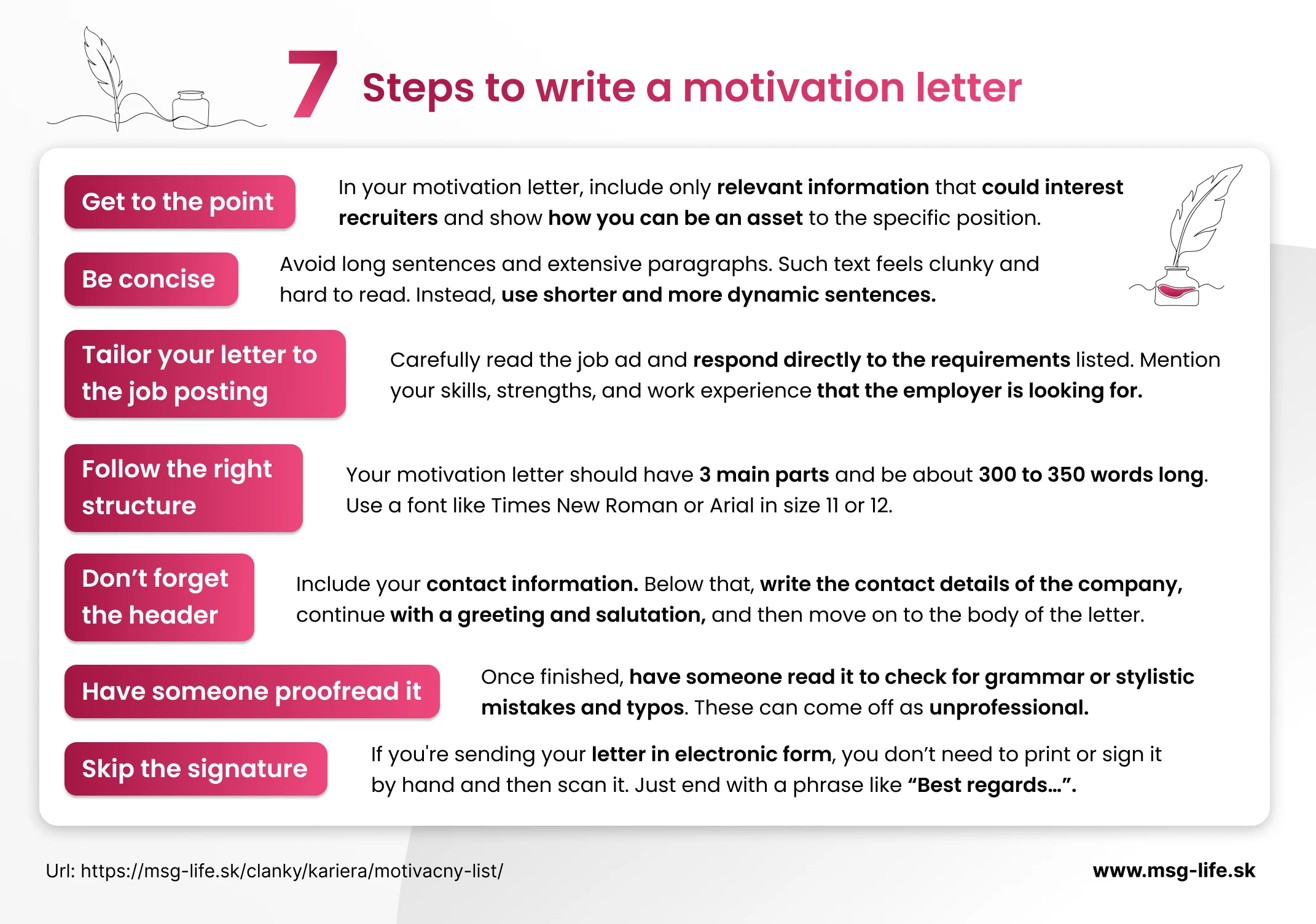
Write a personalized cover letter for a particular job offer. Read the job advert carefully so that you can respond directly to the requirements listed in it. This demonstrates to the employer that you are genuinely interested in the job, rather than just sending out a generic document to several companies.

Follow the cover letter format

Most companies prefer a simple cover letter. Stick to a clear structure and avoid overdoing it – whether in content, length, or email design. A clean document with black text (no italics or bolding) is ideal. Divide the information into paragraphs and use shorter, concise sentences rather than complex phrasing.

Stay on topic

If you’re wondering how to create a cover letter, the answer is simple – focus on relevant information. Avoid information that may not be interesting or useful to the employer. This not only makes you look professional but also shows that you’ve studied the job posting and understand the company’s needs.

Mind the proper structure

A cover letter should be divided into three basic sections, no longer than one page (about 300–350 words). Use classic fonts like Times New Roman or Arial in size 11 or 12. Don’t forget margins—ideally 1 to 1.5 cm. Send the finished cover letter as a PDF attachment.

Don’t forget the header

Every cover letter should include a header with your personal and contact details, followed by the recipient’s (the company’s) contact information. Next comes the salutation, the body of the letter, and a closing (e.g., „Sincerely…“).

Watch your grammar and typos

A great cover letter represents your skills and abilities to recruiters. To make the best impression, proofread the text multiple times and have someone else review it – even a close friend might catch mistakes you’ve missed.

A signature is not necessary

Standard cover letters are usually sent electronically via email, so a handwritten signature isn’t required. Simply end with „Sincerely…“ followed by your name. As mentioned earlier, a cover letter serves as a supplement to a resume, highlighting the applicant’s personal and professional goals, ambitions, and values. It can also include information beyond a direct summary of work experience, such as personal and professional development plans or a commitment to continuous skill improvement.

What cover letter examples look like: Cover letter templates

At first glance, a cover letter (sometimes also called motivation letter) appears to be a simple document you can write in a few minutes. While writing it isn’t generally difficult, you should always set aside enough time to include all the necessary information. A cover letter template usually consists of several sections. The first is the salutation. This is followed by the body of the document, which is divided into three parts, and finally comes the closing and sign-off. To make writing easier, we’ve broken down each section in detail:
cover motivation letter 7 steps to write it
How to write a simple cover letter for a job in 7 steps

Directly address the contact person

Always address your letter to a specific individual, e.g., „Dear Mr Bruckner…“ This makes the cover letter feel more personal and shows you’ve researched the company. You’ll usually find the contact person’s name in the job posting itself – often listed alongside email or phone details.

First section: Explain your interest in the position

In the introduction, state why you’re applying for the position and why you want to work for this company. Briefly mention your relevant experience and highlight how it could benefit the employer. This section is crucial – it sets the tone for the entire letter and shows recruiters why you’re reaching out. Keep it concise and dynamic, using short, impactful sentences without unnecessary fluff.

Second section: Demonstrate your knowledge of the company

Research the company and explain what motivated you to apply for the position, what appealed to you about the company, and how you can apply your skills and knowledge. Be brief, but include specific examples, figures and relevant achievements. Be specific – use numbers, achievements, or examples that prove your suitability. This shows the letter isn’t a generic template but tailored to the job.

Third section: Highlight your strengths

Describe how you could contribute to your employer. Have you noticed any problems within the company? Describe it and suggest a possible solution. Describe your vision for the role. Highlight your qualifications for the position. Imagine you already worked for the company – what could you improve? How would you go about it? This section is designed to showcase your strengths and key skills. Mention the most important ones that would be an asset to the company, and feel free to provide a brief explanation of each one. However, be careful not to appear overconfident or arrogant, as this could have a negative impact on recruiters.

Closing: Call the recruiter to action

How should a cover letter end? Don’t forget to encourage the recruiter to take action. Don’t be too eager; show courtesy and respect. For example, you could say, „If you need any more information, please feel free to contact me at [phone number] or [email address]. I will be happy to answer your questions at the interview. Thanks for your time.“ This shows the recruiter that you would like to meet them in person, or at least have an online interview.
22 min.pracovny-pohovor-ako-sa-pripravit-954x600

How to prepare for a job interview? With us, you can handle it with ease.

The search for a new job has several stages. One of them is the interview, which is usually not very popular among applicants. Stress and tension can often be overwhelming. […]

Sign-off

A short and formal form, such as “Sincerely, First Name Last Name”, is sufficient. There is no need for a signature or any additional text.

Perfect cover letter: Job search mistakes to avoid

When creating your cover letter template, always ensure it is tailored specifically to the job and the company you are applying to. Recruiters can easily identify generic cover letters that have been mass sent to multiple employers. Therefore, dedicate sufficient time to researching the company thoroughly so you can craft a letter that will genuinely capture their attention. Show that you have read the job description and make sure your cover letter relates to the job offer. A cover letter is a great place to show that you are a good fit for the position. Adapt your tone to match the working environment. If the organisation communicates in a more relaxed manner, you may adjust your style accordingly. Conversely, if it is a formal corporate environment, maintain a professional and respectful tone throughout. The recruiter needs to feel that you would fit well within their team and understand the company’s values. There are several key mistakes you should be careful to avoid:

Spelling and grammatical errors

Read your text aloud several times and consider asking a friend or family member to review it as well. Use polite and respectful language, addressing the recipient properly. While incorrect grammar or poor style might seem like minor issues, they can significantly impact how potential employers perceive you – even if you are not applying for a writing or editing position.

Formatting errors

Your letter must be easily readable in any format. Use short, clear sentences and divide your text into logical paragraphs. Recruiters often have limited time and may only skim through applications. To ensure they notice all the key information, make your content as clear and well-structured as possible.

Self-promotion

While you should highlight your relevant achievements, be careful not to exaggerate or misrepresent your experience. During an interview, any false claims may be uncovered. If you have multiple relevant skills or experiences, rather than listing them all, select a few key ones and describe them in more detail. This approach will give recruiters a much better understanding of your capabilities.

Generic clichés

Phrases like „I’m a team player“, „I enjoy working in a team environment“ or „I love learning new things“ are overused and don’t provide any specific information about you. Instead, give concrete examples – mention that you worked successfully in a large team in your previous role, or describe specific training courses you’ve completed that enhanced your skills.

Repetition of resume information

The cover letter provides additional insights about you and your abilities that complement your resume. Focus on expanding aspects that weren’t fully covered in your resume, presenting yourself in the best possible light to increase your chances of securing the position.

Too much text

Aim for between 300 and 350 words – cover letter should be one page long. As demonstrated in our cover letter template, this is not meant to be a lengthy essay but rather a succinct document that recruiters can quickly scan.

Missing specific examples

For each skill you mention, provide a real-world instance where you applied it successfully. Show situations where you utilized these abilities and how you implemented them in practice.

Inappropriate information

This includes reasons for leaving previous employment or any negative comments about former employers. This is not what a cover letter is used for.

Salary and working time requirements

These matters should only be discussed during the interview process.

Online cover letter builders to help you write

The way you choose to write your cover letter is entirely up to you. The classic approach is to create your cover letter from scratch using Microsoft Word or Google Docs, where you can customize everything yourself – from font type and size to margins and line spacing. If you’d like some assistance with the writing process, you can opt for various customizable cover letter templates where you simply insert your text. You won’t need to worry about anything else. Once you’ve included all the necessary details, just save the cover letter to your device and send it off. If you choose the second option (online cover letter builders), make sure the final cover letter design looks professional and well-structured. Avoid overly complex templates that might make the text difficult to read.

Final proofreading

By now, you know how to write the best possible cover letter. You don’t need exceptional writing skills – just follow the proper structure, focus on the prospective employer, and highlight how you can contribute to their success. And don’t forget about spelling and grammar! Steer clear of generic clichés and inject some of your personality into the text – as if you were already working in the position. At the end of your cover letter, you may also include consent to process your personal data, allowing the recruiter to keep your details on file should a suitable position become available in the future. Best of luck!

The best IT podcasts: both interesting and entertaining. Which podcast is worth listening to?

IT podcasts are undoubtedly one of the most popular ways to get the information you need quickly and easily. You can listen to them anytime, anywhere – while you’re driving, exercising or having your morning coffee. If you’re looking for a quality IT podcast but can’t decide which one to go for, we’ve put together our list of the best. We also mention interesting and entertaining podcasts in both English and Slovak.

What are podcasts?

More and more people are finding their way to podcasts. However, it is not such a widespread medium that everyone is familiar with them. If you haven’t come across them yet and you’re wondering what a podcast is, we’d be happy to explain. A podcast is an audio recording, usually in audio format (or in video format if published on YouTube), that can be recorded by one or more people. Once recorded, it is often edited and accompanied by music, although this is not the rule. Most podcasts come out regularly – on a certain day and at a certain time. Podcasts can be general in nature or dedicated to a specific topic. Some of the most common are interviews with people in various fields – from art to technology to business. In addition, they are often available in different languages. Although English has the largest representation, a number of Slovak and Czech podcasts have been added in recent years.
Did you know that…

… podcasts haven’t been around for very long? The word ‘podcast’ first appeared in 2004, when it was popularised by Apple.

Where to listen to podcasts?

If you’re wondering where and how to listen to podcasts, the answer is very simple. Currently, you have several options. The most popular alternatives are streaming services such as Spotify, Apple Podcasts or Youtube. You’ll probably find the widest selection of podcasts in their libraries. In addition, these services have the advantage of allowing you to listen to podcasts wherever you are. All you need is an internet connection, or you can download your chosen episode in advance. Another listening option is the official websites of the companies that produce the podcasts. There you can listen to older and newer episodes. The downside is that they’re not always as convenient, especially if you want to listen to a podcast on your mobile phone.
Recommend
We recommend:

Although streaming platforms may charge a fee for their services, this is not always the case. Some companies offer their employees a subscription to these platforms as part of their benefits package.

Which podcast to listen to?

There are a large number of podcasts available nowadays, which means that everyone can choose something to suit their preferences. On the other hand, too wide a choice can make finding the best session a complicated and lengthy process. Do you want to listen to a good podcast, but don’t have time for a lengthy search? Use our practical tips.

IT podcasts

They can not only provide you with interesting news from the world of information technology, but also teach you something new. There is so many choices of what you can listen to. For a better overview, we have divided the individual tips into two categories:
  • podcasts in Slovak and Czech,
  • podcasts in English.
Let’s take a look at them.

IT podcasts in Slovak and Czech

If you’re not very good at English or just don’t want to listen to it, choose one of the Slovak or Czech IT podcasts. We recommend these ones in particular:

#1 Na vlne kódu

In the podcast Na vlne kódu from msg life Slovakia we regularly bring you not only IT topics, but also topics from the field of psychology or HR. In interviews with experts from the field, we like to discuss current trends and challenges. All this with one goal in mind – to provide our listeners with valuable information and inspiration for their professional and personal development.
Recommend
We recommend:

You can find the ‘Na vlne kodu’ podcast on the PodBean and Spotify podcast platforms. Transcripts of each episode are also available to read on our blog.

Informatika s Mišom

Informatika s Mišom is a practical podcast that teaches you all the basics needed for programming. This includes things like working with the command line and explaining the differences between Java and Python, which will make programming in Java much easier for you. Not only the audio track of the podcasts, but also the video courses are available on YouTube, which will make it much easier for you to study and practice the theoretical knowledge you have acquired. Check out Mišo’s interview with our Java Developer Senior Matúš: Our tester Xenia also talked to Mišo:
29 min.Women in IT - The story of Xenia - Na mojom kompe to ide podcast

Podcast: Women in IT – less stereotypes, more opportunities

How can you work in IT without experience? In this inspiring interview, Xenia talks about her beginnings in testing and coding, and the reality of being a woman in IT. This inspiring interview is a must-watch for aspiring female programmers.
Recommend
We recommend:

You can find the ‘Informatika s Misom’ podcast on streaming platforms such as Spotify and Apple Podcasts under the title ‘Na mojom kompe to ide‘.

Klik

Klik belongs to the daily SME and is published weekly. The presenters David Tvrdon and Ondrej Podstupka discuss events from the world of technology, media and social networks. You can listen to it on your favourite streaming platforms or directly on the SME.sk website.

Shape the Future

If you’re more interested in cybersecurity and digitisation, listen to Microsoft’s Shape the Future podcast. The presenter duo consists of Lukáš Okál and Vladimír Hruban, who invite interesting guests to each episode. The Shape the Future podcast is divided into several miniseries containing several episodes. For example, you can listen to a miniseries on current cyber threats, digital skills or digital businesses.

Online Plus

Online Plus is a Czech podcast focused mainly on IT and new media. In individual episodes they cover topics such as:
  • the future of AI,
  • new IT regulations and laws
  • cryptocurrencies,
  • news from social networks and new media and many more.
Each episode is usually under 30 minutes long and full of interesting information, so you don’t have to worry about getting bored after a short time.

SCRIPTease

Another CZ podcast for testers, developers and all IT enthusiasts. Host Jirka Bachel invites guests from different companies to each episode, who reveal various interesting facts – for example, the latest technologies implemented in workflows and so on. You’ll have to set aside at least an hour of your time for most of the episodes, but it’s definitely worth it. You’ll learn new information that you can apply to your projects or work.

IT podcasts in English

Want to listen to a quality podcast in English? Choose one of our tips:

Linux Unplugged

Linux Unplugged is a podcast focused on the latest events and important information from the world of Linux. It’s perfect for anyone who works with the operating system or plans to.

Floss Weekly

Floss Weekly is a podcast focused on everything related to open source. Host Doc Searls speaks with different specialists each week, which makes all the episodes very interesting. In addition to the free version of the podcast, there is also a paid version that offers bonus content and is ad-free.

Darknet Diaries

Among the TOP podcasts from the IT field is certainly Darknet Diaries, which is dedicated to the darker side of the Internet – the one that the average user does not see when browsing the web. Host Jack Rhysider talks about cybercrimes, collusion and scams. His podcast is ideal for both professionals and laypeople interested in mildly controversial topics.

Daily Tech News Show

Excellent podcast for developers, programmers and other IT specialists. It comes out on a daily basis and has approximately 30-minute segments discussing everything related to information technology – from artificial intelligence to cryptocurrencies. The podcast is designed to be listened to by everyone – beginners and experienced professionals alike.

Decoder with Nilay Patel

A great podcast that you’ll love if you want to learn more about the latest happenings in the IT world. You’ll find out what experts think about the future of certain industries, what’s happening at big companies like META and Google, and what we can look forward to in the weeks and months ahead. Host Nilay Patel conducts the podcast in the form of interviews with renowned IT experts, making the episodes very information-rich.

Podcasts about AI

With the growing popularity of artificial intelligence, more and more podcasts are coming out that discuss the topic in depth. Most of them are in English, but you can also find some in Slovak or Czech. It’s also important to say that the topic of AI is not only covered in dedicated podcasts, but also in many general technology-focused shows. We have mentioned several of them above.

Slovak and Czech podcasts about AI

The best Slovak and Czech podcasts about AI include:

Žijeme sci-fi

Excellent podcast with Kamil Aujesky, who mainly covers news from the world of AI. The host and his guests discuss topics such as AI’s ability to reduce crime, manage finances and educate students in primary and secondary schools. The podcast is very engaging – based on current events, the presenter and his guests predict where artificial intelligence may go in the future.

Hloupější to nebude

One of the great AI podcasts is the Czech one, Hloupější to nebude. Hosts Eliška Zimová and David Strejc look at how AI works, what its strengths are and what its limitations are. They take a realistic view of AI – looking not only at its benefits in personal and professional life, but also at the drawbacks and potential complications in its implementation.

Vygenerováno AI

Generated by AI is a limited podcast series with seven episodes that aims to explain the basics of artificial intelligence. For example:
  • how language models work,
  • what are the most common myths about AI,
  • how ethics are addressed in conjunction with AI,
  • what is the predicted future of artificial intelligence.
The episodes are only about 10 minutes long, so you’ll quickly learn all the basics you need to build on.
16 min.What is artificial intelligence, history, trends, risks of AI

Is AI really intelligent? What is artificial intelligence, types, trends, risks of AI

In this article you will learn whether AI is really fully intelligent, its types, its impact on the market, the future and jobs.

Objavuj AI

Moderator Luki Zajo covers not only the basics of AI, but also the latest news, trends and practical tutorials – from working with ChatGPT to Perplexity and other tools. A big advantage of the Objavuj AI podcast is the short length of the episodes(5 – 7 minutes). They’re short, to the point, and free of unnecessary fluff – the author gets straight to the point to save you time and show you how you can use artificial intelligence effectively.

Foreign podcasts about AI

If you’re not interested in Slovak or Czech podcasts and would like to listen to the ones in English, we have good news for you. The range of foreign podcasts on the topic of artificial intelligence is much wider than the domestic ones. What’s more, they are often treated in much more detail and depth. Popular foreign IT podcasts on AI include:

High Agency

High Agency is a podcast about IT with AI designed more for professionals. It provides practical advice and tips on how to develop products successfully and without much complication using AI. The podcast was founded by Raza Habib, CEO of Humanloop, a company that helps companies use artificial intelligence more effectively. Most of the episodes are conducted through interviews with experts in various fields, covering breaking news, new trends and much more.

Latent Space

The Latent Space podcast has a very wide range of topics. Hosts Alessio Fanelli and Swyx cover the basics of AI, the latest trends and more challenging topics like multimodality and GPU infrastructure. The podcast can be listened to by anyone interested in AI, but it will be most appreciated by advanced IT specialists and enthusiasts who already have a foundation in AI.

No Priors

The No Priors podcast takes you through a variety of AI topics – from the latest trends to questions about the future of culture, society and business in the AI era. Podcast hosts Sarah Guo, founder of investment firm Conviction, and entrepreneur Elad Gil invite guests into the episodes to give you a unique perspective on the impact of artificial intelligence on our world.

Deepmind: Podcast

If you want to look at artificial intelligence from a different perspective, Deepmind: The Podcast is the right choice. Mathematician and celebrity Hannah Fry interviews experts on topics such as:
  • AI ethics,
  • using AI in education,
  • AI regulation,
  • the use of AI in science and many more.
The podcast offers approximately one-hour segments full of practical information useful in both professional and personal life.

AI Today

AI Today is a podcast that covers the latest happenings in the world of artificial intelligence. It follows developments in AI and how the new technology is being used by the world’s experts and major companies. Each episode is short, usually lasting up to 20 minutes, and contains a summary of all the key ideas.

More English podcasts

Looking for more tips on AI podcasts that are in English? You can try these:
  • The AI Podcast – a versatile and general podcast that covers all areas of AI – from the basics to news and interesting trends. Host Noah Kravitz invites different experts to each episode to bring a fresh perspective on artificial intelligence.
  • Data Skeptic – the main task is to show you how artificial intelligence uses the data it has access to. In addition, it also focuses on other details such as machine learning or statistics. The good news is that despite the difficulty of the topics mentioned, the presenter Kyle Polich explains them clearly and in a way that even a beginner can understand.
  • Eye on AI – a podcast from journalist Craig S. Smith focusing on everything related to artificial intelligence. You can look forward to interviews with IT experts and episodes on ethical considerations, implementation, and the impact of AI on various fields.
  • This Day in AI – As the title suggests, this podcast covers the latest trends and happenings in the world of artificial intelligence. The hosts usually invite guests with whom they discuss various topics in depth and follow the latest technology developments.

Interesting podcasts

Do you want to relax with a podcast or learn something new, but not in the field of information technology? We’ve prepared a list of podcasts from various fields, available in Slovak and English.

Interesting podcasts in Slovak

There are some interesting podcasts in Slovak too. The current most popular include:
  • Mozgová atletika – one of the most listened Slovak podcasts in recent years. It is popular due to the fact that it deals with the topics of personal development and science in an entertaining way. In short episodes lasting 30 to 40 minutes, you will not only learn something new, but also have a good time. Many episodes feature experts who approach the subject from a professional perspective.
  • Dejepis Inak – if you enjoy history, this podcast is a great choice for you. It will introduce you to important historical events in a concise and short form. If you would like video content, you can find it on YouTube.
  • Doktor ma Filipa – are you attracted by the backstage of Slovak hospitals? Listen to this podcast, hosted by Dr. Jozef Fatrsík from the emergency room of Svet Zdravia Hospital in Galanta. In each episode he describes his experiences in an interesting, sometimes even funny way. That way you can be sure that you won’t turn off the podcast after a few minutes.
  • Vedátorský podcast – covers interesting topics and answers questions that you may not have thought of, but after listening to them, you’ll want to know the answers. For example, find out if light can be slowed down, how the universe was created, or how the internet is speeding up.

Interesting podcasts in English

If you’re not interested in the Slovak podcasts, you can choose from international ones. From the ones in English that are worth listening to, we choose:
  • The New Yorker Fiction Podcast – Each of the magazine’s current staffers reads a short story by a former staffer and then discusses it with editor Deborah Treisman. The pieces are both entertaining and informative, showing different perspectives on a single story or idea.
  • Stuff You Should Know – a podcast from iHeartRadio that comes out several times a week. It educates and provides nformation from different fields in an entertaining way. Individual episodes are shorter and usually last no more than 60 minutes.
  • Conspiracy Theories – one of the most listened to podcasts in the world. It focuses on conspiracy theories linked to major historical events. You can find it exclusively on Spotify.
  • You Must Remember This – If you enjoy the behind the scenes of Hollywood, this podcast is perfect for you. Host Karina Longworth breaks down the secrets and scandals associated with celebrities and movies.

Funny podcasts

There is no shortage of entertaining podcasts on streaming platforms. A list of the most popular ones is presented below.

Funny podcasts in Slovak

Slovak listeners can’t get enough of these four podcasts:
  • Piatoček – satirical podcast of the daily SME, which in most cases reacts to current events in Slovakia. It comes out every Friday and its episodes usually last up to 30 minutes.
  • Lužifčák podcast – this podcast has been one of the best in Slovakia for several years. In the individual episodes, well-known guests appear with whom the presenters wittily discuss various topics. You can be sure you’ll have a great time.
  • Kuriéris – in the list of top funny podcasts, the Kuriéris podcast must not be missed, which will entertain you with funny stories of couriers.
  • REcast by Duklock – popular youtuber Duklock entertains his fans with a podcast featuring famous celebrities. He and the host talk about a variety of topics, with plenty of entertainment to keep you entertained.

Funny podcasts in English

For anyone who wants to have fun while listening to podcasts in English, we have another inspiration:
  • Conan O’Brien Needs a Friend – a podcast hosted by Conan O’Brien who invites famous celebrities such as Will Ferrell, Ben Stiller, Mila Kunis and Michelle Obama to each episode. He discusses their lives and new projects with them, with a heavy dose of humour.
  • How Did This Get Made – Presenters Paul Scheer, June Diane Raphael and Jason Mantzoukas watch a poorly rated film before recording each segment, which they then discuss. If you want to enjoy each part to the fullest, we recommend you to watch the movie as well.
  • Good One – a podcast in which host Jesse David Fox interrogates comedians about the origins of their jokes. There are also interesting guests who bring the podcast to life.
Armchair Expert – In this podcast, actor Dax Shepard interviews various guests about their successes, failures and personal growth in a very relaxed and humorous style.

What does a Business IT Consultant do?

A Business IT Consultant helps connect business with technology. Simply put, they understand the language of both customers and developers and can align them to make things work smoothly and efficiently. Are you interested in what an IT Business Consultant does here at msg life Slovakia? Read on – in the following sections, we’ll take a closer look at their tasks. Developing usable and practical software is the goal of every developer. However, creating a program that is also “user friendly” is a bit more challenging. Especially when there are inaccuracies between the client’s expectations and the work of the development team. At msg life Slovakia, we aim to minimise this communication gap, which occurs in many companies. That’s why we need someone to bridge the divide between software developers and customers. For this reason we are looking for suitable candidates for our offices in Bratislava, Zilina and Kosice for the position of Business IT Consultant – Process Specialist.

Business IT Consultant job description

The role of a Business Consultant is diverse and includes the following key tasks:
  • Communication with customers: The Business Consultant regularly communicates with our insurance clients to analyze their needs and goals or current issues.
  • Creation of technical specifications: They create technical specifications, including a functional part for users (clients, testers) and a technical task for developers.
  • Configuration and parameterization: They ensure the software is tailored to the client’s requirements, consulting on deployment, customisation of our system, and insurance product queries.
  • Support and consultancy: They provide support, conduct training, and hold workshops to introduce clients to new functionalities in our life and non-life insurance contract management systems.
  • Testing and analysis: They handle software testing, bug analysis and use case reviews.
Recommend
We recommend:

Are you interested in what requirements a successful candidate for this position should meet? Read the details in the job offer Business IT Consultant – Process Specialist.

Business Consultant vs IT Consultant difference

Business consultants and IT consultants share many similarities. Both roles:
  • Focus on problem-solving and process optimization
  • Require strong communication and analytical skills
  • Demand staying updated on the latest industry trends and technologies
At the same time, however, they differ in their focus, roles and expertise:

Business Consultant

  • Focus: Business consultants are involved in the analysis and optimization of business processes, strategic planning and development strategies.
  • Tasks: Listen to client requirements, identify their real needs, and make strategic decisions regarding solutions with an emphasis on the efficiency and effectiveness of business processes.
  • Expertise: depending on the focus of the project, domain knowledge is important, such as accounting, economics or marketing.
  • Communication: The consultant’s basic tool. They consult with the various users of the software – whether it’s the clerk sitting behind the counter who will be working with the software on a daily basis, or the CEO/CTO who makes the decisions on software usage. They have to adapt the style, level and content of communication accordingly.

IT Consultant

  • Focus: IT consultants deal with technical aspects such as computer systems, software and hardware.
  • Tasks: The IT Consultant assists clients in identifying and implementing technologies that increase productivity, efficiency, and profitability.
  • Expertise: Knowledge of software, hardware and IT infrastructure is required.
  • Communication: The IT Consultant works with technical personnel, management, and end users.

Business IT Consultant

A Business IT Consultant operates exactly at the intersection of business and technology. The role is essentially a connection between IT and business. The consultant understands business processes while also having an overview of technical solutions. This allows them to translate “business language” into “IT language” and vice versa. Therefore, the role requires a combination of solid business insight and technical thinking in order to bring both clients and developers onto the same page. Related positions you can apply for:

Business Process Consultant / Business Process Analyst

A Business Process Consultant is a professional who has extensive experience in a given area of expertise. They help organisations improve their processes and build effective documentation strategies. The Business Process Analyst analyses and optimises business processes, identifies areas for improvement and proposes changes that increase efficiency and effectiveness. Key responsibilities:
  • They identify client needs and propose strategic solutions.
  • They improve the efficiency and effectiveness of business processes.
  • They provide support to senior leaders in strategic decisions.

IT Business Analyst / Business IT Analyst

An IT Business Analyst or Business IT Analyst is a person who combines the world of business and IT, but with an emphasis on the in-depth analysis of client needs. Similar to a Business IT Consultant, they connect business with technology. Their main focus, however, is to thoroughly understand what the business needs and translate that into specific technical requirements. Key responsibilities:
  • They analyse business processes and looks for opportunities for improvement.
  • They identify client needs and designs solutions that make sense from both a business and technical perspective.
  • They act as a liaison between management and the IT team – ensuring that everyone speaks the same language.

What is the salary of a Business IT Consultant?

The salary of an IT Business Analyst or IT Consultant generally depends on previous experience and is the result of mutual agreement. For the position of Business IT Consultant at msg life Slovakia, the salary starts at €2,600 per month. The position also includes a starting bonus equivalent to the base monthly salary, as well as additional motivating rewards and bonuses (e.g., a Christmas bonus of up to the value of one month’s base salary).

Meet our colleague Ada: How a financial analyst became a business IT consultant

To get a better idea of what a typical working day for a Business IT Consultant looks like, we interviewed our colleague Ada. She has been working at msg life Slovakia for more than 8 years. Read our interview with a Business IT Consultant. Ada, try to give us an idea of your normal working day. What does it consist of? A normal working day and job of a business IT consultant consists mainly of a lot of conversations and phone calls, whether with developers, testers or other consultants. We discuss what problems and bugs are being solved in projects, what is right and what is wrong, and how bugs should be fixed to avoid damaging the system further—i.e., whether a bug is fixable or not. Then there are managerial and organisational responsibilities. When we create new functionalities, it requires extensive communication with the customer. In meetings, the customer presents requirements, such as what they expect from the system and the criteria it should meet. From this, we derive a specification, written in plain language that even a layman should understand—clear, descriptive sentences. The second part of the specification is more technical, aimed at developers. It’s essentially software documentation for those who can read code.
The Business IT Consultant is involved in every stage of the specification process, from communicating with the customer to using it in development and testing.
So you’re also involved in the documentation. What is this specification actually for? The specification is sent to the customer; they review it, and then we hold review meetings to gather their feedback—what they like or would add. Once approved, we share the specification with developers, other consultants, and testers to implement new functionalities. Do you also solve bugs in systems and functionalities or is it more a job for other testers? Compared to an IT automation tester, a business consultant focuses more on the client’s needs. Many bugs are reported directly by customers. We use Jira for ticketing, where we evaluate the severity of the bug based on its description. If it is valid, we escalate it to the relevant team for fixing. If it’s not a bug – which happens – we explain to the customer how the functionality works as intended. You mentioned Jira. What other tools do you use? Jira is our primary tool for ticketing. All our systems and data outputs are stored in databases. I use Oracle SQL Developer, but we can use any tool to manage and read databases. For languages, I use SQL regularly. I’m also improving my Java skills, which helps me communicate with developers. Several of our colleagues encountered the IT sector for the first time here at msg life Slovakia. What was your previous work experience? I worked as a financial analyst in a large corporation for almost ten years. A friend told me that msg life Slovakia was looking for people with German language skills and a logical mindset. Although English was my priority language, I supported the German market, so I used German actively. I’ve always had a knack for German – even as a child in central Slovakia, I watched more cartoons on German channels than Slovak ones. I applied and succeeded. Despite coming from a different sector with minimal technical experience, my passion for the job and logical thinking – alongside language skills – were key. As a financial analyst, I had no technical background relevant to msg life Slovakia. I only used Excel and macros, extracting data automatically into sheets. Financial analysts in corporations are typically casual users. It was routine work, nothing too technical. This scenario repeats itself quite often. How would you compare working in a corporation with working at msg life Slovakia? What conclusions do you draw? I’ve worked at msg for eight and a half years. There’s very little staff turnover here, unlike in a corporate environment where people burn out every other day. It’s a million to one. A few colleagues have left, but overall, people tend to stay for a long time. This is certainly due to the employee benefits, but it’s mainly thanks to the environment and atmosphere that the company has worked hard to create. As an employee, I feel valued as an individual, not just as a number. I can see that management cares about my satisfaction. Their approach is great. Even the director of the Slovak branch of msg makes time for me — we can chat in the hallway, for example. And our department manager? I’ve never had a better boss. They focus on what’s important, not trivialities. I feel that anything is possible. If someone has personal problems, for example, all they have to do is go to management and explain their situation. We always find a compromise. At msg life Slovakia, we value and welcome employee initiative. This is in stark contrast to the corporate world, where any attempt to increase efficiency or improve processes is frowned upon. How would you describe your colleagues and your working relationships with them, both Slovak and German? We have excellent relations with our colleagues in Slovakia and Germany. Everyone finds time to help each other. I’ve been working with the German market for 18 years, so I can’t assess whether it’s a different mentality—after all this time, I don’t see any differences between us. But I can say for sure that our cooperation is very effective, human, and pleasant. Recently, a German colleague told me that he was pleasantly surprised by the conscientious approach to work we have in Slovakia. Every Slovak colleague is able to answer questions, explain things, and guide him. And he appreciated it very much. So the satisfaction is mutual, and I am sure that it’s the company culture that msg life Slovakia has created that makes the difference. We are always looking for new colleagues, and a lack of experience is often not a barrier. However, some people are afraid to change career. What would you say to them? If I had to give some advice to newcomers, I would tell them to come and try it out. The IT world is much more relaxed than it seems. It’s all about what you know and can do, and whether you’re willing to learn new things. I feel a sense of openness here — I can say and suggest anything. If you like logic, detective work and finding out what works and what doesn’t, then a job as a business IT consultant or IT tester is right for you. If you enjoy thinking about logical problems, it’s a wonderful job. I’m much happier in this role than I was before.

Personality typology: all temperament tests in one article

Personality typology is a great tool to help you divide people into a few basic categories according to their traits and characteristics. This can be done based on a variety of theories, including Hippocratic, Goldberg, and Jungian. The advantage of personality typology is that it allows you to get to know your strengths and weaknesses and use them, for example, when looking for a new job.

What is temperament?

Temperament is, from a psychological point of view, the totality of certain qualities by which a person is characterized. At the same time, it indicates how you view the world and what decisions you make. Temperament has been of interest to many prominent personalities over the years. The first to address this topic was Hippocrates in the 4th to 5th centuries BC . His theory was later taken up by Galenos and then by Carl Gustav Jung, who brought his own view of temperament. Unlike Hippocrates, he divided people into two main groups – introverts and extroverts. Regardless of the particular theory or personality, it is generally true that temperament is innate, manifested from childhood and does not change significantly throughout life. As a rule, only minor changes occur as a result of experience, new experiences, upbringing, education, and other external factors.
Did you know that…

Some experts claim that temperament is simply another word for personality. However, others believe that they are two distinct concepts, with temperament representing the fundamental basis of personality.

What are personality tests and why are they important?

Personality tests are a practical tool to get to know your personality as well as your strengths and weaknesses. You can then work with these to achieve better work results and improve your personal relationships. Tests are also great in that they give you objective feedback based on your answers. They can also help you identify weaknesses or negative traits that you may not be aware of, but may be holding you back in many ways.
Did you know that…

… identifying your strengths and weaknesses can help you find your dream job? Many personality tests offer recommendations on suitable job types.

However, to get a relevant result, you need to fill in the temperament test truthfully. Therefore, always think carefully when answering the questions.

Basic stages of personality development

Each of us develops and grows throughout our lives. We go through several stages that influence us greatly and change our view of the world in certain ways. The stages vary depending on what source you are getting your information from. For example, Erik Erikson talks about 8 stages:
  • Trust vs. distrust (0 – 1 year)
  • Independence vs. shame and doubt (2 – 3 years)
  • Initiative vs. guilt (3 – 6 years)
  • Diligence vs. inferiority (7 – 12 years)
  • Ego-identity vs. role confusion (12 – 18 years)
  • Intimacy vs. loneliness (20-25 years)
  • Generativity vs. stagnation (30-65 years)
  • Integrity vs. desperation (50+ years)
At each stage, different relationships influence a person. For example, in the first three it is relationships with parents and family, while in the sixth (intimacy vs. loneliness) it is friends and partners. Sigmund Freud also spoke about the stages of personality development and divided them as follows:
  • Oral stage (0 – 1 year)
  • Anal stage (1-3 years)
  • Phallic stage (3 – 6 years)
  • Latent stage (6 – 12 years)
  • Genital stage (12 years and older)
If you were to look at the stages of personality development from a biopsychosocial model, you might also encounter such a division:
  • Prenatal period
  • Newborn period (1 month)
  • Infancy (up to 1 year)
  • Toddler period (2 – 3 years)
  • Preschool age (3 – 6 years)
  • Younger school age (6 – 12 years)
  • Adolescence (12 – 20 years)
  • Early adulthood (20 – 40/45 years)
  • Late adulthood (40/45 – 60 years)
  • Old age (60 years and over)

4 types of temperaments according to Hippocrates and Galen

The importance of temperament was first explored by Hippocrates, who came up with the division into four personality types. He assigned to each the bodily juice that was supposed to have the greatest influence on it. However, to make using this theory easier, Galenos named all four personalities:
  • Sanguines (blood) – are known for being sociable, energetic and communicative. This makes it easy for them to make friends, they have no problem working in a team, and they know how to inspire others. Their downside is that they are not always consistent, can be too impulsive and are easily distracted.
  • Cholerics (bile) – they are ambitious, self-confident and dominant, which makes them perfect leaders. In addition, they know how to solve problems very well, they are direct and honest. Their weaknesses are impatience, explosiveness and difficulty accepting criticism.
  • Phlegmatics (phlegm) – tend to be calm, reliable, patient, empathetic, loyal, loyal, organized, and emotionally stable. On the other hand, they can be lazy, reserved, introverted and lack initiative.
  • Melancholics (black bile) – are thoughtful, sensitive, creative, artistic, loyal and have a sense of justice. Their weaknesses are emotional vulnerability, a tendency to pessimism, anxiety and melancholy.
Hippocrates was the first to define four types of personality.

Eysenck’s typology of personality traits

Hans Eysenck was also interested in personality traits and came up with the following division:
  • Extraversion – introversion – while extraversion is known for sociability, impulsiveness and self-confidence, introversion is described by aloofness, quietness and a preference for solitude.
  • Neuroticism – emotional stability – Eysenck argued that neurotic persons are prone to stress, emotionally unstable, and often experience anxiety and mood swings. Conversely, emotionally stable people are calm, balanced, and resilient to stress.
  • Psychoticism – conformity – people with high psychoticism are impulsive, aggressive and egocentric. The exact opposite is low psychoticism, or conformity, characterized by sociability, sensitivity, and moral principles.
For a better understanding, Eysenck combined his theory with Hippocrates’:
  • Extraversion + emotional stability = sanguine
  • Extraversion + neuroticism = choleric
  • Introversion + emotional stability = phlegmatic
  • Introversion + neuroticism = melancholic

Pavlov’s typology

Ivan Pavlov created his own typology based on higher nerve activity. He divided the personalities in the same way as Hippocrates, taking into account the strength of the nervous processes, their equilibrium and ability to adapt.
  • Sanguine – has a strong nervous system, quick reactions and can easily adapt to changes.
  • Choleric – his nervous system is strong, but not balanced. That is why he is explosive and impatient.
  • Phlegmatic – has a strong nervous system, is emotionally balanced and calm.
  • Melancholic – unlike all three, he has a weak nervous system, which makes him unable to cope well with stress and prone to anxiety.
9 min.Why it pays to improve emotional intelligence

Why emotional intelligence in the workplace is so important

In this article, we'll tell you about emotional intelligence and why it's so important.

Big Five – The Big Five by Lewis Goldberg

Lewis Goldberg created one of the world’s most respected theories of personality. It is called the Big Five or OCEAN model and breaks down personality traits as follows:
  • O – Openness – curiosity, originality, creativity and innovative thinking are prominent. Less pronounced is a preference for routine and conservatism.
  • C – Conscientiousness – dominated by discipline, reliability, organization, precision and goal orientation. Minimal recklessness or impulsiveness appears.
  • E – Extraversion (extraversion) – energetic, sociable, assertive and self-confident. Conversely, introversion and a preference for solitude rarely show up.
  • A – Agreeableness – empathy, cooperation, trustfulness and willingness to help others prevail. Only occasionally is there mistrustfulness and stubbornness.
  • N – Neuroticism – predominantly prone to stress, anxiety and instability. Calmness and emotional stability are less pronounced.

Personality typology according to Jung

The Swiss psychologist Carl Gustav Jung distinguished people according to two criteria:
  • Attitude to the world – introversion (I) or extroversion (E)
  • Psychological functions – thinking (T), feeling (F), perception (S) and intuition (N)
The difference between an extrovert and an introvert.
By combining these two factors, he created eight basic personality types:
  • Extroverted Sensing (ES)
  • Extroverted Intuition (EN)
  • Extroverted Thinking (ET)
  • Extroverted feeling (EF)
  • Introverted Sensory (IS)
  • Introverted Intuition (IN)
  • Introverted Thinking (IT)
  • Introverted Feeling (IF)
On the basis of all the information from Jung’s theory mentioned above, we can divide people further into so-called dichotomies :
  • Extroversion vs. introversion
  • Sensory vs. intuition
  • Thinking vs. feeling
Did you know that…

… there’s also such a thing as an ambivert? This term describes a person who exhibits traits of both introverts and extroverts.

MBTI – 16 personality types according to Myers and Briggs

16 personality types according to the MBTI (Myers-Briggs Type Indicator).
Jung’s temperaments, or personality types, were later expanded in the so-called MBTI (Myers-Briggs Type Indicator), as follows:
  • Analysts:
    • Architect (INTJ)
    • Logician (INTP)
    • Leader (ENTJ)
    • Debater (ENTP)
  • Diplomats:
    • Defender (INFJ)
    • Mediator (INFP)
    • Protagonist (ENFJ)
    • Agitator (ENFP)
  • Guardians:
    • Logistik (ISTJ)
    • The Protector (ISFJ)
    • Head (ESTJ)
    • Consul (ESFJ)
  • Explorers:
    • Master (ISTP)
    • Adventurer (ISFP)
    • Entrepreneur (ESTP)
    • Entertainer (ESFP)

16 personality types according to Socionics

Personality typology is also dealt with in the field of Socionics, created by Aušra Augustinavičiūtė. The division of personalities is very similar to Jung’s, as it is based on it. Socionics speaks of 16 personalities, which are divided into four groups (blocks):
  • Quadra:
    • Don Quixote (innovator)
    • Dumas (matchmaker)
    • Robespierre (analyst)
    • Hugo (enthusiast)
  • Quadra:
    • Zhukov (leader)
    • Jesenin (romantic)
    • Maxim (inspector)
    • Hamlet (actor)
  • Quadra:
    • Balzac (critic)
    • Napoleon (politician)
    • London (entrepreneur)
    • Dreiser (guard)
  • Quadra:
    • Gaben (master)
    • Huxley (motivator)
    • Stierlitz (director)
    • Dostoevsky (humanist)

Personality types according to Holland

John Holland believed that every person belongs to one of six personality types. His model is called RIASEC and it looks like this:
  • R (Realistic) – realistic – mechanical and practical type of person.
  • I (Investigative) – researcher – an intellectual who can solve a variety of scientific problems.
  • A (Artistic) – an artistic – creative person who is original and independent.
  • S (Social) – social – a friendly person who is interested in social problems and likes to help others.
  • E (Enterprising) – entrepreneurial – an ambitious and sociable person who is a born leader.
  • C (Conventional) – conventional – organized person who likes order and structure.

Personality typology by color

The color personality typology uses four basic colors to define you as follows:
  • Blue – objective people with minimal prejudice
  • Green – peaceful and quiet person
  • Yellow – well-adjusted, positive and lively person
  • Red – courageous people who are not afraid of different challenges
Eight personality types were also created based on the colours:
  • Red – Leader
  • Red-yellow – motivator
  • Yellow – inspirer
  • Yellow-green – helper
  • Green – supporter
  • Blue-green – coordinator
  • Blue – Observer
  • Red-blue – reformer

Where can I find interesting personality tests?

You can find interesting personality typology tests on several websites. Popular ones include: And as a bonus, check out high5test.com to find out what you’re good at.

Benefits of using personality typology in companies

When you know your strengths and weaknesses, you can work on them and improve them. This is a big plus not only for yourself, but also for the team you work within. By improving certain qualities, you will make it easier to work in the workplace and from your home office, and you will easily achieve both smaller and larger goals.
12 min.8-tipov-na-efektivnu-timovu-pracu-954-600-listing

8 tips for effective teamwork

Teamwork is very important for the effective functioning of the company. Read our tips. If you work as a team leader and are responsible for the functioning and results of […]
When a supervisor knows the personality traits of subordinates, it makes it easier for him to communicate with them and divide tasks. This minimizes conflicts and increases productivity.
Did you know that…

Personality typology helps companies find employees who are truly suited to the position they are applying for. HR professionals can assess their behaviour and work performance.

Risks of using personality trait typology in companies

Although the typology of personality traits has many advantages, there are also disadvantages to be considered. These include, for example, stereotyping and pigeonholing of employees, bias in job and performance appraisals, discrimination against candidates, hindering career progression and underestimating skills. The results of personality tests should be viewed with detachment. They can give you a lot of important information, but on the other hand, they are not always accurate and a person often has dozens of other valuable traits that the test does not reveal.

Hard skills vs soft skills – which skills will help you get your dream job?

Hard skills vs soft skills – which are more important? If you’re asking yourself the same question, the answer is clear: both. Both hard and soft skills are an important set of qualities that can help you perform better at work, impress recruiters and land your dream job in fields like IT, marketing or even developing futuristic technologies for space missions. But before you set out to improve them, you should find out what these English terms actually mean and what the difference between them is.

The difference between hard skills and soft skills

The biggest difference lies in the way they are acquired and developed. You can learn hard skills directly at school, in workshops, training or courses. They are known for the fact that they can be measured in some way. A great example is language level, which is assessed from A1 to C2. Soft skills are their opposite. Either a person is born with them and has them naturally, or he acquires them later through various life situations and experiences. This does not mean that they cannot be developed – quite the opposite. Soft skills are just as important to employers as hard skills, and in many cases they even favour them. So definitely don’t underestimate them. The difference between hard skills and soft skills is also reflected in where you list them on your CV. Hard skills belong in the “Skills” section, which also includes information about the certificates, courses and workshops you’ve taken. You can also mention some in the ‘Education’ section, especially if you are describing your major or degree programme and the skills you have acquired. hard skills vs soft skills Read more in the article: How to write a good CV and what mistakes to avoid? And where to put soft skills? You can add them in the “Skills” section, which is usually under education on a CV, or mention them in a cover letter or cover letter. However, they are best presented directly at the interview and then at work.
Recommend
We recommend:

Recruiters will notice your soft skills even if you do not explicitly mention them. For example, you demonstrate punctuality by arriving on time for an interview, active listening by maintaining eye contact and giving relevant answers.

What are soft skills?

As we have already indicated, soft skills represent skills that are more natural to humans. Many of these skills you have from birth, but you can develop them over the course of your life thanks to the different situations you find yourself in. They are very difficult to measure. Their main role is to facilitate your functioning in society, improve interpersonal relationships and strengthen cooperation with others. They are important not only in work but also in personal life. Although measuring and defining soft skills is challenging, it’s important to pay attention to them and continually develop them – especially during periods when you’re changing jobs or going through major life changes. For example, if you’ve worked remotely for years, your skills like teamwork or team leadership may not be at the same level as someone who has been in a team all the time. Don’t underestimate the power of soft skills. They may seem less important than hard skills, but they play a key role in the work environment. They help you communicate effectively, understand colleagues, resolve conflict and think critically. This leads to better job performance, which can mean a promotion, a pay rise or a move to a better position. hard skills vs soft skills

Examples of soft skills

Imagine a situation where you have to solve a difficult task under time pressure. It is not enough to know how to program or analyse data, but also how to communicate effectively, manage stress and organise your time well. Soft skills include:
  • empathy,
  • communication skills,
  • stress management,
  • presentation skills,
  • support and teamwork,
  • time management and organisation,
  • proactivity and initiative,
  • conflict management,
  • positive attitude to work and adaptability,
  • motivation and dedication,
  • assertiveness and expression of opinion,
  • problem solving,
  • critical thinking (“out of the box”),
  • Leadership,
  • creativity,
  • analytical thinking,
  • personal development and learning,
  • perseverance and finishing tasks.
You don’t have to master them all to succeed. All you need is a combination of a few that you actively work on. Interestingly, some soft skills can help you develop others. For example, if you focus on empathy, you’ll understand your colleagues better, which will help you improve communication.
Did you know that…

… companies that until recently prioritised hard skills are now increasingly recognising the importance of soft skills? Recruiters are now looking for people who are reliable, empathetic, able to work in a team, adapt to change and are not afraid to tackle more challenging problems.

What are hard skills?

Hard skills, also referred to as hard or technical skills, are skills you can learn throughout your life. You learn them either at school, on courses or on the job. They are known for being relatively easy to measure, most often through a variety of tests and tasks. Since hard skills can be learned, you don’t have to have any special predisposition for them. However, it’s an advantage if you’re familiar with the field – learning new knowledge is much easier and more natural. Another characteristic of hard skills is their specificity. Each profession requires a different set of skills that you should master (at least at a basic level) because they are needed to perform a specific job. This is a marked difference from soft skills, which are more universal and many of them, such as empathy or communication, can be used in any job field.

Examples of hard skills

They are mostly related to technical knowledge, working with tools or professional practices in the field. Here are some of the most important hard skills that can increase your value on the job market:
Did you know that…

… some skills fall into both categories? A good example is sales skills. In terms of soft skills, this is the ability to communicate with the customer, persuade them to buy and empathise with their needs. In terms of hard skills, we are talking about knowledge of the products being sold, sales techniques or CRM systems.

How to acquire and improve soft skills and hard skills?

Acquiring and developing hard skills and soft skills is not difficult if you know how to do it. The following tips can help.

Hard skills

You can gain and strengthen them in the following ways:
  • Take online courses – a great way to improve your existing hard skills or learn something new. It’s best to choose certified courses, for which you’ll also get a certificate upon completion.
  • Join a community of people with the same interests – you can find lots of practical information on websites, Facebook groups or forums where people with similar interests meet. You can discuss with them, ask questions and get valuable advice or tips. At the same time, you’ll expand your network of contacts and increase your chances of getting interesting projects or job opportunities.
  • Ask for feedback – feedback from a supervisor, peers or experts can be helpful in improving your hard skills. If you don’t get it automatically, don’t hesitate to ask how they rate your work and where they see room for improvement.
  • Practice your skills and knowledge (find more in our article on “Resume skills tips”)regularly – to be good at your job, hard skills are not enough to acquire. You need to practise them all the time, for example through tests, courses, workshops, professional books or websites.
  • Start working – have you completed the course and have the basic knowledge? Don’t wait and start looking for a job. Many companies are looking for juniors with minimal experience to train. Don’t be afraid to send them your CV.

Soft skills

For acquiring and improving soft skills, you can do the following:
  • Choose the skills you want to develop – the list of soft skills is usually longer than the list of hard skills. So it’s important to choose just a few (ideally two or three) that you want to work on in a targeted way.
  • Find information on your chosen soft skills – find out more about the soft skills you want to improve. Read books and articles, listen to podcasts or watch documentaries and videos.
  • Put it to the test – technical knowledge is important, but even more important is its application in real life. Skills such as active listening, empathy and expressing your opinion can be practised in everyday interactions with people.
  • Be open to feedback – even with soft skills, feedback is the key to improvement. Ask colleagues, supervisors or loved ones to give you objective feedback on your strengths and weaknesses.
  • Don’t be afraid to step out of your comfort zone – soft skills are best practiced by exposing yourself to new situations. If you usually work alone, try teamwork. If you’re worried about public speaking, try presenting a project in front of colleagues.

Hard skills vs soft skills – which is more important?

Hard skills and soft skills are equally important for career success. They influence each other greatly and enable you to achieve the best possible results at work. While hard skills make the technical side of the job easier, soft skills help you fit in with your team, work with others and communicate your ideas and goals effectively. The best way to do this is to try to improve both types of skills – not only on a theoretical level, but also in practice.

Which skills to add to my CV?

Which skills you should put on your CV depends on the job and the requirements stated in the job advert. For some employers, empathy, communication, team leadership and foreign language skills are key. Others are looking for a candidate who is a natural leader, has an analytical mindset, can solve problems and is proficient with a variety of technical tools. So make sure you read up carefully on the job offer and the employer and tailor your CV accordingly. Also, remember that you should only highlight the main hard and soft skills that you know best on your CV. You can describe them briefly or say more about them in the interview. However, be sure to avoid a long list of qualities that tells the recruiter nothing about your real skills.

Podcast: Women in IT – less stereotypes, more opportunities

She learned about programming from her sister, found her first IT job in testing, and today she’s diving even deeper into software development. In his podcast Na mojom kompe to ide, Michal Hucko interviewed our very own Xenia. Tune in to hear more about why testing can be the ideal entry point into the world of IT, what skills are essential in this field, and how women are thriving in the IT world.

Welcome to the podcast Na mojom kompe to ide. My name is Miso Hucko, and in this podcast, we discuss interesting IT topics and interview people who have something to say about the world of technology. Today, we welcome Xenia Richnakova, with whom we will talk about women in IT in Slovakia and what working in software testing looks like. Let’s start broadly – how did you actually get into IT? When did you decide that this was your path? Truthfully, it wasn’t that I told myself back in high school: “I want to get into IT.” I originally wanted to study chemistry or biotechnology. But the more I learned about it, the more I realised that working with data, data mining, and automating different processes plays a big role there. And that’s when it started to make sense for me to understand at least the basics of programming. Then, my plans changed a bit – I wanted to go abroad to study, ended up taking a gap year, and I also spent some time in Germany. And that’s where it all turned around. Thanks to my sister, who is a programmer, I learned that there was a tester job. I had no idea that such a role even existed, but it sounded interesting – so I gave it a try. And I found out that I actually enjoyed it. I started learning more, discovering new things, and eventually, I went from chemistry to the IT world.
Recommend
We recommend:

Would you like to listen to a podcast directly from msg life Slovakia? Check out our podcast Na Vlne Kodu, in which we regularly bring you topics from the fields of psychology, HR and news from the world of IT.

So, it was your sister who got you into IT. That’s very similar to my experience with my brother. When I started programming, he did too. I think it’s perfectly normal for people at secondary school not to know what they want to do yet. It often emerges and takes shape naturally. So, was your first contact with IT really thanks to your sister? Or was it already present in your family? Did your parents encourage you to use technology? I would say it came mainly through my older sister. However, when I was 16 or 17, I started to take a greater interest in the job market. Since then, I’ve had part-time jobs wherever I could find them. I wanted to travel, so I earned money for my own trips. At the same time, I observed the expectations placed on people in different roles. I came across terms like Python, SQL, started researching more about it, watching videos and tutorials. So even in high school, there was a spark of interest, even though I hadn’t yet decided that I was going to dive into programming fully.
25 min.Gender equality in IT: How to improve equal opportunities for women and men?

Gender equality in Slovakia: What do the latest statistics say and how to contribute to gender equality in IT?

Are you interested in the topic of gender equality in IT? Read our article for the latest statistics and interesting facts.
That’s great. When I was in high school, my life revolved around computers and games. After school, my friends and I would turn on League of Legends, and that was it. Was it the same for you? I used to play games, but more in elementary school. It was also League of Legends. In high school, it was more about friends and traveling; I didn’t have as much time for gaming anymore. I was more interested in how things worked – the technical stuff – rather than the actual gaming. As you say, the vast majority of people come to programming through games, which I think is really cool. Sure, so the best way to get into programming is to play League of Legends. The next step is to go to a IT university and study something related to programming. Just kidding! The path to IT can come from many different directions. Now tell me – what do you like best about IT? What do you enjoy most about this field? For me, the number one thing is that I enjoy the work. I get up in the morning and look forward to it – and I think that’s what matters most. I see programming as a game – it’s like solving logic problems or puzzles. You have challenges in front of you that are sometimes difficult, but the feeling when you solved something is amazing. That’s what I enjoy most about it. Exactly – it’s about finding solutions, exploring, and discovering. And if you enjoy it, you’ve won. Btw, are you studying programming at university or have you already finished? I’m currently in my first year. I am studying at an online university in Prague; the field is called Software Development. I think it’s nice to have formal education, but it’s not essential. You can be a good programmer without it. It’s more about what you want – your expectations and where you want to go in the IT world. I often compare it to being an eye doctor, for example. You can do a specialised course on laser surgery, learn the technique, but without knowing how the whole body works, you lack context. And it’s the same with programming. You can specialise in a specific thing – frontend, backend, databases – but some knowledge gaps simply remain without formal education. Formal education can give you the foundation you need sometimes. I see, so it’s mostly about what you expect from it. Specialisation can be nice, but a broad overview is also important. Another thing – you mentioned that you started working while you were still in high school. How did you actually get your first IT position? Those first part-time jobs were not in IT. They were retail jobs – Kaufland, clothing stores, etc. I didn’t start in IT until after I graduated from high school. First, I went to Germany for half a year, but I came back earlier than planned. And then I “accidentally” got a position as a tester. I was in the right place at the right time – companies were hiring aggressively at the time. This was before the AI boom. My advantage was that I speak German. The company wasn’t looking for someone with a technical background; rather, they wanted someone who could learn the business and understand how the product should work from the user’s perspective. This is often more important in testing than coding itself.

“You can enter the IT industry without university – all you need is motivation, language skills, and the right opportunity.”

This is a great example of how you can get into IT without a degree. Sometimes you really just need to pursue opportunities, be prepared, and know the language. And at the same time, testing often acts as a gateway – a lot of people start there. Do you agree that you can get into IT through testing without being a programmer? I totally agree. I know several people who came into IT this way, indirectly. Because the whole software development cycle isn’t just about writing code. There’s a huge process behind it and many different roles – from analysts to testers. And that’s exactly what’s great: you can gradually choose the direction that suits you. You start as a tester, and if you find you’re more interested in communicating with people and business, you move into an analyst or team leader role. If you’re drawn to the technical side, you can shift towards programming. It’s all about what you want and where you want to go.
8 min.zivotopis-programatora

How to write a developer CV + IT CV templates

Read our new article to find out what a developer CV should look like and what it should contain.
A lot of people don’t even know what testing actually is. How would you describe it to someone who has no idea? Testing is basically quality assurance. Imagine a team of programmers. Every day they commit something to the repository, i.e., they add new code or make changes according to the requirements from the customer, product team, or analysts. Those developers are like “builders” – they assemble the application piece by piece. Then there’s the tester. Their role is to verify that what’s been programmed works as intended – and, most importantly, to ensure that no unrelated parts of the code were accidentally broken in the process. It’s a critical role because IT is a relatively young industry. For instance, twenty years ago, testing was very different. In the 1990s, there was little focus on testing. Often, developers would just click through the software briefly, and that was it. The result? Customers received applications that didn’t work as expected, were full of bugs, and required users to test the software themselves. That’s far from ideal because customer-side testing is the most expensive form of testing. Today, testers play a vital role in the team – they safeguard quality, ensure functionality, and prevent unintended side effects. The earlier a bug is caught, the lower the cost to fix it. Testers are essential – they ensure everything works. The earlier a bug is found, the cheaper the fixes are. Does one have to know programming to be a tester? It depends on the company. Some positions require no programming knowledge – just curiosity, a willingness to learn, and strong communication skills. For example, when I started, the only requirement was fluency in German. The technical skills came later. What were your first months like? The initial two to three months involved onboarding, learning the application, and understanding the business processes it supported. Testers typically join projects that are already underway, not when only three lines of code exist. In my case, it was a project for a German health insurance company, so I had to familiarise myself with the concepts of healthcare, understand the business logic, and read a lot of user stories. Shortly after that, I also started learning test automation tools, so I later moved more into automated testing. In practice, this means that every day you troubleshoot the application, keep track of the changes the programmers have added, test them, look for bugs, and monitor what failed where. And that’s essentially the day-to-day work of a tester. So, if I understand correctly, you are testing user stories – that is, specific scenarios of what the customer does in the app. For example, in a bank it would be sending money; in your case, it’s features specific to an insurance company. So you’re effectively playing the customer, clicking through the app, and when something goes wrong, you document it and send feedback to the developers. Exactly. Many people mistakenly think that testing is just about clicking and finding bugs, but you also mentioned testing through code – automation. Can you explain this in a simpler way? The point of automated tests is to verify that something that worked before hasn’t been broken by the new feature. This all clicked for me when I was making my own basic video library app. I had video uploading, searching, specifications. And when I added a plain combo box with preset genres, it broke my search. That’s exactly it – you change one thing, and it breaks something completely different. And this was a very simple app. And that’s what automated tests are all about: ensuring that what worked once still works. This way, testers don’t have to manually repeat the same sequence of steps over and over again. It’s more efficient than clicking through it manually repeatedly, and it saves time and stress considerably. So the idea is to find the bugs through an automated process so you don’t have to keep doing it over and over again. And if anyone would like to become a colleague of Xenia – msg life has job offers, particularly for German speakers and Java developers. Yes, exactly. And testers are welcome too – we’re always looking for new people. And how many of you are currently in the team? There are a lot of us together on my project. It’s really a mega project. But I mostly work with four other Slovak colleagues. And I use German every day – the whole app and user stories are in German. Great, language skills are a really big plus. At least English and German open even more doors. Now for a classic question – if a team has a tester, does it mean that developers don’t have to write tests? No, that’s definitely not the case. Every developer should test their part – do unit tests. The tester then deals more with integration – i.e., whether the new feature broke something else, or whether all the components still work together. Both roles are important, and everyone should test their part. Exactly. You complement each other. I know the feeling. My tests always pass until someone else gets involved. The tester looks at it from a different angle – more through the eyes of the user. And that’s what makes their role valuable. Do you have a lot of testers in your company? Yes, we have many. This is precisely what highlights their importance. If that were not the case, it would be a significant loss for the company. Testing on customers is the most expensive. In insurance software, this could mean a real problem for the client – and the company can’t afford that. What about you personally – do you want to stay in testing? I’m basically already in that transition phase. I knew from the beginning that I was going to be drawn more to the technical stuff. I’m attracted to programming. So yeah – my goal is to eventually go fully into development. And what language are you currently programming in? Until recently, we only worked on the project in our internal automated testing tool, which is Selenium-based. But it wasn’t quite proper programming yet. At the moment, we are looking for a more suitable modern tool. If someone wants to start testing, what should they learn? A programming language or something specific to testing? The best way is to look at job portals like Profesia.sk and find out what companies really require, what they want a person to know. And orientate yourself accordingly. Sometimes those adverts are written in such a way that one should know 20 technologies, which isn’t quite normal. In your company, which technologies are preferred? It definitely depends mainly on the project. Everyone has their basic requirements – somewhere, basic SQL work is expected, somewhere else, at least the basics of some programming language. This can vary not only among companies but also within different teams in the same company. Exactly as you said, getting into testing is often easier than, say, a programming position. And once you’re in testing and you’re thinking about moving further into programming – what’s the next step? Does one need to improve in a particular language? Is it easier from a tester position, or would it be easier to go straight into a programming position? The fact that I had no technical skills at all at the beginning made testing a great start for me. It helped me understand the basic concepts, how a computer actually works, and what the mental processes are in the code. And most importantly – you can learn a lot there without immediately starting to dive into the code. Sure, if someone knows they want to go into pure programming, they can go straight into it. But if they’re still exploring what they enjoy, testing is the perfect starting point. “If you don’t know exactly what you want to do in IT, a tester position is the perfect place to start.” Do you want to become a programmer? Are you going in this direction full-force? You mentioned that you program in JavaScript. Why JavaScript? We started with JavaScript in the very first year at university. And it suited me – it’s the language of the web and it connected perfectly with what I was doing at work. Work and school went hand in hand. So are you planning to go the frontend route, or are you also attracted to the backend? Hard to say. We’re just at that stage now where I’m also terribly curious to see how things will develop in IT, mainly because of artificial intelligence. For now I’m into websites, so more frontend, but I’m keeping the door open. I still want to try a lot of things. That’s what university is great for, it shows you what different areas there are in IT. And then you can choose where you want to see yourself. So you’re leaving the door open. Is it hard to get started with JavaScript? It’s hard to say if there is an ideal language to start with. But JavaScript is pretty high level. There are all sorts of things that don’t need to be addressed. Those are exactly the mental processes and concepts I was talking about. You don’t see how the computer works. For example, in JavaScript, I don’t care that I’m overflowing an array now, because I have some dynamic array that changes itself. I don’t deal with it like in C. And it’s questionable whether it’s better to start with a high-level language and go into programming more superficially or start with a low-level one like C and go from the basics all the way in. Everyone has a different path.
14 min.Najväčšie rozdiely medzi Java a Javascript

The biggest differences between Java and Javascript

Java and JavaScript are popular programming languages, they have a similar name but are different in many aspects. Both have their strengths and weaknesses, and each has different uses. What […]
Was it easy for you to switch to JavaScript? You’re studying maths now, but before that, you were at an online university where you didn’t really get much exposure to those low-level languages like C and C++. It’s quite likely that now at your faculty, those lower-level languages will pile up on you. It will then be interesting to compare whether JavaScript is actually easier, or just looks easier because it solves a lot of things for you. In my experience, if one goes the route of high-level languages like JavaScript, one may never even get to C – and often there’s no need to. I definitely think so. In hindsight, it was a good decision for me. But it certainly wasn’t easy. It took me a long time to grasp the concepts of promises, synchronous code, and the mental processes required for programming. It was like being told to calculate an integral when you’re still learning basic fractions at school. I think that’s one of the biggest frustrations when someone starts programming. I’d like to learn the very basics first – like “if statements” or “for loops” – but the internet is full of tutorials for much more advanced stuff. And then you don’t know where to start. That’s exactly what I see in comments under my videos. I do content about the very basics, and people ask, “How do I turn this into a website?” Well… you need to go through dozens of other steps, watch a hundred other videos, and build on that over time. The basics are really important, and without them, it’s hard to move on. You’re getting ready for university – are you excited? Very much so. Especially since it will no longer be online but in person. I’m very much looking forward to it. I am a proponent of formal study. I like that you chose a Slovak school. Have you considered going abroad? I definitely have – I even studied there for a while. It was a motivation for me to learn better English and German. I think it will soon be almost essential to know at least two or three languages in Europe. We are quite limited to our region, and it is languages that open up new possibilities. And what finally convinced you to stay in Slovakia? Probably the fact that, for me, home is not about the place but about the people. If I feel like going to explore the world and live somewhere else, I will. But for now, I don’t feel like it. And the big benefit of this industry is that you just need a laptop and the internet – and you can work from anywhere. I know very well what you’re talking about. I work for a foreign company, and it really doesn’t matter where I am. That’s the beauty of programming – you can work from anywhere. And languages? Those are absolutely essential. I’m not even going to ask if a programmer needs English. In your case, even German. It’s great that you motivate people to improve their language skills. But let’s move on to another, very topical subject – women in IT. When you say “programmer,” most people still think of a man sitting behind a computer all day. I have a video on my channel, and it’s very popular. Many agree that we just love stereotyping programmers. Do you think programming is only for men? Certainly not. I think the first programmers were women. During the Second World War, when there weren’t enough men, they were replaced by women. And they did it brilliantly. But that huge gender gap is still rooted in historical and social patterns. We live in a patriarchal society – most company directors are men, and politics is dominated by men. It is something that has been going on for hundreds of years. “Women in IT need more role models and fewer stereotypes.” Little boys are told from childhood: “Be strong, be smart, take care of others.” Girls are told, “Be pretty, take care of the house, be a good mum.” These traditional roles have been shaped and passed down for generations. Society functioned as it was most efficient for survival at the time. The man was physically stronger, providing, and the woman raised children and managed the home. And now we can’t expect that, in the last couple of decades, everything would change overnight. If we want a shift, we need to start with young children. And I feel that this is already happening – for example, even in kindergartens today, children are being guided differently.
10 min.zeny v it listing

Software testing interview: Is IT a healthy working environment for women?

Hanka studied interpreting, but now works as a tester in an IT company. In this testing interview with Hanka from msg life Slovakia, you will find out what it’s like […]
I totally agree. By the way, how does it actually happen that two female programmers come out of the family? It’s not really common. What did your parents do differently? Were they part of the IT world as well? Or did they have a goal from the beginning to raise female programmers? I suppose they just bought us a Nintendo at the right time, and that’s where it started. I take that as top parenting advice! I’m a dad now, and I’m considering buying my kid a Nintendo. But seriously – were your parents supportive? 100% yes. Dad was a big gamer – in fact, he still is. So throughout my childhood, we played games, solved logical problems, and always tried something new. And that stayed with me. In our house, it was never suggested that “this is not for a girl” or “play with dolls.” And that’s the difference. Boys are encouraged to think logically, to solve problems, to challenge themselves. Girls are often steered more towards aesthetics, dolls, or kitchens. And these differences shape how a child thinks and what they enjoy, right from childhood. So it wasn’t like that with you. The parental influence was oriented in a different direction. Exactly. And that was probably the key difference. Okay, it was the parents, but parenting isn’t just about them. It’s also about the environment in which one grows up. When you look back at your classmates – did your school encourage you to go into IT? Absolutely not. When I was in primary school, such things were not talked about at all. I hope it’s different today, that schools are modernising their approach and encouraging children more in logical thinking and coding. And if you look at your classmates from high school, there probably aren’t many female programmers, right? No. From my childhood, it’s just my sister. A lot of people think that if they don’t get into programming in high school, they’ve missed their chance. What high school did you go to? I went to a grammar school. There probably weren’t programming classes every other day where they taught you Pascal or Python? No, our IT education was pretty weak. We messed around with Excel and Word, nothing special. Yes, those are useful skills, but that’s only a fraction of what we could have learnt. That’s a shame, if we don’t teach kids in high school the basics of algorithmic thinking, like what a condition is, etc. That’s such a hard concept to understand later… You can hardly expect someone to teach what they don’t know themselves. They haven’t been guided to do so and don’t have the mental processes they can pass on. It’s just challenging. I’ve come across companies that have quotas – for example, they must have a certain percentage of women in their team. Do you ever get the feeling that women are given preference not because of their abilities, but just because they are women? And do you think that’s the right way to go? Honestly, I don’t really want to comment on that because I don’t have direct experience with hiring. Maybe HR teams or recruiters would have a better perspective. But I do know, for example, that in the Nordic countries, they’ve implemented a law requiring every company to have at least 40% women. Now imagine I have my own company, with a stable team that I know works, and suddenly I have to fire someone or hire inexperienced people just to meet a quota? That would probably be pretty uncomfortable for me. But somehow they’ve managed it – and it’s working. It’s great that women have been given the opportunity and have taken it. And today, it’s quite common there – women work in many traditionally male-dominated roles without anyone finding it strange. But I think the transition must have been quite difficult. I totally agree with you. How are you perceived by your surroundings, by your friends? Do they sometimes look at you strangely because you’re in IT or are they supportive? They support me. And I think I’ve already inspired at least one person to go into IT as well. So yes, the support is there and I really appreciate it. I think it is important to talk about these experiences. Just as you mentioned – women often think that IT is not for them. The societal dialogue is not quite set in that direction yet, but the numbers don’t lie – women are still underrepresented in the field and need to be encouraged. I recently listened to a Czech podcast on the topic of women in IT. There was a female manager talking about how being a woman in IT forces her to be perfect. Not to make mistakes. Do you feel that way too? That you’re under more pressure to do everything flawlessly? I’ve always had a mindset of avoiding mistakes rather than making one – but that’s about personal preference. If someone wants to look perfect in front of everyone and pretends to handle everything perfectly, they are just making their life unnecessarily complicated. It’s that person’s decision. All of us make mistakes. What’s important is what a person brings to the team – new ideas, a different perspective, something positive. That’s how I look at it. And your future plans? Do you plan to stay working in Slovakia or would you like to go abroad someday? I don’t think about it. I used to think I would have a precise plan – at this age this, at that age that. But life doesn’t usually work according to plans. I also got into this job by complete accident. And maybe it will be like that with other things too. I’ll see what comes – I’m keeping the door open. That’s a great approach. And now another question – a lot of people think that programmers just sit behind the computer, hunched over, they get fat… Do you have time for other things besides programming? I try to do a lot of sports. I take care of myself. The mental rest during sports is very important for me. And honestly – I recommend it to everyone. It is true that most programmers are also gamers. And when you sit behind a computer for 8 hours and then in your free time you’re back behind the computer playing games… that’s a bit much. You don’t play at all anymore? No, I don’t. Unfortunately, there’s no time for that anymore. I prefer active recreation. After leaving work, do you return to unfinished work in your free time? Do you work on any mini-projects of your own? Or do you prefer to watch an online course or YouTube video? When I have time, I love to program. And especially with my boyfriend, who is literally my mentor in this. He studied theoretical computer science at at the Faculty of Mathematics and Physics and he really teaches me a lot. We often sit down and program together in the evenings – it’s great. And honestly, I recommend pair programming to everyone. That’s great. We’re slowly coming to the end of our interview – is there anything you’d like to say to women who are thinking about IT or are already there and would like to push themselves more? The biggest piece of advice is not to compare yourself too much with others. Not to give in to the idea that I’m slower, someone else is further along, that they already know something and I don’t yet. The best comparison is with myself – where I was a month ago, six months ago, a year ago. That’s when you see most how you’ve progressed. And that’s the real motivation, I think. “The best motivation is to see your own progress.” And what do you think society could do to be more supportive of women in IT? Should we focus on schools? Kindergartens? Definitely start as soon as possible. Already in kindergartens and primary schools. Introduce girls to the world of IT. Show them that it’s not just for boys. There’s nothing special about watching a YouTube tutorial on coding instead of a beauty video. Or when you read an article about technology. And the sooner you get into it, the sooner you’ll get interested.
7 min.girls-day-954-600

Girl’s Day 2025 at msg life Slovakia: Opening doors to IT

Girl's Day 2024 is an initiative to support girls and women in IT. Read the stories of our female colleagues.

Web accessibility – WCAG 2.2. and new EAA rules from June 2025

Web accessibility is one of the hottest topics currently being addressed by medium and large enterprises. That’s because from 28 June 2025, a new European directive comes into force that will require almost all websites (with a few exceptions) to be accessible to absolutely everyone – including people with a disability or impairment. Who all needs to prepare for the new changes and what to look out for?

Web accessibility for users with disabilities

Web accessibility, or web accessibility, allows any user – including those with a disability – to view and use a website. Such sites are usually designed to be enlarged, to be controlled by keyboard or voice, or to allow individual texts to be listened to. In this way, they do not restrict people who have:
  • visual impairment,
  • hearing problems,
  • movement limitation,
  • learning disabilities or cognitive problems.
Accessibility is also beneficial for other user groups. This includes seniors who don’t have a lot of experience with websites, or who may be bothered by shaky hands. Nor should we forget those who have only a temporary health or other handicap – for example, a broken arm, a poor internet connection, and so on.
Did you know that…

IT news

Are you interested in IT and AI news and trends?

Subscribe to our msg IT community and receive newsletters about IT news, events and job offers.

If you are looking for a chronological record of the latest news and trends, don’t hesitate to read our article IT news from the tech world.

The good news is that accessibility can be ensured in a number of ways. In addition to enlarging the font or screen reader support as mentioned above, the following can also help:
  • subtitles in videos or moving pictures,
  • clear and logical structure of the content,
  • simple texts that even a layman can understand,
  • sufficient colour contrast, etc.

The importance of accessibility

Accessibility may seem like a less important factor that many people don’t think about when creating a website. However, the exact opposite is true. It is a key element – not only because of the new law, but also because, according to statistics from 2023, certain disabilities have up to 27% of the EU population. That is approximately 101 million people, almost one in four adults in the EU. This data only confirms that when creating a website or e-shop, you should definitely think about people with disabilities. By ignoring their needs, you could be missing out on a large number of potential customers who would be interested in your products or services.
Did you know that…

According to EU statistics, Latvia has the highest proportion of people with disabilities (40.7%). Denmark (36.7%) and Finland (34.8%) round out the top three. Slovakia is in the middle of the ranking with 30.5% of people with disabilities.

Technical accessibility standards – what’s new?

The topic of accessibility was not much discussed until 2022, when the new law was passed. The most important document in this area was a decree of the Ministry of Investment, Regional Development and Informatisation of the Slovak Republic. However, this concerned mainly state websites and websites of municipalities or schools. However, this was not enough, and the European Union issued the so-called. European Accessibility Act, also known as EAA. It includes the EN 301 549 standard, which is based on WCAG 2.2 at level AA. This standard will not only apply to state websites or websites of local governments, but according to the Act 351/2022 Coll., also to:
  • websites and apps that provide air, bus, rail and water passenger transport services,
  • websites and apps providing information on transport services,
  • financial services such as mobile banking and internet banking
  • eBooks and specialised software,
  • online shops and the like.

WCAG 2.2 standards

Web accessibility is a very general term that can be interpreted differently by everyone. This is why several norms or standards that give a better idea of what an accessible website should look like. One of these standards is the Web Content Accessibility Guidelines – WCAG 2.2. According to them, accessibility is divided into three basic levels:
  • A – these are the most basic and minimum requirements that you must implement in your website to make it accessible. This includes things like alternative image descriptions, keyboard control, or proper contrast. However, according to EN 301 549, this level is not enough – to avoid the risk of a fine, your website must meet level AA.
  • AA – WCAG 2.2 AA is a higher level that makes the web clear and understandable for most users. Requirements include, for example, the logical arrangement of content, structuring using subheadings, and consistency of elements that influence how users navigate the site.
  • AAA – the highest and most difficult level to achieve within WCAG 2.2. For some websites it may not be realistic, but it is advisable to incorporate as many of the solutions as possible. This includes, for example, sign language in a video or its text transcription.

What can I do to make the web accessible?

There are several ways to create an accessible website that is clear and easy to read. For a better overview, we’ve prepared a WCAG 2.2 checker to help you make at least basic changes.
  • Proper contrast and font size – when creating a website, always choose the right combination of colours that won’t clash with each other and ensure good readability of the text. Also make sure the font is large enough. Text that is too small can be a problem not only for users with visual impairments, but also for ordinary visitors.
  • Text transcription or subtitles – provides a transcript from the video into separate text, making it accessible to people with hearing problems or those who can’t currently play the audio. Subtitles perform a very similar function.
  • Zoom option – this can be to enlarge text, images or any other elements found on the site.
  • Clear design – makes it easier to navigate the site and find information. This advantage is especially appreciated by users with lower technical skills.
  • Keyboard control – The WCAG 2.2 checklist must include the ability to control the site using keyboard shortcuts, which is essential for people with mobility limitations.
  • Clearly labelled elements – this includes, for example, CTA buttons or links to other subpages. They should be clearly visible and clearly labelled so that visitors can easily spot them.
  • Alternative text – images and graphic elements should contain alternative descriptions that can be easily read by a screen reader. People with visual impairments will always know what is on the page.
  • Zoom option – this is the ability to enlarge text, images or any other elements on a web page.
Recommend
We recommend:

Make sure your website is responsive – meaning it displays correctly and is easy to use not only on a computer or laptop, but also on mobile devices or tablets.

Exceptions

The new law will affect a large number of companies and businesses. However, there are exceptions that will not be affected. This group includes:
  • micro-enterprises with fewer than 10 employees,
  • micro-enterprises whose annual turnover does not exceed EUR 2 million,
  • content that was published before the date of entry into force of the Act (i.e. before 28 June 2025),
  • websites that have only archive content – remember that to fall within the exceptions to the law, their content must not be updated in any way after 28 June 2025.

Sanctions

The Slovak Trade Inspection (SOI) will be in charge of controlling compliance with the new directive and will have the power to impose sanctions. Their amount will depend on the specific situation. However, fines should start at EUR 200, while in particularly serious cases they can reach EUR 20 000 to EUR 30 000. It is therefore important to prepare for the law as soon as possible to avoid unnecessary inconveniences that could cost you dearly.

How to prepare for the new rules?

There are several ways to prepare for the new rules. First of all, read up on all the important information about accessibility. You can get it from professional articles or courses. For example, you can find a free course at Web.Dev, where all the details are written down. Then do an accessibility audit. Find out where your website currently stands. Do you have any solutions in place? If so, are they working as they should? Several testing tools will help you with the audit, as listed below.
Did you know that…

Read also:
What is Accessibility Testing

In the last step comes the implementation of the solutions into the web. Find out what all it lacks according to WCAG 2.2 AA standard and fix it as soon as possible.

What can cause accessibility problems?

Modern websites today offer a large number of features. However, some of them can cause problems in terms of accessibility. This includes, for example, entering passwords. Many e-shops and websites require passwords to contain a variety of special characters and numbers in addition to letters. However, this can be a major barrier for people with visual impairments. In such cases, it is ideal to incorporate code-based authentication into the site, which the system automatically sends via SMS. Biometrics may also be a suitable solution. Another accessibility challenge is CAPTCHA. It can be easy to tick the box and prove you’re not a robot if you don’t have a disability. However, if you have a visual or cognitive impairment, you may not be able to solve the logic puzzle correctly. Many people therefore opt for the honeypot method in such cases. In this method, web developers insert hidden fields into forms that are not supposed to be filled in – but the bots don’t know this. Don’t forget about the various animations or pop-ups, which can be difficult to read for some groups of people. In addition, they may also be difficult to close. It is therefore ideal to omit these elements altogether.

Tips on testing tools

The best way to find out if your website meets the necessary standards is to use tools that automatically test it and provide important information. Practical automated tools include: If you want to check the colour contrast, you can use for example: Tools like SARRA or Google Text to Speech can help you transcribe audio. There are also a number of plugins available for accessibility testing, such as Lighthouse or Web Developer Tools.
Recommend
We recommend:

Some tools are free, others work on a freemium model. . This means that basic features are free, but if you want to use more advanced features, you’ll have to pay for them.

A modern accessible web is essential

Accessibility is important not only because of the new law, but also because of the large group of people with disabilities. Whether you already have a website or are still planning to create one, be sure to keep this area in mind. Incorporate all the key elements we’ve mentioned and test your site regularly. This is the only way to ensure it meets all the necessary standards and avoid the risk of heavy fines.