Podcast #10: Burnout Syndrome – how to recognize the symptoms and prevent it?

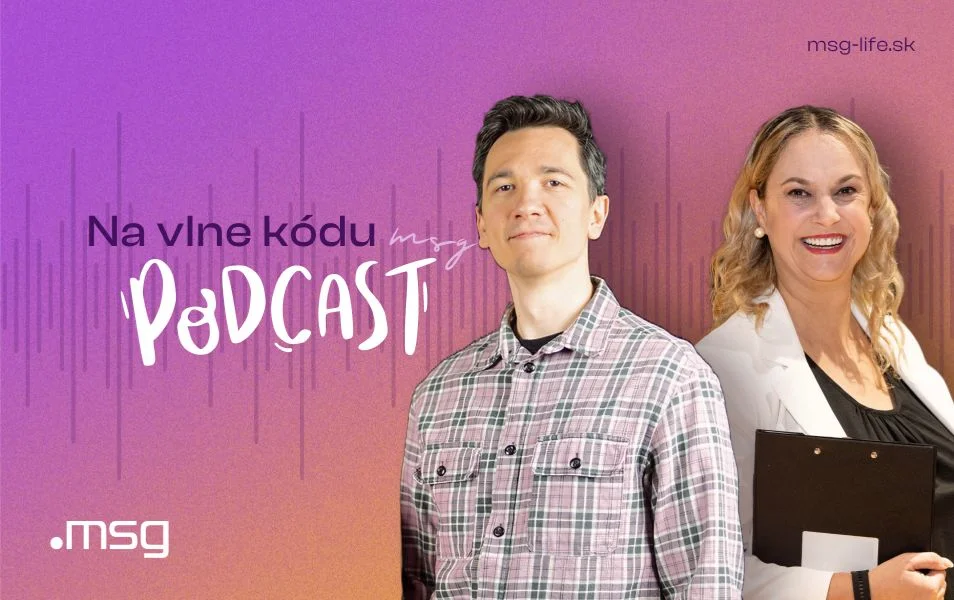
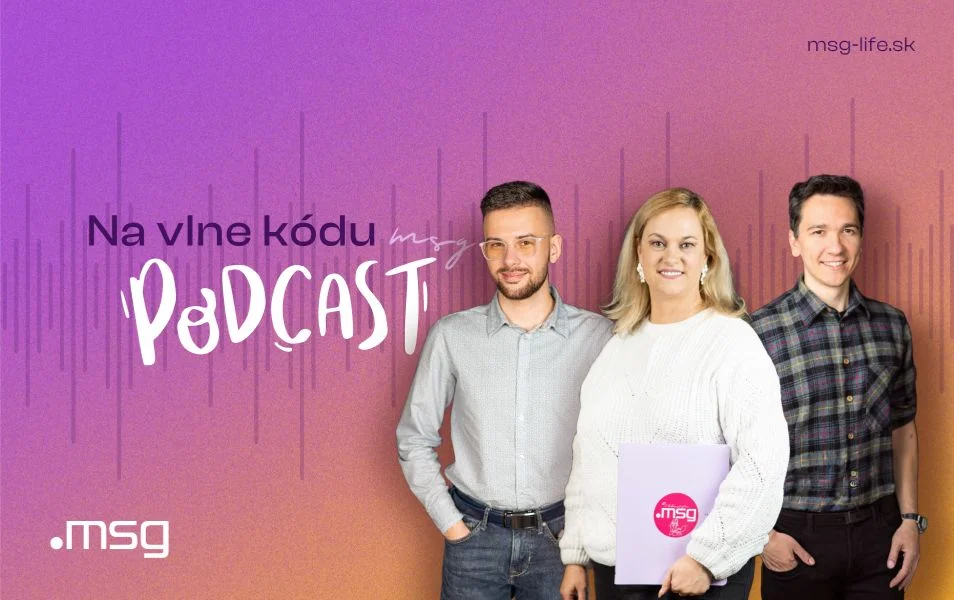
The new episode of our podcast On the Wave of Code was prepared in cooperation with the online platform Ksebe.sk. With Dominika Neprašová, an experienced psychologist and coach, we talk about what burnout is, how to prevent it and what to do when you feel it coming on. We wish you a pleasant listening or reading.

Burnout. A state where our intrinsic motivation goes out and the daily responsibilities that once fulfilled us and made us happy suddenly become a burden. Burnout has become one of the most frequently bandied about terms today. It is a state of physical, emotional and mental exhaustion that arises mainly as a result of prolonged stress, overwork or lack of support in work and personal life.

This phenomenon, which affects people in different professions and life stages, can have serious consequences for health, performance and quality of life. In this talk, we will discuss not only the causes of burnout, but also its symptoms, prevention and ways to get out of this challenging situation. It is time to open a discussion on this increasingly common problem that deserves attention and a solution.

Modern life places many demands on us. We are often expected to be available virtually all the time. Perhaps this is why burnout syndrome is a topic that is being talked about more and more. Dominika, is burnout a modern phenomenon or have we just learned to talk about it more openly?

I think burnout is really coming up a lot now. We can associate it with phenomena, but I think it has always been there. The fact that it is being talked about more now does not mean that burnout was not there before. The topic of mental health is coming to the fore.

To begin with, I would like to explain what burnout actually means. It is a state of emotional, physical and mental exhaustion that most often arises as a result of long-term or chronic stress. It often occurs in people who, for example, have high levels of responsibility, a lot of contact with people or work under pressure.

But burnout can also occur in other areas, such as work. It can be interpersonal relationships, family relationships, parenting, personal life or hobbies.

Is this condition more a question of our psyche or is it caused by the environment in which we live and work?

Definitely both factors. With our psyche, burnout is related to the beliefs or cognitive conclusions we have about ourselves. What I need to do, what I need to become, what will happen if I don’t do it, how others will view me, how I will view myself.

But environment and other influences also play a big role. For example, social networks, comparisons, pressure to perform, perfectionism at work. The term toxic productivity is common. For example, FOMO (Fear of Missing Out) is also related to burnout, that is, the fear of not going somewhere, not participating in something, missing out. And if we have pressure to always be present sometimes, we can burn out from that too.

If we were to compare burnout to the state of a mobile phone, what would it look like? Maybe like a situation where we only have 10% of the battery left and everything is in power saving mode?

That’s a very nice metaphor, I like to use it. The metaphor of a dying flame is also ideal. Burning out comes in stages, we’ll get to that later. But the important thing is that it doesn’t come from one day to the next, but step by step – just like a flashlight in a cell phone dies. At the beginning it is charged to 100% and then it gradually goes down.

Sometimes we don’t recognise burnout because it can look like normal fatigue. In reality, however, there are signs that warn us that we are dangerously close to that threshold. What are the most common signs that tell us burnout is approaching?

I would divide these symptoms into four basic categories. The first category is emotional or feeling symptoms – feelings of exhaustion, frustration, loss of motivation, decreased empathy, outbursts of anger, cynicism, which can culminate in anxiety or depressive states.

Then there are the physical symptoms – fatigue, sleep disturbances, inability to fall asleep, headaches. A lot of clients mention, for example, weakened immunity or digestive problems, this is very common at the moment.

Next, cognitive symptoms, such as impairment of our cognitive, recognition functions. Memory or attention is a little bit impaired because we have so much on our minds that we can’t focus 100%.

The fourth category is social symptoms, which include isolation from other people, withdrawal from social activities, deterioration of interpersonal relationships. We don’t have the capacity for other people, so we withdraw into our bubble.

Why does burnout syndrome arise? And how can we distinguish it from other diagnoses such as depression, work frustration, or some kind of post-traumatic stress disorder?

Burnout syndrome is very closely related to anxiety and depression. These are real psychological disorders that are registered in the so-called Diagnostic Manual or International Classification of Diseases. They are treated with medication, in collaboration between a psychiatrist and a clinical psychologist. Burnout is more of a therapeutic issue. When it is caught early, anxiety and depression may not occur at all.

Burnout syndrome is most often related to chronic stress. Long-term stress kicks in, energy reserves are depleted, the immune system weakens. This is the most common basis. Burnout syndrome also occurs in the sense that we have no control over our life, our work, we feel helpless, frustrated, everything slips through our fingers because there is so much going on.

And then it’s the lack of social support. When we isolate ourselves, we don’t have the mirror of other people to tell us to slow down. Or we have a lack of space for ourselves. We are social creatures, we need to be with other people, but we also need to recharge ourselves. With Netflix, with a show, on a walk, doing crossword puzzles. That is, really being with ourselves.

And the very last thing burnout syndrome can be is even some excessive or unrealistic expectation. Something that is objectively higher that simply cannot be met. It may be an expectation of ourselves, of other people, or of general situations that we should work out. The whole package can lead to a burnout outbreak.

Are there also any groups of people or professions that are more prone to burnout?

As I mentioned at the beginning, it is a job in difficult conditions. That is, for example, long working hours, high work pressure, perhaps low financial evaluation. Lack of control over the work, but also, for example, conflicts in the workplace. Then there are professions where we care for other people – doctors, nurses, psychologists. Burnout is a very common theme here too.

9 min.Addiction to work also negatively affects health

Workaholism: When enthusiasm for work turns into addiction

How to recognise the symptoms of workaholism early and how to fight and prevent the disorder? Having a job that is fulfilling, meaningful and makes us happy is a rare […]

However, caring for children or relatives, financial problems, debt, uncertainty of financial income and financial stress can also lead to burnout. Or then personality factors – perfectionism, pressure to perform. People who may have lower self-esteem cannot cope with stress. Or people who can’t set boundaries and can’t say no. These are all people who then struggle with burnout.

Why do we burn out and slide into it and not, for example, our colleague who has the same tasks at work?

We need to start by growing up in a family, in an environment that influences us. The upbringing style, beliefs and values of our family shape us as a person. From this, personal beliefs such as “I have to do everything perfectly, I have to be everywhere, I need things to run as I have planned” are formed. These are all personal beliefs that we may have, but our colleague has the complete opposite.

Then it’s just the kind of profession that our colleague can do something completely different from us. For example, you are an HR manager, so you have much more contact with people than someone who repairs computers. It’s just as important a profession, but the level of contact with people is completely different. At the same time, it’s the ability to relax, to take care of yourself. Some people have it very well developed, some people hardly at all. And then really it’s setting boundaries. I’m going to repeat myself, but those boundaries and the ability to say “no” are a running theme with the topic of making excuses.

What are the stages of burnout syndrome? How does it all start?

There are four basic stages. The first stage is the enthusiasm stage, when we have high expectations, we are very motivated, we are very enthusiastic about the work ahead of us, we are excited, we are full of energy. Then gradually, quite visibly, comes the stagnation stage, when the motivation drops a little bit, we are a little bit more exhausted, because it is really exhausting, sometimes even impossible, to be fully engaged all the time.

The third stage of burnout is the frustration stage, where there is increased irritability in people, a sense of ineffectiveness, a lack of acknowledgement that maybe what I’m doing doesn’t actually make sense, there is questioning. And then the last phase follows – apathy. That is to say, really a complete emotional and physical exhaustion and a decline in performance and overall interest in what we actually used to enjoy, find fulfilling.

Which area will burnout hit us first? Is it relationships, physical health, or is it overall enjoyment of life?

This is a rather difficult question to answer, but a very important one. It is very subjective, everybody has it differently. But it depends on how one has arranged one’s life, or particular areas of life. Because it is true that if we have a restlessness or something not quite comfortable and well arranged in one area of life, for example in work, social relationships, family and time for ourselves we can somehow manage.

But if it kicks in fully and two areas of life are disordered, that is, for example, work and family, the pressure builds up, heightened emotions build up, and many times we go over the edge. When it’s that one area of life that is affected, burnout comes more slowly. When it’s really two or more, somebody’s whole house of cards really comes crashing down, that’s where burnout is absolutely present.

What do you think about the claim that people who are more passionate about their work and love it more have a higher risk of burnout?

I think that’s debatable, because if a person loves their job, why would they burn out? If a person is doing something, they shouldn’t mind doing it first and last for that job, but there’s a big but there in my opinion.

Even though we love something, we still need to set some boundaries there, set some priorities, some goals, what to say yes to and what to say no to. And again, it comes down to those personal beliefs. So it’s not about whether or not I love a job and then I burn out, but it’s about the person in question, the bearer of those beliefs.

If we could see burnout, what would it look like in everyday life? For example, would it be a slowly dying flame?

The flame is a very nice metaphor. Also the mobile we mentioned earlier. It’s really something that’s gradually fading away from some great whole. In humans, it can also be, for example, the moon when it’s full and it gradually recedes from it, forming a C shape. That, too, is actually waning. Overall, the metaphor of having enough or too much of something and then gradually losing it is a metaphor of burnout.

Is there any way to intervene in time? For example, if I notice a drop in performance in a colleague, or a friend, an acquaintance, how can I help them?

It is very important that we notice this in ourselves. We have to take care of it, because it is about our mental and physical health. But self-reflection, at the great pace that leads to burnout, is sometimes not even in place. That’s why it’s very beneficial when we’re around people, when we don’t hold back and when they give us that mirror. When they say “I see changes in your behavior” or “you’re somehow often sick”, “what’s going on with you that this immunity is limping?”, “I feel like you’re always grumpy, angry, are you okay?”, “are you okay?” or “do you have a lot on your mind?”

These are all things that our friends or family can share with us. And then I think the easiest thing to do is to advise them to go to a professional. To a psychologist who can talk to them about it. Or to ask them what would help them, what they need, if we can lend a helping hand somehow. But that’s what you can also find out in that therapy room. So a psychologist and the topic of burnout is a pretty good functional combination.

We often neglect prevention, because until something actually happens, we do not pay any attention to it. Let’s look at simple steps we can take for ourselves every day.

Two things come to mind. The first one is – and this is how we work with our clients as well – I ask them the question, what is the smallest change you can make in what is currently going on in your life? Because even if the change is tiny, maybe minute, it can change the whole system, and that’s very important.

At the same time, the best prevention is – and more experts probably agree on this – learning to manage stress effectively.

10 min.tipy-od-nasich-kolegov-954-600-listing

Tips from our colleagues on how to cope with stress at work

We asked our colleagues at msg life Slovakia which situations at work are the most challenging for them, how they cope with stress and what helps them to prevent it. […]

What does this mean in reality? Firstly, to seek that support, that is, when I feel I am stressed, to share it with others – with family, with friends or a psychologist, to talk about my feelings. Maybe to have those other people validate it or just to get it out of ourselves.

At the same time, take care of yourself – eat healthy, drink, get enough sleep, move physically. These are all things that can reduce stress. In a work environment, it’s regular rest or, if possible, delegating tasks to colleagues, family members. We are not alone in this system, there are other people who help us.

And it’s also very important to set realistic goals in your work life as well as in your personal life. Not to take on too many tasks, not to have such inflated expectations of yourself. We simply have only one capacity and let’s give ourselves such goals and tasks that we can realistically handle. There is no art to always outdoing ourselves, the art is to manage it so that we are at ease.

How to find work-life balance, which we discussed inprevious podcast?

In my opinion, it’s actually happening in exactly the same way as I mentioned in the podcase. I won’t go into detail, but what’s important for us is priorities. Going step by step from goals, to rest, to dividing up time for both us and other people. These are all things that contribute to work-life balance.

22 min.Na-vlne-kodu-Work-life-balance-954x600

Podcast #1: Work-life balance and healthy work-life boundaries

Listen to the first episode of the Na Vlne Kodu podcast, where topics like burnout syndrome, work-life balance and the art of saying no are discussed.

Do you have any favourite tips that you recommend to your clients for recovery? Either after work or after a harder day, period?

Personally, I like to relax a lot, so I have a lot of those types. And in my type of profession I try very hard to do that, because the burnout is often there. For example, I really like to do different sports activities, sauna, or just sit down with a cup of tea and stare at the wall, but even that is quite so draining. That you just don’t think about anything, don’t do anything, just sit down and chill for a while. Or I really like to do crosswords.

I think everyone knows what rest means to them. The important thing is that we do things that we otherwise consider unproductive. That is to say, doing things that are unproductive or things that are meaningless is also productive.

When a person gets burnt out, the road back can be very difficult indeed. Is it then possible to find joy and balance in work, or is it better to look for a completely new type of activity?

I’m the kind of person who sees hope everywhere. It’s possible, because it’s not about the activity itself, it’s about the setting. It’s about how the person thinks about it all. For example, in sessions with a psychologist, a person can name why they burned out, what made them burn out, what influenced it, how they think about themselves and how they want others to think about them. And when he goes through all this and realizes some of his stuff and his themes in it, I don’t see why he can’t do the profession he was doing before.

Is there anything that can reliably wake up a person with burnout? For example, maybe the thought of missing all the new episodes of his favourite series?

I completely understand the vision in that question. It is very important that a person who feels burnt out or burned out needs to take a proper rest in the first place. That’s really the alpha and the omega. And get yourself together.

And when that happens, I gradually return to those ruminations of watching all those episodes of my favorite show or getting back to that normal functioning. It should be a step-by-step process, starting with that physical recharge first. Because you can imagine that a lot of times people end up in bed. That they have to go on sick leave because of physical collapse. So the fact that we miss a show, again, is that we would be chasing somewhere. We need to slow down, that’s the primary thing.

What are the paths to healing after burnout? Is it something that a person can manage on their own? Or is it better to seek the help of a professional? How long does burnout syndrome take to heal? How long does such a path of recovery take?

Those ways are different. Whether in cooperation with an expert, a person can also set something up on his own, because the change actually happens to him anyway. As far as sessions with a psychologist are concerned, there are different types of therapy that a client can attend. This way he can better find out why he is burnt out and what to do about it.

Then there are changes overall in his lifestyle. That is, sleep, diet, drinking, physical activity, rest – that’s actually what he has a direct influence on. The psychologist can’t help him with that, he can only support him in that. Then there are work shifts, which are very important if we are talking about burnout in the workplace – adjusting the pace of work, reducing the workload, introducing breaks and time-out periods when we can fully rest.

Further, it is the reality in our goals and expectations. And maybe, if it’s a good work environment, getting or soliciting support and help from others. From supervisors, like our boss or boss’s boss, open communication with the supervisor. Telling him how I feel, what my needs are, demands, that I feel I’m going to burn out and what can be done about it. It’s important to have open conversations in that workplace as well, because nobody wants to have dozens of burnt out employees.

Once we recover from burnout, is it likely that the condition can return? How can this be avoided?

Yes, it can happen, and it does happen. It can happen repeatedly, it is a natural thing. There it is just about that change of mindset. Our mindset has to change so that we don’t get into that state of burnout. But I really think that those work habits or work changes, assertiveness, taking care of our physical and mental health more thoroughly are really overall fine preventative techniques and ways to work with this.

If we could have a detox week away from work, what would it look like? Or alternatively, would we be fine with some sort of detox weekend?

Ja si myslím že aj víkend je fajn čas na zrelaxovanie a reset. Je to dostačujúce, keď vieme, ako ho správne využiť. Lebo veľa ľudí má víkend a zahádže sa rôznymi sociálnymi aktivitami, rôznym programom a upratovaním a tak ďalej. Všetko chce dobehnúť cez víkend, ale treba myslieť aj na to, že „len tak sa vyspím, len tak si oddýchnem, len tak budem tou sobotou, nedeľou plávať“. A vtedy je to ten oddych, ktorý to má byť. Ak by sme mali ten detox týždeň, tak by som povedala, že by sme mali oddychovať a robiť veci, ktoré chceme, nie ktoré musíme. Čiže možno urobiť zmenu v rutine a povinnostiach a naozaj ten jeden detox týždeň si viesť sami podľa seba.

Dominika, what advice would you give to those who feel that their torch is slowly but surely running out?

I guess I’d just close with one important sentence, I know it’s making the rounds on social media right now, that “if you can’t handle it, slow down.” Don’t. There’s no shame in slowing down. Slowing down is sometimes extremely important.

Podcast #9: AI mind reading – how close are we to AI reading our minds?

Today’s podcast episode On the Wave of Code is on the border between reality and science fiction. Is mind reading a reality or just a technological utopia? Michal Bystrický, an expert in data science, has once again accepted our invitation to join us in the studio and will tell us what is really possible today and what remains only in the world of fantasy. Listen to him or read his abridged transcript.

In Slovakia, this area has not yet been treated in detail, but at the suggestion of our listeners, we decided to open up this – partly controversial – topic, which is provoking increasingly intense discussions in the world.

How close are we to being able to decipher human thoughts? What technologies are being used today – EEG, MRI or others? Can AI mind reading help in medicine or education? Or can it degenerate into a tool of manipulation? And where is the limit of our privacy?

Did you know that…

…Na Vlne Kodu (En. “On the Wave of Code”) is an IT podcast of msg life Slovakia, which regularly brings you topics from the field of psychology, HR and news from the world of IT? Listen to other episodes of the podcast Na Vlne Kodu.

Michael, let’s look at mind reading from different angles. Nowadays, technology and research in neuroscience and artificial intelligence have reached a level where they are able to recognize certain patterns in brain waves that can indicate a person’s thoughts or intentions. Nevertheless, there are still many questions as to whether direct and complete access to thoughts can be achieved. Michael, is this really just a myth, or are we so far along that it is actually possible?

I think of mind reading as the ability of a system, such as a computer or artificial intelligence, to interpret the signals we measure. These signals correlate with the thought processes of individuals. They are time series that show when and through which neuron an electrical impulse is passing. Artificial intelligence can recognise these signals and assign meaning to them in a computer.

Just imagine you’re thinking about a car. And 300 times we record brain activity and 700 times we don’t. It creates a pattern. This pattern is then “car” and the artificial intelligence can learn it. However, it should be stressed that this is not a literal mind-reading. Rather, it is about identifying patterns – for example, reactions to stimuli or intentions, such as the movement of a limb. That’s when a particular part of the brain is activated.

So, to summarize – the computer monitors brain activity. If I repeatedly think about the car, the brain always reacts the same way. The computer remembers this pattern and can recognize it. But that doesn’t mean it can read what I’m thinking specifically, for example, that I want to drive a car. Rather, it knows that that thought is related to a particular object. That is, it is pattern recognition in the brain, not direct thought reading.

Yes, exactly.

On the subject of mind reading, not only is there a lot of different information being spread, but unfortunately also misinformation. I can think of a moment during the pandemic when there were heated discussions in Slovakia about the introduction of microchips into the brain using test sticks. I am sure you remember that, too – it was during the pandemic. Can we talk a little more about that? Would something like that even be technically possible?

Yes, there was once a hoax that the test sticks used to collect samples for COVID-19 diagnosis contained microchips. These microchips were supposedly to be inserted into the body, specifically the brain, through the nose, and then used – by who knows who – to control thoughts or monitor actions. It has to be said, however, that no mind control or Internet access via such a thing is technically possible yet.

16 min.What is artificial intelligence, history, trends, risks of AI

Is AI really intelligent? What is artificial intelligence, types, trends, risks of AI

In this article you will learn whether AI is really fully intelligent, its types, its impact on the market, the future and jobs.

Nowadays, we have various technologies such as electroencephalography (EEG) or fMRI – functional magnetic resonance imaging – that allow us to monitor brain activity. How do these technologies work? On what principle are they based? And which technologies do you consider the most important when trying to decode thoughts? What makes them unique?

If we are talking about mind reading, there are three basic methods. Measuring the electrical activity of the brain – for example, when we think, do an activity, it produces electricity. The second is measuring the oxygenation of the brain – for example, with a magnet or infrared light. So, when we think, we have different amounts of oxygen in different areas. And the third is the use of X-rays.

In electrical activity EEG, for example, which we measure using electrodes placed on the scalp. These pick up the electrical potentials, i.e. the voltage differences on the surface of the head, which are generated by the activity of neurons. The brain is still processing information, for example, regulating bodily functions and so on. Interestingly, artificial intelligence is being programmed in a similar way today. It actually works like a loop. An agent in artificial intelligence processes information and makes decisions within this loop. In the same way, the brain is continuously processing information. Electrodes on the skin can pick up the electrical signals that are generated when neurons communicate with each other. They pick up the electrical changes that occur when large groups of neurons are activated.

This electrical activity can be divided into waves – delta, alpha, beta, gamma. That is, when I’m in deep sleep, when I’m relaxed, when I’m in an active state of mind, or when I’m in a high state of activity.

The BCI, Brain-Computer Interface, is also based on electricity. An example is Neuralink, which was founded in 2016. It uses microscopic electrodes that are implanted directly into the brain. It’s then much more accurate. In this group there is also the MEG, which is a rather expensive device that measures the magnetic fields generated by the electrical activity of neurons.

Then we have another group – technologies based on brain oxygenation. This includes, for example, fMRI. This is a large magnet that uses hydrogen atoms in water (or therefore in the brain) that are exposed to a magnetic field. These atoms react and give off weak signals. The idea is that the active parts of the brain consume more oxygen, so we can see which areas are more active. Another method in this category is NIRS. This method uses infrared light to measure oxygenation. The light penetrates through the tissues and reflects differently according to the oxygen level.

The last method is by X-ray, i.e. CT scan or computed tomography. These are X-rays, with the computer producing cross-sectional images from multiple angles. The idea is that bones absorb more X-rays than soft tissue, so they appear whiter in the resulting image. By taking images from different angles, the image can be reconstructed into 2D sections.

I’ll summarize. EEG measures the electrical activity of the brain via electrodes on the head. Some people have already encountered this test in practice – it is the monitoring of brain activity, for example in the diagnosis of neurological conditions such as epilepsy. During the examination, we are given a special cap that is placed on the head and brain activity is picked up using electrodes. It’s quick, but doesn’t show details of the deeper parts of the brain. Do I understand this correctly?

Exactly.

Then you mentioned BCI, which allows direct communication between the brain and the computer. It uses EEG to decode signals from the brain. How can I imagine that? What is the difference between EEG and BCI?

Talking about the difference between EEG and BCI, under BCI I mentioned specifically Neuralink. In this project, the electrodes are directly implanted in the brain, which means that surgery has to take place. So the accuracy is much higher than when we just take signals from the skin. EEG captures overall electrical activity, whereas Neuralink captures extremely fine details, that is, individual neurons or small groups.

And then there’s MRI, which measures blood flow in the brain associated with brain activity. It provides high spatial resolution, but on the other hand, MRI is slow and delayed compared to EEG.

Yeah.

And then we have a CT scan. It uses X-rays to create images of the brain. It’s fast and gives a clear view of anatomical problems like fractures or bleeding. But on the other hand, it doesn’t show brain function. Hence, each technology has its pluses and minuses. And why did we stop there? It’s to get to the heart of the subject. Are some of these technologies being used today to map human thoughts?

We’ve already mentioned that we have technologies that can capture brain activity. So we have some signals. Imagine, for example, an EEG recording from one person. We have him do different activities, for example, when he sits still or when he moves his arm.

We will record and mark these sections. When the hand moves, some activity occurs and we mark it as movement. When a person does nothing, we mark the stretch as stillness. Using these labeled segments, we can train artificial intelligence, specifically neural networks.

The artificial intelligence then goes through the EEG recording and learns to discriminate these activities. It can identify what is hand movement and what is stillness. Later, it can identify sections associated with hand movement quite accurately on new, unlabelled recordings based on a pattern.

18 min.Machine Learning - the basics, benefits and challenges of machine learning

What is Machine Learning (ML) – Definition, Models and Difference from AI

Discover what machine learning is, how it works, and how it’s used in real life. Learn about key models, AI basics and practical examples.

Should we be worried that mind-reading will one day invade our privacy?

The closest thing to what you mentioned is just Neuralink, founded in 2016. It uses microscopic electrodes that are inserted directly into the brain. This means the patient has to undergo surgery. The first human clinical trials are already underway as of 2023.

The first patient was a man with quadriplegia, a dysfunction or loss of motor and sensory function in the cervical spinal cord. He was implanted with a chip that enabled him to move a cursor on a screen, for example. This allowed him to control music, play games like chess.

The study also included another patient who could create 3D designs using CAT Fusion 360 software. So we’re already at the level where human clinical trials are underway.

So in this way it could help people with physical disabilities to communicate better.

Yes, especially in the medical field, this technology can help a lot.

Apart from medicine, where could mind-reading be of most benefit? The field of education comes to mind. Will we be able to learn languages more easily, for example? Or could it help in the area of security?

This topic is very broad. The biggest contribution I see is in medicine, as I have already mentioned. For example, the restoration of motor function – the patient who was able to move the cursor on the screen using only his thoughts. Next, prosthetic control – the brain interface may allow bionic limbs to be controlled with greater precision and speed. This is a more precise technology.

In the treatment of neurodegenerative diseases such as Parkinson’s disease, the implant can help control tremors or improve motor coordination. For Alzheimer’s disease, such technologies could help boost memory processes or recover lost memories. Perhaps in the future, Neuralink could store important information directly in the brain or assist in its recall.

In general, as you mentioned, mind control of devices could have a multifaceted impact on all aspects of our lives and society.

When we were explaining the EEG, I also mentioned epilepsy. I had read that in epilepsy there is excessive activation of neurons, which can lead to a seizure. In artificial intelligence, again, it can happen that a certain part of the system gets too much signal and the output is nonsensical or extreme. Do you see a similarity between this overload in the brain in epilepsy and in artificial intelligence systems?

Yes, I do see some similarities in behaviour in epilepsy and in AI. I will mention two examples. In AI, when you intentionally or accidentally modify inputs, it can lead to nonsensical or extreme outputs. In AI, this is called adversarial attacks. Such attacks can disorient the system. Similar to how abnormal electrical activity can disorient the brain during an epileptic seizure.

Second example: in AI, it may happen that a certain layer or neural pathway receives too much signal or activation. This can lead to the output being unnaturally extreme or beyond what we expect. This phenomenon is conceptually similar to excessive neural activity during a seizure.

Could mind reading be a tool for manipulation? How can we prevent this?

So far we have talked about mind reading. That is, we read what we measure and interpret information from that. But we haven’t yet talked about notation. Right off the bat, it should be said that so far this is only about stimulation. It is not possible to write down an actual thought or concrete information.

So what is stimulation? The aim is to affect neurons in a specific area, which can then be used to restore functions that are impaired due to, for example, neurological disorders. This is used to improve motor skills, to stop seizures or to aid memory and learning.

There are already technologies that are being used for this. For example, Deep Brain Stimulation (DBS), i.e. deep brain stimulators. These are medical devices that deliver electrical stimulation to certain parts of the brain.

As for stimulation in AI, there we can amplify scales that are weak. This means that a certain part of the neural network has a higher probability of being activated. A simple way to think of it is that if we stimulate a certain part of a branch of the neural network that is related to reinforcement, that part will be more active and “talk about it more often”.

Michal Bstrický, data scientist at msg life Slovakia, talks about AI mind reading
Michal Bystrický, data scientist at msg life Slovakia, talks about AI mind reading

It is interesting to mention how these deep brain stimulators are implemented. This uses techniques such as MRI or CT scans, which precisely identify the target area related to a particular disorder or symptoms.

Small electrodes are surgically implanted in specific areas of the brain, which are selected by MRI or CT. Then there is a generator that sends controlled electrical impulses through the electrodes to the targeted areas of the brain.

These impulses change or modulate abnormal electrical patterns, which can relieve symptoms such as tremors or stiffness. Specifically, these are the manifestations of Parkinson’s disease. Then the doctor and the patient work together to set the right parameters for the stimulation – intensity, frequency and duration.

I’ll still mention the AI parallel. We can measure which parts of virtual neurons are activated and amplify their weights, that is, stimulate them.

I’ll summarize. It is impossible to write down specific information because the brain is extremely complex and we don’t fully understand how it works. Transmitting specific data would require an accurate understanding of how neurons encode different types of information. And that’s where machine learning comes in to help decode at least the patterns.

Another problem is that if something were to be written down, it would have to be done in such a way that the neurons would correctly interpret the new signals without disrupting existing processes. So we don’t know how to write down specific information yet. The benefit, as has already been said, is more of a medical nature.

Do you think it would be possible to manipulate our thoughts? Because I already sometimes feel like someone is reading my mind – for example, when I want to buy a ski hat and suddenly all I see all winter is ski hat ads everywhere. So someone might be reading my mind, but no one has bought me one yet.

About that ski cap – sometimes it can seem like the current systems are already reading our minds. The way it works is that if you’re talking about ski caps with a friend, for example, and you’re also active on different devices such as a mobile or a computer, algorithms can connect you through information such as location, IP address or network. They’ll then show you ads for ski caps even if you weren’t looking for them before – it’s just that you’ve been talking about it.

If we were to speculate why mind reading might be possible in the future, perhaps it would be related to neuroplasticity. That is, the brain has the ability to adapt and reorganize its structures and functions in response to new experiences, learning, or damage. Perhaps one day the brain will be able to learn to receive new external information, such as from Neuralink.

A good example is playing a musical instrument. When we play when we are young, we see physical changes in the brain, i.e. more activity in specific areas, improved connectivity and lasting changes.

“Sometimes it can feel like the systems are reading our minds – for example, when we see ads everywhere after a conversation about a ski cap. It’s not magic, but a combination of data, devices and algorithms.”

Do you think we should use mind reading to expose lies? Wouldn’t that be too dangerous?

I will give my opinion. I think we should never allow anyone to read our particular thoughts. They could be misinterpreted or misused, which would violate privacy. When we talk about controlling a computer by the subconscious mind, that’s different. But when reading specific thoughts, there is the problem of mistranslating those patterns into reality.

With mind-reading technologies also come various ethical dilemmas, particularly with regard to privacy. If these technologies are used without consent or proper oversight, we could run into problems. What precautions would you recommend to be taken to prevent the possible misuse of these capabilities?

Again, this is a big topic, so I would like to mention here just some of the important aspects. It is mainly about privacy. We should ensure that our thoughts remain private, and that is very important. Any intervention in the brain should be voluntary and informed, that is to say, the user should give consent for such intervention.

Then you have to ask, what happens if someone changes your thoughts or memories? How will this affect your identity and personal autonomy? These are questions of identity, integrity and free will. Finally, there is the risk of misuse of these technologies, for example, for unethical purposes, manipulation or mind control.

Do you think these technologies will become a normal part of our lives or will they remain only for a small group of professionals?

Let me use an example from history. When cars began to appear in the early 20th century, many were sceptical. Cities were full of horse-drawn carriages leaving litter in their wake. Despite the initial mistrust, the practicality and efficiency of cars overcame this scepticism.

Similarly, today we have blockchain technology. Despite the initial difficulties, they are already changing the way we store value (e.g. bitcoin) or trust, as they enable transparent execution of contracts without intermediaries. The practical benefits may in time ensure that blockchain will be as much a part of our lives as cars.

When we talk about Neuralink and similar technologies, they are still at the very beginning of their development – just like cars in their early days. Neuralink is currently the subject of discussion and research, and it is possible that it will eventually become integrated into our daily lives. But that will take some time, in my opinion.

Michal, how would you sum up today’s topic in a nutshell?

I see the theme in two main levels – reading and writing information. In terms of reading, we currently have only very limited ability to measure and interpret patterns of what is going on in the brain. Writing is not currently possible – we can only stimulate certain areas. So these technologies do not allow for literal mind reading, let alone writing. The benefit so far is mainly medical.

Very close to this topic is artificial intelligence, specifically neural networks. There are still many unknowns there, but it is artificial neural networks that can help us better understand how the real brain works. The difference is that we can easily do experiments on an artificial neural network – for example, activate or deactivate certain areas – and observe how the system behaves. With a human, of course, it’s much harder. If anyone is interested in this topic, I recommend you start researching artificial neural networks.

Podcast #8: The impact of sport on physical and mental health – how movement affects our mood, motivation and resistance to burnout

We all know that movement is literally vital for our bodies, but most of us don’t have the time or energy. Physiotherapist Braňo Mišovič fromFitclinicwho is the guest on the next episode of our podcast Na vlne kódu, believes that the body and the mind are one. Listen to the inspiring interview that movement is not only about a healthy body, but also about a balanced mind, resistance to stress and a better mood.

The link between physical and mental health is not esoteric, but a very practical reality. When our bodies feel well, we can handle pressure, challenges, and even harder days much more easily. When we are in psychological well-being, we also perceive physical pain in a completely different way.

You may have already noticed that if you do any sport regularly, your mental health will improve. It is also true that after a good night’s sleep, you can handle a busy day with greater ease. And that’s what today is going to be about. How what we do with our bodies affects our motivation and also our resistance to burnout. And in this episode, we’re going to look at what physical habits can make us mentally stronger, how to improve our mood, what movement does to the brain and hormones, and also how to set up our day so that we feel better in the long run and most importantly, without any extremes.

If you feel that the office chair is getting to you, this is the episode for you. Together, let’s see that even small changes can make a big difference. Our host Ivka Hricová, HR manager at msg life Slovakia, talks to our guest.

Did you know that…

… Na vlne kodu (On the Wave of Code) is a podcast by IT company msg life Slovakia that regularly brings you topics from the fields of psychology, HR, and news from the world of IT? Listen to other episodes of the podcast Na Vlne Kodu.

Today, it’s probably no surprise that when we take care of ourselves physically, we feel better mentally. But why is that? What happens in the body when we go for a run, do some exercise or take some steps? Is it just our mood that improves or how does it all work?

It is not for nothing that it is said that movement is the engine and originator of psychological well-being. The underlying principle is the release of certain hormones – specifically endorphins and dopamine, which are key hormones that are linked to feeling good. When we move, these hormones are produced at an increased rate and create good feelings in our bodies. Endorphins induce a feeling of euphoria, reducing the perception of pain – and that’s actually what makes us feel good. This effect is often referred to as “runner’s euphoria”; runners know it. Of course, other physical activities also create and release large amounts of endorphins and make us feel very cool indeed.

“Movement is the engine and originator of psychological well-being.”

Is there any other way to support such a good mood? By eating, sleeping or something normal that we can fit into our daily routine, even if we don’t exercise?

Basically, yes. There are various other methods that can help us. For example, hardening, cold water, the Wim Hof method, a good diet. When we eat something we like, we also feel happy. And endorphins are not only released when we move. It’s with anything that makes us feel good. So basically, what makes us feel good is also healthy for our bodies.

Did you know that…

The impact of sport on physical and mental health is manifested by the release of hormones? Regular physical activity – such as 10,000 targeted steps a day – significantly improves blood flow and oxygenation to the brain, which immediately boosts our well-being and releases endorphins and dopamine, hormones that induce feelings of euphoria and relieve pain.

Is there evidence that the body and the mind are much more connected than we once thought, or is this still in the realm of hypothesis?

It is also confirmed by scientific studies that a real healthy, strong physical body simply makes us feel good. We have self-confidence and when we have self-confidence, we also have a certain peace within ourselves. And when we have peace within ourselves, we also have a certain humility. So it’s such a nice little train that builds on itself. I don’t want to make it sound like only a strong person is the right person. Because I know that a lot of people, when we talk about this topic, they think of this kind of swell guy from the gym who has more muscle than brains.

Physical well-being in a healthy and strong body is not at all related to muscle size. Even if we look at calisthenic athletes, they are very strong, but they are not extremely muscular. But they will confirm that when I am physically strong and resilient, or I am in good shape, I also have a certain amount of confidence and belief in my abilities. And the psyche works for me, not against me. I’m coping better stress at work, in the family, because I have the comfort of that health in me. When a person is ill, weak, not feeling comfortable in his body, he may be wise in his own way, educated in his own way, but it will reflect on that psyche in the form of discomfort.

I also have patients who are medically disadvantaged and have to work very hard on their fitness. Since I am with them often, I see the physical amplification in them significantly in how their mood improves. Conversely, when there is a period when they go down physically, it automatically affects the psyche a lot. I experience the same thing with professional athletes and with ordinary people in practice. When we make them physically healthy people, they literally shine – in their personal and professional lives. So it’s absolutely connected.

Movement is not only about a healthy body, but also about mental resilience. What physical activities reduce stress the most? Is it better to sweat during an intense HIIT workout, or to indulge in a longer walk in the woods?

It is individual. But something completely different in the body is created by high-intensity interval training – the HIIT or tabata, which is also interval training, just with a different interval setting. HIIT created in me in a very short time a feeling of well-being, happiness, because I get sweaty, I breathe, I get pleasantly tired. In a very short period of time a large amount, even a rush of endorphins is created. So when I need to save time and I want to take the stress out of myself, I go to something like this.

But the question is whether it is healthy for the posture, for physical health, bones, muscles and joints. Because HIIT is an exercise that targets something precisely. If I take exercise really just to improve my psyche, HITT is a very good system in a short time. While I would induce a similar amount of endorphins when walking, for example, I would have to dedicate a lot more time to it. In order to accumulate as many endorphins while walking as I do in 30 minutes with HITT, I would need to walk three to four times longer – so at least 2 – 2.5 hours. And not a slow, shuffling walk, but a bit more brisk.

Ideal is Nordic walking, where I also engage my upper limbs, because people don’t normally engage their upper limbs when walking. And yet engaging the arms to move the legs is an absolute natural thing to do – that’s when I can even get close to HIIT. So if I were to answer your question strictly, HITT will provide a great supply of good hormones in a short period of time. Walking a bit slower and I have to dedicate more time to it.

Recommend
We recommend:

Need advice on how to combat stress and anxiety? Read our article: Tips from our colleagues on how to manage stress at work.

Which kind of movement do you consider the most underrated? Or on the other hand, what is overrated and doesn’t make as much sense?

Now I’ve picked up HIIT a little bit and I’ve sort of put walking on the back burner. But when you put the question like that, I’ll answer it quite accurately. Walking is the most underrated and yet it has huge health benefits. It just needs to be dedicated to for longer periods of time. The most overrated, in turn, is HIIT exercise, because it has the benefit of quickly draining you. I’ve knocked stress off of myself, but the effect on the physique as a whole is debatable.

“Walking is the most underrated movement, yet it brings huge health benefits.”

Let’s go back to walking and to steps. Those 10,000 steps we should take every day, are they for the whole day?

10,000 steps means to tense the muscles of your body 10,000 times in some way, i.e. to activate them. It’s a number that is calculated maybe in a very general way – for somebody it’s more, for somebody it’s less. One larger study found that 10,000 steps is ideal for maintaining cardiovascular health. Careful, cardiovascular, meaning the blood vessels of the heart. That doesn’t mean that if I walk, I’ll have a healthy posture or anything like that.

In the field of cardiovascular health, the 10,000 steps are ideal for all the biomechanisms that need to work in the human body. But they need to be done purposefully. If I look at my watch in the evening and there are 20,000 steps, it doesn’t necessarily mean anything. Is it really 20,000 steps that I’ve done cyclically and purposefully? That I walked for two hours straight and did 20,000 steps? Or is it just 20,000 random movements, because the watch is based on the principle of gyroscopes and counts any shaking as movement?

So for me, those 10,000 steps have to be the 10,000 strict steps. I set aside time to walk, start watching the counter, and walk. Otherwise, it’s just random hand-generated movements and random steps. We need a cycle. Then the body will work in certain intentions, because I won’t do 10,000 steps in 35 minutes, I’ll do them in maybe an hour – an hour and ten minutes, and the body after 30 – 35 minutes will trigger completely different biomechanisms. Exactly the ones that we want. The ones where it starts to burn continuously, where the fluids in the body start to flow steadily, etc. These are not randomly generated movements. I’m going, I’m just going. Foot in front of foot, hand in front of hand. So that’s the way to see it. 10,000 purposeful steps. All the others are random.

I’ll also bridge to the drinking regime, because it is very important during the day. How about drinking water?

In the drinking regime, the split occurs again. Again, there are many studies, so let us agree on this one. If our body is to have something to cleanse the intestinal apparatus and for what it has to go into the blood vessels, we cannot count tea, coffee, soup, juice in there, because there are so many supplements that the stomach has to deal with. Thus, what it has is no longer going into the intestinal circulation. That purifier, that something pure, that’s just water.

So, if I have to drink 2.5 litres of fluids a day, it means 2.5 litres of pure water. Tea, coffee, soup – that’s something else. We should not put these two things together. If I’ve had 3 dcl of soup, another soup in the evening, half a litre of tea, these are things that the body has to work with again and has to put in the work to process them. And on top of that, there’s the product that goes into the gut. I need the gut and the stomach to have to work as little as possible. That’s why I need to drink that amount of plain water, so that I’m always clearing those “pipes” as best I can.

The Wim Hof method, which we have already mentioned today, is also quite popular. Cold plunges, breathing exercises, body work, perhaps sometimes to extremes. In your opinion, can it also be useful as a prevention against burnout? Isn’t it already too much of a shock to the body?

Talking about cold in general, it has great benefits for the body. To put it in technical terms, even a computer needs cooling for the processor. Because when it overheats, it does not perform and can be destroyed. And it is the same with the human body. The human body has certain cooling processes, but it has to put some work into them. That is to say, when we cool the body, we relieve it from having to do a lot of work in warming up when it is cold outside. That is, we prepare and train it for something that it then has less work to do.

The Wim Hof method is primarily based on breathing. Fibrillated breathing, rapid intermittent breathing, etc. There are many techniques. I am absolutely not an expert on the Wim Hof method, but purely from my experience as a hardy swimmer, I know that the cold and the subsequent warming of the body after coming out of the cold water simply has to cause an influx of endorphins for one simple reason. The body needs to warm up and just like any other movement, the blood vessels will dilate. So they dilate really considerably. That vasomotion, that vasodilation, causes a lot of blood flow. And because it causes proper blood circulation and we breathe, we bring a much greater volume of oxygen into the body. This makes the body come alive.

And this is the principle. Oxygen is absolutely the most important commodity for the human body, in the sense of supplying oxygen to the tissues. And I’m going to feel significantly better. If I’m not breathing, I’m breathing shallowly, I get a headache. We say I don’t have enough oxygen, I’m out of breath. Well, then let’s do the cold plunge, because cold plunges are all about breathing. And the cold is just an aid to make the blood vessels constrict and then stretch. We use the cold to constrict the blood vessels because we can’t constrict them any other way. So water is just an aid.

For me, working out is excellent for stress relief because it actually creates a similar environment to when I run, walk or exercise. The blood vessels start to dilate and constrict, thus the body starts to get better blood flow and oxygenation. And when I give my body all this, what I don’t give it for hours and days, I automatically feel better.

“An excellent thing to relieve stress is cold plunge.”

Is it similar with the sauna, when I go from the sauna to the ice water?

Yes, the cold water is the most important part of the whole sauna experience. If people forget this, they don’t sauna as they should. There are the terms positive and negative thermotherapy. Negative thermotherapy is the cooling down, it’s actually the cold plunging. Positive thermotherapy is warming up. For example, a Finnish sauna is called a cardio sauna, there you don’t relax the muscles at all. My body can’t warm up that deeply there because the temperature is so high that the body expends enormous energy to cool itself. That’s what sweating is. That’s extreme sweating. That’s why I’m only in the Finnish sauna for a little while, 10 to 15 minutes. And that’s when my heart is practically working, because then I go into the cold water, the blood vessels contract again, they stretch, and therefore the heart is working. That vasomotion, vasodilatation – that means my blood vessels are dilating, contracting. That’s what the Finnish sauna is all about.

But when I go to an infrared sauna, where the temperature is much lower, more than half, in the range of 50, 55 to 60 degrees, the body has time to heat up more slowly. It doesn’t open up the self-cooling mechanism as profusely, so our muscles get warmed up to a much greater depth. That’s why we don’t use a Finnish sauna after sports, but an infrared sauna, because it actually relaxes our muscles to a greater depth. Or saunas with a lower temperature, where the body gradually absorbs the temperature and relaxes the muscles down to the deeper structures.

I don’t go to the cooling pool after these saunas. It’s enough if I go to the air, to the tepidarium. So yes, sauna has the same effects as cooling down, it’s just from the opposite end. After cooling off in the cold water, I go out in the air, so I usually start to warm up because I have to cover up. I should cover myself in something warm. And this one is just the opposite. I go from warming up to cooling down. So the principle is basically similar. Also, before a normal sauna, there were certain rituals when I’m supposed to warm up. Same as before cooling down. I should take a breath according to the Wim Hof method. If you look at some of our other polar bears in different shows, they’re jumping in that water because they’ve gotten used to it over the years. They’ve already practiced it. But when I start, I have to start with breathing. Even in that positive thermotherapy, that means sauna or cooling down. It’s all about breathing. That’s the first point.

But let’s go back to the movement itself. Is just 5-10 minutes of exercise a day enough to make us feel better, or do we need to work out for at least half an hour – an hour?

Sometimes even a little is better than nothing at all. Just do something. In fact, in 10 minutes, I could destroy you so badly, you wouldn’t know where north is. Really, there’s an exercise called the MREP type – do as many reps as you can in the time given and I’ll have you do three exercises in a cycle. You’ll do this one twice, this one twice, this one twice. If you do as many as you can in 10 minutes, you’ll reach your limit and you’ll be done. But then again, we’re back to that high-intensity interval training.

I’ll tell you how I do it. The less time I have to train, the more intense my training is. If I have more time, I go more into endurance development. If I only have half an hour, I go almost to the edge – interval training. And if you take that person just a regular everyday, untrained person, in those 10 minutes they’ll do the exercises at a high intensity and really get a good workout.

Researchers have calculated that the equivalent of 8 hours of sedentary work is one hour of purposeful cyclical movement. One hour of walking. So, make your own judgement as to whether 10 minutes will be enough. Still better than nothing, that’s how I’ll sum it up.

“The equivalent of 8 hours of sedentary work is one hour of purposeful cyclical movement.”

Let’s go back to the office now. After every hour we should exercise. How can I exercise? Can I just walk to get a coffee, for example?

No, it’s not enough. I have to do targeted exercise. It’s not enough to go purposely for coffee, that’s an alibi approach. Because if you go for that coffee on purpose, are you really going to walk that beautiful walk? Left hand in front of the right foot, right hand in front of the left foot, right? Are you going to keep an eye on it ? You’re gonna turn on your heel and you’re gonna go.

Isn’t it more sensible to actually take those two or three minutes? I have them all to myself. I sit and breathe for a minute. Now, Ivka, if we close our eyes for a minute and we go to breathe together, in that minute you can feel that at least you are pleasantly dizzy, because you have oxygenated yourself. A little more than normal. And after that minute, we stand up and go stretch ten times right, ten times left. We’re gonna do ten lunges. Ten times we stand up from the chair, shake our head. There’s no substitute for walking for coffee. I’ll say again, it’s better than nothing, but let’s not look for escapes.

Which is better for our mood and for our head? Is it running or fast walking? For example, I’ve heard that running burns more carbs and walking burns more fat. Is that true? And what has any effect on our psyche at all?

It is said that we burn more fat when walking than when running, because if it is an ordinary untrained person, he will have a lower heart rate base when walking. And because he has a lower heart rate base, he doesn’t necessarily need to use fast sugars. That means when I take a doboche or a gel, that’s a fast sugar. The body is going perfectly fine, struggling to cover energy expenditure from what it burns from fat. Of course, something goes from the fast sugar as well, even though we have a lower heart rate base when we walk, but it has plenty of time to make the energy we need from that fat. Because it’s a little slower to make it from that and it takes longer for the body to do it.

But when running, a person who is untrained and goes out to start running has a much higher heart rate. So the body automatically needs a faster supply of fast energy. He doesn’t have time to process the fat. Because when he is running, his heart rate is 150 and I need to supply him with energy quickly. But in turn, as a well-trained endurance runner, when I run at a slow pace for me, for example 6 minutes 30 seconds per kilometer, I have a heart rate of 111. For you, that’s a borderline pace where you have a heart rate of 150. What do you think, am I burning sugar fast while doing that? I’m not.

So it’s individual. I’ll show you x number of people who have health problems and they’re 150 when they walk. Those go on fast sugar all the time. So you’ve got to adjust your walking speed as well to keep your heart rate at a level where you’re burning fat. For example, there are zones Z1 – Z6. We know that in the Z1 zone, for example, we’re only using 50% of our body’s potential. In the Z5 – Z6 zone, we use 100%. So by those zones, I know that when I’m in Z1 – Z2, I’m going quasi on fat. That I don’t need that fast sugar. But as my heart rate goes up into zone Z3, 4, 5, I need that energy more and especially fast.

Which types of exercises do you think are the best if you are mentally exhausted and no longer have the strength for big performances, but want to at least move your body a bit and turn off your head?

For me, these are such “lazy exercises” as walking, Nordic walking. There I clean my mind beautifully and the body does not work in high intensity. It goes along with the same intentions, in that cyclical way where it can tune in to everything and everything becomes in sync. Then stretching and breathing exercises, pilates. Just where I’m engaging the body in a kind of quasi isometrics, like those dynamic exercises.

I mean, yes, HIIT will get you pumped up in a short period of time, it will quickly knock everything out of your head. But sometimes it can also make the psyche worse, because it may not go the way I want it to. After just three minutes I feel tired, I’m not in the mood for that explosiveness. So I leave the training more disgusted than when I went there. After walking, I have nothing to be more disgusted about. When I walk, I don’t stress the body as much, but at the same time I do an incredible amount for it. There are a lot of studies on that.

Walking is often underestimated because it is not as intense as other forms of exercise. Yet regular walking improves cardiovascular, muscular, mood and reduces stress. Precisely because there’s that cycling. I might put on some music or a podcast to go along with it and my thoughts will drift somewhere else entirely. Whereas with that high-intensity cardio, maybe I really can’t, I don’t feel like it, I have to listen to the coach. I’ve dealt with that, I’ve been doing those HIITs for years. It’s a lot harder to motivate that person then. So for me walking, stretching, breathing exercises.

How does sitting for long periods of time affect our body and mind? Could it be the silent thief of energy?

It’s true. Sitting is an unnatural position for the body, prolonged sitting means prolonged inactivity. Even if I have those slots in there every hour, it’s a totally unacceptable position for the human body. It’s just not moving. So yes, sitting is a silent killer in every way, and it definitely needs to be compensated for as much as possible.

6 min.Proti bolesti chrbta ti pomôžu správne sedenie a cviky

Back pain from sitting at a computer: tips for correct posture and workout

Almost every person who has a sedentary job is familiar with back pain problems. Hours without movement, stiff muscles, incorrect sitting position or a poorly adjusted monitor. These are all […]

Why are we more tired after a day in a chair than if we had physically worked?

Precisely because nothing happens in the body. We don’t have it sufficiently oxygenated, we have clogged, clogged blood vessels. You’re not doing anything, you’re not putting out energy. Most people who are sitting are probably working mentally. When I’m working mentally, I have to engage my brain and my brain threads. And the brain is a machine that needs a lot of sugar. So I automatically reach for something. So I’m messing up my health by not moving, plus the intake of nutritious foods that aren’t appropriate.

There is a so-called tree theory. For a tree to be healthy and resilient, it needs to grow upwards and have no obstacles. Because when it has them, it weakens it, the trunk is crooked, leaning. It is the same with the human body. It needs to stretch and move as much as possible so that the biomechanisms that need to be triggered in it are also triggered. This is myofascial movement, movement between fascia, musculature, then other structure. Everything is driven by movement.

So I must feel tired when I sit for a long time because I have an unnatural position, my muscles are in unnatural positions and tensions, or the opposite of tensions. A lot of my muscles are then weakened, other muscles are in turn shortened, so I have huge disproportions in my body. Nothing works as it should. So the fatigue just has to set in. Fluids don’t flow in the body the way they should. We’re not getting enough blood flow. We’re not vascularized enough in the acral areas. The body goes like half throttle on supplying the body with beneficial substances.

We are talking about movement. Is it just about blood circulation or is there something deeper going on there, chemically, hormonally, or mentally? How do the processes in our body actually work?

everything is connected. Let’s try to imagine it as a kind of mechanism on old trains, a “backstage” mechanism. When a wheel moves, the driven wheel through that scenery moves another wheel. That is, I’m setting the whole scenery mechanism in motion.

When I’m not moving, none of those mechanisms work. Thus, the physical tied to the mental doesn’t work for me either. The bad mood, the feeling of emptiness, of not being satisfied will come to everyone at some point. I know a lot of people who work in the IT sector, which is probably where they sit the most, and there are those who will say they are absolutely fine with it. But when I ask why you came for a massage – well if it suits you, your back doesn´t hurt or anything. And they’re already chatting. I say, so basically it doesn’t suit you.

The fact that it suits him for the psychological side, well, fine. He’ll be fine with it for a while. And there are even some people that it doesn’t do anything to their psyche. They’re perfectly OK with sitting. But they have a completely broken body. And then that starts to make them angry and suddenly their mood is spoiled again. That their body is not working, which is where the soul and the brain reside.

Either way, it’s loading up.

Ivka, it’s always related. Absolutely all mechanisms. When I don’t move, my vascular supply doesn’t work. When there’s no vascular supply, the muscles don’t have elasticity. The fibers aren’t sufficiently vascularized, nourished. When they don’t have enough blood supply and I stand up, it hinders my movement. I’m hunched over, I can’t bend over. I have pain behind my knees. I can’t do this movement, that movement. I go to play catch a little bit with the kids and I can’t do it anymore. So it then follows all the processes in the human body – from the mental to the dissatisfaction of not being able to do something.

We already know why we move. Now let’s figure out how to do it. Let’s give some simple tips on what we can do every day, even when we have a busy calendar. Can we try some breathing exercises?

100% yes. Breathing exercises are a very popular exercise that many physiotherapists include, as it is quasi-physically demanding unless the body is used to the movement. It has a beneficial effect on the whole body just by getting it properly blooded and oxygenated. In this way I will finally bring oxygen to the most remote areas of the body, it will finally start to live and function there. And most importantly, through breathing exercises, one will slowly work up to the essentially physical exercise as well.

I would definitely put breathing exercises on the very first step when I want to start doing something for my body. To try, those tutorials are relatively many. The simplest one is to try to breathe in as long as possible, breathe out as long as possible. There are a lot of apps where I can set a time and meditate in peace. Work with the breath. Learning to breathe into the shoulders. Learning to breathe into the diaphragm. For diaphragmatic breathing, it’s better to have someone teach you, because you can hardly test yourself if you’re really breathing into your diaphragm. But in any case, breathing is such a first step.

“Breathing exercises have a beneficial effect on the whole organism just by making it properly supplied with blood and oxygen.”

What simple physical exercise can anyone really do? Whether at work or at home, without having to spread out a mattress between chairs?

Every healthy person should be able to do one key, one squat, do a deep squat, hold it.

What if someone has problems with their knees, spine, etc.?

Then I just go into as deep a squat as my knees will allow. Quite normally I engage common sense. I don’t have to give up the squat. Because that squat, that movement in my knees, gives me health in those knees. Because when my knees don’t move, it creates changes in the cartilage that then cause problems. I still have to work with that knee to get the articular surfaces in there to ride out the way they’re supposed to be. So that various osteophytes and stiffening of the knee don’t develop there. And especially when I move, my knee also naturally lubricates with synovial fluid, which seeps in when the knee moves.

And this applies to every joint. When I’m not moving, I’m just not. And at home, I can do whatever my body allows me to do. I can move my arms, my legs, I can stretch them, bend them. I can squat, I can bend over, I can lie on my back. I can move my limbs calmly and chaotically. Just to do something.

And if you want specific exercises, different types of squatting exercises, exercises where I’m extending my limbs in a seated position, forefoot straddling and straddling in a seated position, straddling in a standing position, forefoot straddling in a standing position, straddling in a seated position, straddling in a supine position, lifting both lower limbs in a supine position, we have abdominal exercises. There is a huge amount of exercises. When someone asks me which three exercises I would single out, it’s the squat, the kneeling squat and the sit-lie. Or rather, not the sit-lie, but the shortcut. I mean, some sort of core exercise. Just the simplest.

Don’t complicate things unnecessarily.

For what? Everybody says that sit-ups are not a thing anymore. Yes, they do what’s called shortening, where I go for that upper abdominal muscle and I just do that chest lift. When I want to strengthen that lower part, I put my hands under my butt while lying on my back and lift my extended lower limbs, or legs off the ground in a perpendicular direction. So I can really do any exercises that are very simple.

How do we set up our daily routine so that we don’t feel like a jigsaw puzzle? To keep our mental and physical in balance?

It is necessary to set aside time during the day just for yourself. This time, these 10, 15, 20 minutes, is just for me. And this is the balance to what I have behind me after a full day of work.

I have a workout habits at work. In the morning before work, I have a warm-up. In the evening, I do a little stretching, which prepares me for a restful night’s sleep. And if I have a consistent system of doing 5 Tibetans in the morning, doing something else during the day, then after work I take 10, 20, 30 minutes and go walk, go work out, go on the treadmill, go bike, I’ve practically done the best I can and I can’t feel like I’m a jigsaw puzzle afterwards. Because I’ve got a system in place. If a breathing exercise makes me feel better for the evening, some mantra I’m reading while I do it, complete relaxation, some yoga exercise, I do that. If I’m a more dynamic type of person than that and a routine of those 100 push-ups and 200 abdominal exercises does me good in the evening, I do that and I look forward to it. I’m perfectly happy to have a 10 o’clock time and go work out. And then I’m even more happy because I kept it. So I really have to set aside time. There’s probably no other way to do it, Ivka, there just isn’t.

I understand, basically everyone has to find their own thing.

Exactly, your system. But it should be sustainable in the long term. That is, not to set unrealistic goals. If I can’t do more than 10 reps of that exercise, I’m not going to give myself an unrealistic goal like I’m not going to go to sleep until I’ve done 10 reps of the whole thing. I’m fine going with what I’ve got. I’m packing some motivation and strength and gradually increasing that.

Definitely need to start. That’s where it all starts. An awful lot has already been said, there is an incredible amount of motivation and guidance on the internet, and I guess I’m just repeating some of it now too. But you need to have, or you need to try to build that routine within yourself. It’s hard, it takes time.

“You need to set aside that time during the day for yourself and only yourself. Sometimes even ten minutes is enough.”

If you had to pick some kind of exercise to relieve pain, what would it be? My neck hurts at work, what should I choose?

I really like pilates, so I would probably go in that direction. I would definitely go to a Pilates class, possibly a physiotherapist who does Pilates and there is a wide variety of exercises I can learn. He can be a huge help to me with a lot of postural problems. Stiff neck, lower back, weakened abdomen, etc.

What if my hand hurts, for example, because of working with a mouse?

The hand mostly hurts people who work a lot on the computer or even seamstresses. Mostly it is carpal tunnelwhich arises precisely from the inactivity of the variety of movement of the palm and finger parts. So I try to stretch my forearm, stretch my fingers in all possible directions, use simple strengthening exercises, for example, squishing a rubber ball or a strengthening ring, opening my fingers to the absolute largest possible opening, spreading my fingers, clenching my fists and especially stretching my forearm.

It is there that the movement binds, it stiffens there, so expressly stretching the whole forearm is paramount. I push my fingers backwards, also the whole palm part, then in the opposite direction, that is to the bottom, I move left, right with the whole wrist, circular movements in the wrist. This I would say is general yet very effective for everyone.

22 min.Na-vlne-kodu-Work-life-balance-954x600

Podcast #1: Work-life balance and healthy work-life boundaries

Listen to the first episode of the Na Vlne Kodu podcast, where topics like burnout syndrome, work-life balance and the art of saying no are discussed.

What would you recommend to everyone who wants to start moving a little bit? Maybe even ten minutes in the morning is enough? Or some stretching in the evening with Netflix, or did we mention like those Tibetans, yoga?

100% yes. Whatever movement they are going to do, let them do it in the sense of some cyclical movement. So feel free to start with five Tibetans, feel free to start with a 10-minute warm-up in the morning, add to that some other exercise for 10 minutes in the evening.

I don’t see the problem in how much time to devote to it, but mainly to get started. Stretching, those Tibetans, is totally awesome for the morning, but cool for the evening too. After a full, sedentary day, too. Stretching rather than that intense exercise. If we’re talking about people who sit a lot. And who are just starting out. In the evening, I’d also opt for stretching exercises.

If you came to me as a client and asked me what to do in the morning, I’d tell you to do this stretching exercise in the morning, you’re going to do lunges. You lean your butt against the wall and you slowly lean forward, you rub your palms up your thighs to where your back lets go. You repeat ten times. If you don’t have a problem with that, keep going. You’re back against the wall, arms outstretched, you rest your palms facing forward against the wall and do half-arches. You stretch your arms above your head, doing circles. There’s a lot of exercises. I’m moving my shoulders, my shins, my whole body. Those are the deep squats. I can grab the table, the door, the radiator, if I can’t get into that deep squat. Or I just go within where my knees will let me so I don’t fall. But I’m trying to get all my joints moving.

How to stand properly at the sliding table?

We are not standing on one leg. I always stand nicely on both legs and with my tummy tucked in. The moment I retract my belly, my pelvis sits up slightly. So from antiversion to retroversion, that’s where we should have it.

If you had to give one main message to everyone who wants to improve their life through healthier movement, what would it be?

Move. To find the time, the space, the routine to just do a few of those simple exercises every day. And let’s say what they can start doing today is during their busy day, try to take those two, three minutes every hour to exercise. And to not pay attention to the fact that somebody’s giving me some weird look. After all, it’s my health, not his.

Podcast #7: Gallup Test and Strengths – Turn your talents into a competitive advantage

Do you know your strengths and how to build on them? The next episode of the Na vlne kódu podcast is full of practical how-to’s, inspiration and aha moments. Coach and mentor Janka Turzova brings us expert insight on the topic of strengths and weaknesses and gives you tips on how to turn your natural abilities into an advantage.

Most of us are preoccupied with suppressing our weaknesses instead of developing our strengths. We are always dealing with them and talking about them as if we were trying to turn a mere stone into gold. But why do we do that when we already have the gold inside us? Strengths are not just some psychological concept. They can improve not only our work, but also our life, relationships and mood.

Why do you need to awaken this power that slumbers within you? Otherwise you may end up like someone who wants to break through the wall with a hammer, even though there is an open door next door. Listen to the interview of our HR manager Ivka Hricova and coach Janka Turzova on the topic Strengths and weaknesses: how to take advantage of what we are good at or read his transcript.

Did you know that…

…”Na Vlne Kodu” is an IT podcast of msg life Slovakia, which regularly brings you topics from the field of psychology, HR and news from the world of IT? Listen to other episodes of the podcast Na Vlne Kodu.

Janka, please tell us more about your work. What is your superpower? Are you able to find something strong in absolutely everyone?

You said it nicely in the introduction. I’m basing it on talents, because exactly one of mine is maximizerwho sees talents in other people. And it’s natural for me to develop them further. I love to build and build on other people’s talents. It’s important for people to find what they are naturally good at and what they are good at. Like you said about banging a door with a hammer, even if there’s another one right next door and it’s open. We often don’t realize this and it holds us back, especially in work or business. We blindly copy what others are doing just because it’s a trend or it seems interesting. But if it doesn’t work for us, we start to doubt our Capabilities. But the truth is that we can do anything – if we find a way that suits us and is natural to us.

Why are strengths so important? We all have strengths and weaknesses. Why should we pay attention to our strengths?

If we only focus on what we are not good at, we will never be exceptional at it. A great example is school. I always got straight A’s. Does that mean I really excelled at something? No. If we try to be good in many areas, we dissipate our energy and fail to fully develop our natural talents and excel.

The school system teaches us to focus on the flaws and fix what is not working. When a child comes home with three A’s and one F, what is a parent’s normal reaction? We only deal with that five and look for a way to fix it – instead of supporting what the child really excels at. Of course, weaknesses are not to be ignored, but according to the Pareto Principle, we should devote 80% of our energy to what we excel at. Only in this way can we develop our true potential to the full.

If we focus solely on our weaknesses, we will never achieve excellence.

Jana Turzová, Phd.
Jana Turzová, Phd.

Let’s dive deeper into the strengths. Can I think of them as a superpower?

I work with the methodology Gallup-Clifton Strengthswhich defines talent as something that is completely natural to a person – the way they think, feel and react. We often don’t even realise that we do some things with ease because they come naturally to us. And that’s why we don’t appreciate them. We tend to focus on what we’re not good at instead of developing what we really excel at.

But that is where our strength lies. As we were talking before the podcast, you mentioned that you have a very strong side in communication. And that’s exactly why you’re here today, not somebody else. It’s completely natural and – I believe – comfortable for you to have this conversation.

I also have communication as a strength, so we didn’t have to spend hours preparing or stress for a week before recording. For people who don’t have that talent, it would be much more difficult to sit down here and spontaneously formulate ideas. It might take them longer to put together a coherent sentence, whereas for us it’s perfectly natural to give our words a flow.

So weaknesses are the opposite of strengths?

This is a very interesting topic. According to the Gallup methodology, we all have talents – 34 in total – but we have them in a different order. Talents that are lower in this ranking, however, do not mean that they are our weaknesses. Rather, it’s that we don’t naturally use them as effectively as those ranked higher.

The higher the talent, the easier we can “turn it on”. For example, if someone is strong in communication, it is quite natural for them to sit down and talk without preparation. Automatically, like on autopilot. However, that doesn’t mean that they are using that talent correctly or that they are actually good at it. It can happen that a person who is strong in communication jumps in others’ speech, doesn’t give space to others and needs to be heard all the time. In that case, his talent may be holding him back rather than moving him forward.

Similarly with talent of discretion. People with this strength are great at identifying risks and can “put the brakes” on impulsive colleagues. However, if they don’t get this talent right, they may constantly analyze everything, delay decisions and end up doing nothing at all because they see too many risks.

Weaknesses are therefore not only talents that we have low, but often also those that we have high, but we do not know how to work with them properly. If we don’t work on them, they can, paradoxically, hold us back more than they move us forward. For example, I only realized in hindsight that my communication may have been more of a weakness in some situations. I always felt the need to say something, even if it wasn’t entirely relevant. And this is exactly how our strengths can sometimes weaken us too.

Can our talents also help us in building relationships with others, for example in peer relationships?

Definitely. Each of us thinks differently and naturally has a different approach to things. For example, my husband is prudent, I am, on the contrary, activator – I do things quickly, without thinking too long. And so we complement each other perfectly, but at the same time we can get on each other’s nerves. It bothers me that everything takes him so long, and him that I act too fast. And this doesn’t just apply to relationships, but also to the working environment – in teams, among friends and colleagues.

When I realize what talents I have and what talents others have, I can look at them with more understanding. For example, someone may not have a talent for communication, but that doesn’t mean they can’t talk – maybe they just need more time to formulate their thoughts. Or someone may seem to be communicating too slowly, not expressing themselves the way I would expect. But it doesn’t mean he wants to hold me back – he just works differently.

I often encounter this with the productivity talent, which is the most prevalent in the population. People who have it high don’t understand how anyone can “just sit around and do nothing”. I’ve had clients who used to say: “We used to have colleagues here who looked at the internet while they worked! How is that possible?” Because it’s normal for them to work hard when they’re at work. They can’t imagine that someone else needs time to think, find inspiration or take a break. But that doesn’t mean they’re lazy – they just work in a different way. And it’s understanding these differences that can help us function better, not just at work, but in our everyday relationships.

Janka, you mentioned that you work with Gallup tests with your clients. Could you tell us how such a test works and what it can reveal about us?

I call it a questionnaire rather than a test, because testing makes people anxious, even though there are no wrong answers. It contains 177 questions and takes approximately 40 minutes. It is completed online and the results are available immediately. Each person has the same 34 talents, but in a different order.

When consulting, I focus mainly on the first ten talents, which are the most distinctive and easiest to use. At the same time, we talk about the last five talents, not to focus on them as weaknesses, but to understand how we operate.

For example, if I don’t have the talent responsibility high, it does not mean that I am irresponsible, but that I show it in a different way. Someone with strong accountability sees fulfilling a promise as paramount, even at the expense of their own well-being. But I am guided by a different talent – for example Relations. I care about trust and the quality of relationships, so I finish things so I don’t let others down, rather than because I’ve promised myself something. Every talent can be grasped differently and it’s important that we use it in a way that feels natural to us. So I’m not going to work on being responsible, but I have that responsibility simply through some other talent.

Is the Gallup poll available to everyone? How can it help us? Is it free or for a fee? And what’s next – how do I work with the results I get from it?

The Gallup questionnaire has a fee of 67 euros. It can be purchased directly at gallup.com or through a strengths mentor, such as myself. The questionnaire is available in Czech language because it is an American product and Slovak is not yet supported. If someone has a high level of English (I recommend C2), they can also fill it out in English.

Once completed, the first consultation comes where we focus on the top 10 talents that are key to a person and briefly go through the others. We call this step “name it”, i.e. the naming of talents. And then after that there can be collaboration with a coach – there’s more coaching and less mentoring. The important thing is to tell yourself in what area of your life you would like to use your talents further. Someone wants to function more effectively in a job, another is looking for direction, that where to move after maternity leave or at a time of professional breakthrough.

For entrepreneurs, I focus on building their business based on their strengths. I help them break down the blocks, fears and beliefs that are holding them back so they can grow their business to its full potential through their talents. I don’t focus on optimizing the processes in companies, but rather on the mental side and inner alignment of a person that are important for their growth.

Recommend
We recommend:

You can take the Gallup test online at gallup.com in Czech language.

What is the difference between coaching and mentoring? Can you explain these concepts to us? Many people often confuse them.

As a mentor, I bring my knowledge to the process – in the case of strengths, this is essential. I need to explain to the person what their talent means and how it can manifest itself. But that doesn’t mean I come to you and say you’ve got communication, so you should become a presenter. It doesn’t work that way, at least not for me. That’s why I combine mentoring with a coaching approach.

In coaching, I’m more of a thought guide – I ask questions, but I don’t put my opinions into the process. In mentoring, I sometimes point out certain contexts, for example, that this is probably happening to you because this talent has such and such a predisposition. But I always work in hypotheticals. I’m not looking for a way to “fit” a person to a test result. Rather, on the contrary, we explore together where and how his or her talents manifest in real life. And frankly, it hasn’t occurred to me yet that anyone would say: “This doesn’t fit me at all.”

I’m wondering, if someone fills out a Gallup test and isn’t sure of the result, can it be adjusted somehow? Or how exactly does the process work?

You have 20 seconds per answer, so it’s a spontaneous decision. I always remind clients to answer the way they actually have things, not the way they would like to have them.

The test asks for each talent multiple times (4 – 6 different ways), so there are up to 177 questions. Gallup claims to be able to determine the results with high accuracy after only 70 questions. So there is no reason to worry about the test “not coming out right”.

It is important not to stylize yourself into a role. For example, in the question on communication – do you like to meet people or do you prefer to spend time with yourself? There are people who have both. Gallup, unlike other methodologies, doesn’t work with either-or polarities. You can be both social and relational at the same time. I myself, for example, have relationships as my strongest talent, and I also have the talent Social in sixth place. I have a close circle of close friends that I value, but at the same time I have no problem meeting new people.

That is why there are so many questions. People also find out in the test that why they don’t understand themselves sometimes. For example, if I have a strong talent activator, but also prudence, it can happen that I want to start things right away, but at the same time I need to check them thoroughly.

Moreover, talents may manifest themselves differently at work and in private. They are not always 100% on, but when we know them, we can consciously develop them and use them purposefully. And that’s the beauty of it – when I realize what my strengths are, I can consciously work with them and gradually make better use of them in my daily life. You can also unlearn yourself over time.

So the test actually helps us understand ourselves better and shows us how we naturally function, right?

Yes, exactly. It helps us to understand our inner self and realize that some things are naturally within us. Often we don’t even realize that what we take for granted may just be our strongest point.

Gallup research itself has shown that people who develop their strengths are more satisfied at work and less “burned out.” However, if someone doesn’t want to invest in the Gallup test, they can try other methodologies such as the Hogan tests, Jungian typology, DISC profile, emotional tests or the 16 personality factors? Which of these is, or possibly is not, effective?

Any methodology can be effective. However, it is important to go over the results with an expert to help understand their meaning. The Gallup test does provide a detailed report to read, but I don’t know a person who can follow up with that without mentoring. Similarly with 16 personalities, which I sometimes use with clients with limited budgets, such as teams.

The difference is that this test is more categorical – it puts you into one of 16 types, whereas DISC only works with 4 categories, which may not always accurately represent the individual. If someone tells you that you’re one of the four, then maybe 70% of the time it will fit you. But there will still be about 30% that don’t fit you. DISC can be especially practical for junior positions, especially if the employee has no ambition to grow. In this case, a quick understanding of basic character traits is important, similar to the choleric, sanguine, melancholic and phlegmatic classifications.

And for those people, that’s understandable.70% of the information from a test is often enough to make people realise that we’re all different and that different personality traits have their own strengths. For example, a sanguine is not just a person who lives in the clouds and is happy all the time. His real strength lies in his ability to motivate and enthuse people, act quickly and keep positive energy in the team. In the same way, a choleric is not just someone who blows up or shouts all the time – his or her uniqueness is in actionability, the ability to make decisions and lead others when action is needed. And he will be the one to say that now we need to get busy.

Let’s imagine that we already know what we are strong in. What next? How can we use these skills in our daily lives and work? Does this mean, for example, changing jobs? If I find out I’m great at baking, should I quit my job and open my own pastry shop?

Business is not just about baking. It’s about realizing how much I’m willing and able to do everything myself. Who will take care of invoices, marketing or customer acquisition? Many people think of entrepreneurship as a great thing, but in reality it means managing a lot of different tasks. I know this from personal experience – I’m in my third year of operating this way on my own, and it’s not about having a team of people to take care of everything for me. In a job we focus on one activity, but in business we have to manage more than one, and that might not be a good fit for us. That’s why it’s good to think about whether entrepreneurship is really the right way to go. It’s not just about whether I can bake a cake, it’s also about what I can do with it next. Anyone can learn to bake, but for someone it will be more natural and easier.

And here we come to talents – for example, if I am a baker maximizerI mean, a person who needs to have everything perfect, it takes me maybe 10 hours to bake one cake. But that doesn’t mean it will be better than one that someone else can do in 2 hours and make five times more money on it. It’s about using your time efficiently and understanding your own talents. If I want to change jobs, it’s important to know which talents can help me do that. In baking, it’s maximizer advantage, but I also have to set boundaries – if I can’t stop my perfectionism, it may mean I won’t make a financial living in business.

So the key is not only to know your talents, but also to be able to apply them correctly to practice. I need to realise whether I have the potential to stay motivated and whether I will enjoy the activity in the long term. It’s not enough just to know that I’m good at something – it’s also important whether I can see the point in it and can imagine committing to it for the long term without getting exhausted or discouraged.

What about strengths that are more “soft”? I mean, for example, empathy, patience or a sense of humour. Can they be as valuable as hard skills? And what is the difference between soft and hard skills? How should we perceive it?

I come across this a lot because people often underestimate relational or communication talents. The Gallup test divides talents into four domains: executive, influencer, strategic thinking, and relational. When someone’s relationships come out, they may feel like it’s not useful and a common response tends to be, “I can talk to people, now what am I going to do about it?” Conversely, those who have a dominant executive think along the lines of, “I can only do, so how am I supposed to get along with people?” But Gallup doesn’t just lump you into one box. You’re not just one of those domains. All of us have all four. We just have a different percentage of them.

We need all types of people at work and in everyday life. There is no better or worse, we just all have it differently. If everyone was just a “maker”, who would be inventing new strategies? Conversely, if we only had visionaries, who would put their ideas into practice? In the same way, isn’t it more important to have only hard skills or soft skills. You can be a great professional, but if you can’t communicate, you’ll struggle to get your ideas across. Conversely, a great communicator without expertise won’t translate much into practice.

It is important to understand that every talent is valuable if we grasp it correctly. For example, empathy in a team can be a huge advantage – if the leader is focused on results and execution and only cares about getting things done. If a person with empathy comes to him and says I feel something is not right in this team, that leader will say I don’t see any problem in the spreadsheet. And this is the moment when an empathetic person can help prevent problems in the team. If we look at our strengths as opportunities to complement each other, we can use them effectively not only at work but also in everyday life.

It is said that the best employee is not the one who does everything, but the one who knows what not to do. I think that’s a great idea. Can you give us some practical tips on how we can practice our strengths every day?

The first step is to realize that I have some strengths and start consciously noticing them. It works like a learning process – at first we are not aware that we are doing something in a certain way (unconscious incompetence). When we notice it, we move into a phase where we realize we can’t control it (conscious incompetence). Then we consciously try to do things differently until it becomes automatic (conscious competence), until finally we act differently without conscious effort (unconscious competence).

For example, if I realize that I have strong communication but I often jump into speech, at that conscious stage I tell myself that I’m not going to jump into speech. I start to notice it and consciously hold myself back. And I consciously learn to actively listen because it’s just as important to me as talking. And I can already communicate with people in a completely different way because I’m listening and responding to what they’re saying. And I’m not just trying to put myself out there.

Another example is talent productive. These are the macaques who always want to do something. They need to be busy all the time. I’m starting to realize that I’m only doing this to do something. Not because I need to do it or it needs to be done. I just need to have my time filled.

And then I get to the stage where I realize in retrospect that it’s too much. And that’s the advantage – realizing before I get to the stage of not keeping up. Suddenly, I find that I don’t need 5 cups a day, I only need 4. And I consciously put that one less task in there, and I know that if I accomplish them, I’ll be happier than if I leave that one task in there. I’m already consciously managing my time. And I’m consciously giving myself a break. And I’ll make it through lunch and coffee during an 8-hour workday, and I know that will have a much greater effect on me energetically than sitting down and brushing it off at the pace I’ve been used to.

Recommend
We recommend:

Listen to our Podcast #1 about work life balance.

How to focus on your strengths and not waste energy on your weaknesses? We often tend to try to be good at everything. Should we focus on what we really excel at?

In my opinion, you can’t be excellent at everything. There are people who excel in many areas. But if we distract our attention on too many things, we won’t be truly excellent in any of them. That’s why it makes sense to spend time on what we are naturally good at and what we enjoy.

For example, you’re sitting here as a moderator because you’re probably comfortable with communication. If you dedicate yourself to it, you can get much better at it and maybe one day you’ll become a podcast star. But that doesn’t mean that any time invested is worth it. If someone has a poor relationship with numbers and should forcefully learn Excel, how will that turn out? I’ll send a colleague to training five times because her spreadsheets aren’t working. It’s cost me time, money, and she still doesn’t get it right. Who is this effective for? But if, for example, she has the talent empathy, it will help the team a lot more if I send her to do one-on-one with employees, it will bring me a lot more money and happy employees.

I, for example, have very low talent consistent. And I’m trying to do things somehow, because that’s what somebody says, that you should have everything in that calendar exactly planned out and scheduled. Two weeks. And after those two weeks, I’ll be so disgusted with it that I’d rather not do it at all for three months afterwards. And the same thing is true in every single area. If somebody doesn’t have a natural talent for communication and I put them in front of hundreds of people at a conference, who is that good for? Not for him, not for me. Because he’s not going to perform there like another person who really does have that natural talent. On the contrary, if we use strengths in the right way, we will get better results with less effort and more efficiency.

At work, we often try to develop what the company or team expects of us. It’s logical. But what would you recommend for those who feel stuck and feel they are not using their strengths?

A lot of people don’t even know them. They can’t tell me what their strengths are. But when I ask them what they’re not good at, what their weaknesses are, they spill out of their sleeve immediately. We’re not used to bragging and looking at ourselves, at what works for us. We live in a society that is really tough and demanding. If you ask about an American’s strengths, they’re very likely to tell you what’s working and what’s working for them.

Finding out your strengths is the first step. Whether it’s through Gallup or another methodology, figuring out why I should start looking at things differently is important. Then we can develop our potential and move somewhere further.

Is it better to surround ourselves with people with different strengths to complement each other, or is it preferable to surround ourselves with similar types of people? Which is more worthwhile?

It depends a lot on what the team’s goal is. Sometimes it makes sense to surround yourself with people with similar talents, for example in creative professions. But in general, it’s important to have a diverse team. If we only “crossbreed” certain types of people all the time, it could lead to an imbalance – for example, everyone will come up with great ideas, but no one will see them through to the end.

Relationships are also key – people should be able to communicate with each other, trust each other and ideally spend time together outside of work. When I know the strengths of the team, I know who I’m missing. For example, I have a weak executive team, so I look for someone who has a strong executive team to help me get things done. If two of us were the same, we’d just start 450 projects and not finish anything.

We call it contrasts. That is, they are not opposites. It’s not the opposite, it’s just a different angle of looking at the same thing. And yes, it’s good to have people on the team from different parts of that spectrum, strengths or even knowledge.

Can you give us some examples from your practice? Have you had clients who realized with you that their strengths were not mere talent, but some real foundation on which they could successfully build a career or life?

I certainly do, and it happens to me very often. People commonly come to underestimate themselves. That they don’t realise just what is natural for them and that they are trying to work on the same thing over and over again, which they have failed to do. It is, for example, that Productivity. That it’s what’s strong for me, so I have to learn to keep that at bay. This is not about discovering America. Those people usually know that they do this naturally, they just don’t see it as a strength, it’s just the opposite. They see it as a weakness and start to put the brakes on their strengths. And that’s where they figure out that this talent is bringing them a problem and this self needs to be addressed acutely. Because up until now it was so natural for them that they didn’t realize that it was a problem at all.

What advice would you give to those who are already aware of their strengths? Should they develop them and work with them every day?

A great start is to be kind to yourself. To be able to give yourself feedback too. Appreciate myself for something I do. To be able to appreciate maybe those around me and not keep pushing myself to go get better. The self-development isn’t about me wanting to be I don’t know how awesome I am right now either. I need to get to know myself. And it’s beautiful to just look at some of my reactions, for example. Why does this make me angry now? Why am I now reacting this way and that way?

Such healthy self-reflection.

Exactly. And sometimes I just stop and think, oh, I do this all the time. And when this happens, I react like this. And I always do that. And actually it’s not pleasant for me and it’s not pleasant for the other side either. When I’m in a hurry, I often don’t inform the person who depends on my decisions that I’m going to do something new. And then how does that person feel? It could be a partner or a colleague. For example, if I decide to start a new sport and don’t discuss it with my husband – what about the kids? Who will take them? I sign up and forget to tell him. It’s only later that I realise that this happens to me repeatedly – at work, among friends, in different situations. And here comes the self-reflection, “Why am I doing this?” In my case, I know that it’s talent activator. I need to get started quickly, and sometimes that speed overtakes me before I think everything through. Because it’s important for me to start. Then it’s already done for me.

Can you also recommend an exercise or technique that can be started right away?

I really like to use the classic coaching wheel. When you think of a circle on a piece of paper that’s split like a pizza. You write down each aspect (category) of your personal or professional life. On a scale of 1 to 10, you go through each aspect of your life. For example, it could be work. How satisfied am I? For example, I’ll give you a number 5. Then I have partner life, friends, leisure, health, sport. And like that I’ll think of at least 8, but there can be any number of them.

Then I ask myself, what does it mean for me to get to 10? What would it have to be for me to be most satisfied? Where would I like to get to? And this is a nice self-reflection as I figure out where I’m happy and where I’m not in different parts of my life. And that’s the very first step where I can then seek out a coach or someone who can help me get higher with that than I currently am. Often we don’t realize that we’re just feeling dissatisfied.

I often joke that people know only five emotions, but most often they distinguish only two – I feel good and I feel bad. Nothing in between. The important thing, though, is to start exploring how I actually feel. Is it frustration? What’s behind it? And how can I work with it?

It’s not just that “I’m not happy at work”. Something concrete is going on there. Why am I not happy? Is there something I can change, or am I at the point where the only option is to leave? By exploring in this way, one can get to know oneself more deeply and understand one’s needs better.

However, if I leave one job and find exactly the same one, it won’t solve the problem. I need to admit what’s really bothering me. If I was a manager here and I go to be a manager somewhere else, but I do the same thing, just in a different company, I’m just going to transfer the same problem to a new place. We need to get to know ourselves and ask questions to know what we really want in life. Where we are right now and where we want to go.

Janka, thank you for your inspiring advice. And finally – what would you say to those who are still hesitating? Does it make sense to discover your strengths? If you had to give one or two key pieces of advice on how to make the most of them, what would they be?

In particular, find out what those strengths are. Don’t pretend you just know. But really start focusing on what it is. Really. Put your energy into it. It’s very important to be aware of how you feel in particular moments or situations. That self-reflection can make huge changes in your life. Often we only perceive the consequences, but if we stop in the moment and reflect on why we feel the way we do, we can discover important connections.

The second piece of advice is to not repress the emotion and allow yourself to experience it – whether it’s anger, frustration or whatever – and answer the questions, “What’s really going on right now? Why am I reacting this way?” Therein lies a huge shift.

Dear listeners, I believe that today we have brought you a lot of new ideas and food for thought. I bid farewell to today’s dear guest, Janka Turzová, and we’ll see you on the next episode podcast On the Wave of Code.


Podcast #6: Artificial intelligence in practice – tips, tools and safe use

In the next episode of the podcast “Na vlne kodu” (in Eng. On the Wave of Code), we were inspired by our listeners. We dive deeper into the world of AI with data scientist Michal Bystricky and system administrator Jakub Novak from msg life Slovakia. Listen and get valuable tips on how to use AI effectively in practice and how you can make it your ally instead of your competitor. The AI era is already here, and it’s advancing continuously. It’s clear that we will encounter it more and more often, and it’s up to us to decide whether it will move us forward and open up new possibilities or leave us standing still. Artificial intelligence can help us save time and energy for the things we really enjoy. Today, we’ll take a look at some useful tips on how to use AI tools effectively. Our invitation was accepted by data scientist Michal Bystricky, who specializes in language models and trend prediction, and system administrator Jakub Novak, who uses AI daily to optimize processes and avoid overload. Listen to the episode titled AI in Practice with our HR manager Ivana Hricova or read the transcript. Michal, how would you explain to someone who doesn’t know much about AI what it actually is? Michal: I see AI as a simplified human brain because I see a lot of similarities between the two. The latest models can already selectively forget irrelevant information and, like us, only remember important facts. In late 2024, Google introduced in an article “Learning to Memorize at Test Time” the next generation of Titans, also known as Transformers 2. The innovation lies in the fact that these models learn not only during training, but also during test time (inference time) – that is, at the moment when we interact with them. This means that if we ask the AI model to be stricter, for example, it will remember that and be stricter the next time it responds. This process is now built directly into the model, so there is no longer a need to use external memory management applications, making it more flexible and able to adapt to new situations. Another fascinating thing is the way the models store information. New research shows that this AI model learns better when something surprises it, much like humans. When it comes across unexpected information, it remembers it faster. The researchers are thus trying to replicate the way our brains work – the more cues we have about an event, the more deeply we remember it. AI also learns to gradually forget irrelevant details so that it doesn’t get lost in the mass of information. The paper also describes that memory is part of a neural network and the new models have three forms of memory – short-term, long-term and persistent, which allows them to select relevant data and better respond to new situations. Jakub, what is your opinion on the matter? Jakub: I would explain it more simply. To me AI is still not at the level of the human brain, although it is moving towards that. Developers are using principles we already know from nature – when something works in the biological world, they try to apply it to machines. We do this in car manufacturing, in aircraft, in systems optimization, and now in artificial intelligence. So to me it’s still trying to get closer to that brain, but it’s still an online simulation of something that the brain is supposed to replicate. If I had to describe AI to someone who had never heard of it, I would say it’s like having a personal assistant who can help with almost anything, from writing to solving technical problems. It’s not perfect, but the more effectively you use it, the more time and energy it will save you.

‘AI is a tool that can assist you with almost anything. It’s not perfect, but the more effectively you use it, the more time and energy it will save you.”

So, you’re saying that AI is inspired by the human brain in that it can learn through use, retaining important information while forgetting irrelevant details. However, AI is still far from being as complex as the human brain, although developers are increasingly applying its principles to make it work more efficiently. Right? Michal: I would follow up on what Jakub mentioned when he said that AI is just an online simulation. What if the human brain is also a form of simulated intelligence? The entire universe, including us, operates based on the laws of physics and chemical processes. Human intelligence is the result of neural connections and chemical signals, which we only partially understand so far. What if it too is just a biological simulation? Why do we think ours is the “real” one? Maybe we are just preoccupied with our own subjectivity and experience. Jakub: This is getting a bit too philosophical for me, haha! It’s eleven o’clock, and I’ve got a long day ahead of me. I’d hate to fry my brain. 😊 OK, let’s be practical. What was the first AI tool that you used? Was it ChatGPT, or something less well-known? What was your first reaction? Michal: The first breakthrough article that influenced me was “Attention is All You Need” from Google. It introduced the first generation of Transformer models and the self-attention mechanism,which allows the model to analyze different parts of the input text with varying degrees of attention. This concept became the basis for other models, such as BERT and GPT, which began to specialize in different tasks – GPT for conversation, BERT for classification. My first real exposure to AI came in 2020 with GPT-3, which was a major turning point for me. This model demonstrated far more sophisticated manifestations of intelligence, which came as a big surprise to me. Around the same time, another important article also emerged: “Scaling Laws for Neural Language Models”, which discusses scaling laws. In it, the authors showed that increasing the size of the model, the amount of training data, and the computation time has a directly predictable effect on improving its performance. This principle is the basis for the development of advanced language models today. Jakub: I started experimenting with different online platforms that could rephrase the text, expand it, or change its tone. But it was nothing groundbreaking – there was always a need to provide input text, and the tools often made up the information. So in practice, I used them only occasionally. The biggest problem was that when the AI added something, I had to check the result carefully, because it often generated incorrect or completely fabricated information. Either I didn’t know how to prompt correctly, or the model itself was still imperfect. I couldn’t get a consistently high-quality output. The turning point came in 2023, when OpenAI released GPT-4. That was the moment when artificial intelligence really took off and reached the form we know today. For ordinary users, this leap was huge. It was in that year that GPT-4 gained enormous popularity, with one million users signing up in the first week alone. This shows how massive the demand for this technology has been and how quickly it has been adopted by the public.

The turning point in the use of AI came in 2020 with the release of GPT-3. AI has begun to become accessible to the general public.

How does artificial intelligence actually work? How does it understand our needs, anticipate them and react to make our lives easier? Michal: When we talk about language models, their basis is the prediction of the next word – based on the previous text, they estimate what will follow. It’s basically like a form of statistical regression. AI models are essentially large statistical models that learn from huge amounts of data from the internet. Interestingly, almost all the available data has already been used, so the focus of research today is on generating synthetic data to further improve the models. The new generation of models, like the aforementioned Transformers 2, brings a fundamental change – we will be able to extend those models during runtime (inference time). This means that models can learn, adapt and adjust their answers in real-time as we query them. This makes them even more accurate and efficient. What is your view, Jakub? Jakub: I look at it more from the user perspective. Every day, I work primarily with OpenAI models – GPT, DALL·E , and, most recently, Sora. I’m not saying the other models are bad, but these are the ones I prefer. For me, it’s not so important how they work, but what they can offer me. When I choose a tool, I evaluate it based on three main criteria:
  • Will it help me in my personal development? Will I gain insights from it, and will it help me broaden my horizons?
  • Will it save me time? Can it streamline my work or optimize tasks? Will it add value to my work or personal life in the long run?
  • Can it generate income? Can I use it for something that will justify the cost of using the tool?
With GPT, I realized after a few days that it was a tool that would help me grow quickly and save time. What has impressed you the most about ChatGPT? At what point did you decide that this was something you were going to use and that it was going to pay off? Jakub: I first used it in high school. Back then, I didn’t know how to craft effective prompts to get the desired output. There was a big surge around it – a million users in less than a week – so I was worried it might be discontinued. The system was crashing frequently due to overload. I tried to learn how to use it before it became inaccessible. But that didn’t happen; it evolved over time, and today it’s far more stable. Today, AI saves me hours of work and a lot of mental energy. It takes on tasks that would otherwise drain me – for example, brainstorming concepts. I recently needed to design a new model, and GPT helped me analyse the steps, determine the next course of action, and within nine hours, I had a working prototype. I didn’t have to manually analyse all the details or write lengthy documentation – GPT retained context and could clearly explain its output, such as a piece of code it designed.

‘AI saves me several hours and a lot of mental energy every day. It takes on tasks that would otherwise be exhausting for me. I can now devote that time to more important things.”

In addition to creative support, AI also helps me with decision-making. When I have multiple options, I outline key points, and it helps me evaluate which is the most logical choice. Sometimes it’s useful to have an independent perspective, and AI can provide that.
Jakub and Michal use AI mainly at work.
Since the topic is AI in practice, could you give a few more examples of how it can be used effectively, and how often you use it? Michal: First and foremost, I use AI at work – in programming and training models. Large language models help us find information and optimize processes. In addition, I also use AI in investing, trading and news tracking. I work with time series models that can predict trends, and I build some of the models myself. They are much more sophisticated than conventional statistical indicators such as moving averages. I also use visual analysis models that can process images and analyse charts, identify levels or trends and then use them in various applications. However, AI also helps me with my everyday learning and improves my understanding of the world. Nowadays, it’s relatively easy to understand complex research texts — simply enter them into ChatGPT and it will explain them to you in plain language. Anyone can try it out. It’s a huge help, particularly if you’re unfamiliar with the technical formulas or terminology. I recommend that everyone tries it with a topic they don’t understand to see how the AI can explain it. And now for something a little more light-hearted – I also use AI for unconventional purposes. For instance, at the weekend I enjoy making creative breakfasts and arranging different images out of eggs and vegetables on my plate. What’s the ultimate level of this fun? I let the AI analyse my ‘artistic creation’ and tell me what it sees. It’s fascinating how it recognises different patterns — for instance, where I see a volcano with a lava-like egg yolk, the AI interprets the surrounding vegetables as flowers. I often think back on it and see something new in the image. It’s such an unexpected and creative experiment! Jakub, what else would you add from practice? Since I’ve been able to use GPT to search the internet and find the resources I need, I’ve been using Google a lot less. Now, when I need something, I ask GPT first and then head to the search engine. The AI quickly summarises the information and provides the source directly, saving me time. What’s important to me is where the information comes from, not just what the AI tells me. I don’t care what it tells me, I care where it got it from. That’s why I always ask for the source. This means I don’t even have to formulate prompts. Just give me a brief description of the problem, and GPT will help me find the answer faster than if I try to formulate the question correctly in Google. Could you suggest some practical uses of ChatGPT for complete beginners and advanced users alike? Michal: ChatGPT is certainly an exciting tool. It allows you to process text, analyse images, think and make decisions. It makes my job a lot easier, especially in three areas. For those who develop systems like me – models help us eliminate noise from user input. It used to be that the user had to articulate exactly what they wanted, but today it doesn’t have to be so precise. A model understands the approximate input and can extract the essentials from it. For example, when I’m programming, I don’t have to write full sentences, I just need a two- or three-word description, a few keywords, and the model already knows what I need. The second area is logic and the ability to think. Sometimes, I pit multiple AI models against each other. One takes my input and generates an output — that is, it does what I want it to do. The other critiques what the first one produced. The third acts as a consensus moderator. I let them work this way for half an hour to get different perspectives on the problem. This often leads to solutions that I wouldn’t have come up with on my own. The third area is handling complex topics and communicating in real time. ChatGPT helps me to understand even brand new or highly complex topics without me needing to be an expert on them. I simply ask it a question and it explains the topic to me in simple terms. I also use Advanced Voice Mode a lot, as it enables the AI to respond naturally. I can interrupt it and rephrase the question if I want a different answer. For me, ChatGPT is literally a digital wingman that I discuss various topics with on my way home. Jakub, what is your view on ChatGPT? Jakub: I use it every day – it’s an essential tool for me. However, I often notice how people around me who don’t have much experience with AI perceive it. They often think of it as a soothsayer that will instantly provide them with the exact answer they need. It just doesn’t work that way. As Michal mentioned, you can type just two or three words and the model will understand, but only if it already has some context. I also use it by providing a brief summary, which ChatGPT then understands. However, if I start a completely new conversation, the results can be way off because the model has no prior information. Let’s use an example. Imagine I want to eat. I’ll come to your place and say, “Make me my favorite food.” How would you respond? You have no idea what my favorite food is. So you’d probably try to improvise, because you have to do something. You have to come back with an answer. You’d probably try to make something that you think I might want. But would it really be what I want? Probably not. And ChatGPT works the same way – if you don’t give it context, it has to make assumptions. But if I came to my mother or grandmother with the same question and they had that context, they would know right away what I like. They wouldn’t have to guess. The same goes for artificial intelligence – if it has context, it works more accurately. You don’t have to be afraid to guide the AI a little bit more, to interact with it. You can give it more detail in the beginning. Ask it what input it needs from you to give you the output you want. People perceive ChatGPT as a fortune teller who instantly answers everything they need. But AI works more accurately when it has context. However, one thing is certain. Artificial intelligence will never be able to cook as well as your grandma. Jakub: It certainly won’t. But, for example, two weeks ago I wanted to make dinner and I only had a few ingredients. I put them in ChatGPT and asked what I could cook with them. The result was surprisingly tasty. So even when it doesn’t cook, it can come up with interesting recipes. How can you ask ChatGPT questions correctly? I recently asked Michal a simple question: ‘When were you born?’ He answered: ‘In May.’ I was surprised because I wanted to know the year, but I had worded the question incorrectly. Does it work similarly with ChatGPT? If we phrase the question incorrectly, will we receive an inaccurate answer? Michal: Exactly. If the question is vague or too broad, the answer will be similarly vague or broad. The general rule is that the more specific the question, the more precise the answer. Humans make a number of mistakes when working with AI. One such mistake is combining too many questions into one. This can cause the model to become confused and not provide the exact answer we want. Therefore, it is a good idea to ask questions clearly and unambiguously. Another common mistake is that people blindly trust everything AI generates. While ChatGPT is very advanced, it can still produce inaccurate or distorted information. That’s why it’s important to check the facts, for example by searching on Google. Just type in keywords and verify your sources. Many also assume that artificial intelligence knows everything, but this is not true. Its knowledge is limited and it does not have up-to-date access to all information. Another mistake is using overly complicated language – if a question is unnecessarily complex, the model may answer less accurately. It is best to phrase questions simply and directly. So, how do you get started with artificial intelligence, and what costs are involved? Are there any interesting tools that you would recommend to listeners? What can they be used for? And more specifically, how do you choose the right AI tool, and how much should you expect to spend on AI software subscriptions each month? Jakub: At the moment, I’m a regular user; I don’t use the API (web browser) for AI, although I have an account. I only pay for ChatGPT Plus at the moment, but I can pay extra if I need more. On average, it costs tens of euros a month, so it’s not a significant expense. If you’re just starting out, I’d definitely recommend beginning with GPT – the basic version is free and provides a good introduction to the technology. Michal: I agree. ChatGPT by OpenAI is the best start – it’s free, although it has limits. If one runs into limitations, one can pay $20 a month for advanced features. However, I also use AI through the API – I’m writing a program that connects to ChatGPT. As I mentioned earlier, I’m building multiple models against each other to critically evaluate the outputs. If you want to access the latest OpenAI models via the API, you first have to spend $1,000 to get Tier 5 (long-term user) status – a level that allows you to use the latest versions of the models. Interestingly, on January 20, the Chinese company DeepSeek released a new open model, achieving O1 results, which is currently one of the best models. Open means you can install it directly on your computer and don’t have to send data to external servers. If it’s about using AI over APIs and even weaker models are enough, the prices are actually very low – you pay for tokens (the words that the model processes). It costs me about $5 a month, which is less than a ChatGPT Plus subscription. Jakub: Then again, if convenience is the priority, paying $20 a month for hassle-free access on the app is still the better option. If the price went up to $100, however, I’d be considering my own solution. At the current price though, I think it’s worth it for the convenience. Michal, you mentioned advanced features. Are they worth using? And what exactly do you use them for? Michal: One of these is Advanced Voice Mode, which I’ve already mentioned. This feature allows me to talk to the AI in real time. Originally, it was only available in the paid version, but it has since been made available to a wider audience. However, there is still a limitation. If you want to brainstorm or have a natural conversation with the AI, it’s definitely worth checking out. Another advanced benefit of the Plus version is access to the latest models. As soon as OpenAI releases a new model, subscribers get it first, while users of the free version wait longer. So if you want to always have the latest and greatest performance, it’s worth investing in the paid version. If someone is considering using tools like ChatGPT, what should they know in order to get the most out of it? Are all versions paid? What should the user rather avoid? And how is the paid version better? Jakub: ChatGPT is also free to use. It was even possible to try it without registration for a while, I don’t know if that is still valid. Basically, you just have to open the site, register in a moment, or use your Google account to log in. GPT-4o is currently available on a limited basis. OpenAI does not disclose how many messages or tokens users of the free version can send. However, if you exceed your limit, the system will either switch you to GPT-3.5 or prompt you to try again later, when you will be able to use the full version again. If you need to write more, you can pay extra. If not, you won’t be charged. I like OpenAI’s philosophy that they’ll give everyone access when they develop something new. First to paying users, of course, but a limited version is released a few months later. $20 a month for the Plus version is not a large sum. In my opinion, it’s a worthwhile investment because the technology is constantly evolving. What many people don’t realise is that OpenAI has received substantial backing from Microsoft, which has invested around $13 billion in the company in recent years. Because of this, many people don’t realise that OpenAI has significant development resources. In turn, Microsoft integrates these models into Bing, Copilot, and Bing Chat for search. It’s running GPT-4 Turbo there, which is not available directly through the ChatGPT site. Running Bing Chat gives you access to a more powerful version of the model than is normally available in the free version of ChatGPT. As for the versions, all advanced AI models are paid for nowadays. I remember when OpenAI first released DALL-E for image generation. Initially, it was free, offering a limited number of tokens per month. You could generate 10 to 15 images; each token meant four images. It could generate quite abstract images based on text. Things that basically didn’t exist. For example, you could generate an image of a cat on a skateboard or a cat as an astronaut in space. The O1 and O3 models that are emerging now have advanced logical thinking and planning capabilities. Another interesting development is the multimodal AI Sora, which combines text, images and videos. I’m testing its video generation capabilities, but I’m not yet fully satisfied with the results. Everyone has to choose a model according to their needs. If I were starting from scratch with AI, ChatGPT would definitely be my first choice. Just sign up and give it a try! If the free version meets your needs, that’s great. Otherwise, you can always pay extra to access the advanced features. What are the actual differences between the latest version and the previous one? Are they that different? We discussed the various models: ChatGPT is free, DALL-E is geared towards marketing and graphic design, and o1 is intended for science and mathematics, offering more advanced analytical capabilities. Is ChatGPT sufficient for the average user? Jakub: Yes, that’s right — you can either use the free version or pay for a subscription. Personally, I don’t use DALL-E or Sora that often. I know Sora has some limitations within the subscription. For example, even as a paying user, you can’t generate videos of the highest quality — I had a limit of four seconds per video, as well as limits on the number of characters in the description and the total number of videos I could generate. This makes sense, as generating videos is much more computationally intensive than typing with ChatGPT. When it comes to the differences, it’s all about the speed of the responses and the available features. If you exceed the GPT-4o limit, you will automatically be switched to o4-mini. This model is slightly slower and may have poorer response quality and limited features. How exactly are those algorithms set up? Last time, I wondered when it would switch me from the higher version to the mini version. How does that work? Jakub: This is exactly what Michal mentioned — it’s about tokens. The model counts how many tokens you consume, i.e. how many input and output words have been processed. When you reach your limit, it simply switches you to a weaker version. It’s not random; it’s not an algorithm that just ‘turns you off’. It simply informs you that you have used up the permitted number of tokens and that you can return in a few hours. Michal: I would add to the o1 model – it is not just for research and math analysis. It has a function called chain of thought, which means that it thinks for some time before answering. The outputs are then more logical and of higher quality. For simple questions, it answers quickly, but if it is given a more complex task, it may think about it for a minute. So, in my opinion, it is also usable for ordinary users, not only for scientists and analysts. Jakub: That’s a good point – I had completely forgotten about this! The interesting thing about the O1 is that when you give it a command, it doesn’t just show how long it has been thinking for. If you click on it, however, you can see the whole chain of thought, i.e. the sequence of its thoughts. You see step by step how the model proceeded – what it considered, what options it evaluated, what variables it took into account, and why it ultimately came to a particular conclusion. So it’s not just a random answer generated or an artificially delayed response time. You can really see that it went through some logical process before it gave you a final answer. How can IT professionals effectively use AI tools in companies to comply with security policies? What should they be most careful about? Jakub: The basic rule for me is simple: no sensitive data, whether corporate or private. I think of AI as a database in which I store information, but I never send anything confidential. I always consider what I’m sending to the AI, whether it’s corporate or private data. For example, when I solve a technical problem for a colleague, I never enter any sensitive data, such as a specific machine number. Instead, I describe the problem in general terms. “I have a problem like this: I found this solution, but I need some advice.’ This way, I can receive a response without compromising security. The same applies online. Don’t post pictures on Facebook that you wouldn’t want someone to use against you 10 years from now. The same goes for AI — you need to think twice about what you post. Everyone should set their own boundaries, but it’s definitely a good idea to use AI sensibly and consider security. Do not use the AI tool for any sensitive work or privacy data. Michal: I would expand on this a little further: it’s not just personal or company data, but also information that could reveal how a company works, including its systems, architecture and strategic plans. Providing details to AI about how we plan something could backfire on us. It is important to share as little specific information as possible. If we need to consult with AI about a problem, it is better to formulate it in general terms, without direct connection to our company or project. If you don’t trust the models at all and don’t want your data to leave your computer, you can run them locally. However, running AI models quickly requires a powerful graphics card — ideally two with at least 45–55 GB of NVRAM.
Recommend
We recommend:

Listen to our Podcast #2: AI and the future of IT work and learn how AI will impact the work of IT professionals in the future.

Some of the open models you can install include Llama 3 or some vision models capable of analyzing images. Today, such a setup with the necessary power can be bought for around €1,000. If you are looking for a bargain, the NVIDIA RTX 3090 second-hand can be acquired for around €500. It still has the best price/performance ratio. The AI model can be run without a graphics card, but then everything is done in RAM and on the CPU, which is extremely slow. There is also the possibility of a combination – part of the model can run in RAM and part on the GPU, but it’s still not ideal. Jakub: The difference lies in the number of processors. GPUs have many more compute cores than regular CPUs. This is why graphics cards are essential for AI — they can handle parallel computations much faster. Michal: Small models up to 10 GB of VRAM can be used, but their capabilities are quite limited. They work for simple tasks, but you can’t do much with them. Have you ever used AI for something unusual? For example, in what ways has this tool pleasantly surprised you or even unpleasantly disappointed you? Michal: I also use Chinese models, and it is fascinating how they work in image analysis. The model first extracts features from the image and then processes them. I recently came across an interesting situation – I was analyzing an English text. Since it was a Chinese model, it misinterpreted it as Chinese characters. This is an example of how training data affects AI performance. I often encounter surprises like this when developing these systems – they are not always pleasant. Thank you, Michal and Jakub, for introducing us to the world of artificial intelligence today. If you could give the audience one piece of advice, what would it be? Jakub: Don’t be afraid of AI! Many people are worried that AI will take their jobs. But let’s look at history: people used to plough with horses and ploughs; then tractors came along. The work didn’t disappear; just the tools changed. Rather than fearing AI, it’s better to learn how to use it to your advantage and add value. AI isn’t dangerous; it just needs to be understood and used wisely. AI won’t take our jobs. Only the tools we use to do our jobs change with it. Michal: AI agents are the future. This trend allows AI agents to communicate with each other and solve tasks together. We can model the dynamics of their collaboration, and I think this is the future – creating entire teams of machines to work on our behalf. Dear listeners, today’s podcast was a real journey of discovery for me. I hope you found it interesting, and that we added a dash of humour while providing you with new insights. AI has the power to fascinate, surprise and amuse us. What is the message at the end? Don’t be afraid to try new technologies! The more you learn about them, the easier it will be to use them to your advantage. I look forward to seeing you on the next episode of Na vlne kodu.

Podcast #5: Working from home and its impact on wellbeing

The ability to work from home is one of the essential benefits of any modern company. However, this way of working brings us not only many advantages, but also challenges. Our guest in today’s podcast is psychologist Dominika Neprasova from the online platform Ksebe.sk. The pandemic has changed the way we work. What was impossible before it has become commonplace – many at work started and still work in home office mode. On the one hand, this way of working gives us some flexibility, but on the other hand, it can have a significant impact on our health, productivity and overall wellbeing. That’s why today we’ll be looking at both the benefits and challenges of working from home, and we’ll also be looking at ways to keep yourself physically and mentally healthy, whether you work in the IT world or anywhere else. Listen in to the episode titled Working from home and its impact on wellbeing with our HR manager Ivana Hricova or read the transcript.
Did you know that…

Na Vlne Kodu Podcast (in English “On the Wave of Code” podcast)

Na Vlne Kodu is an IT podcast from msg life Slovakia, which regularly brings you topics from the field of psychology, HR and news from the IT world. Listen to other episodes of the Na Vlne Kodu podcast.

Dominika, how do people manage to work from home? Aren’t we getting lazy? Since the pandemic, working from home has been a highly debated topic not only in the world of human resources, but also in general. Are we becoming lazy? I’ll answer that simply. Those who want to get lazy, let them get lazy. Those who don’t want to get lazy can work efficiently and productively from home. There are certainly some specifics, advantages, disadvantages. But I’m forging the path of the happy medium, and I bring a certain relativism to this topic, as well as to our podcast today. Do you think working from home will become more and more common? Or are we due for a return to the office? How are employers approaching this? When I was still working in HR, there were still companies that were staying at home on remote or starting to create a hybrid working model. There were also companies that went back to a traditional office working model right away. But there were also companies that forced employees to go to the office even during a pandemic, which was perhaps even life-threatening. How a company goes about this is its own decision. But the times are moving forward, and from the perspective of Generation Z, but also overall, the music of the future is definitely remote, or at least a hybrid working model. Because it wasn’t entirely comfortable for people to have to go to the office after spending time at home. I think the hybrid is the answer – that trend is really strongly at the forefront. When I was hiring, I did it for other locations in Europe, not only for Slovakia. If I told the candidates that they couldn’t work from home, the work was not interesting for them at all. So also from a recruiting point of view, I know that people want to have flexibility and they want to be able to at least choose when they are in the office and when they are at home or in a coworking space.
Working from home provides us with both opportunities and unexpected complications. How do I find out what really benefits me and what exhausts me? What do you think is the biggest benefit of working from home? In order for us to find out how we are doing, we should observe ourselves and find out what works for us, when we feel like it. Some people know exactly, others need to do more digging to find out what and how affects their wellbeing. In my opinion, there are several advantages of working from home. The first is time-saving – we don’t have to move around, which also makes it a greener alternative. Plus, there are so many stimuli influencing us nowadays that we are overstimulated. When we are at home in our comfortable environment, there are fewer stimuli. Because we’re not on a tram or a bus, we don’t have to make small talk with anyone, etc.
Recommend
We recommend:

Read also: Home office vs full remote.

At the same time, there is a degree of flexibility. If we have meetings that we all have to be at, the early birds can get up as early as 6:30, start work and then finish early. Conversely, someone might prefer to sleep longer because they don’t have to travel and start work later. From a psychological point of view, we also develop skills that we might not have developed in that office environment – our own time management, setting boundaries, independence. These are all things we need to learn so that we don’t get lazy, so that our productivity and efficiency doesn’t drop. It is a challenge for us.
A lot of research says we’re more productive at home because even if we’re doing laundry or washing dishes, it’s still a shorter time than going out for lunch, coffee, a cigarette – we’re a little sleepy after lunch, so we slow down… These scales are equivalent – we want to socialize in the office, and that takes away from our time and it takes away from our efficiency.
Home office productivity is comparable to office productivity.
These were the biggest advantages of working from home. What are its pitfalls? From my point of view, social isolation is a big issue. We don’t have direct face-to-face contact with colleagues, we only have virtual contact. Then there are the technological challenges of making meetings work, of making ourselves heard, of having good internet. Because the technical challenges reduce the effectiveness. If somebody is doing a remote, for example in Bali, we have to reckon with time delays. Then it’s also such a personal test of resolve – if we can stand up from Netflix and stop at two episodes and not continue on for three more. Those are the kind of personal skills that are nice to develop. From a managerial point of view, it’s definitely a control of work – how employees are meeting KPIs, how to set goals and overall collaboration when everything is done virtually. And ultimately, it can also be a stereotype when we’re always at home, in the same room. Depending on our personalities, we respond better or worse to the stereotype.
Why is the feeling of isolation so strong when working from home, even though we have technology that supposedly connects us? Because a screen will always be a screen and physical contact will always be physical contact. Even small talk, which may not make sense to introverted IT people, is important. We meet people in the kitchen or other common areas, we can consult problems, play table football, ping-pong, whatever. We need to be around people psychologically and professionally. It’s always easier to go to someone with a question than to type it into a chat and wait for an answer. Physical contact is dominant and is very important to us. IT professionals were among the first to make the big switch to the home office. However, working in this sector often requires constant availability and coping with demanding deadlines. How does this affect their wellbeing and how do IT professionals cope? There is very often just the theme of healthy boundaries – to be aware of when to turn off the computer, when they may not be available. There is also a theme of technology fatigue per se. Computers, monitors, screens and blue light make us tired in general. And when you add on top of that the mental work that developers have, it’s a huge package. It’s also always about the fact that each of us is different and has different predispositions. Someone is energized by the amount of work, another is very tired. It depends on the individual person, how they cope with it. Someone needs frequent breaks, someone will pump up the work and then quit early so they can rest. A lot of it has to do with who is what and how they need what. Do a lot of people come to your therapy sessions with the problem of digital fatigue? Digital fatigue, in my opinion, exists both in the office and in working from home. The question is which environment is easier to manage. I would say – but this is purely my subjective view – that it is easier to manage at home because we don’t have other stimuli influencing us there (colleagues, turmoil, etc.). But digital fatigue is a big separate topic that we need to learn to work with, for example in therapy with a coach. It’s also very important to talk about it in an HR context. What techniques would you advise IT people to switch off and find their lost balance? Can you recommend any tools that can promote wellbeing when working from home? Too much of everything is harmful. The more different tools we have, the more complicated it gets. I see the way out in simple things. When I’m overworked and need a break, I turn off my computer and phone and do something else, the work can wait for me until tomorrow. If it’s very urgent, I can get back to it. With digital fatigue, movement and being outdoors go hand in hand. You need to be physically involved in your work. Especially for IT specialists who sit a lot, hunched over, staring at displays, short breaks are extremely important. You need to get some air, even if it’s only for 10 minutes. That refresh can not so much reduce fatigue, but better manage it psychologically and physiologically. Otherwise it will manifest itself in health problems, migraines and so on.
What steps can we take to protect ourselves mentally when working from home? Can you recommend any tricks or classic routines? When we worked from home during the pandemic, my friend had a routine of getting up, changing, making her bed, making coffee, and sitting down at her computer. This was her way of trying to avoid the laziness of being at home but having to work. She created something of her own. And that’s what I think is best – when everyone creates something that works best for them. Because we know ourselves best, we know where our limits are, our strengths, what works for us. There are a lot of those routines. They’re to-do lists, for example. I know people who normally get dressed for work at home in the clothes they would be in at the office, put on makeup, groom themselves. Even when they’re at home, they’re just at work. And when work is over, they put on sweatpants and do other things.
In my opinion, the best routine or the best trick is to take care of yourself. Whatever that means to you. It can be a good meal, a tea break, a walk, a morning workout or something else. We have to find what works for us. General advice and tips are fine, but when people read them they can get frustrated because they can’t put them into context. That’s why I don’t like to give tips either, they’re more like inspirations. I can tell you what helps me, and you can try to analyze it and figure out what helps you.
How can we better cope with the feeling of isolation if we only work remotely? If the company has the capacity or budget or other possibilities, it is very nice to go to the offline world. To meet, for example, once a week or once a month, to go somewhere out, so that we are not just behind those displays. It’s very good if the company culture or the HR department supports that. At the same time, if IT specialists work completely remote and have colleagues only in India, for example, they can also socialise with people from their own environment, not just with colleagues. We also have other people around us – family, friends… For someone, it’s still nice to have that contact just in the online space, which is not a bad thing if it’s okay for them. Everyone has to deal with their situation in a way that suits them.
Did you know that…

…at msg life Slovakia we also take care of our colleagues who work online? We go on group hikes and have team-building events such as go-karting, rafting, and more. We believe in a strong corporate culture and support the growth of our employees. We offer a range of employee benefits, including flexibility and mental health care. Take a look at our job offers, join us and become part of our successful team!

Dominika, do you have any examples or personal experiences with people who have managed to set healthy boundaries and improve their well-being when working from home? I think my personal experience is the most telling. I was able to get my work from home to a level where the work was done, I was productive and efficient. My life changed 180 degrees because I had time to myself, a tidy household, I started running, I was training for a half marathon… It just suited me, I had no boundary issues. Maybe it’s about decisions, about consciously setting when to turn off the computer. I learned how to function that way, it was completely comfortable for me and I got a lot out of that period. But all the things we talked about – social isolation, laziness, routines, rituals – all of those things I had to laboriously set up and learn. But I liked it very much. I felt like I could do five times more work at home than in the office. I’m quite a social person and when I was in the office I wanted to have fun with everyone. But I didn’t feel socially isolated at home either. I always had colleagues on the phone or on online chat platforms. And the people I wanted to be with were after work. I was able to set a boundary and go for a walk, run, skate with them after work… I was able to incorporate exercise into my life because travel was cut short and I had already done two laps around the lake instead.
Working online from home has changed Dominika's life 180 degrees.
Working online from home has changed Dominika’s life 180 degrees.
Can you share with us a specific real-life example of how someone managed to transform working from home into something that really empowered them mentally? Not entirely out of practice, but my mom’s examples come to mind. The important thing about working from home is time – what we do with it, how we use it. She realized that this time can be devoted to many things, not just work. That she can do her work and then devote herself to the activities she likes. She started going to different clubs and doing different activities.
Recommend
We recommend:

Read also: Working from home with kids.

It is up to us how we choose to deal with time. I think we can use every situation to our advantage. As well as we can do that, we will be successful. What would be your advice to our listeners? If they were my clients in a therapy room, I would tell them that work is just work. Also think about what other things can make your life better and happier. If I were in an HR position again, I would ask the staff how they need it. Or what they would need to go through, set up. And I would trust them to know what’s better for them – whether to be at home, hybrid mode, remote or be in the office. I would try to actively broach the subject with them, because I think it’s very beneficial to analyze yourself. It will give us a lot of answers to what works for us. The key is to be kind to myself, to find my way to myself and figure out where I feel comfortable and where I don’t feel comfortable. But work is just still work. We have to do it wherever we are, but it’s still work.
Last question – what trends do you see with employers who offer work from home? Will employers help employees in this sphere? I think it’s going to be about management setup and company culture. There will remain firms that will have an office-only model, firms that will be hybrid and also firms that will be maybe only remote or mostly remote. It depends on the recruiter’s needs. There are positions that we cannot fill in the regions and it is worth thinking whether we can fill them in other European cities and give the job to remote recruiters. This is a wide-ranging issue that affects several sectors. But it’s all about the set-up of the company – whether it trusts the employees, whether it sets an example for them. Thank you Dominika for today’s interview. I hope that you, dear listeners, have learned something new and practical that will help you to manage working from home in a way that is conducive to your mental health. Dominika Neprasova was in the studio with us today. I am Ivana Hricova from msg life Slovakia and until next time, goodbye.