

We have a rich employee program and plenty of benefits for you!

Are you interested in our job offers? In addition to interesting work, we also have a rich staff program for you.
Are you interested in our job offers and the opportunity to participate in innovative projects, but still hesitant about whether it’s the right job for you? Let us convince you that in addition to interesting work for international clients, we also have a rich staff program for you and that you will feel valuable and comfortable with us.

Get more time off

Like any modern IT company, we try to move with the times, so we offer flexible working hours. We have fixed working hours from 9.00 am to 3.30 pm. Si it’s okay if you come to work early in the morning, or get a good night’s sleep and come in at nine o’clock. In any case, you can leave as early as 3.30 pm and spend the whole afternoon either with your family or with activities that fulfill you.

Are you a traveller or a family man? You can get up to five days’ leave beyond the law for well-deserved time off. What’s more, you can enjoy the New Year’s Eve celebrations to the fullest every year, as we offer you paid time off on 31 December. With us, you can arrange your life according to your wishes and adapt your work to your family or favourite activities.

Leave beyond the law and flexible working hours
Enjoy your time off and recharge your batteries with an extra holiday.

We value quality

At msg life we value the work and commitment of all our colleagues. We have a sophisticated reward system of employee benefits and your efforts will not go unnoticed. The annual rewards are sure to please you as much as the personal bonuses for a job well done.

Our employees are important to us, both new talents and long-standing colleagues who have been doing quality work in our company for several years. Loyalty is highly valued in our company, which is why we offer long-serving employees a reward for their years of service.

As a bonus, you’ll also get an individual activity allowance, which is reimbursed quarterly, and will appeal to athletes, parents and book lovers alike.

Sophisticated remuneration system
At msg life Slovakia you can also get various financial bonuses.

Advance with us

We provide our IT staff with various trainings throughout the year to push them further not only in the working sphere. They also participate in conferences such as Hackerfest. We believe that investing in talent and enthusiasts is a win-win for both parties.

We also support internal training and colleagues who are willing to share their knowledge further. Therefore, you will also learn interesting information thanks to lectures from professionals in the field. Since our company is dedicated to software development for foreign companies, we will also provide you with employee benefits like online language courses for free. Specifically, these are German language lessons that are half-counted towards your working hours. Conversations in English are also a bonus, where you can brush up on or maintain your previous knowledge.

Internal and external staff training
Take advantage of several training and development opportunities in the IT sphere.

Stay fit and relax

We realize that working all day on the computer with codes and tests is hard not only on your concentration, but on your back. You can relax with a pleasant relaxing massage or physiotherapy, or relieve stress and improve your fitness in our FITlandia.

We have our own fitness center with cardio, massage and power zone right in our premises. Read about our relaxation zone in the article.

In addition, every year we have a health week, when we have a full range of activities for you. During the pandemic, a week became a month. Read about it in the article online Health Awareness Month.

Emphasis on mental and physical well-being when working in IT
At msg life Slovakia you can do sports or have a massage.

Have fun with us

A bonus at the end are our corporate events. You can look forward to them now! Every year we organize a Christmas party where we have a great time until the morning. In the summer, we organize a summer party where you can have a lot of fun with your family, so both adults and children can enjoy themselves.

Be sure to read more about our teambuilding events, which we hold several times a year. You’ll have a lot of adrenaline and fun with us, we guarantee it. Are you interested in our employee benefits? See our latest job offers.


Great corporate events
Come and have fun with your colleagues at our corporate events!


Comprehensive runoff insurance platform for the sale of life insurance policies

A highly efficient IT platform is the trade secret of a run-off insurer. It allows insurance portfolios to be merged, managed efficiently and profited from. Up to 30% of life insurers are liquidating their old portfolios. Existing policies will be migrated to a new platform based on modern standard software, allowing for cost reductions. A highly efficient IT platform is the trade secret of a run-off insurer. It allows you to merge insurance portfolios, manage them efficiently and profit from them.

Run-off – sale of old life insurance policies

Low interest rates, poor returns in the capital market, new capital requirements, unattainable performance guarantees on existing contracts, etc. All products that give rise to legitimate claims or are of a savings nature, such as health and life insurance, are under great pressure. Insurers are barely able to raise revenues to meet future liabilities.

It is therefore not surprising that more and more insurers are dropping some lines of business, for example in traditional life insurance, and considering new, more flexible products to reinvigorate their business. What to do with existing insurance portfolios and guarantees that affect the statements of financial position? Some insurers, such as ARAG Leben or Basler, have opted for a run-off, which means they have sold their life insurance portfolios.

Generali entrusts 4 million policies to a run-off specialist

A recent example – the Generali insurance company has chosen this route. In the summer of 2018, the decision was taken to sell more than four million high-interest-rate life insurance policies with a volume of around €37 billion to Viridium, the run-off specialist. With a stake of 89.9 percent, Viridium took control of its subsidiary Generali Leben Deutschland, with Generali retaining a minority stake. After a thorough investigation, the Federal Financial Supervisory Authority (BaFin) gave the green light to the takeover on 9 April 2019. The sale is currently the largest transaction of its kind in Germany.

One in three insurers is considering a run-off

Many other insurers are also considering this option: according to a survey by the French fund company Amundi Deutschland among 100 insurance managers at the 12th annual Handelsblatt Insurance Conference in September 2018, around 30 percent of life insurers are looking into the possibility of liquidating their old portfolios. According to the study, about 17 percent are planning an internal runoff, that is, a complete termination of new business and their existing policies. About 13 percent are considering an external runoff, i.e., the sale of insurance tribes to an investor. The existing insurance group will either sell the entire company or the entire portfolio will be transferred to another insurer in its entirety.

The advantage of a run-off is that with the exit of existing business, insurers achieve a positive balance sheet effect and can thus more easily comply with Solvency II capital requirements.

Intensive scrutiny by the Federal Financial Supervisory Authority (BaFin)

The sale, on the face of it, has no impact on the policyholders themselves. The buyer of the portfolio assumes all the rights and obligations of the previous insurer, continues to administer the policies properly and in accordance with the contract – the relevant supervisory authorities, such as BaFin in Germany, make sure that policyholders are not disadvantaged in any way. This principle also applies to the profit share, which must remain stable after the takeover. Prior to the portfolio transfer, supervisors also check the buyer’s economic situation, solvency, reputation and strategy.

Cost as a driving force for run-off

Cost is a key argument for run-off in life insurance. In addition to the pressure of low interest rates on older portfolios, costly portfolio management in outdated IT systems is causing problems for insurers. Transferring portfolios to a new, modern IT platform can lead to significantly more profitable management of insurance contracts. According to a study by Boston Consulting for the Dutch market, modern information technology can be used to reduce the cost of a contract from around €44 down to €16.

From the perspective of runoff platform operators, portfolio transfers only make sense if the company can reduce the cost of managing policy portfolios through cutting-edge IT,” says Frank Grund, head of insurance supervision at BaFin. Run-off operators attract higher profits because they manage portfolios better, save distribution costs and manage investments more profitably. This seeks to remove mistrust, particularly towards consumer protection agencies.

This is what run-off specialists like Viridium build on. Its business model is based on the fact that old policies acquired are transferred to a new platform based on modern standard software, as Viridium CEO Heinz-Peter Roß explains in an interview with Frankfurter Allgemeine Zeitung in the summer of 2018. “We include in it as many insurance policies as possible, and this allows us to reduce our costs considerably.”

IT expertise is a key resource

It all depends on IT skills, as Frank Wittholt, board member of Ergo Lebensversicherung, pointed out at the Süddeutsche Zeitung “Run-off 2019” professional conference held on 19 February 2019 in Hamburg: “The key resource is the IT expertise you need to have.” Ergo opted for an internal run-off. The new policies are now administered through Ergo Vorsorge LV, while its original “Leben Klassik” life insurance policies are administered on a newly created IT platform.

Ergo needed a new modern IT system with a high degree of standardization combined with support for multi-client care. Therefore, other portfolios can also be managed here. “The most precious resource we talk about is always IT,” says Heinz-Peter Roß, CEO of the Viridium Group. For this reason, the planned acquisition of Generali’s life insurance portfolio is particularly interesting given the expected economies of scale on its platform.

msg.Insurance Suite creates an efficient run-off platform

msg life offers exactly what run-off specialists need: a modern, comprehensive IT solution with a high degree of standardization and automation, years of experience and unsurpassed migration expertise on the market. Insurers and run-off specialists can rely on msg.Insurance Suite because this standard solution digitally maps all the insurer’s core processes in full.

With a high degree of automation and preparation, an end-to-end integrated platform is the key to extremely efficient IT and cost reduction, making it a must-have for run-off platform operators. As the standard software supports multiple clients, a wide range of insurance portfolios can be managed on a single platform. The resulting economies of scale further reduce policy costs.

Reduced costs thanks to self-service

Self-service options are another way of reducing management costs and thus increasing profitability. This is also possible with the comprehensive solution msg.Insurance Suite: with the built-in innovative self-service management portal msg.Online Insure, business processes can be outsourced by the end customer thus reducing administrative costs.

Unrivalled expertise in migration

The issue of runoff is inevitably linked to the issue of migration. Run-off specialists take over a number of insurance policies from legacy systems that have to be migrated to a modern IT platform. Effective standardization is one of the most important criteria for success in avoiding the disproportionate tariff increases of the past. This requires a systematic and effective approach. msg life also has unrivalled expertise in this area: over the last 15 years, msg life has successfully implemented more than 40 migration projects with more than 25 million policies migrated.

msg life – your partner for a successful run-off

The comprehensive msg.Insurance Suite, the self-service msg.Online Insure portal and unrivalled migration expertise provide insurers with the necessary impetus for run-off in the form of process efficiency, cost optimization and productivity. Numerous installations in well-known insurance companies and the successful migration of legacy portfolios are a testament to the performance of our solutions.

Insurance companies and cloud computing

Insurers need to focus on the customer, their needs and different preferences. Most insurance companies are moving their business data and applications to the cloud. Digital networks are one of the dominant themes today for consumers, but especially for businesses. Naturally, this also applies to the insurance industry. While FinTechs are developing the financial services sector with their new business models, InsurTechs are breaking into the insurance market with new digital ideas.

That’s all the more reason for insurance companies to develop their digital strategies. Cloud computing, in particular, plays an important role in this as an important part of the strategy digitalization. In cloud computing, applications, services and data are not installed on a local computer, but are provided as a service through either a private or public cloud. While private clouds use the company’s own servers or computing centres, public clouds are provided by external operators. The user no longer buys IT services in the form of software or servers – they just rent them.

Digitalization strategy: Insurance companies rely on cloud solutions

Cloud IT has been prevalent for a long time. According to Cloud Monitor 2018, a recent study conducted by Bitkom Research on behalf of KPMG, two out of three companies were already using cloud computing services in 2017. “Cloud computing is helping companies of all sizes meet the challenges of digital transformation. It has become widely accepted, ” said Dr. Axel Pols, CEO of Bitkom Research, when presenting the results of the study at Cebit.

The insurance industry is also building its digitalization strategies on cloud solutions. According to a survey conducted by Lünendonk & Hossenfelder, 39% of German insurance companies had a cloud strategy in 2018, which means that most German insurers have already started to gradually migrate parts of their IT infrastructure and applications to the cloud and now prefer to procure new infrastructure services and applications from the cloud. Of particular interest to insurers is the Internet of Services, especially Software as a Service (SaaS). SaaS licensing models allow users to access the software over the Internet – they pay a fee for use and operation, which saves them some of the acquisition and operating costs.

Cost-effective and schedulable

In addition to flexibility and time-to-market, economic aspects are also crucial for the SaaS model. At a time when new regulatory requirements must constantly be implemented, interest rates are barely yielding returns, and cost pressures and competition are much tougher, many insurance companies need to do one thing above all else – save. SaaS offerings can help, as they have huge potential, especially in terms of cost control, productivity and response times. Using SaaS can significantly reduce IT costs. High procurement costs and investments in hardware and software are eliminated.

Partner reward system

In contrast, only variable costs are incurred for services actually used. Pay-per-use in the form of, for example, an annual price-per-policy (PpP) agreement brings a range of benefits for both the SaaS provider and the insurance companies. Costs are only incurred for policies that are actually managed in the system. Paying on the basis of use and indirectly contributing to the economic result is an innovative, fair and, above all, partnership-based alternative to the market-based remuneration models that have been used so far. In addition, by knowing the fixed cost of the contract, the SaaS user gains long-term certainty for planning.

Smaller and medium-sized insurance companies benefit from this because they can participate in complex schemes as needed and without greater investment risk. And not only that: also administrative and management tasks are eliminated. This unburdening allows companies to focus more sharply on their core business and the services that differentiate them from their competitors. In addition, SaaS offers a high degree of flexibility, each service can be provided separately and tailored to individual customer requirements.

Project msg.Insurance Suite
SaaS offers a high degree of flexibility for insurers.

Access to data across all national borders

Customer Relationship Management (CRM) is also trending towards cloud computing: according to a study by analytics firm MUUUH! Consulting in 2018, 7 out of 10 companies are currently using CRM solutions in the cloud or plan to do so in the foreseeable future. The advantage is that, depending on their access rights, employees, agents or customers can quickly retrieve data whether in the office, on business or from home – even across all national borders.

Data protection, security, standardization and storage location are also among the most important criteria when deciding for (or against) cloud solutions. In many countries, the financial and insurance industries have strict regulatory restrictions that determine where customer data can be stored and who can access it. Therefore, cloud security solutions must meet additional requirements compared to conventional solutions. Insurance companies should therefore opt for cloud-based solutions and software architectures that meet their requirements for security, compliance, risk management and data integration.

Safe, flexible and tailored to individual needs

The msg.Insurance Suite will be your path to the cloud: This comprehensive management platform for insurance companies and pension funds consistently leverages the benefits of cloud computing while offering the highest standards of quality and security. It is a technologically sophisticated system that covers the entire insurance industry and automates all necessary business processes.

The msg.Insurance Suite and its many add-on modules are a benchmark in standardising processes and making them available online, expanding digital customer contact and customer service, and ensuring better integration and compatibility of new and existing technologies. The solution maps all core processes from product development, sales and portfolio management to performance processing, remuneration and payment.

The system, composed of various components that can be combined as required, is characterised by a high degree of pre-preparation. This significantly reduces time to market. In doing so, business cases are not only available for the back office, but are also available online via portals or apps for intermediaries and end customers. Our system is already successfully used by many insurance companies: by sharing this solution, our customers benefit from economies of scale and, thanks to regular updates, from further central development.

msg.Insurance Suite can be run as a cloud solution in a high-performance data center, either its individual elements or as a complete platform. Under the SaaS model, each functional unit available on the platform can be provided separately as a service. Services that are not relevant to competition, such as Riester’s administration of contributions, can be obtained from the cloud as managed services. This allows insurers to focus on the competitive environment and devote more resources, currently tied up in administration, to strategic and innovative projects.

The distribution of service tasks is adapted in detail to the needs and strategic direction of the insurer. For example, msg life may completely manage the operation and administration of the system, while the insurance company focuses on product development and customer service. Or insurers rely on the product models contained in msg.Insurance Suite and use the link to cloud services to test product models without large integration costs and without financial risk.

Security and data protection are of the highest priority: operations are run according to established processes that comply with applicable data protection directives and meet all international security and quality standards. Regular software updates also ensure that all regulatory and statutory requirements are taken into account and that the system is kept up to date. The requested performance of the computer is specifically adapted to the current need. Flexible cost structure, high quality of service, offloading of in-house IT, strict security criteria and compatibility with existing systems – discover msg.Insurance Suite and increase the productivity and efficiency of your insurance company.

Continuous integration and continuous delivery

The practice of continuous integration and delivery of software systems enables rapid and less costly development of high quality software solutions. Insurers need to accelerate the pace of innovation to remain competitive and stay one step ahead. However, insurers’ core systems are complex applications and implementing new requirements takes a lot of time and money. Automating the process of delivering software releases allows them to be delivered smoothly in shorter cycles.

Continuous delivery: Software releases one after another

Digital transformation and its challenges are putting constant pressure on the insurance sector. New providers are penetrating the financial and insurance markets with innovative services. New products and services need to be developed and marketed ever more quickly so that businesses can remain competitive and stay one step ahead. Added to this are new regulatory rules that often need to be implemented at short notice. Insurers need to increase the pace of innovation as well as the speed and flexibility in delivering new products.

Stable and high-quality software systems that are always up-to-date and can be adapted to new requirements as quickly as possible are a prerequisite for this. But insurers’ core systems are highly complex applications, and implementing new requirements requires a lot of time and money. Development and delivery of software versions usually take too long. It is a risky and error-prone process, with many repetitive tasks still being performed manually. Maintaining sustainable quality is also an ongoing challenge.

Continuous delivery as a basis for accelerated software releases

How can this process be accelerated so that new software features are available in a short period of time, regardless of whether the requirements are technical, regulatory or domain specific? Using continuous delivery and continuous integration. These two strategies play a key role as central elements of agile software development. The practice of continuous integration and delivery establishes the principles and technical methods that enable rapid, low-risk, and efficient development and delivery of new software features.

In this way, new requirements can be made available expressly and at minimal cost. Continuous delivery describes the development of a fast, reproducible and reliable process to simplify and accelerate software accessibility. In doing so, continuous delivery itself relies heavily on the automation of the entire access process. This not only shortens the process as a whole, but also reduces the number of errors that negatively affect the operation of the software.

Quick feedback – fast response

Continuous integration allows changes to the software source code to be made using automated integration and end-to-end tests that have been implemented before the software is released. Developers get feedback on code changes in a short time and can fix any bugs in a timely manner.

The results are then also available to all other programmers involved in the software. This gives everyone an overview of the current state of development. By automating the build, deployment and testing processes and improving collaboration between developers, testers and IT departments, teams can make changes available on a daily basis, regardless of the size of the product or the complexity of IT architectures.

msg life builds on continuous delivery

Agile software development is a high priority at msg life. For this reason, it goes without saying that continuous delivery and continuous integration should be used to develop and deliver software releases. The software application is divided into many smaller bootable units such as docker containers, which display a single specialist function and can be commissioned separately. The use of docker container technology enables an elegant implementation of the immutable deployment strategy, which aims to use the same deployment in all phases of development and to rule out potential problems in advance.

The deployment pipeline, which includes all the processing and verification phases that the software goes through until its release, is fully automated. The system ensures that changes made by developers to the software code actually reach the end user as intended, and as quickly and as high quality as possible. In this process, every change is directly integrated into the entire system.

Benefits of continuous delivery

  • Shorter software release times and thus more frequent commissioning.
  • The ability to quickly correct errors.
  • Continuous improvement and quality assurance.
  • No release risks (in terms of deadlines, quality, budget, migration, etc.).
  • Fewer manual processes, manual testing runs in parallel.
  • Continuous rapid feedback allows immediate problem solving.
  • The customization can continue simultaneously without interrupting the delivery of releases.
  • Lower costs thanks to a fully automated process.

Digital technologies and efficient migration enable the digital transformation of the insurance industry

The insurance industry is in the midst of a disruptive phase. Especially in personal lines insurance, low interest rates and the digitalization process are leading insurers to reassess their best practices and solutions. The insurance industry needs a compelling service offering for its customers and is therefore pushing for new approaches. The prerequisite for business success is a modern and efficient IT environment and various digital technologies. But what are digital technologies and what role do they play in the digital transformation of the insurance industry?

This is where we see a wide scope for implementation. Mergers and acquisitions in recent years have created a number of IT environments in insurance companies, all of which are run in parallel. It costs a lot of time and money because heterogeneous IT ties up valuable human resources – exactly the kind of professionals that are urgently needed to shape digital transformation and innovation in society. Last but not least, the interaction with customers can be often confusing, for example because of different page formats in correspondence, and sometimes they are not up-to-date anymore.

Consolidation and digital migration of IT environments and contract portfolios is therefore at the top of the list of necessary steps for many insurance companies. Insurers can only prepare for the digital future by migrating data to a modern IT system. Similar challenges must be technically mastered by an adept for the position of actuary – migration.

Digital migration makes the insurance industry leaner, more efficient and successful

Migration projects are often subject to all sorts of prejudices – they are too complex, carry significant risks and put innovation in society on hold for long periods (at least these are the most common concerns). However, they are not justified, because with the right migration strategy and an experienced partner, it is a challenge that can be very well managed.

Digital migration in the insurance industry also provides an opportunity to adapt business processes for migrating insurance portfolios to the new information and communication requirements of clients. Moving to a standardised modern platform not only contributes to more efficient processes in insurance companies, but also creates better customer relationships and provides more services in the digital world of insurance.

Job

Actuary/Developer

Bonus from 2100 / 2600 / 3100 €

Digital migration allows data to be transferred to the target platform unnoticed

One of the prerequisites for a successful migration is, of course, an actuarial analysis in accordance with the regulations and its proper implementation with confirmation that all data has been fully and correctly transferred from the legacy systems to the target platform. Ideally, insurance customers will never know about the migration – except for new communication channels and improved services.

Migration in the insurance industry
msg life has the experience and extensive know-how to meet the high actuarial and technical requirements for migration.

The perfect solution for the digital transformation of the insurance industry: msg.MigrationFactory

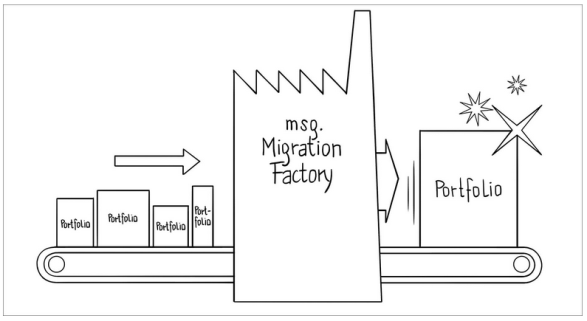
The perfect partner to meet this challenge is msg life. Over the past 15 years, we have successfully implemented more than 40 migration projects with more than 25 million contracts. As a result, msg life has a unique digital technology with experience and extensive know-how that meets the high actuarial and technical requirements for digital migration and guides the insurance company through the migration project efficiently, safely and reliably.

Digital technology and proven methods have been combined with sophisticated standard software solutions to create a migration solution offering that is unparalleled in the marketplace and that improves with every new project. The solution called msg.Migration Factory includes a proven and systematic approach to digital migration and is complemented by msg.Migration System, a turnkey migration tool that can be audited, and finally by msg.Migration Archive, an archiving and information system.

Our services also include complete planning and preparation of the migration, implementation of all actuarial, professional and technical tasks, as well as the migration itself, including testing procedures and approvals. Specialists from msg life support support and manage insurance companies throughout the migration project. Find out more about our company and our range of solutions for insurance providers in Europe.

If you have experience in the insurance market or in IT, check out our latest job offers and send us your CV.


Digital transformation of insurance companies, insurance products and services

Increasing digital transformation can be found in all walks of life and is of great importance to the insurance industry. Customer behaviour, needs and demands have changed fundamentally. The internet generation, who are now in their 30s, have long since stopped thinking about what digitalisation actually is, and are instead using it directly. They are used to communicating and shopping with smartphones. They also prefer to communicate with insurers through them. This effect is also known as digital transformation.

If members of this ‘digital’ generation are interested in insurance products, they search the information on the web via consumer and advice websites, consult relevant blogs and look for the best deals on comparison websites. Finally, they conclude the contract online, for example via an insurance app they have downloaded on their smartphone.

In general, laws regulate insurance products to protect the interests of customers. They ensure that customers are adequately informed about the terms and protection offered by a particular insurance product.

What is digital literacy and digitalisation in insurance

Digital literacy is becoming an essential factor when it comes to insurance companies. These companies have to adapt insurance services to the reality that an increasing number of customers are digitally literate and therefore prefer digital services. The generation that asked questions like what is digitalisation or what is digital technology is being replaced by a new age of customers. And that is what we need to adapt to.

In addition to digitalisation, there is another challenge to be overcome. Small and agile insurance companies are moving into the insurance market with innovative ideas and concepts. They are finding new and exclusive approaches to customers and in the process putting pressure on the huge sales structures of insurers.

Finger pointing in the air
Digital transformation has also affected customer requirements.

The age of the customer has begun

Customers are becoming more and more demanding. They expect insurers to provide the same convenient and easy experience they know from online shopping, as well as the ability to quickly compare prices, services and products of all kinds. Information, advice, contracting, claims reporting or contract management – all contract management should be available 24/7 in digital form. For this reason, the insurance industry’s understanding of changing customer needs and behaviours, as well as how to adapt products and processes accordingly, is crucial. Caution in the online space should not be forgotten either. Companies must do everything they can to ensure digital security.

What is digital transformation in the insurance industry: IT is becoming the core

Digital insurers need to maintain digital ecosystems, build digital insurance products and services. To be successful, they need to automate all processes extensively – the information technology and systems used to develop, distribute and test insurance products need to work as smoothly as in a factory. Every insurance analyst and digital insurer relies on processes built specifically for the internet – 100% seamless, with no wait times, automated and equipped with powerful analytics and artificial intelligence capabilities.

Essentially, this means that the insurer’s business model is primarily an IT issue. This applies to all areas and does not depend on the market in which the insurer operates. The potential and opportunities associated with digital transformation, such as sales, communication channels, customer relations or collaboration platforms, can only be fully exploited with a modern IT infrastructure.

Data – the source of 21st century

The same goes for another important topic that dominates the headlines in relation to digitalisation – big data. Data is often referred to as the new oil. This means that it is one of the most important raw materials and acts as a fuel for entire value chains, industries and economies. It is no coincidence that Google, for example, has surpassed the stock market value of many traditional businesses, demonstrating how desirable data-driven companies are to investors.

In keeping with that metaphor, analytical information systems are often referred to as refineries that refine valuable raw material and generate information and insights from data. The insurance market has a vast amount of data on customers, products, claims trends and so on. Using intelligent analytical processes and proven algorithms specific to the digital insurance industry, these huge data sets can be structured and evaluated in a meaningful way.

The information gathered provides valuable insights for the company. This means more than just predicting general trends and developments. It also means having a 360-degree view of the customer. This knowledge is invaluable to all areas of the insurance industry – from product development, marketing and sales activities, pricing to value-driven corporate governance. Overall, data analytics can be used to minimise business risks and improve products and services.

Be successful with an experienced partner by your side

Digital transformation in the insurance industry is transforming IT into the cornerstone of a successful insurance company. With msg life , insurers have a partner with global experience by their side. We understand that IT and data are the keys to success and that customers today have different expectations of their insurers than they had before. Digitalisation, as we understand it, means streamlining and automating processes, taking into account trends and the desire for greater flexibility in product development and, not least, to stay close to the customer. This means that insurance data must be mobile and constantly accessible.

With our comprehensive solution msg.Insurance Suite, digital transformation works immediately after deployment. Our innovative, comprehensive, component-based system offers continuous digital processing of core business processes in all segments: from life and health insurance to property and casualty insurance – for the entire insurance sales process. For example, the contract management system for life insurance msg.Life Factory enables fast product implementation and efficient processing of all business processes.

The solution supports not only traditional business models, but also new digital forms of insurance through B2C sales on the portal. With our portal solution msg.Online Insure, insurance company customers can manage almost all relevant aspects of their insurance policies themselves. Easy-to-understand technologies actively engage customers in business processes – correspondence between the insurer and the end customer is conducted exclusively digitally. In addition, dealers and other partners can also be involved in the communication with the customer.

Standard software msg.Ilis which is also integrated into the complete msg.Insurance Suite solution, offers an ideal starting point for analysing large amounts of data. The integrated solution also includes insurance migration, which is a comprehensive expertise in insurance contract migration (including all data between systems). Software msg.Ilis provides a framework for a central analytics solution that makes projections, analyses and other available. The solution also includes a cluster-based portfolio compression method.