
How to use database and database management system

Database systems are often talked about not only in the IT world, but also in the everyday world. They can be used in a number of ways, but in most cases they will be used to store and organize some data. Before you start using them, it’s best to get some background information about them. Find out about the database management definiton, how database management system works, what database types there are and why database is important .

Database administrator processes anddata
Modern database systems have many additional functions.

What is a database?

There is a fairly simple answer to the question of what a database is. A database is used to collect and organize data. You can use it to create a kind of data centre. We could therefore describe it as a tool that works with data. Experts also refer to it as a set of structured data, a database program. The data that a database works with are different. They are used by IT companies in software development, but also by other companies. Database normalization is also a key process in the design, development and implementation of new software or information systems. A good example are e-shops that use them to database information about their own products, shipped orders and customers.

Database normalization

Database normalization is the methodology and process of organizing the data structure in a database to achieve optimal performance. The goal of database normalization is to ensure efficient storage, updating and retrieval of information in the database. There are several database normalization standards known as normal forms. The two most common database normal forms are: the first normal form (1NF), where each column in the table should contain only atomic values. Second normal form (2NF): in a table, each column should be completely dependent on the primary key.

What are database systems?

In addition to the databases themselves, you also gain knowledge about database systems and learn about database programs. Database systems are sophisticated software tools that are designed to efficiently store, organize, manage and manipulate data. They are made up of several key parts that work together to ensure effective management of the information in a database. The system is referred to by the English abbreviation DBMS (database management system). We will describe database systems in more detail, examples and their advantages or how the database creation process works.

Database management system facilitates data organization

The database management system is the power source or engine of each database. The system handles all user requests. This tool acts as the third link between you and the database. However, it manages the data and the database schema itself at the same time to facilitate organization and overall data manipulation. Database systems are used to make you familiar with the data and be able to use it to your advantage. The functions of the database management system vary depending on which one you use. In order to earn the database designation, a system must be able to manage persistent data and access large amounts of data, and do so in the most efficient way possible.

System commands and normalization of existing schemas

Modern database systems have other features too. These include: transaction management, the use of a higher level language or user authentication. Users appreciate the ability to access from remote locations, support data recovery in the event of damage or enforce restrictions. Database management system operate based on system commands. In practice, the system receives instructions from a database administrator. Based on these, it then performs data editing, retrieving existing data from the system and a number of other actions. In the context of database systems, you may also encounter the term database normalization. Database normalization in a DBMS is used to modify an already existing schema. This minimizes redundancy and data dependency by splitting a large table into several smaller ones and defining the relationship between them.

Database model usage

Each database contains a description of the structure and type of data it contains. This description is also referred to as a logical schema. The schema is used to describe objects and the relationships between them. There are several ways of creating schemas. Currently, the most commonly used is the relational model based on tables. Somewhere you will also come across the term relational data model. Relational data model is used to specify the logical structure of a database. It decides how individual data can be stored, organized and manipulated.

Past use of databases

Databases have been in use for many years and there are many database types. Their history dates back to the 60s. when the first database management system was developed. During this period, a hierarchical model was used, which was later used by IBM for its IMS product. The relational data model was introduced in the 1970s. It was used by Oracle. In the 80s, research began to focus on distributed database systems. In the 90s, people turned their attention to object-oriented databases, which were mainly used in areas with more complex data. Relational systems were able to work much better with them. XML databases are a separate category. Their goal is to blur the distinction between data and documents.

Did you know that…

… that open source databases such as PostgreSQL (postgre database or postgresql drop database) and MySQL began to spread in the 1990s?

Database in SQL

For databases, you will encounter the term relational database (also called SQL database), or relational database management system (RDBMS) which is a type of database system that uses the relational data model to organize and manipulate data. SQL databases are a category of relational database systems where data organization and manipulation is controlled using Structured Query Language (SQL). SQL is used to define the structure of the database, perform operations on the data, and control access to the data. Database in SQL is an efficient tool and a popular system that is generally used to store corporate data. Companies use relational database when managing orders and invoices. Examples of popular relational database systems are MySQL database, PostgreSQL database, Oracle Database or Microsoft SQL Server relational database system from Microsoft.

PostgreSQL database vs Oracle database

PostgreSQL database = an open source object-relational database system. Oracle database = a commercial relational database system from Oracle. Relational database store data in clear tables very similar to those you’ll encounter in Excel. Each table in the database then forms a session. A relational relationship is created between each session. By the word session, you can understand not only tables and their relationships, but also other objects found in the database. These are views and indexes designed to analyze data faster or triggers used to automate actions. Database tables have columns and rows. It is true that each column corresponds to an attribute. An attribute represents a property of an element or object. In computer terminology, it usually consists of a name and a value. In databases, each row corresponds to one record.

Recommend
We recommend:

When working with a relational database, you will also come across the term ‘SQL’ (Structured Query Language). What is SQL? It is a basic programming language that can be used to create databases, work with data, and grant access to databases. If you’re just a casual database user, it’s not essential, but if you want to maximise your database potential, it’s definitely worth knowing.

Access database improves your data management

You can use Microsoft Access to manage relational database. With it, you can add new data to the database, edit existing data in the databases or remove unnecessary information. Access is also used to organize and display data in multiple ways, to share data with other users or to process or manipulate data.

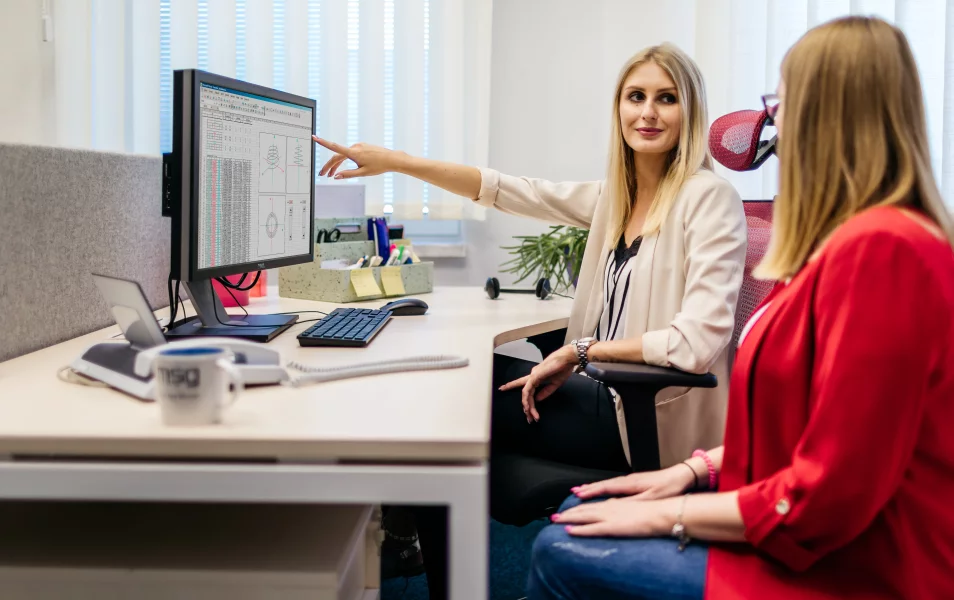
Database administrator at work on the computer
You can use databases to store and organize lots of data.

Microsoft Access has several components, namely:

  • Tables – Access database looks at first glance similar to the one in Excel. The only difference is how the data is stored and organized.
  • Forms – allow you to create a user interface. In it you can enter and edit data. Forms usually also contain controls.
  • Reports – this element is used for formatting and presenting data. Each time you run the report, it will reflect the current data in the database.
  • Queries – they perform several functions in the database. Users generally use them to retrieve data from tables.
  • Macros – you can use macros to add some functions to the database. That is why they are considered a simplified programming language.
  • Modules – they are very similar to macros because you can add functions to the database through them. The difference is that you can write them in your favorite programming language.

What other database types we know

The database is not just one. We know several database types. In fact, there are several types that differ from each other depending on what data you store or manage in them.

Centralized database has high security

As the name implies, a centralized database stores data in a centralized database system. It allows users to access it from different locations through several applications. These applications also have an authentication process, so everything you store in the databases is safe. The benefits of a centralized database include the fact that tampering with the data will not affect other data. Not to forget the high security. The downside of a centralized database is that if it is large, response time increases. Updating can also be a problem as updating a large system takes time.

Distributed database facilitates access to data

In a distributed database, data is distributed among different database systems that are linked with communication links, which helps to facilitate access to the data. Distributed databases can be subdivided into other types, namely:

  • homogeneous – systems run on the same operating system and use the same application process,
  • heterogeneous – systems run on different operating systems and use different application procedures.

The advantage of this type of database is that the system can be expanded at any time by adding new computers and connecting them to the system, while a single server failure will not affect the entire data set and the remaining database servers. Network database systems are also known, but are less common nowadays, whereas database servers are widely used and form the basis of many modern information systems and applications.

NoSQL database for storing large amounts of data

NoSQL is a type of database that is used to store a wide variety of data sets. At first glance, it may appear to be a relational database. However, NoSQL differs, it stores data not only in tabular form, but in other forms as well. A NoSQL database has several types, which differ from each other mainly depending on the data stored. For example, some databases are used to store data in graph form, while others are designed to store documents. The strength of a NoSQL database is that it is perfect for storing large amounts of data. In addition, it is great for those who do not want to store data in a structured format. Another big plus is that the database provides high scalability.


Job

Java Developer

Cloud database allows easy access

The cloud database works by storing data in a virtual environment. It provides various cloud computing services to the users to access the database. For example, it is SaaS, PaaS or IaaS. Currently, there are many cloud platforms, with Amazon Web Services, Microsoft Azure or Kamatera being among the most popular.

The oldest hierarchical database

A hierarchical database stores data in a tree structure. It is one of the oldest ones, which were very popular in the past. It was also used by IBM. Today it is being replaced by other types of databases.

What other database types do we know?

There are other database types besides the ones mentioned above. These include:

  • Object-oriented database – Uses an object-data model approach to store data. Data is represented and stored as objects that resemble the objects used in an object-oriented programming language. We classify this branch as object-oriented programming.
  • Personal database – This is a database designed for one user only.
  • Network database – Usually managed by a network data model. Unlike a hierarchical database, it allows each record to have multiple child and parent nodes.
  • Object-oriented database management systems (OODBMS) are a type of database management system that integrates the principles of object-oriented programming (OOP). In this area for database programming, this includes an approach to design and implementation that incorporates the aforementioned object-oriented programming with the manipulation and processing of data in database systems.

The database administrator uses the SQL computer language
The SQL language is a great help in databases.

Why is it worth knowing how database works?

Many people think they will never use the database, but the opposite is true. You have fairly close contact with them even when you’re doing routine spreadsheet work, using fast formulas and useful Excel functions. However, simple spreadsheets with a few rows and columns may not be enough after a while, especially when you have too much data. In these situations, databases save the day, where you can not only enter data, but also organize it in a convenient way and select and use it at any time. If, after a while, even this basic isn’t enough, you move on to more advanced operations.

Why should you use databases?

Databases can be used in thousands of different ways. You can not only store, but also manage and organize data within them. What’s more, they can make it easier for you to work and navigate through lots of different information. Use the basic knowledge we’ve given you about databases and put it into practice. Maybe this practical skill and our latest IT job offers can kick-start your career!

msg News: Hot desking and a summer of teambuilding and fun

The summer program in our IT company was rich. We enjoyed good food, team events and adrenaline experiences.

We tried to make the hot summer days more pleasant for our colleagues with various events and activities. During the lunch break we prepared a tasty barbecue and sweet breaks with lots of goodies. On the other hand, we burned calories during our legendary adrenaline teambuilding. Hot desking offers the opportunity to work three days from home and two days from a shared office location.

In the introduction of this article, please be warned that you may get a big appetite while reading it, for which we sincerely apologize. It seems that here in msg life the Slovak proverb that love comes with a full stomach (and so does love for work), is starting to apply. At least that’s how it seems to be on our company instagram. Don’t you follow us there yet? Be sure to fix that quickly! After the great success of our breakfast and lunches together, we decided to continue this tradition during the summer. If the weather allowed it, employees from the Bratislava office gathered in our garden relaxation area and enjoyed good food, sunshine and a nice get-together with colleagues, which always goes down well, especially after a hard and hot day at the office.

BBQ lunch in the Bratislava office
During the BBQ lunch, many colleagues came to enjoy themselves.

After the themed lunches, we bet on a real summer BBQ party, which was appreciated by many meat lovers, but equally enjoyed by vegetarians and vegans. We didn’t forget about our colleagues from the Kosice and Zilina offices either. They also had the opportunity to enjoy their working hours with a tasty lunch in a local restaurant.

Sweet July and a healthy back thanks to online exercises

At work, we regularly rewarded great performances with sweet breaks as part of an event named “Sweet July”. Different treats were offered each week, such as refreshing popsicles and ice cream, amazing donuts or delicious cookies. To balance our calorie intake and keep our backs healthy we had the opportunity to work out online. Yoga and exercises for a healthy back are important not only for good posture, which is negatively affected by hours spent behind the computer, but also for fitness and a flawless lifestyle. In addition to sweet treats, colleagues enjoyed a pleasant time at the garden barbecue, where table football was also played.

Sommerfest and summer adrenaline teambuilding must not be missed

After a two-year break, our corporate festival Sommerfest, which dates back to the company’s founding, was finally able to take place. Despite the fact that some colleagues were on holiday during the summer, the event was a real success. “It was very nice to spend a summer day with colleagues and their family members again. After two years, the society has grown and attendance at Sommerfest has increased significantly. Colleagues from other branches also came and attended various events,” says our colleague Zuzka. During the summer festival we had many activities prepared. Colleagues could go rafting, surfing, scooter, boat or horse riding. There was also a foam show and tasty refreshments. We also thought of colleagues who could not join us. They had the opportunity to take part in other adrenaline teambuilding activities such as Wakeboarding in Zlate piesky or Lasertag. The adrenaline summer was enriched by an informal company barbecue at Koliba, where our colleagues could try to run the Lanoland route, which was really challenging after the rain. We are also planning interesting events for our colleagues during the autumn, when we want to compete in go-karting again and take part in the Danube rafting.

More flexibility at work

“Most colleagues are currently working in hot desking mode, which means they can work from the office two days a week and from home three days a week. It’s a way to re-establish relationships that have cooled with the pandemic and to come up with new ideas or inspiration together. Team building is also an irreplaceable part of this process,” says Dominika. Do you also want to experience summer with msg life Slovakia? Are you looking for a flexible and stable job that you can adjust to your own needs? In the career section you will find our latest job offers, so don’t hesitate and come and work for our leading IT company. Soon you too can join our msg life family and enjoy many employee benefits!

msgNews: back to the office, lots of events and a fitness challenge before the summer

Breakfast in the office, MDD, blood donation and teambuilding. Spring was really colourful at msg life Slovakia.

Along with the improvement of the pandemic situation, our regime is also changing. Colleagues are still able to work from home, but we are all happy to meet again in the office for lunch or breakfast. In addition to a number of gastronomic events, we have also organised adrenaline-fuelled teambuilding or a fitness challenge. There was also a charity blood donation event or a visit by Milenka Radic, a member of the German board of msg life, who brought lots of good news.

Tasty lunches and shared company breakfasts

Tasty brunch, varied breakfast, barbecue, pizza day, but also lunch with the theme of popular dishes from Bohemia, Ukraine, Austria, Poland and Hungary. That’s what our welcome weeks in msg life Slovakia looked like. The so-called “Willkommenswochen” are organised across all branches, not only the Slovak ones in Bratislava, Žilina and Košice, but also abroad, including Germany, Austria, Spain and other countries. Although the events take different forms, the goal remains the same: to welcome colleagues back to the workplace, to renew internal relationships and to help them adapt more easily to change.

“The aim of the welcome weeks is not to get workers back to the branches. The pandemic has shown us that our colleagues know work effectively from home, therefore their return is not necessary. What we would like to restore, however, are the relationships in the workplace, which undoubtedly contribute to the motivation of employees,” explains office manager Zuzka. “Colleagues continue to work from home, we currently have a regime where 60 per cent of working time can be spent in the form of a home office and forty per cent in the Office. However, this is not fixed and we continue to strive to keep our staff flexible,” adds HR manager Dominika.

Team adrenaline experiences and sports activities

The office team tries to bring colleagues together in different ways and another was the adrenaline team games. During the spring and early summer, the employees took part in several of them. In Team Up, also called Fortress Boyard, employees had to tackle different types of challenges than they are normally used to. However, teamwork remained essential. For the more adventurous, we also arranged a ride on scooters or quad bikes; on the other hand, colleagues from the office tried their hand at cooking tasty recipes in Makery World.

“We try to plan teambuilding so that everyone can enjoy themselves, and we are now fully planning the traditional summer Sommerfest with family members, which was postponed for two years due to the pandemic,” adds Zuzka, office manager. Family members were not forgotten during the International Children’s Day, when we organised various activities for them at the Leon Centre.

In addition to having fun, we also thought about the health of our colleagues before the summer. Since we have a sedentary job, we tried to motivate them to move, whether they took yoga classes with Ayka and exercises for a healthy back with Fitclinic trainers, or worked out through the monthly msgFit challenge. Employees have completed running workouts with a professional, while others have swapped their trainers for skates or a bike. Three female colleagues skated a total of 120 kilometres, six runners ran a total of more than 1,041 kilometres and the highest figure was achieved by four cyclists, 1,584 kilometres.

Some colleagues also took part in an internal competition for the highest number of steps, with nine colleagues completing more than three million steps. After a very successful running event, the ČSOB Marathon, in which 4 of our relays participated, in June our runners again entered the summer cross-country race through the paths of the Little Carpathians and despite the hot weather they ran really great results. Apart from my colleagues, two “our juniors” also took part in the race. It is nice when work is combined with fun and family, which is also the goal of many of our events.

The next big running event in Slovakia will take place in the place of our branch – in Košice and our colleagues are preparing for it, we are already keeping our fingers crossed with the preparation, as we have a notice that they will not only run relays, but also half marathon and marathon courses.

Colleagues who could not participate in the blood donation will be able to take part in the next round – we have decided to include the msgDrop of Blood event among our regular activities and to organize another one in the autumn. We hope that this will motivate not only our Slovak colleagues who may still be hesitant to donate blood, but also colleagues from other branches will join us.

Did you know that…

… Approximately 180 000 units of red blood cells are transfused annually in Slovakia alone.

Source ntssr.sk

Shortly before the summer, our Bratislava branch had the honour to welcome a member of the German board of directors, Milenko Radic. “The last time we held such a company-wide meeting with a foreign member was two years ago, when it was possible to meet in person. It was therefore very nice to have not only a foreign visitor, but also so many colleagues together who are interested in what is going on in the society. In addition, Milenko, as a member of the sales department, brought all good news and forecasts, despite the challenging period in which the markets and the economy are currently in. We are therefore very pleased that our goal is to continue to grow,” concludes HR manager Maria.


Java vs Golang vs Python programming: what is the difference?

Java vs Go vs Python programming: a comparison of programming languages to help you make a better decision.

Changing the programming language is a big step for a programmer. It should only be done if the current language does not suit them or does not provide everything they require. There are now a large number of programming languages. In addition to the comparison of Python vs Golang programming language, known as Go, it is interesting to illustrate the comparison of Golang vs Java programming language. What are the benefits of each programming language and which one is best for you? Each programming language has its own applications, is constantly evolving and may have its own specific advantages or disadvantages. We will start with a short review comparing Java and Python language, and we will conclude with a look at the Go language and Golang programmers.

Java programming language

Probably everyone has heard of Java jdk. The question of what Java is, is quite simple to answer. It is a multi-purpose, object-oriented programming language. It is developed by Oracle and its syntax is based on languages you may also be familiar with. These languages are C and C++. The interesting thing about Java is that in 1991, when it was created, it was called Oak. Unlike C/C++, this language could be compiled on different platforms without recompiling again. The name Oak was later changed to Java because a language with that name already existed. However, the change did not affect only its name. The Java programming language was initially used in consumer electronics, but later its direction turned to the Internet. No wonder. In the 90s, when the language was created, there was a big boom of the Internet. Programmers therefore needed a tool that they could use in this sphere.

Did you know that…

… the Java programming language is named after coffee? That’s why there’s a cup in its logo. The developers of the language struggled for a long time to come up with a new name for it, having initially called it Oak. However, while working on it, they drank a lot of coffee from Java, an island in Indonesia. So they decided to name it after that place.

Chief engineer James Gosling then focused on modiying the language. These modifications ensured that Java could work within web browsers and was sufficiently interactive. In addition, it was also thought of security. The syntax of the language was checked before launching, which ruled out crashes due to corrupted code. Another strength promoting security is that Java does not have access to local programs, minimizing the danger of viruses and other problems. The Java programming language is used by server-side Java developers for most backend development projects, including those that work with a lot of data.

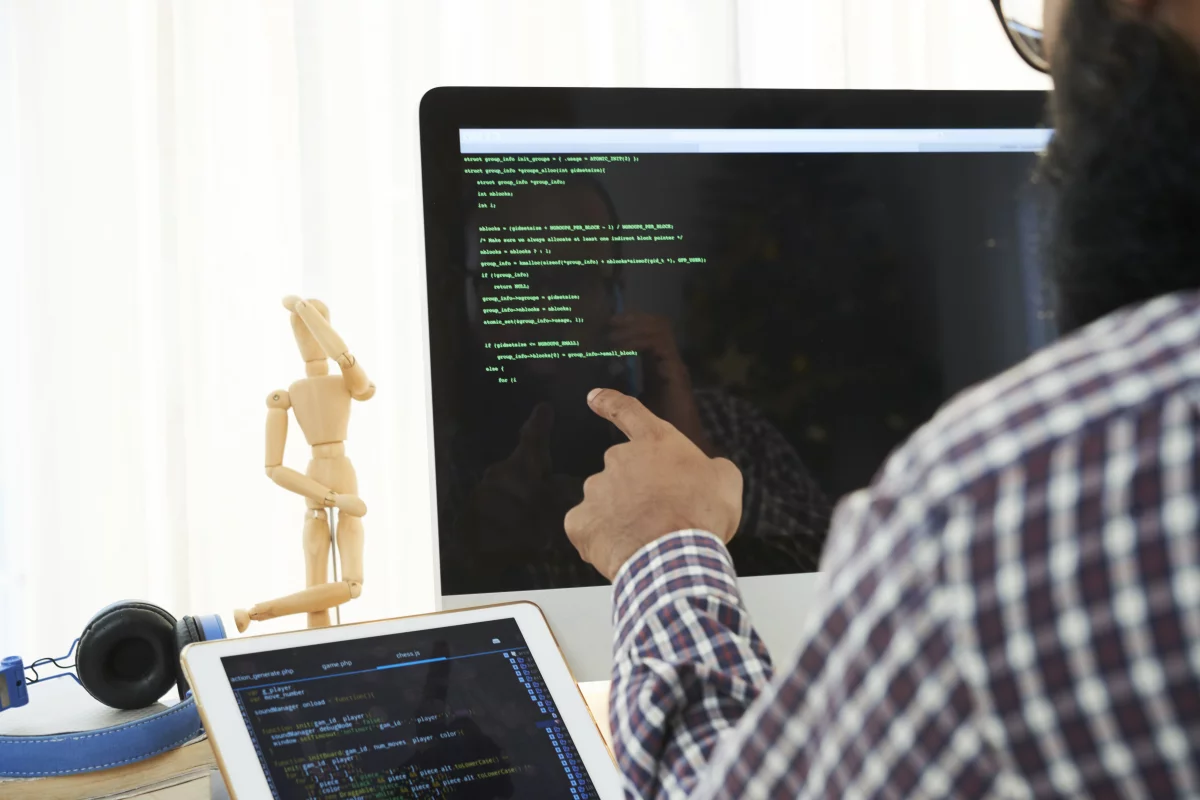
The male programmer looks at the monitor and points his finger at a line of code
With languages like Java, Go or Python, the work is easy.

Java benefits

Java benefits are the reason why it is one of the most popular languages when programming. Java benefits are:

  • absence of charges – Java is free, so you don’t have to pay anything extra to use it;
  • universality – since Java is universal, you can use it to program almost anything. It’s especially key for Android users, as most Android apps run on it. In addition, the language is also present in laptops, computers, game consoles and data centers;
  • functionality – Java works on a variety of operating systems, including Windows, Mac and Linux;
  • easiness – Java is perfect for beginners without any programming experience. It checks for errors before running, reducing the risk of various unnecessary complications. Learning Java is not difficult and can be mastered in a relatively short time;
  • security – we must not forget about security, which is achieved by the fact that Java does not have access to local programs.

Java disadvantages

Every programming language also has its drawbacks. In the case of Java, you may encounter the following:

  • It is demanding on memory. Unlike other languages, Java has relatively higher RAM requirements.
  • It is not suitable for creating complicated user interfaces. Complications and inconsistencies can arise when using this language.
  • Lack of backup. Java does not focus on backups, which can cause the loss of important data.
  • Requires detailed and complex codes. Java codes are detailed and composed of long sentences that reduce their readability.
A male programmer looks at a monitor and types into a computer
You can learn Python programming language quite quickly

What is Python programming?

The Python language is a modern and powerful general-purpose open source programming language copyrighted under a license compatible with the GPL certified Open Source Initiative. Python programming has a simple and easy-to-use syntax. This makes Python an interesting language to learn for beginners.

Did you know that…

…the Python programming language is also used by large companies such as the Wikimedia Foundation, Yahoo!, CERN and NASA?

At the same time, it is an object-oriented programming language suitable for processing large amounts of data, including complex mathematical calculations. It is used in fields such as bioinformatics, neurobiology or even astronomy. It is also one of the oldest languages – it was created in 1989. A key Python function is that you can easily extend it. You can use the language itself to extend existing applications. Many people mistakenly think that the name Python comes from the name of the snake. But the truth is that its developer, Guido van Rossum, was inspired by the British satirical series Monty Python’s Flying Circus.

What are Python functions?

In Python, functions are blocks of code that perform a specific task and can be called from other parts of the code. They are defined using the keyword “def”. Here are some aspects of basic functions in Python:

  • len(iterable): Returns the number of elements in an iterable object (e.g. list, string, tuple).
  • min(iterable): Returns the smallest element of the iterable object.
  • max(iterable): Returns the largest element of the iterable object.
  • sum(iterable): Returns the sum of the elements in the iterable object (usable e.g. for adding numbers in a list).

Python functions are very useful for organizing code and reusing it.

How to program in Python?

As a future Python developer at the beginning of your Python programming journey, it is essential to gain a solid understanding of the basic concepts that characterize the Python language. This includes a thorough familiarity with the principles of object-oriented programming (OOP), which is a key pillar for us if we program in Python. Understanding concepts such as classes, objects, inheritance, polymorphism and encapsulation is essential for effectively creating scalable and reusable code bases. Programming in Python and a few basic principles to get you started programming in the language.

  1. Python installation:

The first step is to install Python on your computer. Visit the official Python website (https://www.python.org/) to download the latest version for your operating system. Most modern operating systems already have Python pre-installed.

  1. Basics of the language:

Variables and data types: define variables and understand basic data types such as numbers, strings and Python lists.

  1. Conditions and loops: learn how to use conditions (if, else, elif) and loops (for, while) to control the flow of a program.
  2. Functions:

Define custom functions for code reusability.

  1. Data structures:

Learn about basic Python data structures such as lists, tuples, sets and dictionaries.

  1. Working with modules and packages:

The extensive library contains various Python modules and tools that extend the functionality of the language and that you can use effectively in your code. If we already know the Python basics and program in Python, it allows us to take full advantage of the benefits and functionality in a variety of areas from data analysis to task automation and artificial intelligence. We can efficiently and quickly build applications for a variety fields, including web development, which greatly increases the productivity of Python programmers. The best way to learn to code in Python is to code. Create your own projects, solve problems, and participate in the open-source Python community.

Python benefits

It has several advantages, including:

  • simplicity – learning the Python programming language won’t be a problem and you’ll be able to master it in no time. If you know English, everything will be even easier. Basic English verbs are all you need to use Python;
  • absence of charges – it’s open source, you don’t have to pay anything. It is available for free for users. This is a great advantage, especially if you just want to try it out;
  • productivityPython programming is highly productive. This means you don’t have to spend a lot of time understanding the syntax and you can get down to coding;
  • large library – the standard Python library is large and contains all the data you need. So you don’t have to worry about having to do some research using other sources.

Python disadvantages

When using Python, you also have to take into account a few disadvantages:

  • slow performance – unlike other languages, Python is a bit slower;
  • uses a lot of memory – you’ll need quite a lot of storage for Python;
  • weak on mobile devices – so it is not used very often on mobile devices, as it is not memory efficient and is slow.

Golang or Go programming language

Golang, often referred to as Go, is a multi-purpose programming language that is compiled and statically typed. Compiled means that its source code is translated directly into machine code, allowing for faster operation. The Golang programming language was designed by Google in 2007, but was only released to the market in 2009. The Go language was meant to be a solution for older languages that couldn’t handle large amounts of code. This is the reason why Go’s syntax is concise and its usability and readability is much easier. If you want to build bigger and better software, be sure to get clear on what Golang is as soon as possible.

Golang programming language advantages

There is a number of Golang benefits, which is why it is used by people all over the world. The main advantages include:

  • simplicity – Golang is one of the easiest languages to learn. You can learn the basics in a short time;
  • good documentation – Go has easy-to-read documentation, which you can find on the official website. It also has a large and active community behind it, which will be happy to help you if you have any problems;
  • versatility – you can use Go for different projects you have ahead of you because it’s multi-purpose. It’s also often used in cloud programming. For example, Amazon (Amazon Web Services) or Google (Google Cloud Platform) are popular;
  • absence of charges – since Golang is free, you pay nothing to use it.

Golang programming language disadvantages

The Golang programming language also has a few cons:

  • Creates room for minor coding issues. Although Go is easy to use, it sometimes creates room for unnecessary errors that can occur when a project grows to larger sizes. For large projects, it is therefore a good idea to choose more intelligent programming languages.
  • This is a relatively new language. Compared to other programming languages, Golang is relatively new, so you won’t find as much information about it as you will about Java.
  • It’s time-consuming. Golang isn’t the most complicated programming language, but it’s in last place compared to languages like Java or Python.

Comparison of Java vs Python vs Golang programming languages

If you want to choose the best programming language, you need to compare them all and see what advantages and disadvantages they have. For a better overview, we’ve prepared a handy table where you can find all the basic information.

Memory usage*

up to 40 MB

up to 14 MB

up to 3 MB

The biggest advantages
  • speed
  • easy to use
  • suitable for beginners
  • high security
  • free of charge
  • medium RAM memory requirement
  • easy to use even for beginners
  • free of charge
  • a large library of information
  • great documentation
  • large community
  • free of charge
  • easy to use
  • low RAM requirements
The biggest disadvantages
  • high RAM memory requirements
  • slower performance
  • lack of backup
  • slower performance
  • weaker on mobile devices
  • time-consuming
  • a relatively new language, which is not so much known about

*According to information from the portal Medium.com

Test a programming language

It is not possible to universally evaluate which programming language is the best. Each has its advantages and disadvantages. If you can’t decide based on the information we’ve given you, give each language a try. They’re all free, so you don’t have to worry about investing unnecessarily. Knowing at least one of the most well-known programming languages will give you the opportunity to respond to our interesting IT job offers and kick-start your new career in the world of technology.

International Father’s Day: what our colleagues say about their children’s future in IT

In many countries, the World Father’s Day has no fixed date and varies by country and culture. Celebrations are often associated with honouring fathers and fatherly attitudes towards children. In this article, we mark Father’s Day and ask colleagues at msg life Slovakia about their children’s future in IT.

When is Father’s Day in Slovakia?

Every year, the Father’s Day in Slovakia is celebrated the third Sunday of June. Father’s Day and its history dates back to 1910, when it originated in America and quickly spread around the world. It highlights the irreplaceable role of a father in a person’s life.A great way to express gratitude and love to your dad is to congratulate him on Father’s Day. Greetings can be expressed by a personal visit, sending a card or a gift, while even a small gesture can make this special day more enjoyable for him. We at msg life Slovakia also appreciate fathers and we have given them a nice gift for Father’s Day. We also interviewed our colleagues and asked them if they lead their children to information technology.

Original tips on what to give dads for Father’s Day

Here are a few ideas of what to buy or make for Father’s Day as gifts for you to consider, but keep in mind that it’s important to pay attention to his interests and tastes to make the gift personal and special for him.

  • Books: if your dad is a bookworm, choose a book by his favourite author or on a subject that interests him.
  • Clothing or accessories: a good quality shirt, tie, cap, hat or other clothing or accessories can be a suitable gift.
  • Sports equipment: if your dad is the sporty type, gift him some sports equipment or accessories such as a tennis racket, golf set, cycling helmet, etc.
  • Peculiarity: If he has a special hobby, think of a gift that goes along with it. For example, if he likes to barbecue, a quality barbecue set could be a great gift.
  • Technological devices: if your dad is technologically inclined, a new gadget, smart watch or other technological device could make him happy.
  • Relaxing Gifts: Give him a relaxing gift such as a spa pass, massage, aromatherapy oil or a quality coffee maker.
  • Personal Gifts: Create something personal for him, such as a photo book with family photos, a handmade gift or a piece of jewelry with a custom engraved message.

The concept of parental leave comes up many times in relation to the role of father. A father on parental leave is still something unusual for many compared to a mother. Although the focus is on the first three years of a child’s life, maternity leave (check also our article about return from maternity leave) is not the end of a child’s upbringing, quite the opposite. After the first stage of life, the son or daughter starts kindergarten and school, their first personality traits and qualities begin to emerge. Gradually, therefore, the question of their orientation, which will determine their future direction in life, also arises. All this can be influenced by the parent through the upbringing of the children, but also by providing them with a quality education and a future. And since, according to the latest surveys, IT is the field that will have a good perspective in a few years, we asked our colleagues whether they are leading their children in this direction as well.

Supporting children’s IT education

“I will definitely encourage my daughter to know her way around IT. IT skills will be a great asset to her no matter what life path she chooses,” says teamleader Lukas about his four-month-old daughter. Another colleague of ours – scrum master Michal, who has a 13-year-old daughter and an 11-year-old son, also sees potential in IT: The development of IT systems has real added value because it makes everyone’s work easier and more efficient. In addition, working on software development can also be quite fun and varied because it allows us to dive into the areas for which we develop software. What my children will eventually focus on is an absolute mystery to me for now. But I like to be surprised.” Consultant Richard, who has two daughters and a son, leaves the choice up to his children. “It’s better if this life direction grows on them naturally,” he adds.

The IT world is interesting for children

“With children it’s simple. When they like something, they come and ask what I’m doing, what’s in my notebook and why it’s like that. I think that kids are pushed towards IT by the current world situation. Being without a computer, phone or smart watch is probably an exception today. My oldest daughter had a period in life where she was constantly wondering what was running on the computer, where something was stored or why problems were occurring. She’s over it now, but she can still navigate it well,” describes our IT consultant Richard. On the other hand, team leader Lukáš says he will try to make sure his daughter gets IT knowledge: “We don’t plan to rely only on our school system in this matter.” Our colleague Michal, on the other hand, has decided to involve his son in a different way. He combines the pleasant with the useful: “My son and I like to go running together and often discuss an interesting topic in mathematics or physics. It’s time well spent.”

Our colleague Michal with his son at a running competition.
Our colleague Michal with his son at a running competition. (Source: Zuzana Sefcovicova)

According to Michal, interest in the chosen topic is the key predisposition for success. “The son and daughter are very different in this matter. My daughter is more of an artist, but at least sometimes she lets me talk to her about physics. Although she would never admit it publicly, I think she enjoys it. My son is an athlete at heart, but he is also very interested in technical topics. I think both children have a very good ability to understand technical problems. However, I think predisposition also includes interest, so if I had to put my money on anyone, it would be my son. He was drawn in that direction from a young age, asked a lot of questions and was usually very good at understanding connections and remembering. He successfully participates in mathematical competitions, such as the Math Olympiad or Pythagoriad. My daughter, by the way, is also good at these, but for her it’s more like a mandatory thing.” Children’s interest in IT can start at an early age when they are exposed to new technologies – as early as four months. “I think my daughter is starting to show an interest in IT, she’s fascinated by my mobile phone and laptop, she wants to look at them,” says Lukas. In contrast, colleagues with older children tend to reduce time their children spend with electronic devices. “We try to encourage children to see IT as a tool to help us solve our problems. I certainly wouldn’t want children to spend long hours playing computer games. They have a weekly schedule to play, which they manage themselves. They mainly use mobiles to communicate and listen to music. The installation of new apps has to go through our approval. The combination of children and IT can sometimes be harmful. For example, I don’t like to see a group of children spending time together sitting next to each other, each looking at their phone,” explains Michal.

IT is related to mathematics

IT is also very often related to mathematics and logical thinking. Some of our colleagues use maths at work on a daily basis, so we asked if they also help their children with it. “My wife and I are both trained teachers, so we have been trying to naturally develop mathematical thinking in children since they were young. However, they usually manage the school curriculum without our help. Rather, we try to show them some interesting things that would broaden their knowledge from school. When they do happen to need something explained, I try not to do it in a straightforward way. I ask them questions that gradually help them to find the solution themselves. I have to admit that I am always happy when I get such an opportunity,” says Michal. Proof that math is not for everyone is our colleague Richard. “For my eldest daughter, maths is fun, she doesn’t have to study and gets good results, but for my younger daughter, maths is a nightmare. It’s her biggest fear,” laughs Richard. “But if she asks for advice, I’m happy to help,” he adds.

Colleague helping a child
Our colleagues help their children with homework preparation.

Children’s IT knowledge and school curriculum

It is still true that children learn most of their lessons at school, so we were also interested in whether our colleagues are satisfied with the teaching of mathematics and the level of IT in schools. “It always depends on several factors, i.e. the school, the teacher and the diversity of the classmates. All of this affects the level of attainment. The most important thing is the teacher and their experience. There are not enough teachers that at the moment, which is reflected in the pupils’ knowledge. When in primary school, children sometimes encounter teachers who lack experience. If the class is diverse and the teacher does not create a positive relationship with the curriculum, the children do not have the will to acquire knowledge and it is difficult to change their mind at home when they do homework,” says Richard. The main focus is still in memorizing formulas and learning certain procedures, but the development of abstract and analytical thinking is lacking. Thus, pupils can only solve narrowly confined types of problems. When the task is varied slightly, they already have a problem because they cannot generalize and analyze the problem. However, in their lives and careers they will encounter these types of tasks,” adds Lukas. Michal also prefers a different approach to learning: “When it comes to maths, I’m a fan of the Heine method, which is designed to develop independent thinking using experience. Many Slovak schools are trying to get up to speed with this system, but it’s not easy, because it requires changes not only in the pupils’ attitudes, but also in the teachers’ attitudes. The biggest problem, in my opinion, is the low salaries in education. Many capable teachers leave to do other jobs in which they are paid several times as much as in teaching. This is especially true for teachers of mathematics or computer science.” However, according to Michal, the situation is slowly improving: “Mindset of responsible people is good in my opinion. New modern methods are being introduced in schools and there is a will to teach children so that they are able to think independently and courageously about the tasks they are given. In practice, however, it depends very much on the particular school and, in particular, on the particular teachers. At the school my son goes to, they have been trying to teach kids the basics of coding since the first grade, using children’s programming environments. These are games that teach children to think algorithmically.”

Is studying IT at university important for children?

On the subject of education, the question of the necessity of going to university has also come up recently. In job interviews (read about tips on how to prepare for a job interview), recruiters often prefer experience over education. We therefore asked colleagues if they would be happy if their children went to university. “I don’t consider graduating from university to be essential for working in IT. In general, however, I think that attending a university of sufficient quality is a great benefit for a young person, and I plan to support my children in their decision to choose and graduate, but not force them to do so,” says Lukas. Michal also agrees with his team leader: “IT can certainly be mastered without university, especially if one is passionate and likes to educate himself in the field. However, univesity brings much more than just knowledge that can be used on the job. The student gets a more general overview, they get to explore topics that they might otherwise have bypassed, and that opens up a wide range of possibilities. In addition, the university environment is stimulating because there is a large community of like-minded people. I will definitely be happy if my children decide to go to university.” Our colleague Richard, who is a trained chef, has a different opinion on this question: “Studying at university is important in terms of educational attainment, so in some cases it also opens closed doors. From my own experience, I have to say that it is not completely essential. If a young person can adapt and gain knowledge, they can achieve success without going to university. Even in the IT field. However, university provides deeper information through which one can see broader contexts. So I would be pleased if my children took that route. It can certainly help them in some areas.”

The future of the IT sector

As our colleagues’ children are still at a young age, the fact remains that by the time they graduate from university, the world around us, and especially the IT field, may look completely different. We therefore asked our colleagues if they dare to guess what problems their children will solve in the IT field in the future. “I am convinced that artificial intelligence will solve many things in the future. When I see the world our parents lived in and the world we live in, I think the changes are going to be really big. Even programming itself has come a long way since its beginnings. Programmers are becoming more and more comfortable in their jobs, modern programming languages do a lot of the ‘dirty’ work for us, technical proficiency is not as important as it used to be. This is the direction I think it will continue to go in. One day, maybe the developer will just be a kind of configurator whose job is to explain to the machine what to program,” says Michal. Lukas sees the future of IT in a similar way: “I expect artificial intelligence to play a much more important role. This trend is already evident. I can imagine that if my child one day decides to pursue a career in IT, he or she could, for example, program self-learning algorithms or be a neural network architect or something similar.” “It may be that in 20 years’ time, the IT worker will be one of the sort of elite, and the work will be done by computers,” concludes Richard.

Effective brainstorming activities: How to guide your team from brainstorming ideas to success

In this article we will discuss what brainstorming is, the importance of brainstorming, brainstorming methods and how to use them properly.

When people talk about teamwork, problem solving and interesting ideas, there is one term that is often repeated: brainstorming. This creative technique helps you achieve excellent results. It allows you to come to conclusions that you might not have come to on your own. Although there are many brainstorming advantages, not everyone knows or uses it. How to do brainstorming effectively?

What is brainstorming and examples

Brainstorming is a term composed of two words brain and storm. When you use it, you strain your brain to come to different conclusions. Brainstorming can also be described as a set of creative methods to help you come up with different ideas, which you then present to your colleagues. The basis of brainstorming is zero critical evaluation. This means that no one present should judge the ideas of others. In most cases, brainstorming takes the form of a spontaneous discussion on a given topic. A colleague’s idea may develop yours or inspire you to do something new. This method tries to relax the atmosphere among the participating group members. It is meant to create a safe place where no one judges anyone. This can be particularly helpful for quieter colleagues with less tendency to talk in a group.

Brainstorming in practice

Brainstorming focuses on new ideas and developing creative thinking. It can be used in marketing, IT sector or any other field where it is necessary to come up with something new. Although it is a more free-flowing discussion where ideas should flow, you should keep a few important brainstorming rules in mind. Use them to get the necessary results with the whole group.

Basic brainstorming rules for developing creativity and generating new ideas

  • Set a time limit. Depending on the complexity of the problem, set a time together with your colleagues. It takes usually between 15 and 60 minutes. A longer time makes it harder to concentrate and makes the meeting unnecessarily long. If you would like to spend more time with this activity, do not forget to take regular breaks.
  • Choose the main person of the discussion. If there are more than one of you in the team, it is a good idea to choose someone to lead the discussion.
    This person will choose the type of brainstorming, keep track of time, define the problem, and can award the floor.
  • Select the number of discussion members. Everyone can bring their own perspective to the discussion, but when there are many people, you may find yourself drowning in ideas as a group. The best number of people for a brainstorm activity is 2 – 6.
  • Define the problem. Each brainstorming session should have a defined topic or issue. An imprecise topic will cause you to move from one area to another. So, define the problem you want to find a solution to.
  • Avoid criticism. To foster creativity, you and your colleagues need to create an environment where everyone feels comfortable and safe. Don’t criticize any thought or idea, quite the opposite. Try to make use of their brainstorming tips.
  • Encourage crazy ideas. There’s nothing too crazy about brainstorming. Even though an idea may seem unrealistic, keep it open. It might help you come up with something interesting.
  • Focus on quantity. Although quality is better than quantity, this is absolutely not the case with brainstorming. Sorting through the ideas and choosing the best ones will come after you’re done with the discussion. Therefore, you and your colleagues write everything down and don’t leave out even the smallest detail.
  • Bet on the visuals. Some things encourage creative thinking more when they are drawn or in the form of a table or diagram. So get some clean, preferably unlined paper, pencils, pens or a whiteboard to draw on with your colleagues. Other options are handy UML diagrams, also known as “mind maps”, various sticky notes, stickers and other aids.
  • Avoid shouting. When someone speaks, others should listen and think quietly.
    If there are more of you in the group, agree that whenever someone wants to say something, they will speak up.
    That way everyone gets to speak and there is no chaos.

The rules and principles of brainstorming can be adapted to the needs of the group and the specific situation.

Recommend
We recommend:

Digital technologies can enhance the brainstorming process. Don’t be afraid to use them and make the most of the features they provide. As well as UML, you could use simple spreadsheets in Excel or classic lists in Word.

Basic brainstorming methods

Brainstorming has several methods. Choose one before starting the discussion. This will help you stick to the topic and ensure that you get the results you want.

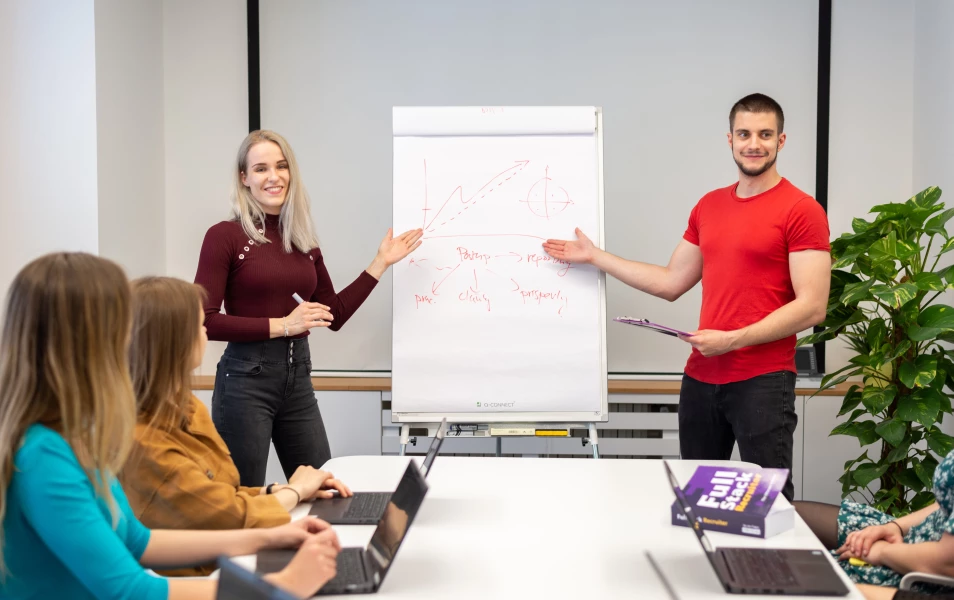
You can also draw ideas as part of brainstorming
A white board or blank paper is great for brainstorming.

1. 6-3-5 Brainwriting method with six participants

This type is also known as the 635 Method. It is based on six participants. Each of them writes down three ideas on paper, which are then developed by colleagues to their right. The individual ideas circulate among the members five times. In this way, everyone participates in each idea and contributes their share. If you ask who the brainwriting method is best for, the answer is introverts. Their involvement in debates is usually minimal. It’s a shame, though, because their creativity is often unappreciated. However, the main idea behind the 635 Method is to encourage creativity and divergent thinking in the group, with each participant contributing to the creation of ideas through writing and sharing with other team members.

Recommend
We recommend:

If you can’t see the problem from a different angle, invite someone who works in a different field to join the debate. Since they don’t know everything about the topic, they can resolve the complication much more quickly.

2. The alter ego method – think like the target group

The method known as Alter Ego is great when you need to look at a problem from a different perspective. When brainstorming in this way, you need to put yourself in the shoes of a famous person or target group. When you start thinking like someone else, you look at the situation differently.

3. Wordstorming method – a waterfall of ideas

Innovative methods especially suitable for creating large numbers of words and original slogans include wordstorming. All you need is paper and a pen. Write a word or sentence related to a topic or issue and let your colleagues write more. You can then use the ideas to come up with an interesting whole.

4. Questioning method

This type of brainstorming is great for perfectionists. When you want the best results, have the group question all possible assumptions. See where the idea has a flaw or a minus. Using the opinions of others, you can uncover what else to improve and change.

5. Brainstorming and mind mapping for visualizing connections

A mind map is also an excellent brainstorming tool. It helps you to see things in context and notice the bigger picture, organise your thoughts and improve your memory. In fact, many people find it easier to remember information in visual form.

Did you know that…

A mind map is one of the few brainstorming options suitable for one person. In most cases, you need two or more people for the discussion.

Creating mind maps is easy.
All you need to do is get a pen and paper.
Write your main idea or problem in the middle.
From that problem, start making basic branches.
The number of them varies, but they should connect to the main idea.
Write whatever comes to mind.
Once you have the first branches, you can divide them into more.
There is no limit to creativity.
If you’re not comfortable writing on paper, use a mind map program.
You can find lots of them on the internet and most of them are completely free.
You can find them in our article Tools that make work easier.

Other brainstorming types

Other variants include:

  • Hobo method – in this method, a problem or topic is first introduced. Then each participant has time for self-study. After a certain amount of time, everyone gets together and starts discussing. The Hobo method is especially suitable if you don’t know much about the topic and are new to it;
  • carousel brainstorming – discussants divide into groups and solve different tasks. When they have completed them, they move to the next place where another group was before. The aim of this variation of thinking is to get everyone to comment on an issue or idea;
  • ping pong – this type is suitable for two people exchanging ideas and sharing their views.

How to avoid common brainstorming mistakes?

The most common mistake in brainstorming is its lack of regulation, which leads to a situation where extroverts talk a lot and introverts hardly at all. Therefore, the best solution is to choose a main member, i.e. someone who will lead the whole discussion. If you don’t want someone “superior” in the group, try a warm-up activity, often called icebreaker (a game designed to break the ice and initial shyness).

Brainstorming is a great solution even for introverts
Criticism must be avoided during brainstorming.

The warm-up activity can be anything.
The best is a simple question to think about, answered by all the judges.
For example, each person chooses an object and says at least five things they associate with it.

Did you know that…

Another risk of brainstorming is going off topic and addressing a different issue. The solution is to regularly return to the original idea. Write it down and put it in the middle of your desk or on a magnetic whiteboard. Whenever you feel like you’re going off on a tangent, ask yourself how your idea relates to the topic at hand.

Another risk of brainstorming is straying off topic and tackling a different issue.
The solution to this problem is to regularly return to the basic idea.
Write it down on paper and put it in the middle of your desk, or place it on a magnetic whiteboard.
Whenever you feel like you’re going off on a tangent, ask how your idea relates to the topic at hand.

Brainstorming to support creativity

In conclusion, if we ask the question “What is brainstorming?” it’s a great creative technique that opens the door to new ideas. It improves the results not only of whole groups but also of individuals. It can develop creativity and allows you to look at a problem from a different perspective. It can be used in almost every field, but in the IT sector or marketing it is crucial. Try it out with your colleagues or completely on your own and help your personal growth and career!

msg News: teambuilding, new colleagues, successful relay and material collection

We make it a priority to maintain team spirit through shared events, courses and lunches.

After a long period of fighting with strict pandemic regulations, many societies and individuals have gradually adapted to the new normal. But then something came along that no one would guess. The war conflict in our neighbourhood also affected msg life Slovakia, so we immediately responded with a collection for the people affected by this situation. We will continue to expand our help not only thanks to our employees, but also with the support of our parent organization in Germany. Since the beginning of the new year, we have organized a number of interesting events that we would like to make our colleagues’ working hours more interesting and help them to relax in these challenging times.

The year 2022 has started in full swing at msg life Slovakia. Although our colleagues continued to work in the form of Home Office, the HR department tried to make their working time more pleasant with various events. In mid-January, employees tried out an online escape game, where they not only relaxed, but also practiced teamwork, which is extremely important for our company. We also took part in the CSOB Marathon relay race. It is no secret that our colleagues from msg life Slovakia are not only IT specialists, but also sports lovers. This is confirmed by their placing on the winners’ podium. 16 colleagues took part in the competition, even our colleagues from Kosice. Sports events promote not only our health, but also teamwork and workplace relations, which is extremely important for our company. Congratulations to all participants for a great performance!

Successful relay of msg life Slovakia team
The msg life Slovakia relay team placed third at the CSOB marathon.

We organized a painting course for our art oriented colleagues. The theme was spring rain, and despite the fact that some colleagues were holding a paintbrush and watercolour paints for the first time, the two-hour session produced some really tasteful works of art.

Gourmet specialties and action-packed team games

At the end of March we also organized two adrenaline teambuilding activities – Laser Tag and bowling, which were again very popular. Even during the cold days we did not forget about the delicious food and continued our tradition of lunches together. Pizza day had a high attendance, but also Fresh lunch, where we enjoyed exotic soups from Asian cuisine and there were also specialties such as poké, bao or various vegan delicacies. There was also interest in the Mix Your Own Drink course, which could be taken both in person and online. For this online course, we sent the professional bartending equipment directly to the colleagues’ homes. On the eighth of March, we did not forget about our female colleagues and the International Women’s Day. A little attention sent directly to everyone’s home as well as various relaxing activities in the form of massages, meditations or a flower workshop made our female employees’ working hours more enjoyable. We believe that also thanks to these events our team continues to grow. In the first three months of 2022 alone, we have hired 13 employees, 7 of whom are women. In msg life Slovakia we are still looking for new colleagues and update our list of employee benefits to make it as attractive as possible.

Fundraising for Ukraine

However, along with all the joy and pleasant activities, we do not forget about the current situation in Ukraine. We are closely following what is happening in our neighbours and we are trying to contribute to helping people who had to leave their homes from one day to the next. That is why msg life Slovakia joined the material collection and bought sleeping bags and pads, durable goods, baby food, formula, toiletries and hygiene products. All of these essential resources were given to charitable organizations who will deliver them to the right hands. A big thank you goes to our colleagues who have contributed financially or materially to this collection, showing that despite difficult times we can still show solidarity and humanity.

Looking for an interesting job in IT? Don’t hesitate and check out our job offers!

How do mums cope with returning to work after maternity leave?

Working in IT and motherhood can be managed thanks to employer helpfulness and time flexibility.

Returning to work from parental leave can be challenging for some women, especially if they have decided to give their full attention to a new family member and have taken a break from work. At msg life Slovakia, we offer mothers the opportunity to gradually return to work alongside their maternity leave on a part-time basis. Our colleagues will give you tips on how to combine family and work responsibilities and integrate into your work team.

Although motherhood is the most important mission in the world, the work team and new incentives are sooner or later necessary for every mum. Returning to work after parental leave doesn’t have to be stressful, especially if you have a tolerant employer and supportive colleagues.

Coming back to work after parental leave could now be like returning from home office mode after the pandemic. The difference is that while during the work-from-home period, employees remained focused on work-related issues, mothers are usually dealing with an entirely different agenda. This is also why returning to work after maternity leave and the end of their parental leave tends to be associated with apprehension.

Can I work during maternity/parental leave?

The answer is yes I can. Earning extra income during maternity leave or even part-time work during maternity leave depends on the legislation and in Slovakia it is regulated by the Labour Code. In Slovakia, there are several ways to work alongside maternity/parental leave and not lose your allowance:

  • Work activity agreement. Conclude a work activity agreement with the original employer or conclude a new contract.
  • Apply for a trade licence or for s.r.o. licence.

One possible solution for mums on maternity leave is working from home. A gradual return to work after maternity/parental leave will give you the opportunity to set your own routine, balance your maternity responsibilities with work and prepare for a permanent return to work.

For many mothers, maintaining work habits is beneficial not only financially, but also in terms of personal and professional development. Of course, everyone is different and various ways of dealing with going back to work after parental leave are the right ones, whether a mum decides to work alongside maternity leave or remain a full-time mum for a little longer. “Coming back to work from maternity leave helped me in a number of ways. One of them was that I had my first child in a nursery and the the company was helpful to me. I was able to gradually integrate more and more into the working regime. Working from home on maternity leave was also helpful and saved me time spent travelling. The friendliness of my colleagues, with whom I work on the same project, certainly played a role,” says IT tester Lucka. Our colleague Monika, also a tester, has a similar experience: “The option to change to part-time work as well as the flexible working hours helped me a lot. This way I avoided time stress and was able to return to my original project with the same colleagues.” At the same time, each colleague chose her own volume of work, which she added to her maternity duties as it suited her.

Working for mums on maternity leave is beneficial for a number of reasons

Our tester Monika decided to devote herself to her family and Zuzka, the office manager, preferred worked at first and later take a break. IT tester Lucka preferred the opposite, as did Simona, a project management team leader, for whom the combination of maternity leave and work made sense. Although they had different workloads, they all agreed that working while on maternity leave was a nice refresher for them. “The home office tasks were great for clearing my head,” says Simona. “I was given less time-consuming tasks that kept my brain busy and I was able to discuss more challenging topics,” adds Andrea, the regression test leader. “Working alongside motherhood was my psycho-hygiene and socialization. I didn’t want to lose my knowledge and contacts in three years, so I greatly appreciate that my employer allowed me to continue working.” says IT tester Lucka.

Gradual return to work and Home Office after maternity leave
Working in IT part-time alongside maternity leave makes it easier to get back into the swing of things again.

For many mums, working alongside parental leave is also a financial benefit. “I was glad to be able to work in the evenings. Not everyone has the opportunity to earn something on top of parental leave,” says Simona. This is one of the reasons why we have a very individual and lenient approach to working mothers. “We try to approach each employee individually and take into account not only her capabilities but also her needs. We want to support our colleagues in this special time in their lives,” adds HR manager Maria. “We don’t ask about their family plans in any way at interviews or during the job. We understand that motherhood is a natural part of life, so we welcome such news,” adds Maria.

Management and colleagues as support

Announcing your impending maternity leave doesn’t have to be stressful. Here at msg life Slovakia, we are sincerely looking forward to seeing every colleague in joyful anticipation and we are equally looking forward to seeing our colleagues after they return from parental leave. Working for mothers with children is one of the ways in which we try to be as supportive and accommodating as possible during this period, which is full of life changes. At the same time, it is a way for mothers to continuously prepare for their return to work after parental leave. The reactions of the management of msg life Slovakia are proof of this. “My superior was pleased and congratulated me. My colleagues also congratulated me. I don’t feel that my pregnancy has disturbed our relationships in any way, everyone has been very nice,” says IT tester Lucka. Andrea, a regression test supervisor, has the same experience: “The supervisor congratulated me and we agreed to train a colleague to take over my tasks.” Nikola, office manager, also has positive memories. “My colleagues were also very helpful. They asked me how I was feeling, gave me advice and made sure I didn’t carry heavy things,” she says. Motherhood is a big change in a woman’s life, which is why many of them often rearrange their priorities or ambitions. We asked our female colleagues how they experienced this period. “Children come first for me, but I don’t see myself having to choose between work and family. Moreover, msg life Slovakia has a very positive attitude towards children, I can take my child to work if necessary.” says IT tester Lucka. Team leader Simona confirms it: ‘Although I had to switch to part-time work, I am more efficient in my approach to solving tasks. This is also helped by the company’s above-standard relationship with children. msg life organizes a lot of events for them with lots of presents.” Andrea, the head of the regression test, also realized the change. “Now I know I’m replaceable at work, but not for my son. Maternity leave also provides a different perspective on life. I still do my work honestly, but when my son needs me, I give my full attention to him”, she concludes.

Advice from our colleagues for future working mothers

Lucka, IT tester: “They certainly have nothing to fear. At msg life Slovakia, it is possible to combine motherhood with the opportunity to earn while on maternity leave.” Nikola, office manager: “If one has good colleagues, there is no need to worry. They have helped me by summarizing all the news that has come up, which I have very much welcomed. I recommend working alongside maternity leave. Working while on maternity leave, or even part-time work alongside maternity leave, is also an opportunity for many mums to earn extra money. At the same time, you don’t experience such a big change when you come back to full-time work.” Danka, software tester: “Colleagues assured me that they are used to working with mothers, so there is nothing to worry about. Whether women choose to work alongside their maternity leave or after it ends, the employer will help them secure an income and a smooth return to the work environment.” Monika, IT tester: “I would definitely recommend to maintain your foreign language skills. Although I watched and read German media, it was difficult to start speaking fluently again. I realized the problems the first time I spoke German on the phone after three years.” Office Manager Zuzka: “It is important to maintain your work commitment to make it easier to return to work after parental leave.” Although the phrase “maternity leave” makes more than one Slovak mum smile (in Slovak we say “maternity holiday” and motherhood definitely is not a holiday), this period of life is a unique and precious time for both parents and offspring. Come back to work after maternity leave in an IT company like ours is easier thanks to the time flexibility and the possibility to work alongside childcare. In addition, during the pandemic we got used to working part-time remotely, and although we like to see each other live every day at work or at work events, the ease of working from home alongside maternity leave is a great benefit for a mum for many reasons. Whenever the baby needs her, she’ll be close by and doesn’t have to waste precious time traveling. At msg life Slovakia we do not compromise between family and work. Join us too, you don’t have to worry about sensitive questions at the interview, if and when you plan to become a mother. Working during parental leave in IT allows you to combine the pleasant with the useful.

Effective communication reduces errors and increases productivity not only at work. How to achieve it?

When asked what communication is, we find the definition that it is the verbal or non-verbal process of exchanging information, ideas, opinions or feelings between individuals or groups in order to convey a message and ensure that it is properly understood.

By contrast, when asked, what is effective communication, we are talking about the ability to express oneself clearly, to listen with understanding, to be open to the views of others and, where appropriate, to resolve conflicts or misunderstandings. It speeds up the process of performing each task and provides several ways to get to the goal. Despite being an important aspect, effective communication is missing in many work teams. The reason is that it is not natural and we have to learn it. What does this type of communication require?

What is effective communication?

To understand effective communication, it is necessary to understand the common communication that we have on a regular basis. Communication is a fundamental aspect of human interaction and has several functions:

  • to inform – you can use communication to pass on a message, add another message or report a fact;
  • to instruct – to teach, instruct and guide someone to do something;
  • to negotiate and agree – to come to some solution or agreement; to resolve a conflict;
  • to amuse – to improve the mood, to distract or cheer up another person or people;
  • to persuade – to get the addressee to change their mind.

Communication does not have to be just spoken. It can also be written or in the form of gestures, facial expressions and body movements. Some also include clothing and a person’s overall appearance in this group.

Effective communication is one of the basic types of communication. It represents the type of conversation that is clearly aimed at finding an optimal solution. It is clear, direct and generally non-confrontational. It seeks to reach conclusions suitable for both sides. It is also considered assertive. Assertive communication means that it allows you to express your own views and needs with firmness, but in an appropriate and considerate way towards others.

Unfortunately, it is not natural. This is mainly because within it you have to throw away your prejudices and keep an open mind, which is not easy. We all have things we believe in and parties we are more inclined to.

Although some people can express themselves better naturally, they need to develop this ability constantly. It’s the only way to ensure that even in a difficult conversation, they come to a solution.

Did you know that…

You can receive similar articles directly to your email? Become a member of the msg IT community and we will regularly provide you with IT news, interesting podcasts, important events and current job offers. As a member you can also take part in our competitions! With our community, you’ll never miss a thing in the IT world!

Principles of effective communication

Every effective communication has several principles. If you follow them, you can be sure that conversations with colleagues or supervisors will be much more pleasant. You will get to a result or a solution more quickly, without arguing or insulting each other.

If you want to learn the basics of effective communication, stick to these rules:

1. Listen actively

Listening is one of the basic elements of communication. You are not supposed to listen to the other person just to answer, but also to see their attitude. You can form an opinion about them from what they say. You’ll find out if you share the same views or if you’re completely different.

In the workplace, many times it happens that colleagues do not listen to each other enough. Such ignoring causes leakage of necessary information, which leads to a reduction in the effectiveness of communication. Things that might have been obvious at the beginning have to be repeated. This increases the time to complete the task and decreases the actual performance of the employees.

In general, the deeper the connection is between people, the more they listen. So focus on building good working relationships. You will ensure that you will not be ignored when you speak. Plus, your team members will develop trust in you.

Recommend
We recommend:

When you have some important information, meet with a colleague alone, for example in a quiet office. There, you can talk quietly without phones ringing or anyone interrupting your conversation. Your colleague will then be able to give you their full attention, so they will understand everything you say.

2. Be direct

Beating about the bush or talking vaguely has never helped anyone. Be clear at work. Be clear about what you want to do or what you need help with. Forget lengthy stories and explanations. Most people don’t have time to listen to the story behind the task. They want to know what to do.

If you tell your colleagues or subordinates right away what you need, they are more likely to do it. However, if you tell three stories with five digressions before the actual request, you will only confuse them.

Don’t forget to provide the necessary data, such as facts, figures and statistics, for your project or thesis. If you have any more details, have them ready. Don’t keep others waiting. Their concentration is decreasing by the minute. Prepare well for your speech.

3. Don’t jump from one topic to another

Effective communication in an organisation means accuracy, clarity and integrity. We have already explained the first two. But what does integrity mean? Simply that you will complete sentences and thoughts as you speak. Jumping from one topic to another will throw you and your listeners off balance.

When you can’t focus on one thing, make an outline of your talk. According to it, start talking about individual points. First, describe point number one. Move to number two only when everything is clear to your colleagues.

Next, pay attention to the sentences themselves. Long sentences and run-on sentences are not only difficult to form, but also difficult to listen to. The sentences must not lack logic. Throw out the so-called cotton wool in the form of the words simply, namely, like, actually, well, hey, anyway, or fundamentally. These words usually add nothing to the sentence and unnecessarily prolong the whole speech.

The advantage of integrity is that when you finish talking, other people won’t have a lot of additional questions. This avoids lengthy explanations, which would reduce the effectiveness of the communication.

4. Focus on non-verbal communication

Words are important in communication, but don’t forget that your body language also influences the whole situation. Gesticulation is generally a sign of a self-confident and courageous person. The same is true of the correct body posture. When you slouch and your arms are lowered next to your body, you don’t make the best impression on people. You look less confident and exude no authority.

Using non-verbal communication while speaking helps you build stronger relationships with others, not to mention that you can use it to get your message across more effectively. But don’t just think about yourself. Observe the gesticulation of other speakers. It will help you better interpret what they want to say.

Non-verbal communication is very easy to work on. You can try courses or read books and interesting articles. You can also take inspiration from some well-known personalities who have taken similar courses. As you gain experience, your speech will improve and you’ll find it easier to converse with others.

Recommend
We recommend:

Gesticulation and facial expressions are great, but don’t overdo them. It could have exactly the opposite effect. This is because the listener will focus on your facial or hand movements rather than what you are saying.

5. Inform others in the team

If you want to be an effective communicator, you should let others know what you’re going to talk about. They will be able to prepare themselves for what lies ahead and get an idea of the discussion. Another advantage of informing is the fact that it is easier for the listeners to assimilate all the knowledge.

If you tell the topic and key points in advance, others will know what to expect. You then repeat this to them several more times to make sure they are listening to you effectively.

A colleague explains her idea to a colleague on the whiteboard
Effective communication must be clear, distinct and concise.

6. Don’t be stressed

Stress and anxiety have a negative effect on your speech. They are the cause of illogical narratives and jumping from topic to topic. Before you start talking to someone, repeat what you want to say to them. When there’s more, make brief notes on paper or on your phone.

The next step is to eliminate stress. It may seem like a difficult process, but in reality you just need to learn some basic breathing exercises. You can also exercise before the conversation.

Recommend
We recommend:

If you can’t get rid of stress, try different courses. They will teach you how to let the tension out of your body so that it doesn’t weigh you down unnecessarily.

7. Don’t forget empathy

One of the principles of effective communication is understanding the other person and respecting their opinion. To do so, you must not lack empathy. Only through it can you empathise with other people’s feelings.

When someone has a completely different opinion to yours, tell them you understand, but your values are different. Don’t try to fight or argue with them at all costs. You’d never get anywhere like that. If you want to agree on something, you both have to give in and find a compromise.

8. Provide feedback

Providing feedback in communication is more important than it seems. It is one of the basic skills. It is the way how to show that you have really listened to the other person. Your feedback doesn’t have to be too long or complicated. All you have to do is say one or two sentences.

Tips on how to improve communication skills

Not everyone knows how to communicate effectively. For someone it is very natural, for another it is not. If you are one of those people for whom it is not natural to speak in front of others, you have nothing to fear. There are a few tips to improve your speech and listening to others:

  • Be brief and specific. Brevity is valued in today’s fast-paced world. However, its disadvantage is that it sometimes results in basic things being missed. Try to keep your speech or monologue short, but be specific enough. Leave out the padding and just focus on data, facts and figures.
  • Think carefully about what you want to say. Are you afraid of speaking illogically and complexly? Think what you want to say in your head first. Write the outline and then say it. Do the same when writing messages and emails. After writing them, go through them again and correct any mistakes.
  • Write down the important things. When communication is lengthy, write down the important points. You can come back to them later and add to them, or have the speakers explain them to you. The same is true when you speak. If you don’t want to forget anything, write down the basic points.
  • Adapt communication to the person you are talking to. While the use of neologisms and abbreviations is welcome, make sure the person you are talking to understands them.

Effective communication has several principles. If you follow them, you can enjoy the best results. But not everyone has the gift of the gab. If you do not have it, help yourself with our practical tips. You’ll see, they’ll help you express yourself logically, clearly and comprehensibly. Effective communication is important in the workplace, not only in leadership positions, but also in jobs that require teamwork. Browse our job offers and choose the one that meets your expectations!