


Choosing an AI agent platform is an architecture decision with legal consequences, since the platform will touch policy administration, claims, and billing data. Most advanced AI assistants built for general business use were never designed for an insurer’s legacy core systems or its audit requirements. This guide compares AI agent platforms against insurance-relevant criteria and gives IT and architecture leads a replicable evaluation method.

What makes an AI agent platform relevant for insurers?
An AI agent platform is a software environment that enables the development, deployment, and management of autonomous AI agents for specific business or operational tasks. V7 Labs defines it as software designed to create, deploy, and manage AI agents, where the agents perceive their environment, make decisions, and take autonomous actions toward a defined goal. The platform is the infrastructure; the agent is the component that acts inside a policy record or a claims file.
Why insurance changes the calculation
A workflow error in a marketing automation tool wastes time. The same error in a claims payout system creates a liability, a regulatory finding, or both. Insurers weighing a general-purpose AI agent platform, or one of the advanced AI assistants marketed broadly across industries, need to test it against that higher bar before any pilot begins.
Deployment options
Personal-use agents, such as consumer assistants and individual productivity tools, sit outside the scope of this guide. They typically lack the audit trails, role-based access controls, and vendor accountability an insurer’s compliance function requires. Business and enterprise platforms, the focus here, are built for multi-user governance and integration with line-of-business systems. Within that category, insurers choose between custom-built agent frameworks and off-the-shelf platforms. Custom-built frameworks maximize control at the cost of engineering time. Off-the-shelf platforms trade some flexibility for faster deployment and vendor-maintained security patching.
Who decides, and who is accountable
Enterprise or solution architects own the integration and technical fit. The compliance and risk functions own the regulatory sign-off. The business process owner, whether in claims, underwriting, or customer service, owns the use case definition. A platform that scores well on features but has no clear compliance owner rarely survives procurement.
Comparison table of AI agent platforms
The following table compares AI agent platforms across criteria that determine fitness for an insurance deployment, beyond general usability.
The platforms below represent different approaches to building and operating AI-enabled workflows. They are not a ranking of the best or most secure platforms for insurers. Their inclusion illustrates distinct deployment and integration models, from self-hosted workflow automation to managed agent platforms. The comparison identifies questions for vendor evaluation; it does not establish that any platform meets an individual insurer’s regulatory, security, or integration requirements. Vendor statements in the table were last checked on November 18, 2026.
| Platform | Integration with core systems | Compliance and auditability | Security | Insurance process support | Pricing model | Example use case | Best for |
|---|---|---|---|---|---|---|---|
| Lindy | The vendor lists 3,000+ integrations on its pricing page at the time of writing; none is specific to insurance core systems | The vendor states SOC 2 and GDPR compliance for the product; HIPAA compliance with a signed BAA is an Enterprise feature. These are vendor statements; verify the current ones | SSO, SCIM, and audit logs are Enterprise features, which is the tier a security review will typically ask for | Conversational setup with built-in approval steps before consequential actions | Paid plans up to a custom-priced Enterprise tier; audit features are Enterprise-only | Customer service triage with escalation to a human agent for complex cases | Teams that want conversational setup and are prepared to pay for Enterprise-tier audit logging |
| n8n | Source-available (fair-code, Sustainable Use License) workflow automation with node-based connectors; self-hostable, which allows deployment behind an insurer’s own network perimeter | Self-hosting keeps the workflow engine and its logs on the insurer’s infrastructure; data sent to external model APIs, databases, or telemetry is governed by those services. Audit tooling must be built or integrated separately | Security posture depends on the insurer’s own hosting and patching discipline | Suited to moving data between existing systems, such as policy admin exports and reporting feeds | Source-available core under the Sustainable Use License, with paid cloud and enterprise tiers; check the license terms for the intended commercial use | Routing claims documents between a document management system and a reporting dashboard | Insurers with engineering capacity to self-host and maintain their own security controls |
| Dify | Visual builder with a retrieval-augmented generation pipeline and agent support; self-hostable deployment | A self-hosted option keeps the application layer on the insurer’s infrastructure; data residency also depends on the external models and services the application calls | Security depends on hosting configuration | General-purpose LLM application building, adaptable to insurance document question-answering | Community Edition under a modified Apache License 2.0, with hosted paid tiers and an Enterprise offering | Internal knowledge-base assistant for underwriting guideline lookup | Teams building a custom retrieval-based assistant who need visual tooling over raw code |
| Monday AI Workspace | The vendor describes an AI workspace with AI agents and an agent builder on top of its work-management platform, so agents operate inside existing project and task records | Governance depends on the underlying work-OS permission model | Security posture inherits from the broader work-management platform | Best fit for process coordination tasks, such as claims handoffs and task escalation, rather than document-heavy underwriting | Subscription tiers; confirm with the vendor how agent usage is priced | Coordinating a multi-step claims handoff across adjusters and supervisors | Insurers already standardized on this platform for project and task management |
| Gumloop | No-code AI agent and workflow builder for data extraction, content generation, and multi-step logic, built for non-developer setup | The vendor’s pricing page lists role-based access control, SCIM/SAML support, and audit logs among plan features; confirm which plan includes them | Security depends on hosting and data-handling configuration | Document data extraction, a common underwriting or claims-intake task | Monthly plans with included credits, up to a custom-priced Enterprise plan | Extracting structured fields from scanned claims forms | Business teams needing document-extraction automation without developer involvement |
| Orckai | Positioned for agents needing permissioned access to internal databases, with tenancy and an audit trail built in, according to the vendor’s own comparison | Built around tenancy and an audit trail as core features, by the vendor’s own description | The vendor states a focus on access control for internal data; independent verification was not found in the available material | Suited to workflows requiring direct, governed access to internal systems of record | Not published in the sources analyzed; request pricing from the vendor | Agents requiring direct, permissioned reads from a policy administration database | Teams evaluating platforms that advertise tenancy and audit as built-in features; these vendor claims need independent confirmation |
Two observations follow from the table. Lindy gates audit logs and SSO to its Enterprise tier, so insurers should check the tier requirements of each platform they evaluate. The self-hostable platforms in the table, n8n and Dify, keep the workflow or application layer on the insurer’s infrastructure but leave the audit tooling to the insurer, and data sent to external models stays outside that boundary. In both cases, the insurer should plan for a compliance layer added on top of the platform.
How insurers should evaluate AI agent platforms
Insurers should evaluate AI agent platforms against six criteria: integration fit, compliance posture, auditability, security architecture, scalability, and total cost including the compliance layer. Integration fit is a practical place to start, because a platform that fails integration fit disqualifies itself before compliance review begins. Testing compliance on a platform that cannot reach the policy administration system wastes the compliance team’s time. The order is not fixed: where a security, legal, or data requirement is a hard exclusion criterion, test it first.
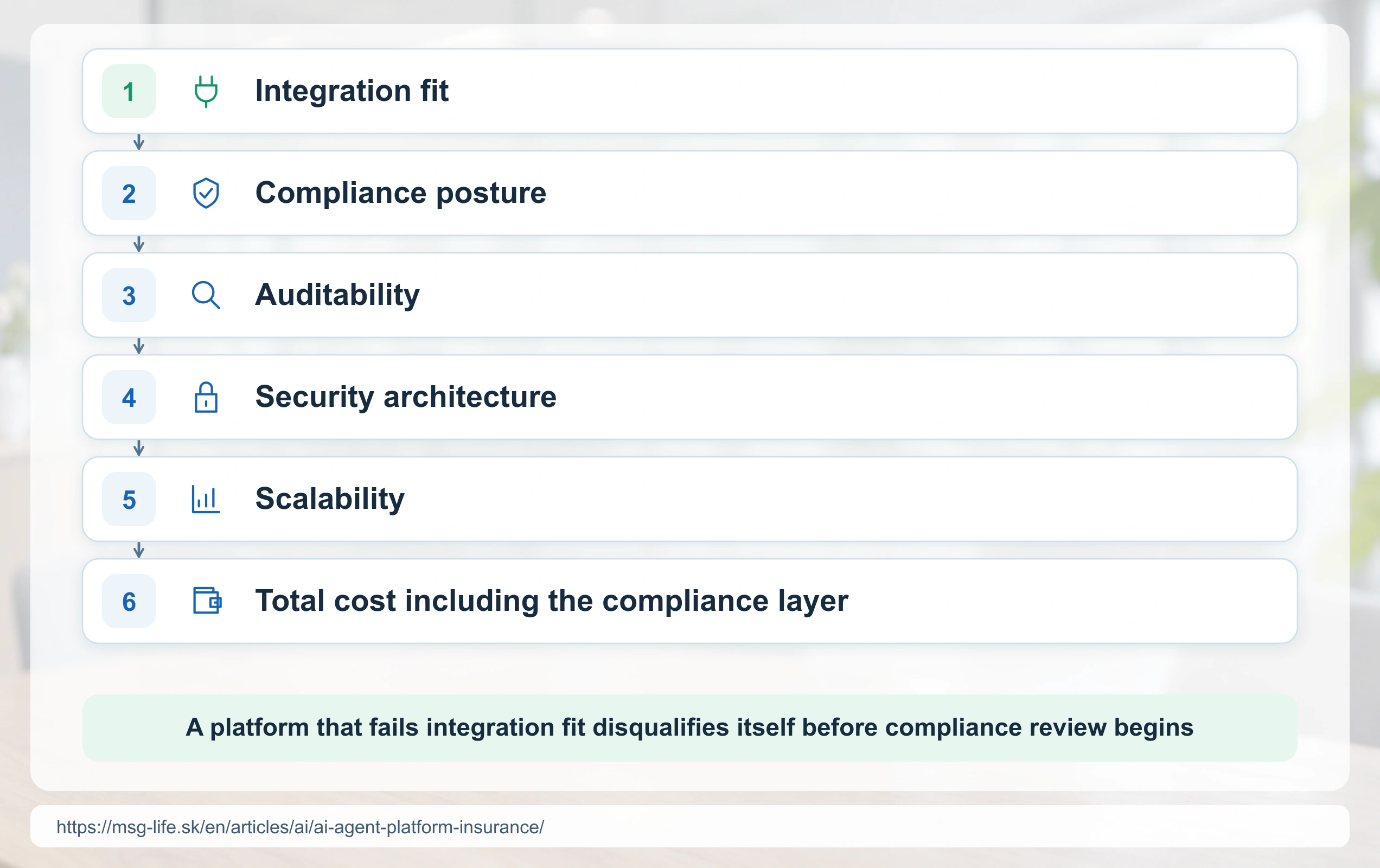
Integration fit
This criterion asks whether the platform can connect to the insurer’s policy administration, claims, and billing systems without custom middleware for every connection. Legacy core systems, often decades old, rarely expose modern REST APIs. A platform’s claimed catalog of integrations may not include the insurer’s actual core system, so a working connector should be demonstrated, not assumed from a feature list. Integration may run through APIs, middleware, event streams, or batch files; the test is whether the agent can act on current data.
Compliance posture
This criterion asks whether the vendor’s evidence, such as a SOC 2 report, an ISO 27001 certificate, or GDPR data processing terms, matches what the insurer’s own compliance function requires for a third-party processor. These are different kinds of evidence, not interchangeable certifications. This is a vendor due-diligence exercise.
Auditability
This criterion asks whether every agent action generates a log entry sufficient to reconstruct a decision months later, for an internal audit or a supervisory request. An agent that silently retries a failed action, or overwrites a prior output without a log entry, creates a gap. A compliance review will not catch that gap until it is tested against a real scenario.
Security architecture
This criterion asks how the platform authenticates agents, scopes their permissions, and isolates them from systems they do not need. The zero trust architecture model described by NIST calls for granting access to individual resources per session instead of extending implicit trust based on network location. Applied to an AI agent with access to policy records, this principle favors narrow, per-session permission checks over a broad grant made once at onboarding.
Three further checks belong here. Documents and messages the agent reads are untrusted input, and content from external sources can alter a model’s behavior, a risk known as indirect prompt injection. Credentials for connected systems should sit in a secrets store, not in agent prompts or workflow definitions. Tool actions with a financial or contractual effect should require approval before they run.
Scalability and total cost
Scalability asks whether the platform’s pricing and performance hold when the use case moves from a ten-person pilot to a department-wide rollout. Total cost asks what it costs to add the audit logging, single sign-on, and role-based access control that some platforms gate behind an Enterprise tier. The advertised starting price may not include them. A platform that looks inexpensive in a demo can cost substantially more once the features a compliance review requires are added.
Insurance context
An insurer evaluating an AI agent platform for claims intake does not ask whether the agent can process a claim. It asks sharper questions. Can the agent’s access to the claims system be scoped to read-only for its first ninety days in production? Does every field the agent populates generate a log entry naming which agent instance wrote it, and when?
If the agent escalates an ambiguous claim to a human adjuster, is that handoff itself logged with a timestamp, so a later audit can show the human decision point? Who, inside the insurer, signs off that the agent’s error rate on a sample of past claims is acceptable before it touches live policyholder data? These questions sit with the architecture function for the technical answer and with the risk or compliance function for the acceptance decision. Neither function owns both halves alone.
The checklist below breaks the six criteria into nine questions. Process support, vendor lock-in, and legacy system support extend integration fit and scalability; the pricing question belongs to total cost.
| Criterion | Question for the insurer |
|---|---|
| Integration | Does the platform connect natively to our policy administration, claims, and billing systems, or does it require custom middleware for each? |
| Compliance | Does the vendor provide evidence, such as a SOC 2 report or an ISO 27001 certificate, that matches our third-party risk requirements, and does its data processing agreement cover our jurisdiction? |
| Auditability | Does every agent action generate a log entry sufficient to reconstruct a decision for an internal audit? |
| Security | How are agent permissions scoped, and can access be limited to specific records? |
| Scalability | Do pricing and performance hold when usage grows from a pilot group to a full department? |
| Process support | Does the platform support human-in-the-loop approval steps before a consequential action, such as a payout or a policy cancellation? |
| Pricing | Does the advertised price include audit logging, SSO, and RBAC, or are they gated to a higher tier? |
| Vendor lock-in | Can agent workflows be exported or rebuilt on another platform if the vendor relationship ends? |
| Legacy system support | Has the vendor demonstrated a working connector to a core system comparable to ours? |
Methodology: How this comparison was built
This comparison evaluates platforms against criteria an insurance IT or architecture lead applies during vendor selection. It does not use general usability benchmarks. Platforms were selected for inclusion based on two factors. The first is presence in the comparison sources linked in this article. The second is a distinguishable approach to agent building: conversational, visual-builder, code-first, or embedded in a broader work-management platform.
Each platform’s capability claims in the comparison table are drawn from the vendor comparison sources linked in this article and from the vendors’ own product, pricing, and license pages linked in the table. Where a claim rests only on a vendor’s own description and has no independent verification, the table says so explicitly. Orckai’s tenancy and audit-trail claims fall into this category: they come from the vendor’s own comparison page, and no independent source confirming them was available.
The table uses two levels of evidence. Statements cited to a vendor’s own documentation, license, or pricing page reflect what the vendor itself declares. Statements from secondary comparisons or marketing material are unverified and need confirmation. No platform in the table was independently tested for this article, and none is presented as having passed an insurance-specific security or compliance audit.
Scope: This comparison covers general-purpose AI agent platforms evaluated for fit with insurance core-system integration, compliance posture, and auditability. It reflects publicly available vendor documentation and independent comparison coverage current as of each cited source’s own publication date.
What this does not address: It does not benchmark agent accuracy or task-completion rates on insurance-specific workloads. No public benchmark of that kind was identified during research. It does not evaluate pricing beyond publicly listed tiers, which vendors change without notice, and it does not substitute for a vendor’s own security questionnaire response or a penetration test.
Prerequisites for use: Before applying this comparison, an insurer should complete an internal assessment of which core systems the agent must reach. For a use case involving risk assessment or pricing in relation to natural persons in life or health insurance, confirm whether it is high-risk under Annex III, point 5(c), of the EU AI Act. The obligations for Annex III systems apply from December 2, 2027. Non-life underwriting and pricing are not covered by point 5(c). A particular system may still fall under other provisions of the AI Act or other regulations, depending on its intended purpose.
Source: Platform capability claims are drawn from the vendor comparison sources linked in this article. Claims not independently verifiable are marked as such in the comparison table above.
A comparison built this way has a limit worth stating directly. It tells a reader which platform fits which pattern of use. It cannot tell a reader whether a specific vendor’s claimed compliance certification is current, since certifications lapse and renew on their own schedules. Verifying a current certificate directly with the vendor remains a required step before any contract is signed.
Use cases: Where AI agent platforms deliver value in insurance
AI agent platforms deliver the most measurable value in insurance where a task is repeatable, data-rich, and currently bottlenecked by manual handling. Four processes show this pattern clearly.
Claims intake
An agent can extract structured data from a first notice of loss, route straightforward claims toward automated processing, and escalate ambiguous or high-value claims to a human adjuster. Where a claim file contains health or other special-category data, GDPR considerations for special categories apply in addition to ordinary claims-handling obligations. The claims operations lead typically owns this use case. The compliance function signs off on what data the agent can access.
Underwriting support
An agent can pull prior policy history, flag missing documentation, or summarize risk factors for a human underwriter’s review, without making the underwriting decision itself. Whether an underwriting or pricing system is high-risk under the EU AI Act depends on its intended purpose. Under Annex III, point 5(c), only risk assessment and pricing in relation to natural persons in life and health insurance qualify. Non-life underwriting and pricing are not covered by point 5(c). A particular system may still fall under other provisions of the AI Act or other regulations, depending on its intended purpose. The determination requires its own legal assessment (see the Security and compliance section below, and Artificial intelligence governance for insurers: Who owns which control under the AI Act and Solvency II for the full framework).
Customer service
Agents that answer policy questions, process address changes, or initiate simple claims interact directly with the policyholder. Where an agent interacts with a customer this way, the EU AI Act requires, from August 2, 2026, that providers design the system so that the customer is informed they are interacting with an AI system, unless this is obvious from the context. An insurer selecting a platform should confirm that the platform supports this disclosure.
Regulatory reporting
Agents that assemble data from multiple core systems into supervisory filings or internal risk reports support the undertaking’s broader governance function. Solvency II requires an effective system of governance with a clear allocation of responsibilities across the undertaking’s operations.
The shared risk across all four
An agent that acts on incomplete or stale data produces a confident, wrong output faster than a human would have. The benefit, faster cycle times and reduced manual routing, is real but conditional. It depends on the auditability controls discussed in the evaluation section above being in place before the agent touches production data, not after an incident reveals they were missing.
Security and compliance considerations
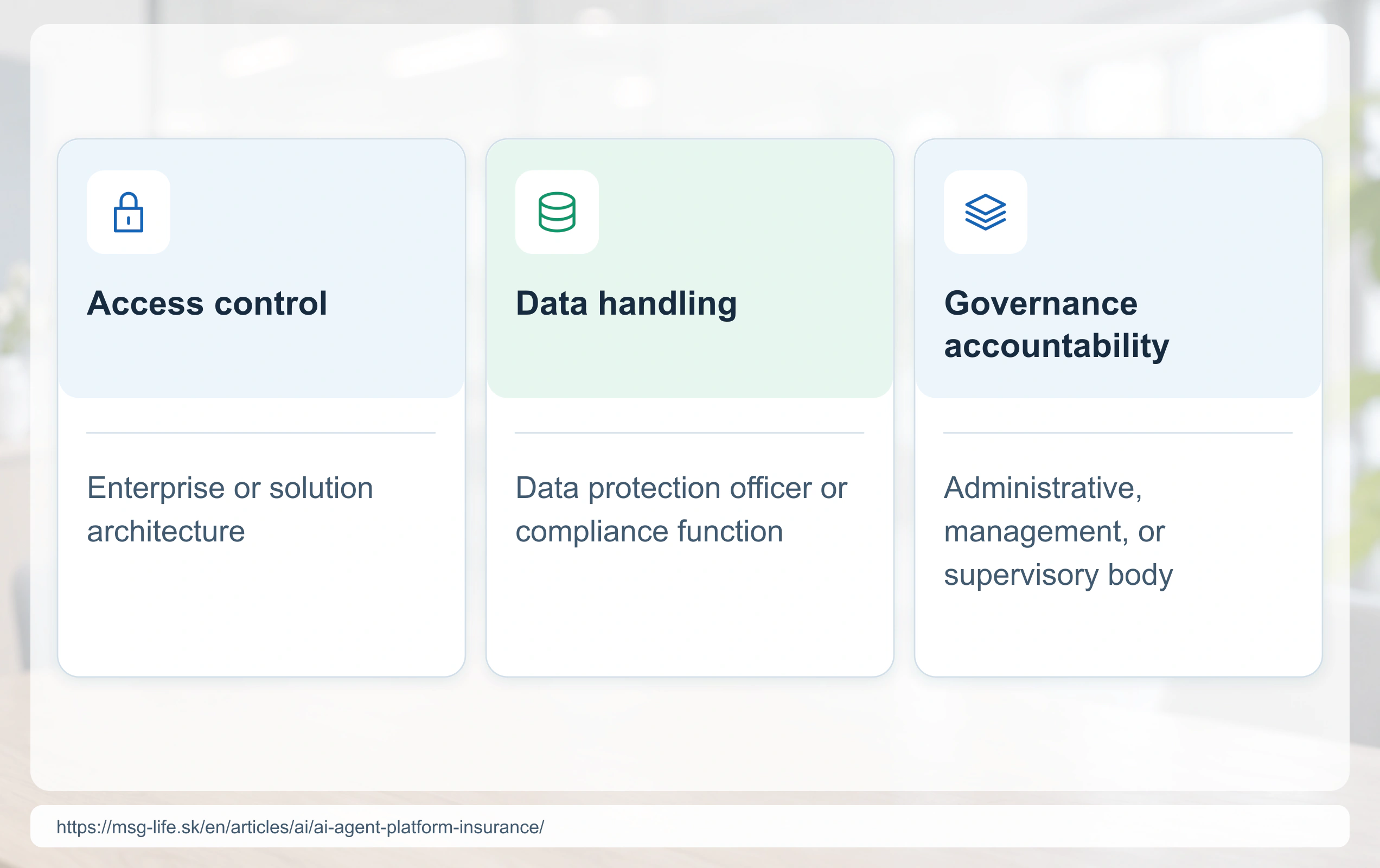
Security and compliance for an AI agent platform in insurance rest on three pillars: access control, data handling, and governance accountability.
Access control
Access control follows the zero trust principle that no agent is trusted by default based on where it sits on the network. Access to each resource is granted per session, with trust in the requester evaluated before the access is granted. For an AI agent with read or write access to policy and claims records, this means scoping permissions to the narrowest set of records the task requires. The alternative, granting broad access at agent creation and trusting it indefinitely, is what this principle rules out.
Data handling
Data handling falls under the GDPR where the agent processes personal data. Processing needs a lawful basis under Article 6. The agent’s output may feed a decision with a legal or similarly significant effect on a customer, taken solely by automated means. In that case, Article 22 restricts the decision unless one of its stated exceptions applies. Where the insurer relies on the contract or consent exception, Article 22 also requires safeguards, including at least the right to obtain human intervention, to express a point of view, and to contest the decision.
Governance accountability
Governance accountability sits within the insurer’s own system of governance under Solvency II. This system must be proportionate to the nature, scale, and complexity of the undertaking’s operations, with a clear allocation of responsibilities. According to EIOPA’s Opinion, Solvency II and the Insurance Distribution Directive apply to AI systems used in insurance; EIOPA published this Opinion in August 2025. The Opinion focuses on uses outside the AI Act’s prohibited and high-risk categories.
What applies and from when
The EU AI Act adds specific obligations on top of this governance baseline for defined high-risk uses, including risk assessment and pricing in relation to natural persons in life and health insurance. The obligations for Annex III systems apply from December 2, 2027; the transparency obligation for systems that interact directly with customers applies from August 2, 2026. Insurers deploying life and health risk assessment and pricing systems must also carry out a fundamental rights impact assessment under Article 27 before first use. The full framework is explained in Artificial intelligence governance for insurers: Who owns which control under the AI Act and Solvency II.
Insurers should also verify whether DORA applies to their undertaking; it excludes, for example, the undertakings referred to in Article 4 of Solvency II. Where it applies, DORA’s ICT risk management requirements cover the hosting and operation of the agent platform, including third-party risk.
| Area | Typical owner inside the insurer |
|---|---|
| Vendor due diligence and contract terms | Procurement, with legal and compliance review |
| Data processing lawful basis | Data protection officer or compliance function |
| Agent access scoping | Enterprise or solution architecture |
| Log retention and audit readiness | IT operations, with compliance sign-off |
| Governance accountability for outcomes | Administrative, management, or supervisory body, which holds ultimate responsibility for compliance under Solvency II, Article 40 |
Limitations
This comparison does not benchmark task-completion accuracy for any platform on insurance-specific workloads. No public benchmark of that kind was identified during research. A prospective buyer should run its own pilot against a representative sample of claims or underwriting cases before committing to a vendor.
This comparison reflects publicly listed features and pricing tiers, which vendors change without public notice. A reader should confirm current feature availability directly with the vendor before using this table in a procurement decision.
This guide does not cover custom-built, in-house agent frameworks assembled entirely from open-source components without a named vendor platform. That path trades vendor dependency for engineering ownership and sits outside this comparison’s scope.
This guide does not resolve whether a specific planned use case falls under the EU AI Act’s high-risk classification. That determination depends on the system’s intended purpose and requires a case-by-case legal assessment, a point the Methodology section above also flags as a prerequisite for use.
This comparison applies most directly to mid-size and large insurers with dedicated architecture and compliance functions. A smaller insurer without those functions in place may need external advisory support to apply the checklist in the evaluation section above.