


Claims intake, underwriting triage, and policy servicing still depend on people who read data, apply a rule, and decide where a case goes next. Intelligent agents can take over parts of that loop, but each agent needs a defined type, a named owner, and a clean connection to core insurance systems. Drawing on msg life’s work on enterprise insurance software, this guide explains the five agent types, typical use cases, and what to check before a first pilot.

What are intelligent agents in insurance?
Russell and Norvig, in Artificial Intelligence: A Modern Approach, define an agent as anything that perceives its environment through sensors and acts on that environment through actuators; a rational agent chooses the action expected to best achieve its performance measure. In software, intelligent agents are programs that read data, decide, and act toward defined goals. In insurance, that environment is the data and workflows inside policy administration, claims, billing, and customer service systems.
The standard textbook classification describes four basic agent programs (simple reflex, model-based, goal-based, and utility-based), any of which can be built as a learning agent, giving the five types usually listed.
For an IT or architecture lead, this classification matters wherever a process currently depends on a person reading data, applying a rule, and making a routing or pricing decision. Claims intake, underwriting triage, and policy servicing are typical candidate processes for this pattern in core insurance systems. Each of the five types brings a different balance of simplicity, state tracking, and adaptability, and that balance determines which one fits a given process.
How do agents fit into insurance systems?
Software agents fit into insurance systems as components that sit between core platforms and the people or downstream systems that act on their output. They do not replace policy administration, claims, or billing systems. They read from and write to them.
A typical agent workflow starts when a trigger event occurs: a new claim is filed, a policy renewal approaches, or a customer submits a service request. The agent perceives this event through an API or data feed, applies its decision logic, and produces an action: a routing decision, a flagged exception, or a generated response. This loop, sometimes called an agentic loop, lets the agent use the outcome of one action to inform what it does next, instead of stopping after a single response.
Where agents typically connect
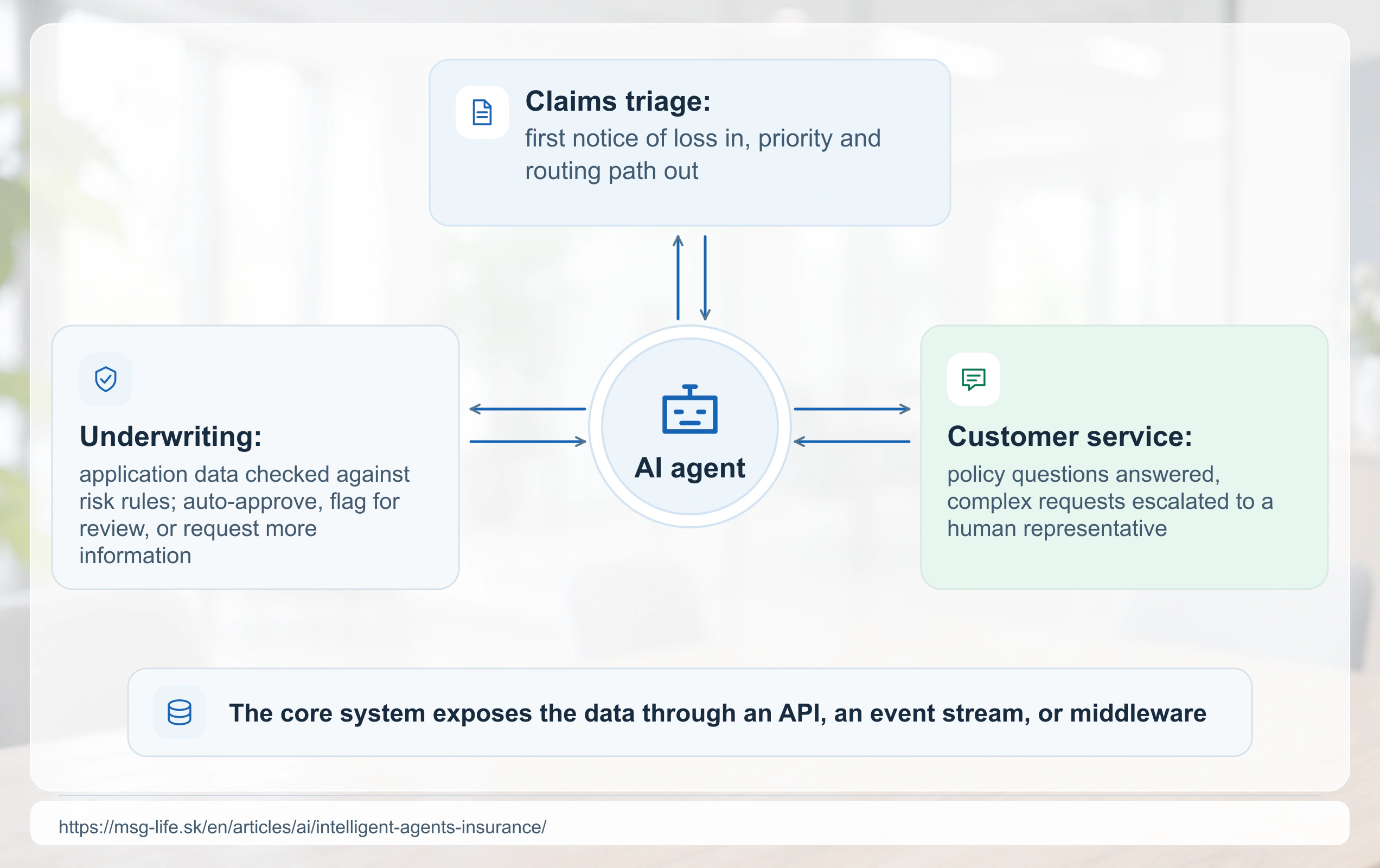
In a claims triage example, the agent receives a first notice of loss from the claims system, checks policy and coverage data, and assigns a priority and routing path. In underwriting, an agent reviews submitted application data against risk rules and either auto-approves, flags for review, or requests more information. In customer service, a conversational agent handles policy questions and escalates complex requests to a human representative. Each of these connections depends on the core system exposing the relevant data, typically through an API, an event stream, or middleware; without that access, the agent cannot act on current information.
Who owns intelligent agents in an insurance organization
Ownership splits by function. The IT or architecture team owns the integration and technical infrastructure. The business process owner, such as an underwriting lead or claims lead, owns the decision logic and its outcomes. Compliance and risk functions own the oversight and audit trail. These responsibilities are shared, but one named business owner stays accountable for each agent’s use and outcomes. The responsibility matrix in the next section breaks this down by agent type, so that a reader can assign each row to a named function before deployment rather than after an incident.
Types of intelligent agents in insurance
This article focuses on three of the five classical agent types (model-based, goal-based, and learning agents) because most insurance processes need to track state, pursue a defined outcome, or improve from historical outcomes. Simple reflex agents, usually implemented as business rules engines, are already widespread in insurance for well-defined checks such as validation and straight-through processing, and utility-based agents appear in ranking and prioritization tasks.
Model-based agents maintain an internal representation of their environment, going a step further than agents that only respond to current conditions (AnitaB.org). Learning agents improve their performance by using feedback and experience.
| Agent type | Description | Example use in insurance | Responsibility in the insurer | Key data used |
|---|---|---|---|---|
| Simple reflex agent | Acts on the current input using a fixed rule, with no memory of past states | Returning an incomplete claim submission for completion | IT operations maintains the rule set; claims operations defines the rule | Form completeness checks, field-level validation rules |
| Model-based agent | Maintains an internal model of its environment to track state over time | Tracking a claim’s status across multiple systems and flagging stalled cases | Claims operations owns the workflow; IT owns the system integration | Claim status history, policy data, SLA timestamps |
| Goal-based agent | Selects actions to reach a defined goal rather than reacting to a fixed rule | Guiding a policy renewal process toward completion by a deadline | Policy servicing team owns the goal definition; IT owns execution | Policy renewal dates, customer contact history, outstanding tasks |
| Utility-based agent | Evaluates possible actions by the value of their outcomes, not just goal achievement | Ranking open claims for adjuster review by expected cost and complexity | Claims management owns the utility function; actuarial or analytics teams validate it | Claim severity estimates, adjuster capacity, historical settlement data |
| Learning agent | Improves its behavior through experience and feedback | A fraud-detection model that refines its flagging criteria from confirmed fraud outcomes | Data science or analytics owns the model; compliance owns the audit of its decisions | Historical claims, confirmed fraud labels, transaction patterns |
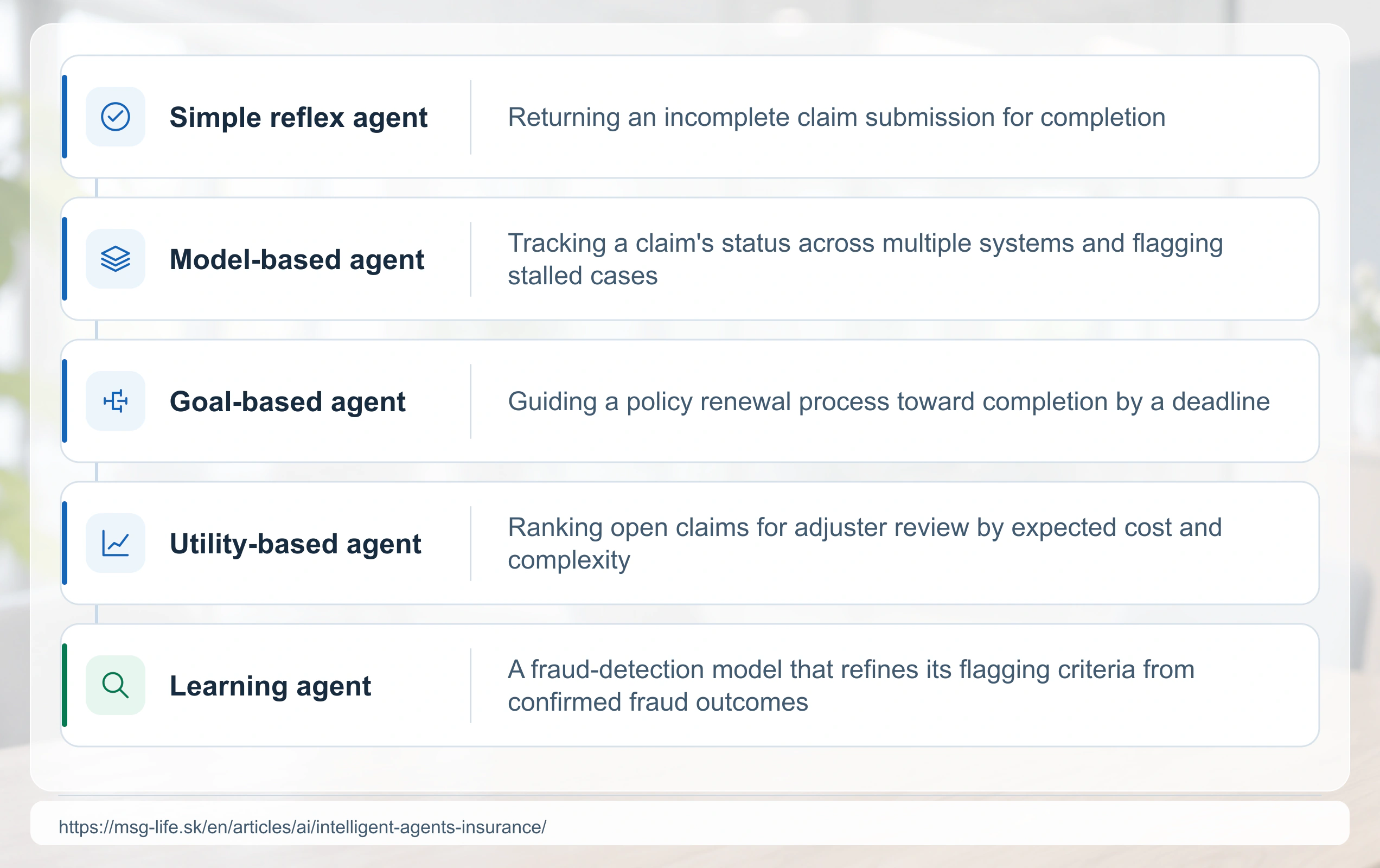
Model-based agents suit processes with multiple steps and systems, such as claims tracking. Goal-based agents suit processes with a clear target state, such as renewals. Learning agents suit processes with enough historical outcome data to train on, such as fraud detection.
Illustrative uses of intelligent agents in insurance
Intelligent agents are used in insurance for claims triage, underwriting support, fraud detection, customer service automation, and reporting and compliance monitoring, each drawing on a different agent type and data set.
Claims triage and routing
A model-based agent reads incoming first-notice-of-loss data, checks policy coverage, and routes the claim to the right queue by complexity and urgency. The expected benefit is faster initial handling and fewer claims sitting unassigned. Because the agent maintains a model of claim state across systems, it can also flag a claim that has stalled past its service-level target.
Underwriting support
A rule-based agent, a simple reflex agent in Russell and Norvig’s terms, reviews application data against underwriting rules. It completes straightforward cases automatically and routes exceptions to an underwriter with a summary of the flagged issues. This reduces manual review time on low-complexity applications, letting underwriters focus their attention on cases closer to the risk-appetite boundary.
Fraud detection
A learning agent scores incoming claims for fraud indicators and refines its criteria from confirmed fraud outcomes, adapting through feedback and experience rather than relying entirely on predefined instructions. The agent’s output is a prioritized list for a human investigator; it does not issue a final denial. This distinction matters for the accountability structure described in “Who owns intelligent agents in an insurance organization” above, since the agent narrows the queue but a named person still makes the determination.
Customer service automation
A conversational agent, which in classic designs combines reflex-style intent matching with a model-based dialogue state, answers policy questions and escalates anything outside its scope to a human representative. The dialogue state lets the agent track what the customer said earlier in the same conversation, which a stateless reflex agent cannot do.
Reporting and compliance monitoring
A model-based agent tracks regulatory reporting deadlines and data completeness across systems, flagging gaps before a filing deadline.
How to implement intelligent agents in insurance
Implementing these systems in insurance follows a structured process: identify the use case, select the agent type, define data needs, integrate, monitor, document, and verify compliance.
Methodology scope: This methodology applies to deploying software agents in core insurance processes such as claims, underwriting, and customer service.
What this does not address: Vendor-specific product selection, detailed system architecture patterns, or step-by-step regulatory filing procedures.
Prerequisites: Data quality controls, API-accessible core systems, and an assigned governance owner, detailed in the next section.
Source: Agent types follow the classification in Russell and Norvig; the implementation steps are a practitioner checklist, not taken from that book.
Implementation checklist
Step 1: Identify the use case. What you need before this step: a documented process with a known pain point, such as slow claims routing or inconsistent renewal follow-up. What to do: name the specific process and decision the agent will support, and name the business owner accountable for that decision today. What you should have after this step: a one-paragraph use case statement with a named owner. Common failure point: choosing a use case too broad to scope, such as “automate claims,” instead of one decision within that process.
Step 2: Select the agent type. What you need before this step: the use case statement from Step 1. What to do: match the process to simple reflex, model-based, goal-based, utility-based, or learning agent behavior using the matrix in the types section above. What you should have after this step: a documented agent type with the reasoning for that choice. Common failure point: selecting a learning agent for a process with no historical outcome data to train on.
Step 3: Define data requirements. What you need before this step: the agent type from Step 2. What to do: list the data sources, required quality level, and access permissions the agent needs from core systems. What you should have after this step: a data requirements document reviewed by the data owner of each source system. Common failure point: assuming a data field is populated consistently across all policies when it is only populated for a subset.
Step 4: Design the integration. What you need before this step: the data requirements document from Step 3. What to do: map the APIs or middleware connecting the agent to core policy, claims, or billing systems. What you should have after this step: an integration diagram reviewed by the systems team that owns each connected platform. Common failure point: designing for a direct database connection where the core system only supports batch file exports.
Step 5: Set up monitoring and control. What you need before this step: the integration design from Step 4. What to do: define who reviews agent decisions, how often, and what output triggers escalation to a human. Before go-live, test decision quality, escalation behavior, access permissions, and failure handling against predefined acceptance criteria, and confirm that the agent can be stopped and its actions reversed or corrected. What you should have after this step: a documented escalation path with a named reviewer, a review frequency, and recorded test results. Common failure point: setting up monitoring for the agent’s uptime but not for the quality of its decisions.
Step 6: Prepare documentation. What you need before this step: the monitoring plan from Step 5. What to do: record the agent’s scope, data lineage, and decision logic for internal audit and supervisory review. What you should have after this step: a documentation package a compliance reviewer can read without asking the implementation team for context. Common failure point: documenting the system architecture but omitting why specific rule thresholds were chosen.
Step 7: Verify compliance. What you need before this step: the documentation package from Step 6. What to do: confirm with legal and compliance teams whether the use case’s intended purpose places it within a high-risk category before go-live. What you should have after this step: a written compliance sign-off or a list of remediation items blocking go-live. Common failure point: treating compliance verification as a one-time check instead of repeating it when the agent’s intended purpose changes.
Prerequisites for deploying intelligent agents in insurance
Before deploying these systems, an insurer needs reliable data, accessible APIs, and an assigned governance owner for each agent.
Poor data quality can block deployment. An agent reading inconsistent or incomplete policy data produces unreliable decisions regardless of how well it is designed. Solvency II already requires insurers to maintain processes ensuring the appropriateness, completeness, and accuracy of data used in technical provisions.
Infrastructure readiness means core systems expose the data an agent needs through APIs, instead of requiring manual extracts. Without this, integration work can expand well beyond the agent itself and add significantly to pilot cost.
Governance readiness means a named owner exists for each agent’s decisions, separate from the team that built it. Compliance and risk functions typically define what oversight and logging that structure requires for a given agent.
For the criteria and application dates for high-risk insurance systems, see AI Regulation for Insurers.
Limitations of intelligent agents in insurance
Intelligent agents in insurance face limits tied to data, integration complexity, organizational accountability, and regulatory scope.
- Data dependency. An agent trained or configured on incomplete claims history produces unreliable flags. A supervised fraud-detection model, for example, can miss a fraud pattern absent from its training data.
- Integration overhead. Agents connecting to legacy policy administration systems without modern APIs often require custom middleware, extending implementation timelines well beyond the agent build itself.
- Accountability gaps. Without a named owner for each deployed agent, a decision can go unreviewed for longer than intended. The responsibility matrix above is a starting point for assigning owners. Solvency II places ultimate responsibility for compliance on the administrative, management, or supervisory body (Article 40) and requires a clear allocation of responsibilities (Article 41). Insurers can use that existing structure to assign agent ownership rather than building a new one.
- Regulatory scope uncertainty. Whether a specific agent use case falls into a high-risk classification under the AI Act depends on its intended purpose, for example, whether it is used for risk assessment and pricing in relation to natural persons in life and health insurance (Annex III, point 5(c)).
- Scale constraints. An agent tuned and validated on one line of business, such as motor claims, does not necessarily perform the same way on a different line. Health claims, for example, require separate validation.