Multi-agent systems split a complex task across several coordinating agents instead of one program. That flexibility has a price: less predictability and auditability, which are the two properties a regulated insurer weighs most. This article covers the five design choices that decide whether the pattern fits. The architecture, centralized or decentralized, shapes your audit trail and how the system fails. The agent type, reactive, deliberative, or hybrid, trades latency for adaptability. The framework sets how much orchestration you write yourself. The learning approach decides whether the system improves from data or stays fixed between releases. In insurance, the fifth choice is where human decisions sit. For claims and underwriting, the article adds an orchestrator-specialists-human design pattern. It shows where that pattern fails and which controls keep it supervisable.

A single-agent system concentrates reasoning, tool use, and decisions in one model instance. A multi-agent system distributes that work across several autonomous, interacting agents in a shared environment. The difference matters architecturally. A single agent either completes the task or fails it, while a multi-agent design can degrade gracefully if individual agents fail, provided coordination is designed for it.
Multi-agent systems (MAS) are valuable for large-scale, complex tasks that can involve hundreds or thousands of agents, but that scale brings coordination overhead absent from single-agent designs. Each agent operates with a degree of autonomy and can act and decide independently.
Agents are commonly classified by how they decide. Reactive agents respond to stimuli through condition-action rules without internal state. Deliberative agents keep an internal model of the world and plan before acting. Hybrid agents combine both: reactive behavior for time-critical responses, deliberation for longer-horizon planning. Each agent in a MAS has individual properties, while all agents behave collaboratively to produce the desired global properties.
| Dimension | Single-agent system | Multi-agent system |
|---|---|---|
| Control | Centralized in one model or process | Distributed across several agents |
| Failure mode | Total task failure | Partial degradation possible |
| Coordination overhead | None | Required (communication, negotiation) |
| Best for | Narrow, well-defined tasks | Complex tasks that decompose into parallel subtasks |
Google Cloud notes that single-agent systems suit tasks where interaction is minimal and centralized control is efficient, such as recommendation engines or fraud detection, and that they are simpler to develop, with lower maintenance costs and more predictable outcomes. That is a useful default: start with one agent, and add agents only when the task genuinely decomposes.
MAS can operate under centralized or decentralized architectures. In a centralized network, a central unit contains the global knowledge base, connects the agents, and oversees their information. This simplifies auditability, because every decision passes through a traceable coordination point.
In a decentralized network, agents coordinate peer-to-peer without a single point of control. That improves fault tolerance but makes the decision path harder to reconstruct afterward. A hierarchical arrangement, with agents at different levels of autonomy, works as a hybrid of the two.
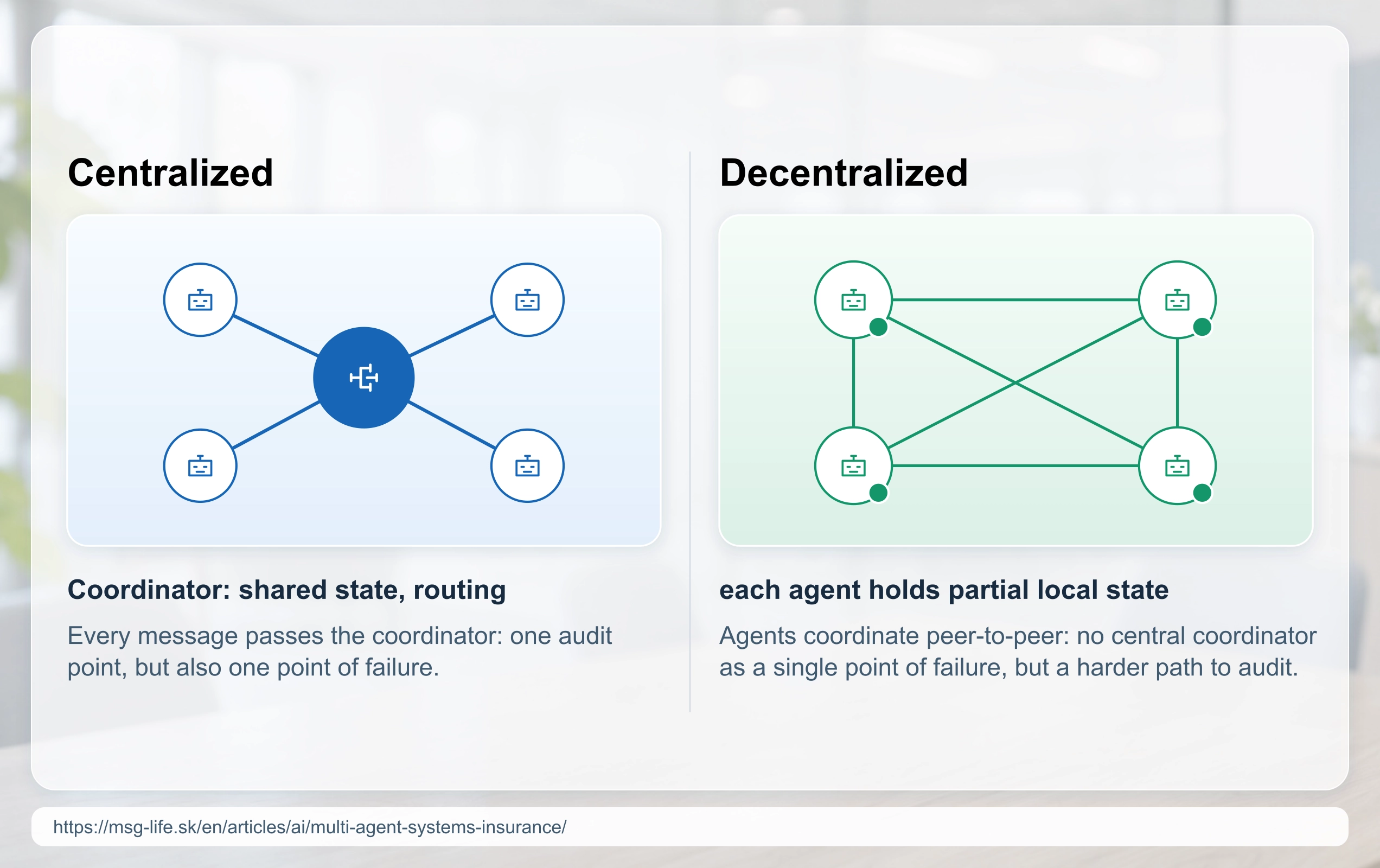
Every MAS, whatever its architecture, has four core components:
Coordination, communication, and negotiation determine whether a system’s emergent behavior is reliable or chaotic. To align their actions, agents can follow predefined protocols or strategies. Contract Net Protocol schemes allocate tasks through bidding; market-based mechanisms use price-like signals to allocate resources; stigmergy lets agents coordinate indirectly by changing a shared environment.
In production LLM-based systems, the coordination pattern has a direct effect on reliability. Anthropic’s account of its research system describes a lead agent that plans the work and hands subtasks to subagents running in parallel. LangChain’s analysis of that post and of Cognition’s opposing post draws two shared lessons.
First, context engineering (giving each model exactly the context it needs) is one of the hardest parts of the work. Second, agent systems that mainly “read” are easier to build than those that “write,” because conflicting writes typically produce far worse outcomes than conflicting reads. Production agents can run conversations spanning hundreds of turns, which requires deliberate context management. Agents are also stateful, so errors compound: a small early failure can cascade without mitigation.
Multi-agent systems can handle complex, dynamic, or large-scale challenges that would overwhelm a single agent or a large, monolithic program. Their advantages include scalability, robustness, and flexibility. Scalability comes from decomposition into parallel subtasks. Robustness comes from the absence of a central coordinator as a single point of failure in decentralized designs. Flexibility comes from the ability to replace or specialize one agent without redesigning the rest.
Typical deployments of MAS include supply chain management, where agents connect stages from manufacturing to consumer purchase, and transportation, where they coordinate train networks, truck assignments, or ships.
Anthropic reports that multi-agent research setups excel at breadth-first queries that pursue several independent directions at once. On its internal research evaluation, a system with Claude Opus 4 as the lead agent and Claude Sonnet 4 subagents outperformed a single Claude Opus 4 agent by 90.2%. Breadth-first research of that kind resembles due-diligence and compliance-review work in financial services.
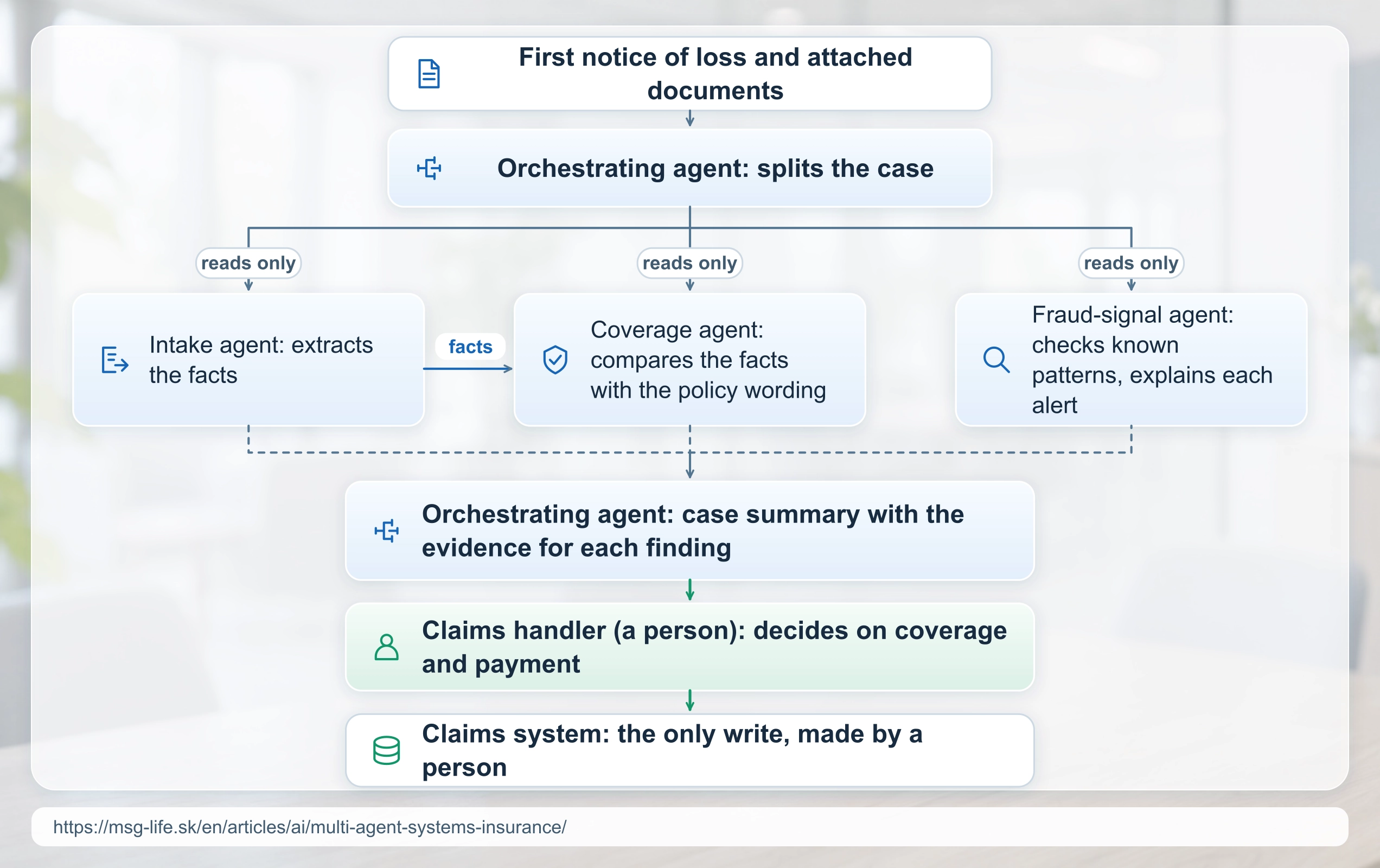
Insurance processes decompose naturally into specialized steps, which makes them good candidates for agent designs. The pattern that fits supervision best is orchestrator-specialists-human: an orchestrating agent splits the case, specialist agents each do one bounded task, and a person makes the decision that changes the customer’s position.
An intake agent reads the first notice of loss and attached documents and extracts the facts. A coverage agent compares those facts with the policy wording and flags the clauses that apply. A fraud-signal agent checks the case against known patterns and explains each alert. The orchestrator assembles a case summary with the evidence for each finding, and a claims handler decides on coverage and payment. All specialist agents in this design only read; the single write (the decision in the claims system) is made by a person.
A data-gathering agent collects the application, prior policies, and external data. A summarizing agent prepares the case for the underwriter, with sources for each fact. Any risk score comes from a validated model, not from a language model’s judgment, and the underwriter decides.
This matters legally: AI systems for risk assessment and pricing of natural persons in life and health insurance are high-risk under the AI Act (Annex III, point 5(c)). These obligations apply from December 2, 2027. A system listed in Annex III that profiles natural persons is always high-risk, so supporting agents do not automatically fall outside this scope (Article 6(3)).
The failure modes in the general literature apply directly:
Claims and underwriting agents read text that outsiders wrote: claim forms, letters, attachments, emails. OWASP lists prompt injection as the first risk for LLM applications and describes indirect injection, where an LLM accepts input from external sources, such as websites or files, and that content alters the model’s behavior.
In an agent chain, one manipulated document can steer every agent after it. Treat every document as data, never as instructions; give each agent only the tools its task needs; and keep the write step with a person. Cisco’s 2025 study shows how far most organizations are from this: 83% plan to deploy AI agents, but only 31% overall say they are fully equipped to control and secure them, compared with 75% of the most AI-ready companies.
Three controls follow from the rules that apply, or will apply, to these systems. Log every handoff: the AI Act requires automatic record-keeping for high-risk systems (Article 12), and EIOPA’s Opinion lists record-keeping among its expectations for other AI systems in insurance. Define where a person reviews or overrides: human oversight is an AI Act requirement for high-risk systems (Articles 14 and 26) and part of EIOPA’s framework.
Finally, classify the use case before the design is fixed, because the classification decides how much of this is mandatory. The control matrix in Artificial intelligence governance for insurers maps who owns each of these controls.
The most consequential limitation in production is cost. Heavy reliance on LLMs through API calls can lead to significant computational cost, and scaling can become prohibitively expensive if not managed. Cost grows with the number of agents and coordination rounds, not only with task complexity. Non-determinism makes reproducing a specific failure harder than in a deterministic pipeline. Synchronizing many agents adds coordination overhead, and, without mitigation, minor failures can escalate.
In regulated settings, two further constraints apply. First, decision paths must be reconstructable after the fact, which centralized architectures support more naturally than decentralized ones. Second, runtime monitoring becomes essential precisely because of the non-determinism. Data monitoring for AI and regulatory reporting covers the data side of that monitoring.
Choosing a framework means matching its orchestration style to your production constraints. No framework is best on every axis. Three questions separate them: how much control over orchestration you keep, whether the project is actively maintained, and how easily it exposes the structured logs a regulated deployment needs.
In a sandbox, framework choice follows developer speed. In a regulated production environment, check first that the framework, or your wrapper around it, can emit a structured, timestamped log of every inter-agent decision and handoff, because that log is what an auditor asks for after an incident. Also check that the project is maintained: a framework without security fixes is a liability in a core insurance process.
| Framework | Architecture type | Maintainer and license | Status (November 2026) | Enterprise fit | Best for |
|---|---|---|---|---|---|
| LangGraph | Graph-based orchestration with explicit state | LangChain; MIT license | Actively developed | Explicit, inspectable state transitions suit audit logging | Production pipelines that need an inspectable state graph |
| Microsoft Agent Framework | Agents and multi-agent workflows, including sequential, concurrent, handoff, and group patterns; Python and .NET | Microsoft; MIT license | Successor to AutoGen | Built for durability, observability, and human-in-the-loop workflows | Teams on the Microsoft stack, and AutoGen users planning migration |
| CrewAI | Role-based agents with task delegation | CrewAI; MIT license | Actively developed | Role abstraction aids task traceability; check logging depth for your audit needs | Teams that want role and task abstraction over raw orchestration |
| AutoGen | Conversation-driven agent-to-agent | Microsoft | No longer actively maintained, per its README; Microsoft points new users to Agent Framework | Not suitable for new production work | Maintaining existing code until migration |
| Custom orchestration (lead-agent pattern) | Centralized; a lead agent decomposes work for subagents | Your team | Your responsibility | Full control over logging; higher build and maintenance cost | Regulated environments that need full control of the audit trail |
The most important caveat sits outside the table. Anthropic and Cognition published posts with opposite titles (“How we built our multi-agent research system” and “Don’t Build Multi-Agents”), yet both point to context engineering as the hard part, and to read-heavy systems as easier than write-heavy ones. That distinction should weigh more in your choice than any single framework’s feature list.
Learning approaches decide whether agents improve from experience or stay fixed between releases. Supervised learning trains on labeled historical data and suits stable subtasks such as document classification, but it degrades when the environment changes faster than labels can be produced. Reinforcement learning lets agents learn from rewards in their environment.
Multi-agent reinforcement learning (MARL) is a research field of its own; Zhang, Yang, and Başar give an overview of its theory and algorithms. Its central practical difficulty is that each agent’s learning changes the environment the other agents face. Evolutionary methods optimize populations of agents through selection and variation and are typically used when rewards are too sparse for standard reinforcement learning.
| Learning approach | Data requirement | Enterprise suitability | Key constraint |
|---|---|---|---|
| Supervised | Large labeled dataset | High for stable, well-defined subtasks | Degrades under distribution shift |
| Reinforcement (incl. MARL) | Environment with a reward signal | Low in core insurance processes: exploration on live cases is rarely acceptable | Agents’ changing policies destabilize training |
| Evolutionary | Population of candidate policies and a fitness function | Low to medium: compute-intensive | High compute cost, slow convergence |
In most enterprise LLM-agent systems, “learning” does not mean retraining. Anthropic describes improving its research system mainly through prompt engineering. For an insurer, that is the realistic path: improve instructions, tools, and evaluation, and keep any model that scores risk under the model-validation process.
Methodology scope: enterprise deployment of multi-agent systems, where auditability, reliability, and compliance shape the evaluation, not academic benchmarking.
What this does not address: agent-based simulation for research and performance benchmarks of specific frameworks against standard test suites.
Prerequisites: familiarity with distributed systems, LLM-based application architecture, and basic AI/ML terminology.
Source basis: the sources linked in the text, including the primary posts by Anthropic and Cognition, the framework repositories, and the AI Act and EIOPA texts for the insurance section. Framework status was checked in November 2026.
The framework table compares architecture, maintenance, and license, not performance; treat it as a shortlist and test candidates on your own workload. The enterprise lens underweights considerations that matter more in research, such as raw accuracy on open benchmarks. Framework status also changes quickly: AutoGen went from one of the most discussed frameworks to a project Microsoft no longer actively maintains, so re-check the status before you commit.
The six steps below condense the article into a pre-deployment check. Each row links back to the section that explains it.
| Step | What to verify | Why it matters | Section reference |
|---|---|---|---|
| 1. Classify your workload | Do the agents mainly read, or do they write to shared state and core systems? | Write-heavy coordination is harder to make reliable | Agent behaviors and interactions |
| 2. Classify the use case | Is it high-risk under the AI Act, or subject to sectoral rules only? | Decides which logging and oversight duties are mandatory | Multi-agent systems in insurance |
| 3. Choose the architecture | Centralized, decentralized, or hierarchical? | Decides the trade-off between audit traceability and fault tolerance | Architectures and components |
| 4. Place the human decision | Which step changes the customer’s position, and who approves it? | Human oversight is a requirement for high-risk systems | Multi-agent systems in insurance |
| 5. Confirm logging and maintenance | Does the framework log every handoff, and is it actively maintained? | The log is the audit evidence; an unmaintained framework gets no security fixes | Frameworks for multi-agent systems |
| 6. Plan for non-determinism | Does monitoring capture run-to-run variance? | Non-deterministic decisions complicate debugging | Challenges and limitations |


A centralized architecture routes coordination through one unit that holds the global knowledge base, which simplifies the audit trail but creates a single point of failure. A decentralized architecture lets agents coordinate directly, which improves fault tolerance but makes the decision path harder to reconstruct.
Start from whether your agents mainly read or write shared state, since read-heavy systems are easier to make reliable. Then confirm that the framework is maintained and can emit structured logs of every handoff before you compare convenience features.
None is best everywhere. Supervised learning suits stable, labeled subtasks; reinforcement learning suits learned coordination but is hard to use safely on live cases; evolutionary methods suit sparse-reward problems at high compute cost. In Anthropic’s research system, prompt engineering was the primary lever for improving agent behavior.
The main risks are non-deterministic behavior that complicates audit, errors that compound across stateful agents, and the computational cost of heavy reliance on LLMs through API calls. In insurance, AI systems for risk assessment and pricing of natural persons in life and health insurance are also high-risk under the AI Act, with record-keeping and human-oversight requirements that apply from December 2, 2027.
Test for error propagation and run-to-run variance, not only single-run accuracy, because agents decide non-deterministically even with identical prompts. Keep the full log of each test case so that failures can be traced to the agent that caused them.
Effective human oversight is required for high-risk AI systems, but this does not automatically mean manual approval of every decision. In the architecture proposed here, a named person approves coverage, payment, and underwriting decisions before they are written to the core system. For AI systems that assess risk and price life and health insurance for natural persons, human oversight becomes a legal requirement from December 2, 2027 (Articles 14 and 26(2)). For other insurance uses, EIOPA’s Opinion includes human oversight among its supervisory expectations. The question is where, not whether: agents can prepare, check, and summarize, while the decision and the write to the core system stay with a named person.
Decomposition by a lead agent into independent subtasks scales well for breadth-first, read-heavy work. Write-heavy coordination is harder, because agents’ conflicting decisions can create incompatible outputs that are difficult to reconcile.
Before starting an agent project, score the use case with the scorecard in AI readiness assessment for insurers. To assign owners for logging, oversight, and classification, use the control matrix in Artificial intelligence governance for insurers. Once the system runs, Data monitoring for AI and regulatory reporting covers what to monitor in the data the agents read and write.
For the original debate on when to build multi-agent systems, read the Anthropic and Cognition posts directly. For the basics of the models agents are built on, see what machine learning is and how it is used.
At msg life Slovakia, I work as a Data Scientist with experience in developing insurance systems. I focus on the design and compliance of agentic AI systems in insurance and write about how the regulatory requirements of the EU AI Act translate into real-world architecture. I'm the author of the video series S Michalom o AI on the msg life Slovakia YouTube channel, where I explore various aspects of agentic programming.
See who translates insurance into code at msg life Slovakia.