When a customer reports water damage, a software agent can read the loss notice and route the claim to an adjuster. Approving a payment requires different evidence and a different level of authority. For IT leaders designing agents for claims, underwriting, customer service, or reporting, the design starts with three questions. What data can the agent read? What can it change? Who can review and correct its work?

How software agents work in insurance
A software agent reads information about its environment, uses rules or a model to select an action, and carries it out within the permissions it has been given. In an insurance core system, the agent may read policy records, claims data, or a customer’s request.
Not every software agent uses artificial intelligence. A rule-based agent follows predefined conditions, while an AI agent can use a model to interpret information and select an action. Agentic AI is an approach, not a separate class of agent: software agents plan and carry out several steps toward a goal, with adaptive behavior, complex coordination, and delegated decision-making. In insurance, all three approaches may interact with core systems, but their autonomy, testing needs, and operational risks differ.
An architect can examine this loop one step at a time. For claims intake, the input might be the loss notice and the policy in force on the date of loss. The decision is which queue should receive the claim. The action is writing that assignment to the claims system. An adjuster can then inspect the documents and correct the assignment.
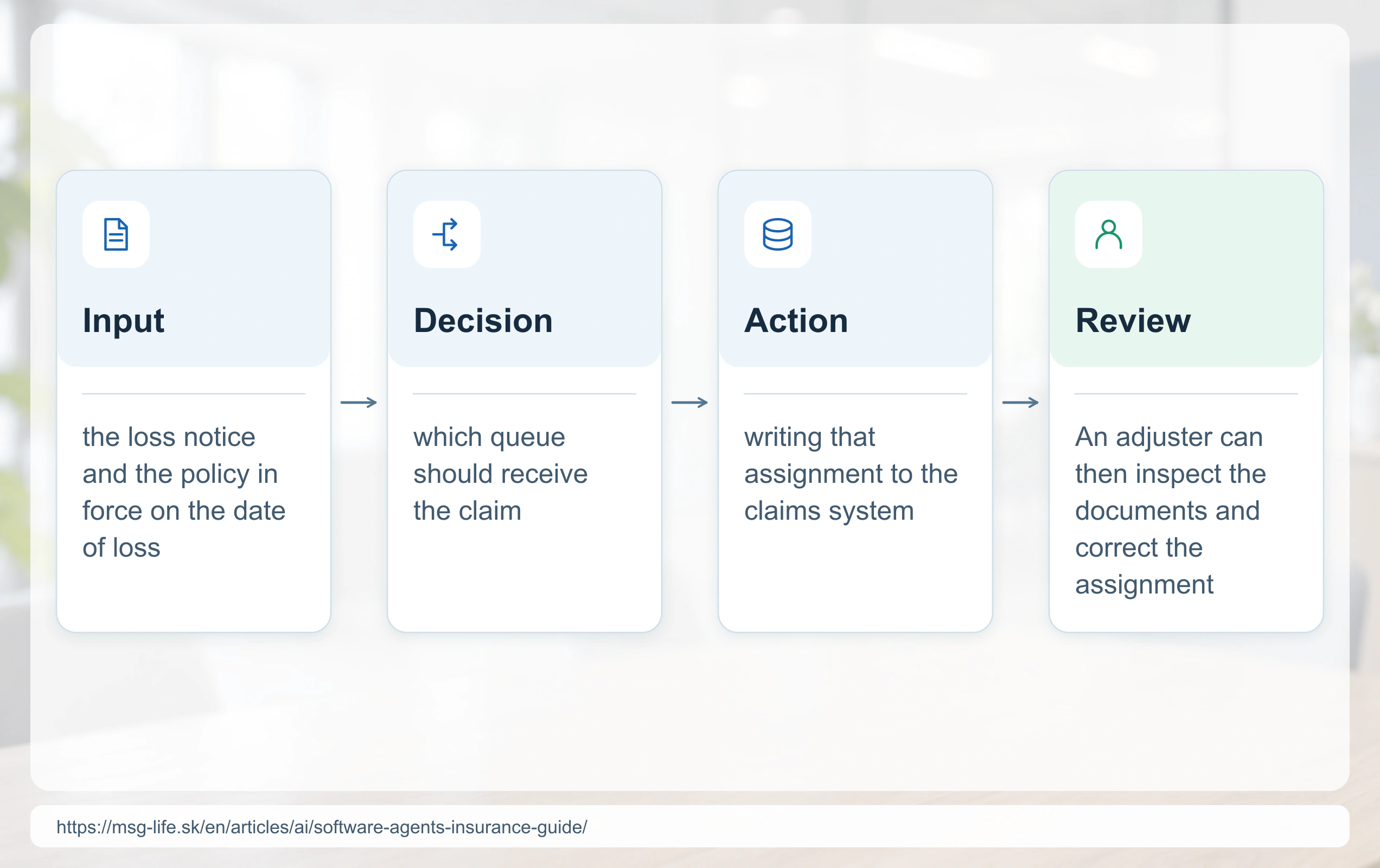
The point at which a person reviews the output matters. A reporting analyst can investigate a flagged discrepancy before a filing goes out. If an underwriting score feeds directly into a quoted premium, a later review may come after the customer has seen the price. The underwriting team needs to decide when a quote can be issued and who can stop it.
Types of software agents and their insurance roles
The four labels below describe different aspects of an agent’s work. Intelligent describes how it selects an action, collaborative describes who it works with, and reactive and proactive describe when it acts. An agent that checks flood maps ahead of renewal can be both proactive and model-driven.
| Agent type | Insurance process | Responsibility | Example |
|---|---|---|---|
| Intelligent agent | Claims complexity assessment | Uses a model to estimate how much specialist attention a claim needs | Weighs the damage description, repair estimate, and policy terms to recommend a review queue |
| Collaborative agent | Customer service | Coordinates with other agents to resolve a single inquiry | A billing agent checks payment history and a policy agent checks an endorsement. A service agent uses both findings to explain a premium change. |
| Reactive agent | Fraud and anomaly monitoring | Responds to a defined event or threshold | Flags two similar submissions within 24 hours for a handler to check for duplication |
| Proactive agent | Underwriting risk updates | Monitors for changes and alerts an underwriter ahead of a scheduled review | Flags an in-force policy when an updated flood map changes the property’s risk classification |
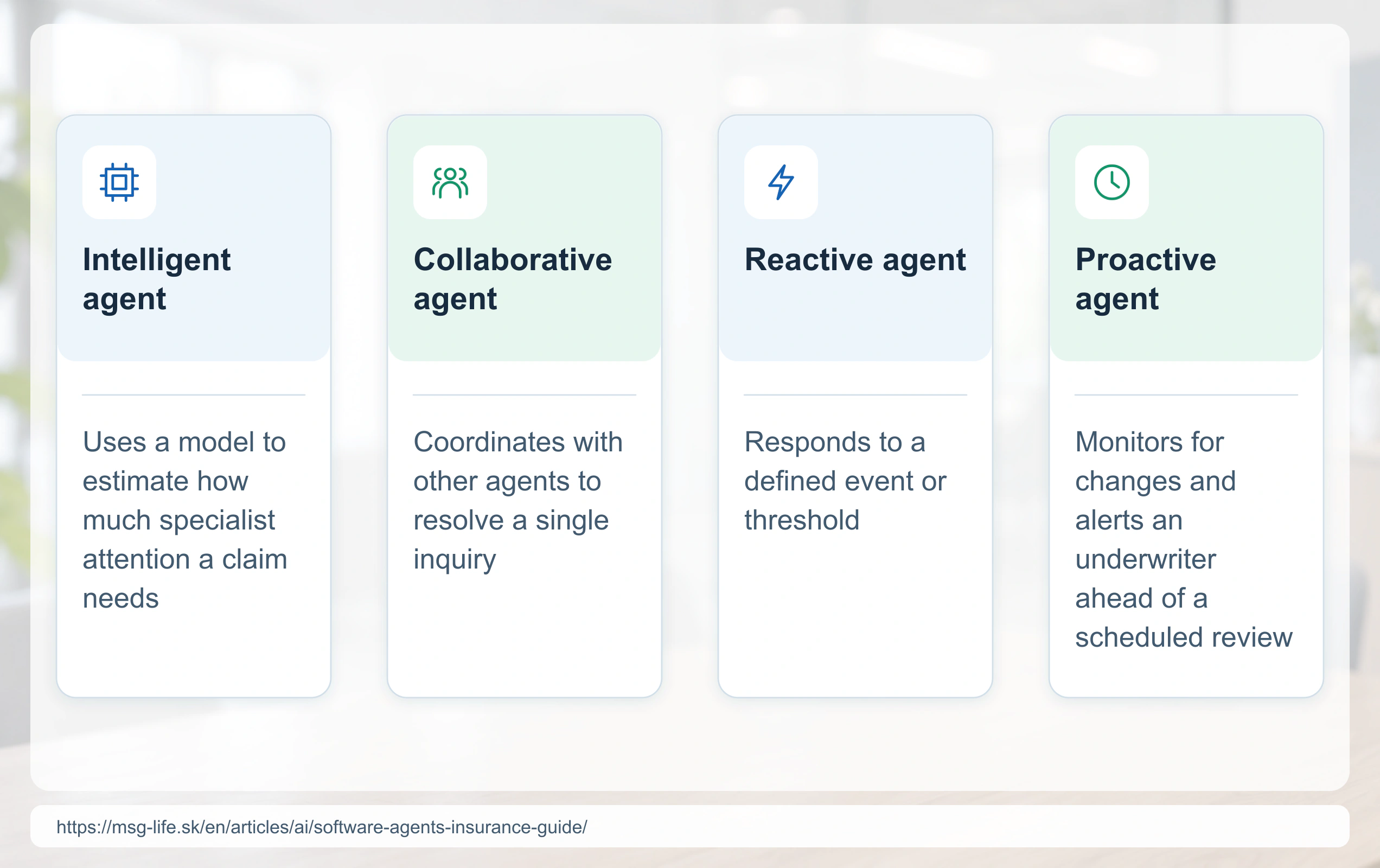
A model score on its own is not an agent. It becomes part of one when the result triggers an action in a workflow, such as a queue assignment. A proactive alert informs the underwriter; what happens to a policy in force remains the underwriter’s decision.
A single service agent can read several databases. In the billing example, the service agent delegates two checks and uses the results to answer the customer. That handoff is what makes the example collaborative. For ways to coordinate those handoffs, see Multi-agent systems: Architectures, frameworks, and where humans decide in insurance.
How insurers can use software agents
In underwriting, an agent can compare an application with the documents on file and ask an underwriter to resolve discrepancies. In claims, it can route a first notice of loss by complexity. A customer service agent can retrieve policy and billing details to answer a routine question and hand a disputed charge to a specialist. In reporting, an agent can flag an unexpected value in a data feed while there is still time to correct a filing.
Insurance context: An illustrative claims-triage example
A customer reports a burst pipe. The loss notice describes damage to one room, but the attached repair estimate lists work on two floors. The triage agent records the discrepancy and assigns the claim to an adjuster. Its permissions allow it to update the queue. The adjuster checks the documents and decides what the policy covers.
If the adjuster moves the claim to a different queue, the case record shows the original assignment, the document versions used, and the reason for the change. The claims manager can use those records to see whether similar losses are repeatedly sent to the wrong team.
Skills and roles for developing and running agents in insurance
An agent developer builds and maintains the logic that selects an action. A rule for flagging duplicate claims needs test cases on either side of the threshold. A model that estimates claim complexity also needs validation against reviewed cases and monitoring as the mix of claims changes. In both cases, someone must design the screen where a handler can inspect the result and correct it.
| Role | Responsibility | Evidence of the work |
|---|---|---|
| IT lead / architect | Defines access to core systems and assigns responsibility for operational logging | Architecture diagrams, access records, and integration tests |
| Agent developer | Implements routing logic and the handler’s override | Versioned rules, test cases, and override tests |
| Data scientist or model specialist | Evaluates the model’s performance across claim types and monitors for drift | Validation records and changes in routing errors over time |
| Compliance officer | Advises on applicable requirements and checks that the controls address them | Regulatory mapping and documented control reviews |
| Claims manager | Approves the routing rules, names exception reviewers, and acts on recurring errors | Approved thresholds, exception logs, and follow-up decisions |
Before integration begins, the claims manager and IT lead can check whether the necessary data are available and whether handlers can act on the result. The AI readiness assessment for insurers: A scorecard across data, core systems, and governance includes a scorecard for that review.
Benefits for insurance operations
Earlier routing can reduce the time a claim waits for its first review. Whether it does depends on where the delay occurs. If a specialist queue is already overloaded, moving more files into it may simply move the wait. Compare timing and routing accuracy with a baseline for similar claims.
| Process | Before deployment | With an agent | What to compare |
|---|---|---|---|
| Claims | An adjuster sorts each incoming claim | The agent assigns a queue and flags uncertain cases | Time to first review and share of claims that handlers reroute |
| Underwriting | The team checks flood maps at renewal | The agent flags changes affecting in-force policies | Time from a map update to review and share of alerts that warrant action |
| Reporting | An analyst checks a batch before filing | The agent flags out-of-range values as the data arrive | Time to resolve discrepancies and number of issues missed before filing |
Challenges and risks in deploying agents in insurance
An agent can apply a rule correctly to the wrong policy version. It can also make a plausible recommendation from a file with a missing attachment. Testing both cases before launch gives the team a concrete way to check whether the agent stops, requests the missing information, or sends the case to a handler.
| Risk | What to check |
|---|---|
| Data quality | Check completeness and effective dates. Test how the agent handles a missing estimate or a policy endorsement issued after the loss. |
| Auditability | Can a reviewer trace a case from the relevant source versions and rule or model version to the action taken and any override? Limit the personal data retained and set a retention period. |
| Regulatory compliance | Record the intended purpose, applicable requirements, and responsible roles before launch. Recheck them if the agent’s use changes. |
| Integration | Test read and write permissions separately. If the claims system is unavailable, can a handler still pick up the case? |
| Human oversight | Give a named reviewer the authority and tools to correct routing. Check a sample of unflagged cases as well as escalations. |
NIST’s Zero Trust Architecture applies least privilege to access decisions. In the burst-pipe example, the agent needs permission to read the claim and write a queue assignment. Restricting payment authorization to a separate role makes that boundary enforceable in the claims system.
An agent’s instructions are not a substitute for access controls enforced by the underlying systems. The integration layer should validate every action against the agent’s permissions, including which records it may access and which fields it may change. Higher-impact actions, such as changing a premium or authorizing a payment, should require separate authorization or an explicit approval workflow. Testing should also cover unauthorized tool calls, repeated actions, and recovery after a failed step. Documents the agent reads are untrusted input: content from external files can alter a model’s behavior in unintended ways, a risk known as indirect prompt injection.
Which EU rules apply?
Insurance governance
Article 41 of Solvency II requires an effective governance system with clear responsibilities and regular internal review. An in-scope insurer can use its existing controls to assign responsibility for an agent. EIOPA’s 2025 Opinion explains to national supervisors how sector rules, including Solvency II and the Insurance Distribution Directive, apply to AI. The Opinion focuses on uses outside the AI Act’s prohibited and high-risk categories.
AI Act
Classification depends on the AI system’s intended purpose, not simply on its use within an insurance company. Annex III, point 5(c) identifies AI systems used for risk assessment and pricing in life and health insurance for natural persons as a high-risk use case. Other insurance applications require their own assessment of the applicable provisions. Under Article 6(3), an Annex III system is not high-risk where it poses no significant risk to health, safety, or fundamental rights and meets a listed condition, such as performing a narrow procedural task; the provider documents that assessment. An Annex III system that profiles natural persons remains high-risk. Under Article 113, the relevant Chapter III high-risk rules for Annex III systems apply from December 2, 2027. Insurers deploying life and health risk assessment and pricing systems must also carry out a fundamental rights impact assessment under Article 27 before first use. For a customer-facing assistant, Article 50(1) separately requires providers to design it so that people know they are interacting with AI, unless that is obvious in context.
Operational resilience
Insurers within DORA’s scope must manage ICT risk, including risks from third-party services. If a vendor runs the agent, the insurer remains responsible for its own obligations. One practical test is to take the service offline in a rehearsal and check whether claims still reach a handler.
Personal data and automated decisions
GDPR applies when the insurer processes personal data. Article 22 concerns a narrower situation in which a fully automated decision has a legal or similarly significant effect on someone. For example, automatically refusing a claim calls for an Article 22 assessment. A decision of this kind is permitted only if it is necessary to enter into or perform a contract with the individual, authorized by EU or Member State law that provides safeguards, or based on the individual’s explicit consent. Where the insurer relies on contractual necessity or explicit consent, the individual must be able to obtain human intervention, give their view, and challenge the outcome. Article 22(4) sets further restrictions for special-category data, including health data.
For a breakdown of who owns each control, see Artificial intelligence governance for insurers: Who owns which control under the AI Act and Solvency II.
Methodology
The workflow examples follow a single action from its source data through to the person responsible for the outcome. The regulatory discussion draws on EU legislation and EIOPA’s supervisory Opinion. NIST’s voluntary AI Risk Management Framework offers a way to organize the operational work through its four functions: govern, map, measure, and manage. For a claims-triage agent, that means assigning ownership, identifying risks before deployment, measuring errors, and deciding how to respond.
Agent-based modeling has a separate use in insurance research. F. Zhou’s doctoral thesis simulated how insurers interact over a market cycle. Its findings concern simulated markets. The operational examples in this guide are illustrative.
Limitations
The regulatory discussion covers the EU. Its application depends on the insurer, the product, and the agent’s intended use. DORA, for example, excludes the insurance and reinsurance undertakings referred to in Article 4 of Solvency II.
The role assignments and before-and-after comparisons illustrate possible designs. To estimate the benefit for a particular insurer, measure its existing queues, review times, and error rates before a pilot.