


An AI system that prices life or health policies can fall under several rulebooks at once, and no single function in an insurer owns compliance with all of them. Which rules apply to your systems, and who is responsible for what? Based on msg life’s experience building insurance systems, this guide maps the regulatory layers, compares the EU, US, UK, and China, and includes a practical compliance checklist.

AI regulation for insurers is not one law but a stack of overlapping regimes. Sector-specific rules already govern insurance through Solvency II and the IDD. Horizontal AI law, chiefly the EU AI Act, adds obligations on top for specific uses. Cross-cutting rules on data protection and operational resilience (GDPR, DORA) apply alongside both. A compliance lead’s first task is mapping which layer applies to which AI use case.
Five points matter most for a compliance lead starting this work:
- The EU AI Act classifies AI systems intended to be used for risk assessment and pricing in relation to natural persons in life and health insurance as high-risk under Annex III point 5(c). The high-risk obligations for providers and deployers apply from December 2, 2027 (AI Act).
- Solvency II and the IDD apply to AI systems an insurer uses through existing governance, data quality, and product oversight rules (IDD Article 25; EIOPA Opinion on AI governance; Solvency II Article 82).
- No single function owns AI compliance: risk management, the actuarial function, and the business unit using the system each carry distinct duties. The administrative, management, or supervisory body holds ultimate responsibility for the insurer’s compliance with Solvency II requirements.
- Jurisdictions differ sharply in approach. The EU regulates by risk category; the US regulates by sector and state, creating different compliance burdens for cross-border insurers.
- A working compliance checklist turns these layered requirements into assignable, auditable tasks by process.
The key distinction for compliance leads: the AI Act adds high-risk obligations for certain insurance uses from December 2, 2027. Sectoral rules under Solvency II and the IDD already apply today to AI systems an insurer uses in the activities those rules govern, such as governance, risk management, underwriting, product design, and distribution.
How global AI regulations affect insurers
Global AI regulation reaches insurers through two channels: horizontal AI-specific law and the sectoral rules insurers already follow. The EU AI Act is the most developed horizontal AI framework, classifying AI systems by risk level: unacceptable (prohibited), high-risk, limited-risk (subject to transparency duties), and minimal-risk (largely unregulated). For insurers, the category that matters most is Annex III point 5(c): AI systems intended for risk assessment and pricing in relation to natural persons in life and health insurance. Whether a given system falls under this point depends on its intended purpose. Insurers should confirm this classification for each system individually.
United States, United Kingdom, and China
Insurers operating in the United States, the United Kingdom, or China face different combinations of sectoral oversight and AI-specific rules. In the US, state insurance regulators oversee insurers. The Brennan Center’s tracker lists AI bills introduced in Congress, most of which have not been enacted (Artificial Intelligence Legislation Tracker). The 2023 UK white paper sets out a role for existing sectoral regulators. China’s rules are technology-specific and enforced by the Cyberspace Administration of China (CAC): under the Algorithm Recommendation Provisions (Article 24), the Deep Synthesis Provisions (Article 19), and the Interim Measures for Generative AI Services (Article 17), providers whose services have public opinion attributes or social mobilization capacity must complete algorithm filing, and recommendation providers must publicly explain the basic principles, purpose, and main operating mechanisms of their algorithms (Algorithm Provisions, Article 16).
Why the split matters operationally
An EU-based insurer’s risk assessment and pricing AI for life and health insurance faces a defined compliance deadline. A US-based insurer’s equivalent system faces a patchwork of state rules that shifts as legislation moves through individual states, with no single compliance date to plan around. A global insurer running the same model across jurisdictions needs separate compliance tracking for each.
Which processes intersect with AI regulation
Underwriting and pricing are the EU AI Act’s direct target for life and health. Claims handling is not named as high-risk under Annex III, but Solvency II governance and GDPR still apply where personal data drives automated decisions. Customer-facing interactions fall under AI Act transparency duties where a chatbot or voice assistant is involved. Regulatory reporting matters where AI-assisted output feeds supervisory submissions. An insurer that develops or commissions a chatbot and puts it into service under its own name can itself be the provider.
Key regulatory developments and trends in AI laws
The clearest trend across jurisdictions is the shift from voluntary guidance toward binding compliance deadlines. The EU AI Act illustrates this directly. The AI literacy duty and the Act’s initial prohibitions have applied since February 2, 2025. General-purpose AI model obligations have applied since August 2, 2025. Since July 27, 2026, amended Article 4 has required providers and deployers to take measures to support AI literacy among their staff and others who operate or use AI systems on their behalf. Article 4 does not require them to guarantee a particular level of AI literacy for each person. High-risk obligations for Annex III systems, including those for risk assessment and pricing in life and health insurance, apply from December 2, 2027. This phased rollout spreads obligations over several years. It also means an insurer’s compliance posture changes at fixed dates instead of gradually.
A second trend is a growing emphasis on documentation as the operational core of compliance, instead of performance benchmarks alone. The detail of what this means for insurers is set out in the roles and responsibilities section below.
| Date | Jurisdiction | Event |
|---|---|---|
| 2023 | UK | White paper “A Pro-Innovation Approach to AI Regulation” sets sectoral, non-statutory approach |
| February 2, 2025 | EU | AI Act prohibited practices and the Article 4 AI literacy duty apply |
| August 2, 2025 | EU | AI Act general-purpose AI model obligations apply |
| July 27, 2026 | EU | AI Omnibus amendments enter into force; amended Article 4 turns the AI literacy duty, applicable since February 2, 2025, into a duty to support AI literacy |
| August 2, 2026 | EU | AI Act Article 50 transparency obligations for systems interacting with natural persons apply |
| December 2, 2026 | EU | Deadline for Article 50(2) compliance for generative AI systems placed on the market before August 2, 2026; additional prohibited practices added by the AI Omnibus apply (Article 5(1), points (ba) and (bb)) |
| December 2, 2027 | EU | AI Act high-risk obligations for Annex III systems, including risk assessment and pricing in relation to natural persons in life and health insurance, apply |
| August 2, 2028 | EU | AI Act high-risk obligations for Annex I systems apply |
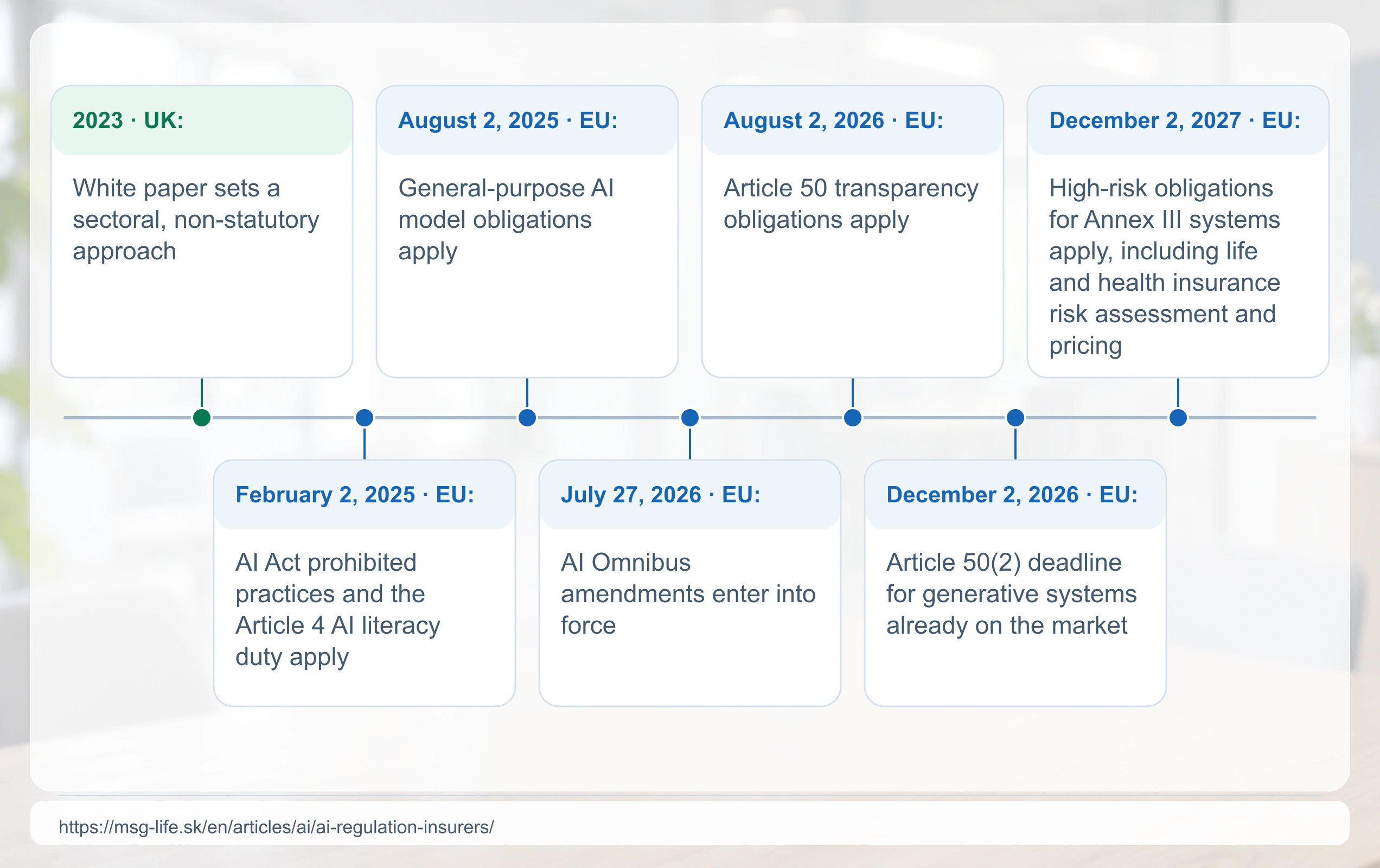
The practical reason to track this timeline closely is sequencing. An insurer that waits until close to December 2, 2027, to build the governance, documentation, and impact assessment processes Annex III systems require will not have enough lead time to establish and test those processes credibly.
Comparing AI regulatory approaches: EU, US, UK, and China
The EU, US, UK, and China take structurally different approaches to AI regulation. The difference that matters most for insurers is whether obligations attach to a risk category or to a sector-by-sector judgment call.
The EU’s horizontal, risk-tiered model
The EU AI Act applies horizontally across sectors, including insurance, and places special focus on high-risk AI systems, which must comply with a comprehensive set of requirements. This gives predictability. An insurer knows in advance that an AI system intended for risk assessment and pricing in relation to natural persons in life and health insurance is listed in Annex III, regardless of which EU member state it operates in. Such a system is high-risk unless the narrow exception in Article 6(3) applies, and it is always high-risk if it profiles natural persons. A new use outside Annex III may still qualify as high-risk under Article 6(1). To extend Annex III itself, the Commission can add use cases by delegated act under Article 7, but only within the areas the annex already covers, and anything beyond those areas needs a legislative amendment.
The US, UK, and China: Sectoral and technology-specific models
The US has no equivalent horizontal statute. AI oversight for insurers runs through state insurance codes and NAIC-level guidance instead of a federal risk classification. The UK rejected a central classification system, directing existing sectoral regulators to apply AI oversight within their existing remit. China regulates specific technologies (recommendation algorithms, deep synthesis, and generative AI services) through rules enforced by the Cyberspace Administration of China, rather than a single cross-sector framework, and requires algorithm filing for services with public opinion attributes or social mobilization capacity.
The sector-led approaches in the US and UK give regulators flexibility to respond to harms as they emerge. The cost is fragmentation: a US insurer operating in multiple states faces different requirements state by state, with no single compliance calendar.
| Jurisdiction | Regulatory instrument | Classification approach | Binding status | Key requirement for insurers | Best for |
|---|---|---|---|---|---|
| EU | AI Act (Regulation (EU) 2024/1689, as amended) | Risk-tiered (unacceptable, high, limited, minimal) | Binding, phased from 2025 to 2028 | High-risk obligations for Annex III point 5(c) life/health risk assessment and pricing from December 2, 2027 | Insurers needing a fixed, predictable compliance calendar across all EU operations |
| US | State insurance codes, sector guidance; no single federal AI statute | Sectoral, case-by-case | Fragmented; varies by state | No uniform requirement; federal AI bills introduced across multiple Congresses, largely not enacted | Insurers prioritizing state-level regulatory relationships over a single compliance framework |
| UK | 2023 white paper, sectoral regulator-led | Context-based, non-statutory | Non-statutory AI principles; existing binding FCA rules, such as the Consumer Duty, apply to AI use | Oversight through existing financial services regulators, not new AI-specific law | Insurers already embedded in UK sectoral regulatory relationships |
| China | Algorithm and generative AI service rules, CAC-enforced | Technology-specific (recommendation algorithms, deep synthesis, generative AI) | Binding for the technologies named | Algorithm filing with the CAC for services with public opinion attributes or social mobilization capacity; disclosure of recommendation-algorithm principles | Insurers deploying recommendation or generative AI systems in the Chinese market |
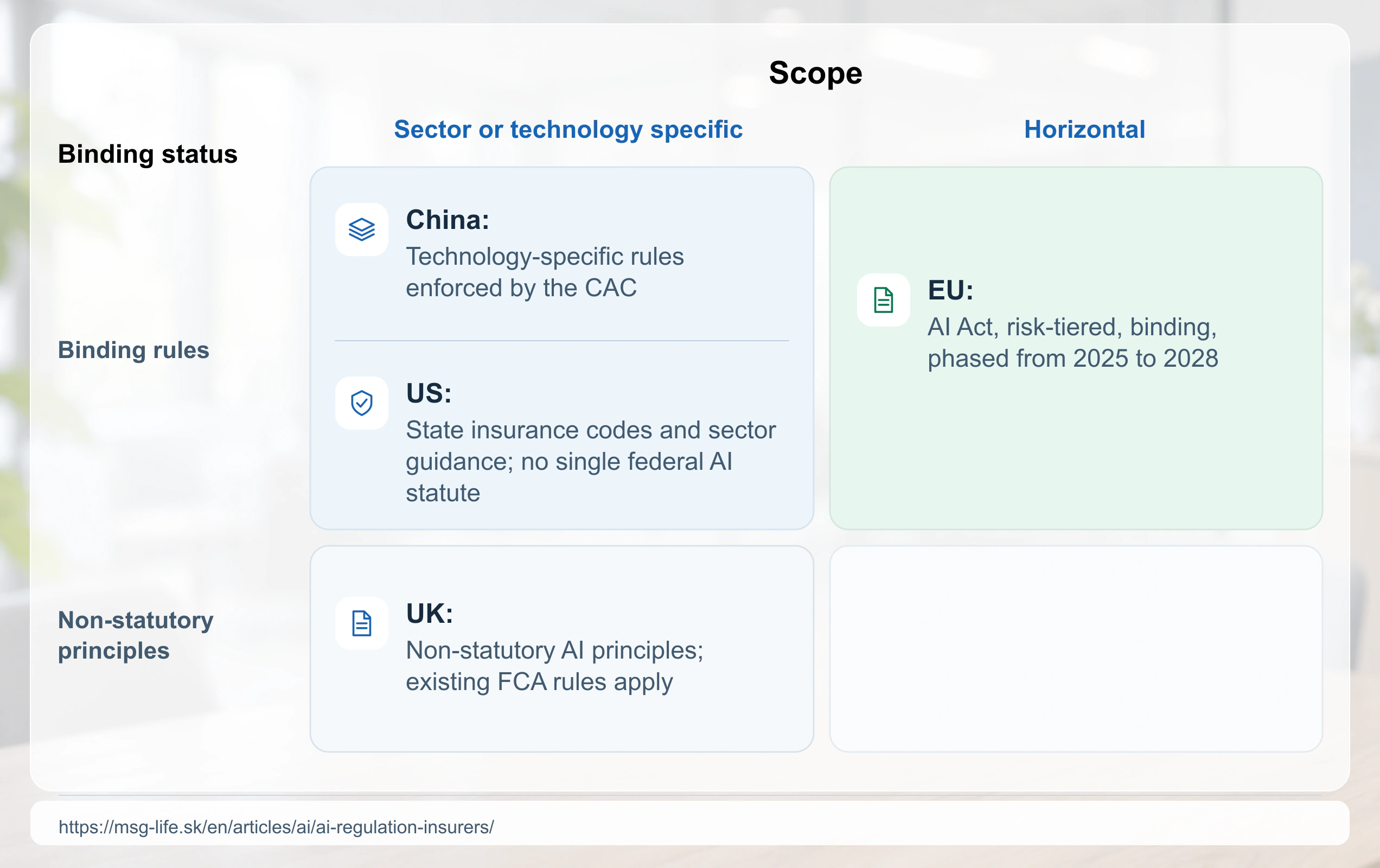
A global insurer should treat this table as a starting map. Each jurisdiction’s requirements interact with that jurisdiction’s existing insurance supervision, and confirming the current rule set for each market remains necessary before deployment.
Legislative tracker: Major AI laws and bills
Tracking AI legislation for insurance compliance means watching enacted law with binding deadlines and pending bills that signal where regulation is heading. Among the four jurisdictions covered here, the EU AI Act is the only enacted horizontal AI law with insurance-relevant provisions and dates; most of the rest is sectoral guidance, technology-specific rules, or pending legislation.
| Jurisdiction | Instrument | Status | Insurance relevance | Where to track |
|---|---|---|---|---|
| EU | AI Act (Regulation (EU) 2024/1689, amended by 2026/1744) | Enacted, phased application through 2028 | Annex III point 5(c): life/health risk assessment and pricing classified high-risk | EUR-Lex consolidated text |
| EU | EIOPA Opinion on AI governance | Supervisory guidance, not binding law | Clarifies Solvency II/IDD application to non-high-risk AI | EIOPA publication |
| US (federal) | AI bills, successive Congresses | Pending; largely not enacted | Depends on each bill’s scope and status | Brennan Center Artificial Intelligence Legislation Tracker |
| US (state) | State insurance department AI guidance | Varies by state | Sets supervisory expectations for AI use across insurance operations, including underwriting and claims, in some states, based on the NAIC Model Bulletin | State insurance department publications; the IAPP’s separate US State AI Governance Legislation Tracker covers cross-sector state AI bills |
| UK | White paper “A Pro-Innovation Approach to AI Regulation” | Policy framework, non-statutory | Directs existing financial regulators; no new insurance-specific AI statute | UK government publications |
| China | Algorithm recommendation and generative AI service rules | Enacted for the technologies named | Algorithm filing for services with public opinion attributes or social mobilization capacity; disclosure of basic algorithm principles for recommendation systems | Cyberspace Administration of China publications |
Legislation in this space changes faster than a static table can capture, particularly in the US, where state-level activity and federal bills move independently of each other. For insurers operating in both the US and EU, the EU side of compliance planning follows fixed dates. The US side needs ongoing monitoring instead of a fixed calendar.
Who owns AI compliance in insurance? Roles and responsibilities
AI compliance in an insurer sits with the system of governance as a whole. No single function owns it. The administrative, management, or supervisory body holds ultimate responsibility for the insurer’s compliance with Solvency II requirements (Article 40). Solvency II does not mention AI by name and requires no AI-specific committee or inventory; AI systems sit within the insurer’s existing governance structure like any other operational element.
The business unit confirms how the insurer plans to use the system
In this guide’s example, the business unit that uses the AI system (underwriting, claims, or pricing) describes the planned use and checks it against the provider’s stated intended purpose. The actuarial and risk management functions use that information to confirm the classification internally.
The deployer’s monitoring duty
From December 2, 2027, deployers of high-risk systems listed in Annex III must monitor the system’s operation. They must also keep the logs it generates automatically, to the extent those logs are under their control. For an insurer, this monitoring duty is deemed fulfilled by complying with Solvency II’s internal governance rules. The logs are kept as part of the documentation Solvency II already requires. The six-month minimum for log retention applies unless Union or national law provides otherwise. For an Annex III system placed on the market or put into service before December 2, 2027, all high-risk obligations, including these, apply only if the system’s design changes significantly on or after that date. For an Annex I system, the date is August 2, 2028 (Article 111(2) read with Article 113, third paragraph, point (c)(ii)).
When an insurer also becomes a provider
An insurer that deploys an AI system is also considered a provider of a high-risk AI system under Article 25(1) if it puts its name or trademark on a high-risk system already placed on the market or put into service, makes a substantial modification to a high-risk system such that it remains high-risk, or changes the intended purpose of a system that was not previously high-risk so that it becomes high-risk. This distinction matters because providers carry the obligations of Article 16, including ensuring the system meets the Section 2 requirements, a materially heavier burden than the deployer duties of Article 26, which still apply while the insurer uses the system.
| Process | Who owns compliance confirmation in this example | What they confirm | Evidence retained |
|---|---|---|---|
| Underwriting and pricing (life/health) | Actuarial and risk management functions, with input from the business unit | Whether the system falls under Annex III point 5(c) | Intended purpose, planned use, and classification rationale |
| Claims handling | Business unit, with compliance function | Whether automated decisions trigger GDPR Article 22 safeguards | Human intervention and contestability records where Article 22 applies |
| Customer-facing interaction | IT architecture lead, with compliance function | Which party is the provider under Article 50(1), and whether users need a disclosure | A record of the provider and a test of what customers see at first interaction |
| Vendor-sourced AI models | Procurement and compliance function jointly | Whether the insurer has deployer obligations, provider obligations under Article 25(1), or both | GDPR Article 28 agreement where the vendor processes personal data on the insurer’s behalf |
| Regulatory reporting | Compliance function, with actuarial function | Whether AI-assisted output requires additional disclosure | Supervisory reporting under Solvency II Article 35 and public disclosure under Article 51, supported by governance documentation under Articles 41 and 44 |
Practical compliance checklist for insurers using AI
A compliance checklist turns the layered requirements above into tasks a CRO or compliance officer can assign and audit, process by process. It does not substitute for jurisdiction-specific legal review, since applicability depends on confirming each system’s intended purpose and the jurisdictions where it operates.
| Process | Requirement | Responsible | Evidence to retain | Note | Source |
|---|---|---|---|---|---|
| Life/health underwriting and pricing | Confirm whether the system falls under Annex III point 5(c); prepare for deployer obligations from December 2, 2027 | Actuarial and risk management functions, with input from the business unit | Classification rationale; fundamental rights impact assessment under Article 27 and notification of its results to the market surveillance authority | Applies only to risk assessment and pricing in relation to natural persons in life and health insurance, not motor or property; for a system placed on the market or put into service before December 2, 2027, only after a significant design change | AI Act Annex III point 5(c); Article 27 |
| Claims triage and automated decisions | Confirm whether a claims decision is based solely on automated processing with legal or similarly significant effects | Business unit, with compliance function | Human intervention and contestability records if GDPR Article 22 applies | Article 22 safeguards apply only without meaningful human review | GDPR Article 22 |
| Customer-facing AI | The provider designs the disclosure. An insurer using a vendor’s system checks the customer experience before launch. | Provider for system design. Insurer’s IT architecture lead for the rollout check, with compliance function. | Provider’s documentation of the disclosure mechanism; a test of what customers see at first interaction | From August 2, 2026. Disclosure is required unless the AI interaction is obvious in context. | AI Act Article 50(1) |
| Technical provisions calculation | Ensure data used in calculating technical provisions is appropriate, complete, and accurate | Actuarial function | Data quality assessment under Solvency II Article 82 | Applies only where AI output feeds technical provisions | Delegated Regulation (EU) 2015/35, Article 19 |
| Vendor-sourced AI models | Confirm the insurer’s role under Article 25(1) and whether the vendor processes personal data on the insurer’s behalf | Procurement, compliance function | GDPR Article 28 agreement, where applicable; provider/deployer determination | Rebranding, a substantial modification, or a change of intended purpose that makes the system high-risk can add the provider obligations of Article 16 | AI Act Article 25(1); GDPR Article 28 |
| Overall AI governance | Situate AI oversight within the existing Solvency II system of governance | Administrative, management, or supervisory body | Governance documentation under Solvency II Articles 40, 41, and 44 | No separate AI committee is legally required | Solvency II Articles 40, 41, and 44 |
Using this checklist starts with classification, not documentation: a compliance lead identifies, for each AI system in production, which row applies, since a system’s intended purpose determines its category, not its underlying technology. For a system deployed in the EU, the compliance lead uses the first checklist row to determine whether its intended purpose matches Annex III point 5(c): risk assessment and pricing in relation to natural persons in life and health insurance. The same system deployed in the US faces no equivalent federal classification, though state-level insurance AI guidance may apply instead. A UK deployment routes through existing sectoral regulators’ expectations. A system operating in China may additionally need algorithm filing with the Cyberspace Administration of China if it provides recommendation-algorithm or generative AI services to the public with public opinion attributes or social mobilization capacity.
Methodology: How we track and compare AI regulation
This guide draws on primary legal texts: the EU AI Act’s consolidated version, Solvency II, and GDPR. It also draws on authoritative trackers (IAPP and the Brennan Center) to limit the risk of outdated claims about fast-moving legislation.
Scope: The article covers the EU, US, UK, and China, four jurisdictions with well-documented AI regulatory activity relevant to insurance. Each represents a structurally distinct regulatory approach: risk-tiered, sectoral, non-statutory, and technology-specific.
Limits: The article does not provide a jurisdiction-by-jurisdiction legal opinion, nor does it cover every US state’s insurance AI guidance individually or Japan’s regulatory approach in statutory detail.
Prerequisites: Readers should understand their organization’s existing Solvency II or equivalent governance structure before applying the compliance checklist, since the checklist extends that structure instead of replacing it.
Limitations: What this article does and does not cover
This guide has four boundaries a compliance lead should know before relying on it.
Jurisdictional depth varies by region
The EU section draws on the consolidated AI Act and EIOPA’s Opinion. For the US, the comparison uses legislative trackers and distinguishes federal bills from state insurance guidance. The UK section describes the approach in the 2023 UK white paper. For China, the comparison draws on Articles 16 and 24 of the Algorithm Recommendation Provisions, Article 19 of the Deep Synthesis Provisions, and Article 17 of the Interim Measures for Generative AI Services.
State-level US detail is not itemized
The Brennan Center tracker covers federal bills; state insurance department AI guidance varies by state and is not itemized here. An insurer operating in multiple US states needs state-by-state verification beyond this guide’s scope.
Japan falls outside this guide’s scope
No source consulted for this guide described Japan’s AI regulatory approach with enough statutory specificity to state it as fact. A compliance lead operating in Japan should seek jurisdiction-specific guidance directly.
This guide is not legal advice
Every classification question here (whether a system is high-risk under Annex III, or whether GDPR Article 22 applies to a specific claims decision) depends on facts specific to that system and that insurer. Confirm each classification with counsel before relying on it for a production decision.