An underwriting, pricing, or claims model can treat a group of policyholders less favorably without any risk-based reason. Bias can enter through the training data, the model design, or the way the model is deployed, and a clean data audit says nothing about the other two. Drawing on msg life’s work on core insurance systems, this guide shows how bias arises, what to test for, who owns each mitigation step, and what no program removes entirely.

Algorithmic bias occurs when a system’s inferences are systematically less favorable to individuals from a particular group where there is no relevant difference between the groups that justifies the outcome (Pluralsight). In insurance, this surfaces in underwriting decisions, pricing models, and claims handling, where it can disadvantage groups of policyholders without a risk-based justification. Some characteristics are off limits whatever the statistics show: following the Test-Achats judgment, EU insurers must apply the unisex rule to new insurance contracts concluded on or after December 21, 2012. For those contracts, using sex as a rating factor must not result in different premiums or benefits for individuals (Court of Justice of the European Union, Commission guidelines).
The core finding for insurance IT leaders: algorithmic bias is not a single defect with a single fix. It can enter at several points, which this guide groups into three channels (data, model design, and deployment), and each channel calls for its own detection method and a clearly assigned owner. A data audit catches a skewed training set. It does not catch a model that amplifies a small skew into a large disparity. Nor does it catch a well-calibrated model misapplied to a customer segment it was never validated against.
The key trade-off insurers face: broader bias testing catches more failure modes but costs more in engineering time, compliance documentation, and model retraining cycles. A narrow testing scope ships faster but leaves “unknown unknowns” (biases nobody tested for because nobody expected them) undetected until a regulator, a journalist, or a customer complaint surfaces them.
How algorithmic bias arises in insurance AI
This guide groups the sources of algorithmic bias in insurance AI into three channels: the data a model learns from, the model’s own design choices, and the way the model is deployed into a live process. Each source introduces a different kind of risk and requires a different fix.
Data bias occurs when the training data does not represent the population the model will serve, or encodes historical patterns that were themselves discriminatory. Pluralsight describes one form of this, sampling bias, as a case where “the collected data doesn’t reflect the environment the solution will run in.” In insurance, this typically means historical claims or underwriting data that underrepresents certain demographic groups, geographic regions, or risk profiles. This often happens because those groups were historically underserved or excluded from coverage.
Model bias occurs when design choices such as the objective function, the features, or the decision threshold introduce a disparity, or when the model amplifies a skew that was already present, even a small one, into a larger disparity in outcomes. A model trained on biased historical labels does not merely replicate the bias: it can systematize it, applying the same skewed judgment consistently and at scale to every new applicant.
Deployment bias occurs when a model validated for one context is applied to a different one without revalidation. A pricing model tuned on a mature market segment, deployed unchanged to a new product line or region, carries no guarantee that its calibration holds for the new population.
Insurance context. In automated underwriting, data bias can arise from historical claims data that underrepresents certain groups. Model bias can amplify this if the model is not recalibrated against current applicant populations. Deployment bias can occur if the AI is applied to a new customer segment or product line without revalidation. In a typical insurance governance structure, the IT or data team monitors for data and model drift, while the compliance function documents the mitigation steps taken, for audit purposes. Confirm the specific ownership split against your own insurer’s governance structure, since it varies by organization (see the system of governance requirements in Solvency II, Article 41).
These three failure points share one operational implication: detecting bias at one stage does not detect it at the others. A clean data audit says nothing about whether the model amplifies small residual skews. A validated model says nothing about whether it was deployed against the population it was validated for.
Examples of bias in insurance pricing, underwriting and claims
Discrimination in insurance AI typically surfaces as unequal pricing, unwarranted exclusion from coverage, or inconsistent claims outcomes, and each pattern traces back to one of the three failure points above. The patterns below are illustrative, built from the documented mechanisms of data, model, and deployment bias instead of from a single named case.
| Process | Type of bias | Illustrative pattern | Impact |
|---|---|---|---|
| Underwriting | Data | Historical approval data underrepresents a demographic group that was previously denied coverage at higher rates for non-risk-related reasons | Model learns to replicate the historical denial pattern rather than assess actual risk |
| Pricing | Model | A rating model trained on aggregate claims history assigns higher premiums through a rating factor that acts as a proxy for a protected characteristic (for example, geographic location standing in for ethnic origin) | Policyholders in affected groups pay premiums not justified by their individual risk |
| Claims | Deployment | A claims-triage model validated on one product line is applied unchanged to a newly acquired product line with a different claimant population | Claims from the new population are misrouted or delayed more often than claims from the validated population, without a risk-based justification |
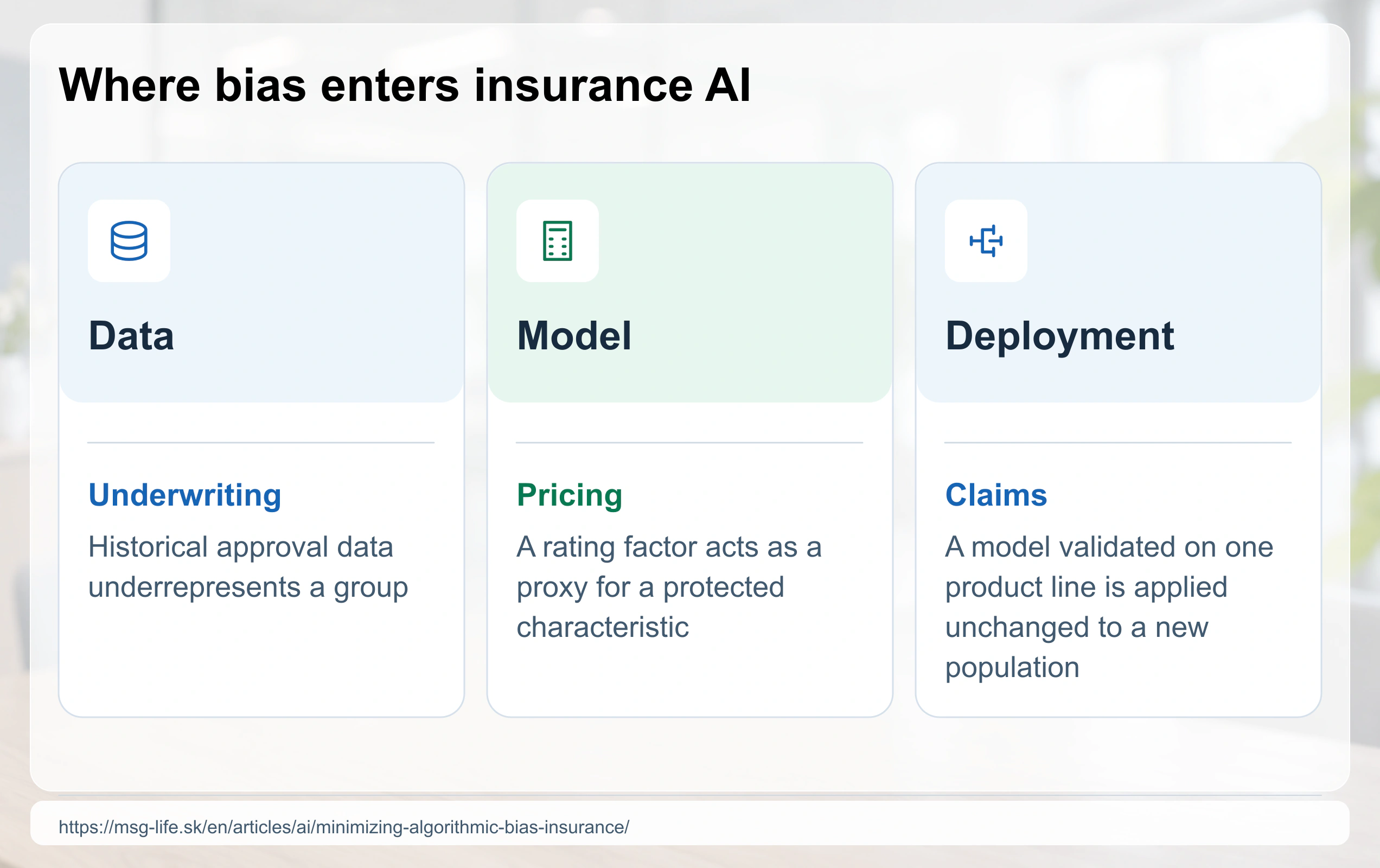
The common thread across all three rows is the absence of a relevant difference between groups that would justify the disparate outcome. This matches the description of algorithmic bias given by Pluralsight: inferences are systematically less favorable to individuals from a particular group where there is no relevant difference between the groups that justifies the outcome.
Impacts and risks of algorithmic bias for insurers
Algorithmic bias exposes insurers to regulatory, financial, and reputational consequences that compound each other once a biased outcome becomes public or is flagged by a supervisor. Pluralsight lists several negative implications of algorithmic bias: unfairly allocated opportunities, resources, or information; infringement of civil liberties; and failure to provide the same quality of service to some people as others.
For an insurer, these general risks translate into:
- Regulatory exposure. Solvency II and IDD governance and conduct rules already apply to AI systems an insurer uses in the activities those rules govern. EIOPA‘s Opinion clarifies how they apply to AI systems that are neither prohibited nor high-risk under the AI Act; those two categories are excluded from the Opinion’s scope.
- Financial exposure. Mispriced risk at scale, whether underpricing one segment or overpricing another, affects loss ratios. It can also trigger retroactive remediation costs if a biased pattern is identified after many policies have been written.
- Reputational exposure. A documented pattern of disparate treatment, even when unintentional, damages customer trust and can trigger media and regulatory scrutiny that outlasts the technical fix. The IEEE Technology and Society analysis notes that it is “exceedingly rare that biased algorithm behavior is shown to have been intentional,” which does not reduce the reputational cost once a pattern is identified.
Bias in insurance AI carries a distinct weight compared to other industries because insurance decisions are risk-differentiating by design: an insurer is expected to price different risks differently. This makes the line between legitimate risk-based differentiation and unjustified discrimination harder to draw than in domains where any differentiation is suspect. The processes carrying the highest risk are those combining large customer populations, high-stakes outcomes (coverage denial, premium level), and historical data most likely to encode legacy patterns. Underwriting and pricing sit at the top of that list, with claims triage close behind.
Mitigation strategies for algorithmic bias in insurance
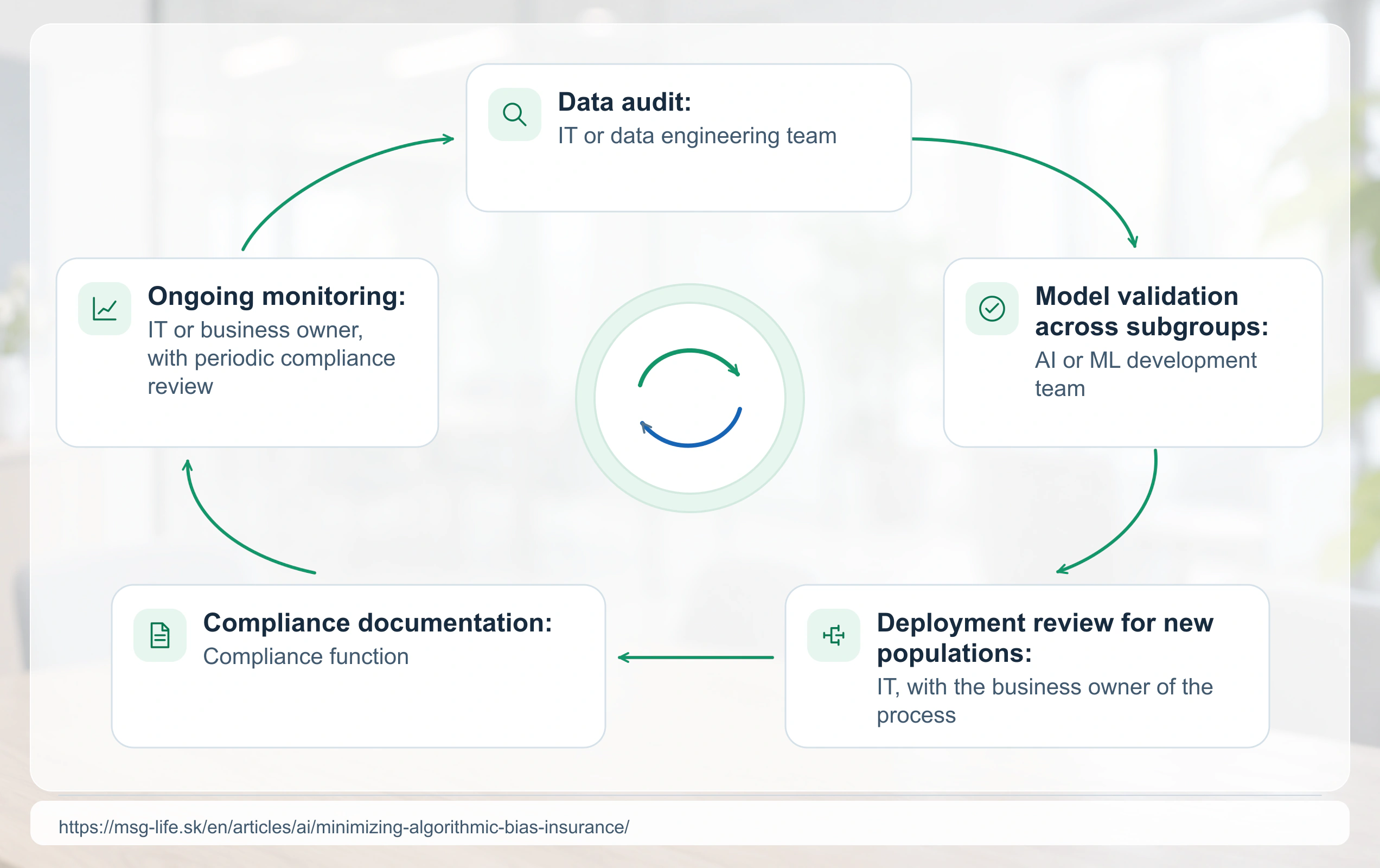
Insurers mitigate algorithmic bias by combining technical checks, organizational ownership, and compliance documentation across the model’s lifecycle, rather than relying on any single control. A data audit alone does not catch model amplification, and a validated model alone does not catch deployment drift.
Data audit
Before training, assess the training data for representativeness across the groups the model will affect. Acxiom notes that “an incomplete or unrepresentative dataset can lead to biased models, which might result in unfair outcomes.”
Model validation
Test the trained model’s outputs across population subgroups, not only its aggregate accuracy. A model with strong overall performance can still show a consistent disparity for a given subgroup, a pattern aggregate metrics do not surface.
Deployment review
Before applying a validated model to a new population, product line, or region, confirm the validation still holds. Where it was validated on a materially different population, revalidate rather than assume generalization.
Ongoing monitoring
Bias is not a one-time check. Acxiom advises brands to “implement regular audits and ongoing monitoring of AI systems to detect and correct any emerging biases.” Population drift and changing product mixes can introduce new disparities into a model that passed validation at launch.
Compliance documentation
Each mitigation step above needs a documented record: what was tested, what was found, what was changed, and who approved the change. This record is what a supervisor or internal audit function reviews. EIOPA’s Opinion lists documentation and record keeping among the areas an insurer’s AI governance should cover, building on the system of governance required by Solvency II.
| Step | Responsibility |
|---|---|
| Data audit | IT or data engineering team |
| Model validation across subgroups | AI or ML development team |
| Deployment review for new populations | IT, in coordination with the business owner of the process |
| Compliance documentation | Compliance function |
| Ongoing monitoring | IT or business owner, with periodic compliance review |
Deliberately adjusting a model to favor a disadvantaged group, to correct a historical imbalance, is one fairness strategy among several, with its own legal and ethical trade-offs. In insurance it needs legal review first: an adjustment that makes individual premiums or benefits depend on sex would breach the unisex rule that applies to insurance contracts concluded on or after December 21, 2012.
On the regulatory side: where an AI system is used for risk assessment and pricing of natural persons in life and health insurance specifically, confirm with counsel whether it falls under the AI Act‘s high-risk category for that use. For classification and application dates, see AI Regulation for Insurers.
Methodology for identifying and reducing algorithmic bias
A replicable methodology lets an insurer identify, assess, and reduce algorithmic bias the same way every time, rather than relying on ad hoc review that varies by team or by model. The methodology below follows five steps: identification, assessment, mitigation, documentation, and ownership assignment.
Step 1: Identification
Map where AI influences a decision affecting a policyholder: underwriting approval, premium calculation, claims triage, or customer-facing recommendations. For each, identify the data sources feeding the model and the population segments affected.
Step 2: Assessment
Test model outputs across population subgroups using fairness metrics appropriate to the decision type. At minimum, compare outcome rates (approval, pricing tier, claim denial) across groups defined by legally protected or operationally sensitive characteristics, where data protection rules permit this comparison. Before using special categories of personal data to test for bias, check whether your organization and system fall within Article 4a of the EU AI Act and whether its strict necessity and safeguard requirements are met. Treat a difference in outcome rates as a signal to investigate, not as proof of unlawful discrimination. Before concluding that a disparity is unjustified, check the sample sizes, the statistical uncertainty, the error rates across groups, and whether a legally permissible risk factor explains the difference.
Step 3: Mitigation
Where assessment finds an unjustified disparity, apply a correction at the appropriate stage. Rebalance training data, adjust model features or thresholds, or restrict deployment to validated populations until the disparity is resolved.
Step 4: Documentation
Record what was tested, what was found, and what was changed, in a form an internal or external auditor can review without needing to interview the original development team.
Step 5: Ownership assignment
Name who is accountable for each step, matching the responsibility checklist in the mitigation section above, so that accountability does not default to “the model” or “the vendor.”
Methodology
Scope: This methodology applies to AI systems used in insurance decisions affecting individual policyholders, specifically underwriting, pricing, and claims processes.
What it does not address: Bias introduced outside the data-model-deployment chain, such as bias in how human reviewers override model recommendations, or bias embedded in the business rules surrounding a model rather than the model itself. It also does not address fairness metric selection in detail.
Prerequisites: Access to training and production data disaggregated by relevant population segments, a defined model inventory, and clear assignment of the IT, AI/ML, compliance, and business-owner roles referenced throughout this methodology.
Source: This sequence synthesizes standard AI governance practice with insurance-specific role structures; it is an editorial construction drawing on documented bias mechanisms, not a single cited external framework.
Tools and resources for bias mitigation in insurance AI
Several categories of tools and frameworks help insurers detect and mitigate algorithmic bias, though no single tool covers the full methodology above end to end.
Fairness metric libraries calculate statistical disparity measures (such as differences in approval rates or pricing outcomes across groups) directly on model outputs, supporting Step 2 of the methodology. Which metric applies to a given insurance decision (demographic parity versus equalized odds, for example) depends on the decision’s context.
Bias-testing frameworks run structured test suites against a model across defined population subgroups before deployment, supporting both Step 2 and the deployment review step in the mitigation checklist. These are most useful where an insurer has a defined, repeatable testing process to plug them into; they add limited value without the organizational process around them.
Monitoring and drift-detection tooling tracks model outputs in production over time, flagging when subgroup outcome patterns shift, which supports the ongoing monitoring step.
Governance and documentation platforms maintain the model inventory, test records, and approval history that Step 4 of the methodology requires. These platforms provide the audit trail a supervisor or internal reviewer would examine.
| Tool category | What it does | Where it fits in insurance |
|---|---|---|
| Fairness metric libraries | Calculate statistical disparity across groups on model outputs | Model validation (Step 2), before and after retraining |
| Bias-testing frameworks | Run structured subgroup test suites against a model | Pre-deployment review and deployment-to-new-population checks |
| Monitoring and drift-detection tools | Track production output patterns over time | Ongoing monitoring in production, not a one-time check |
| Governance and documentation platforms | Maintain model inventory and audit trail | Compliance documentation, supporting Solvency II governance records |
No tool in any of these categories replaces the ownership assignment step. A tool surfaces a disparity, but it does not decide whether the disparity is operationally justified or assign the mitigation to a team.
Limitations
No methodology, including the one above, guarantees the complete elimination of algorithmic bias. Insurers should treat mitigation as risk reduction instead of risk removal.
- Incomplete subgroup data. Testing for disparity across population subgroups requires reliable data on those subgroups. This data may not be fully available, or it may be legally restricted from collection, depending on jurisdiction and data category. Where this data is unavailable, disparity in the affected dimension cannot be directly measured. Data protection counsel should confirm which subgroup categories may be collected and processed for this purpose under applicable law.
- Population drift. A model validated as fair against today’s applicant population can become biased as the population shifts. A new product line can attract a different customer mix, or economic conditions can change the risk profile of existing segments. This is why ongoing monitoring, not a one-time validation, is part of the methodology above.
- Unknown unknowns. Bias testing can only test for disparities the testing team anticipated. A bias dimension nobody thought to test, such as an interaction effect between two variables, neither of which looks suspicious on its own, can pass every planned test and still produce discriminatory outcomes.
- Proxy variables. Removing a protected characteristic from a model’s inputs does not remove its influence if a correlated proxy variable remains. The geographic-location example in the examples table above illustrates this. Identifying proxies requires active investigation. A one-time feature removal is not enough.
- Trade-off between testing depth and delivery speed. Broader, more frequent subgroup testing catches more failure modes but adds engineering time, data requirements, and documentation overhead to every model release. A narrower testing scope ships faster but leaves a wider band of untested disparity risk. The right balance depends on the stakes of the decision the model informs. Those stakes are higher for underwriting and pricing than for a low-stakes customer-service recommendation.